Clever way of getting around Brisbane City Council food business licensing

Bean1

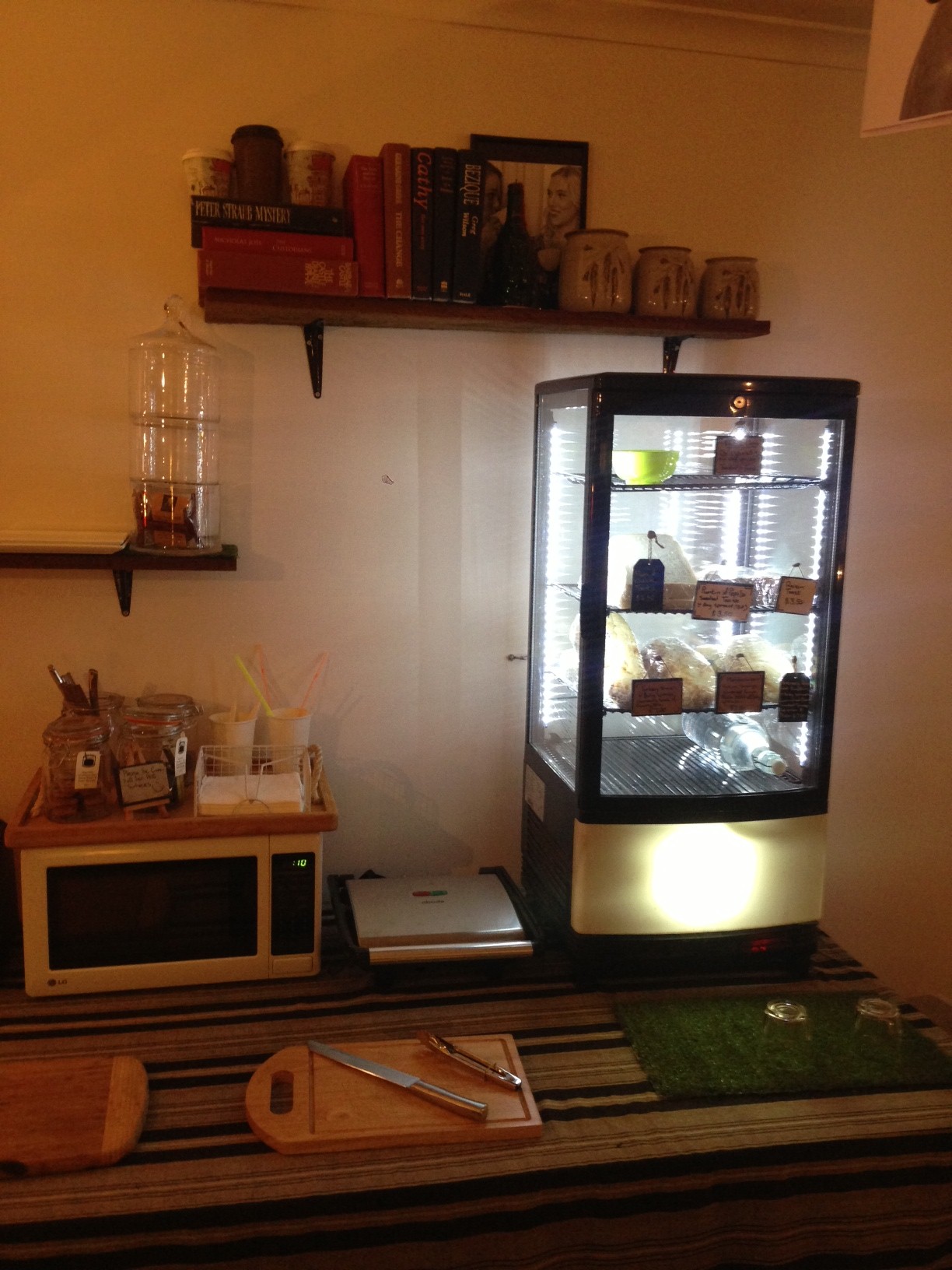
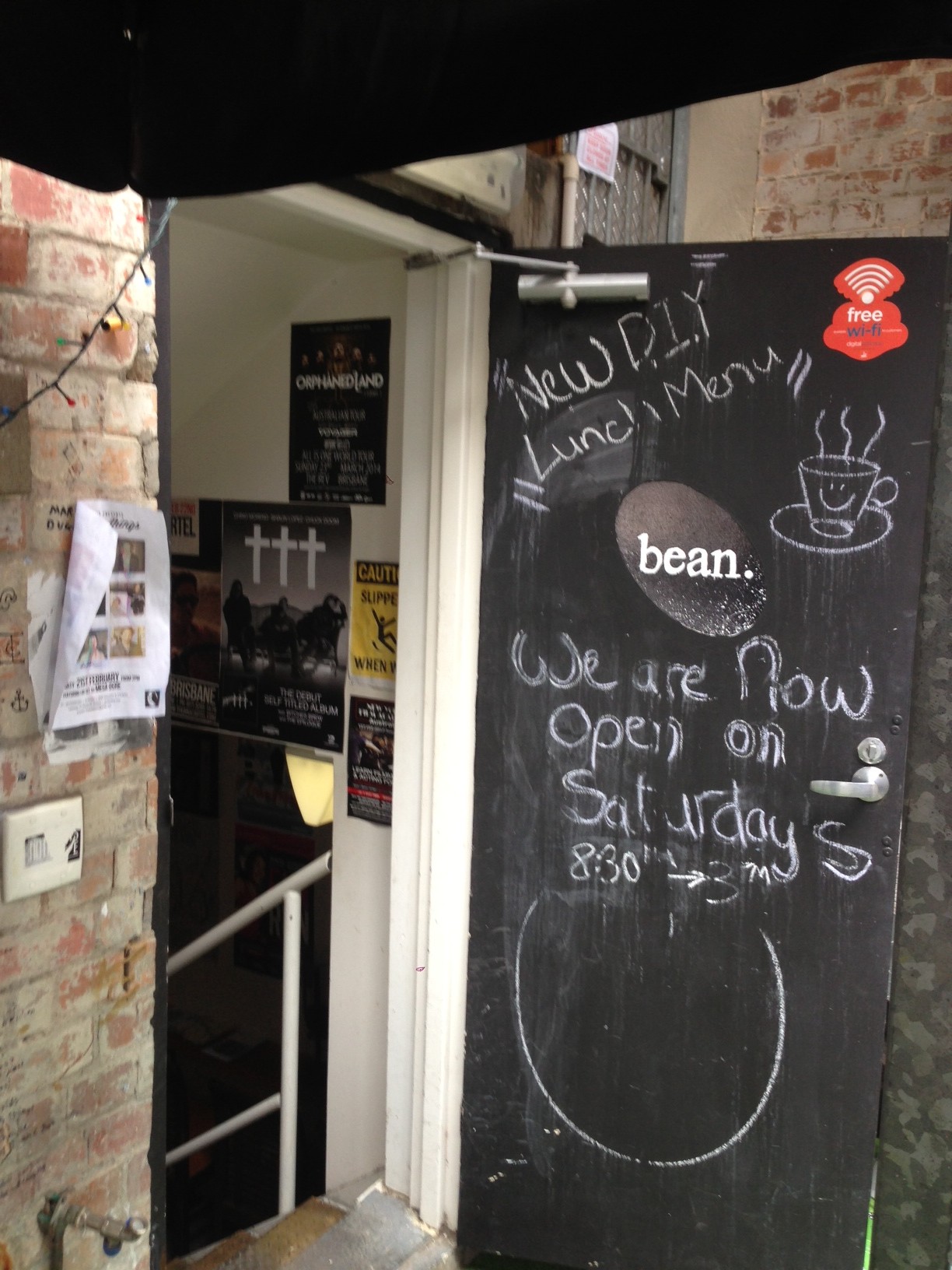
Bean Coffee, which is accessible from an alleyway off George St in Brisbane CBD, has come up with a clever way of circumventing Brisbane City Council’s food business licensing regulation. Bean will sell you the ingredients to make a toasted sandwich, but you make it yourself in the cafe (see photo below). This means Bean doesn’t prepare food and, therefore, it doesn’t need to be licensed as a food business, avoiding an annual licensing fee of at least $675 and whatever other costly requirements are imposed on license holders. For example, it appears there might be requirements around the design of licensed kitchens.

Great work, Bean! It’s heartening to see that businesses can find innovative ways of avoiding regulations that are unnecessary restraints on trade. I’d suggest the Council should review its food licensing regulation to ensure it really is necessary for protecting public health and that it isn’t unnecessarily inhibiting the opening of food businesses – at a cost of forgone economic activity and jobs.

Bean2

Posted in Retail trade | Tagged , , , , , | 8 Comments

Reduce youth unemployment through improved regulation – e.g. of penalty rates, taxis

With overall unemployment creeping up to 6%, unemployment among 15 to 24 year olds, which tends to be naturally higher anyway and ends up even higher when the economy slows, has increased to over 15% and has re-emerged as a significant policy issue (e.g. see this Brotherhood of St Laurence report). While much of the recent increase in youth unemployment is cyclical, there are a range of regulations that limit employment opportunities for young people. These regulations impede the efficient operation of markets and prevent the realisation of substantial gains from trade, at a cost of forgone GDP, household incomes and jobs. Reforms to these regulations could result in a signficant boost to employment opportunities for young people. Let’s consider three examples: penalty rates, retail trading hours and taxi licensing.

I’ve previously posted on the impact of penalty rates on the hospitality and tourism sectors:

Hospitality suffering under IR regime

Tourism sector needs IR reform

It’s possible there could be signficant employment gains among young people if penalty rates were reformed and there was greater scope for them to be negotiated away as part of enterprise agreements. Let’s hope the current review of modern Awards makes some bold recommendations on reform.

Another area of potential reform is retail trading hours, as I’ve posted on many times – e.g.:

OBPR recommends fast-tracked review of trading hours restrictions

Obviously, longer opening hours for shops could boost employment opportunities for young people.

On taxi licensing, I’d note that current licensing arrangements restrict the number of taxis on the road, raising prices and generating economic rents (i.e. super, above-normal profits) for owners of the licences, which are valued at around $500,000 each (see the Black & White Cabs website). If the taxi industry were largely deregulated, so any number of new licences could be purchased from the Government at a nominal fee, there would be a huge increase in taxis on the road, a significant reduction in fares (see the analysis in the Productivity Commission’s research paper Regulation of the Taxi Industry), and greater employment opportunities, many of which could be taken up by young people. There would still need to be some regulation, of course, around safety, but restricting the number of taxi licenses isn’t necessary to ensure public safety. (Hat tip to Brad Rogers for getting me excited about the potential economic gains from taxi deregulation.)

Posted in Uncategorized | Tagged , , , , , , , , , , , , , | 5 Comments

Fiscal restraint impacting Queensland economy

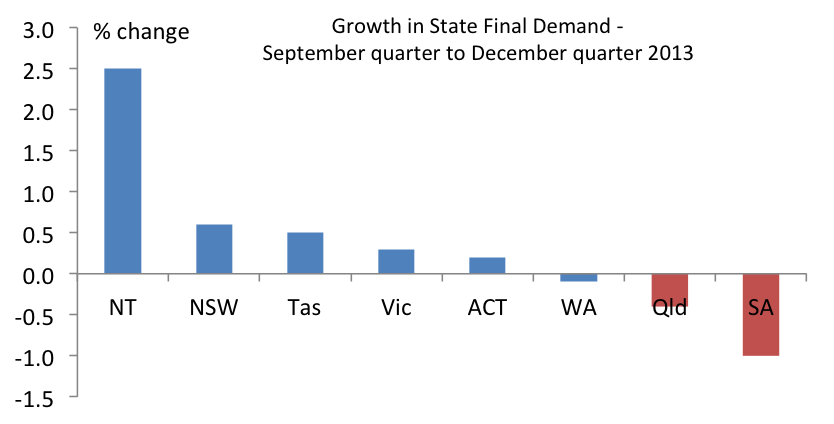
While containing reasonably good news for the national economy, today’s new National Accounts data from the ABS suggest the December quarter of last year was a lacklustre one for the Queensland economy, with the (albeit imperfect) measure of State Final Demand falling over the quarter:

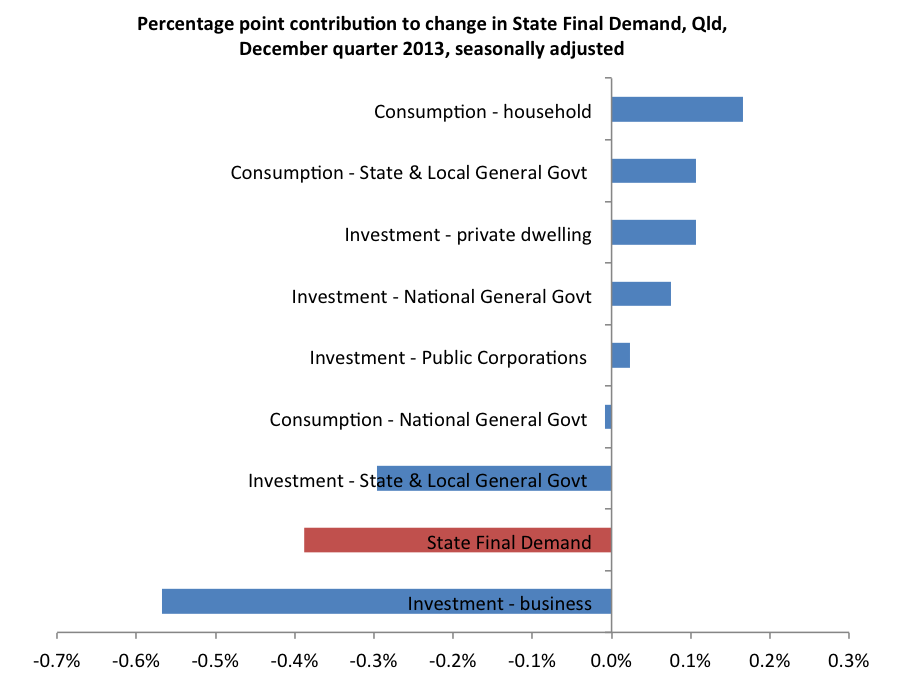
SFD1The decline was driven by falls in business investment and State and Local General Government investment, as shown in the chart below. Note that, in the National Accounts, the term investment refers to capital expenditure – i.e. expenditure on equipment, mines, roads, dams, etc. It doesn’t refer to investments in financial assets such as shares or bonds.

SFD2The decline in business investment is likely related to the slowing resources sector, while the decline in State and Local General Government investment is likely related to fiscal restraint aimed at addressing the State’s budget deficit and debt. Reduced expenditure (in real terms, adjusting for inflation) on roads is a likely suspect. The RACQ appears to have meekly accepted restraint in road spending, noting in its 2013-14 Budget Comment last year:

Budgeted capital and operating road expenditure for 2013-14 is $4.487 billion. This is less than the amount budgeted in 2012-13 but more than the 2012-13 estimated actual spend. RACQ considers that the 2013-14 road budget is acceptable, albeit not ideal, given the current fiscal environment.

Given the Government’s strong messaging around the need to pay down debt, I expect the public sector will continue to act as a restraint on demand for a while yet. Today’s data are another reason not to get too excited about the short-term prospects for the Queensland economy, despite yesterday’s strong building approvals data.

Good commentary on what today’s National Accounts data mean for the Queensland economy can be found at:

Queensland Treasury information brief

GDP firms but QLD lags


Posted in Macroeconomy | Tagged , , , , , , | Leave a comment

Residential building approvals have recovered nicely – but some weakness still in regions

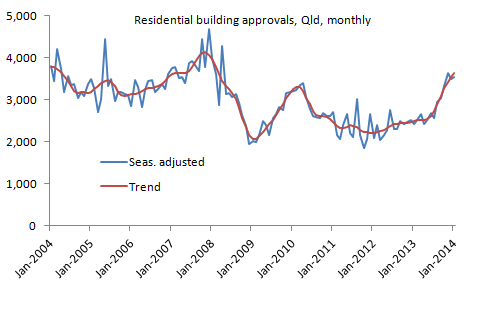
It appears Master Builders Queensland was right to report last month that Queensland builders are optimistic (see my post on the report), with today’s new residential building approvals from the ABS showing a strong upward trend nationally and in Queensland (see chart below).

Buildingapprovals_Jan14But, as noted by Pete Faulkner, approvals in some areas in North and Far North Queensland remain weak (Strong Building Approvals not reflected locally). Pete has a nice summary of the macroeconomic implications of these figures:

The RBA have been looking at house building to take up the slack left by the slowdown in mining investment and, at least on the back of these numbers, there is a sign of that now happening. This data, combined with strong trade balance numbers also released today which will add some 0.6 ppts to GDP (released tomorrow), will certainly see the RBA leaving the Cash Rate unchanged later today.

I still remain somewhat concerned about the short-term outlook given recent unemployment data. Nonetheless, I’m pretty encouraged by today’s figures.

Other coverage of today’s figures is at MacroBusiness:

Dwelling approvals surge

Posted in Housing, Macroeconomy | Tagged , , , , , , , | Leave a comment

FIFO & DIDO workers in Qld gas fields nearly doubled in 2013

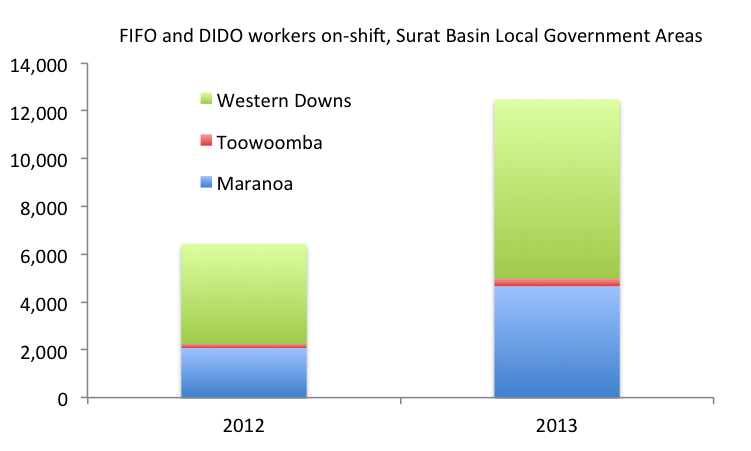
The new data from Queensland Treasury on non-resident – i.e. fly-in, fly-out (FIFO) or drive-in, drive-out (DIDO) – workers in the Surat Basin illustrate the boom we’re seeing in the gas-field communities out west of Toowoomba on the Darling Downs, including Chinchilla, Miles and Roma (see the Treasury report). FIFO and DIDO workers in the Surat Basin local government areas increased from 6,445 to 12,480 people in 2013 – an increase of 94% (see chart below).

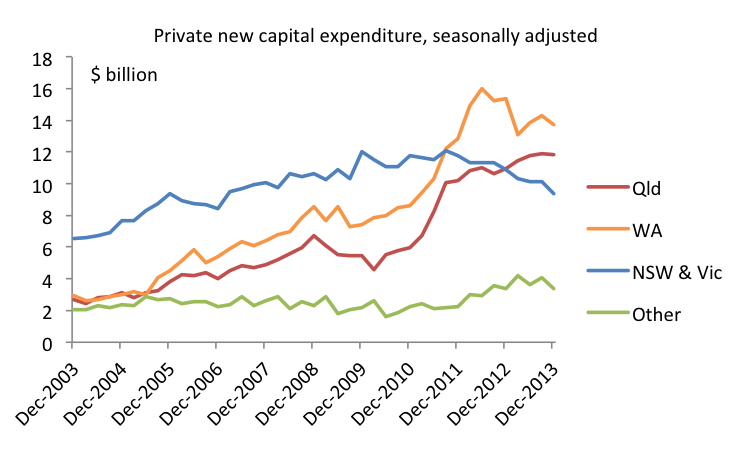
SuratThe activity in the gas fields and the commencement of LNG exports later this year is one reason I’m not panicking yet about the plateauing of capital expenditure in Queensland that is now evident in the data, and the declines in other States, particularly WA, driven by falls in mining investment, and in NSW and Victoria, reflecting the parlous state of Australia’s manufacturing sector (see chart below).

capexGood coverage of yesterday’s capital expenditure data can be found at MacroBusiness and Pete Faulkner’s website:

Actual capital expenditures fall sharply

Q4 CAPEX will hit GDP. Forward estimate weak.

Queensland is now expected to see a large drop in capital expenditure over 2014 and there will clearly be a loss of construction jobs associated with this over coming years, as projected in a construction industry report released yesterday:

8000 Queensland construction jobs to go: report

Nonetheless I remain confident about Queensland’s longer-term prospects and our ability to adjust to the drop in mining-related construction, as I’ve posted on before:

Qld’s economic future bright if we look beyond short-term

That said, it’s possible the whole Australian economy could be in for a challenging year in 2014, given recent discouraging signs from the labour market suggesting a weak economy.


Posted in Macroeconomy, Mining | Tagged , , , , , , , , , , , , | 3 Comments

Queensland has too many low-performing schools

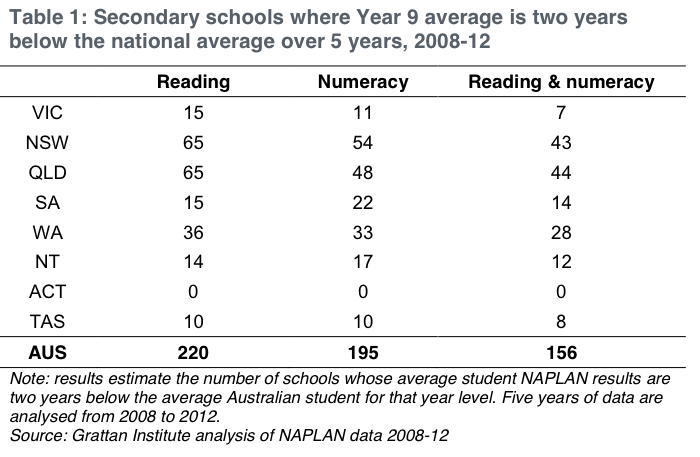
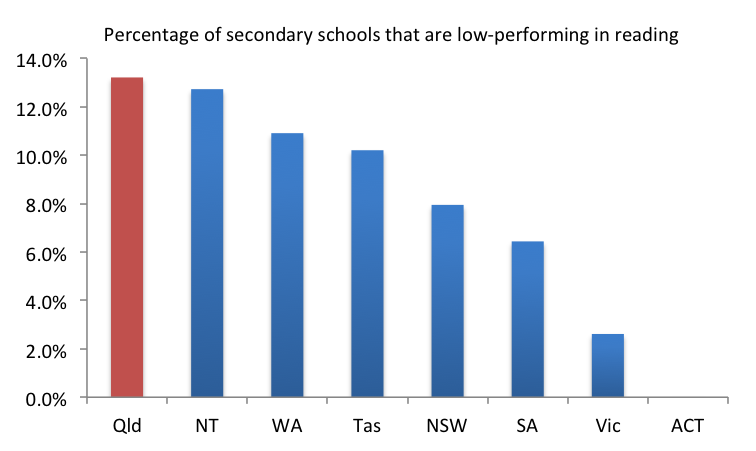
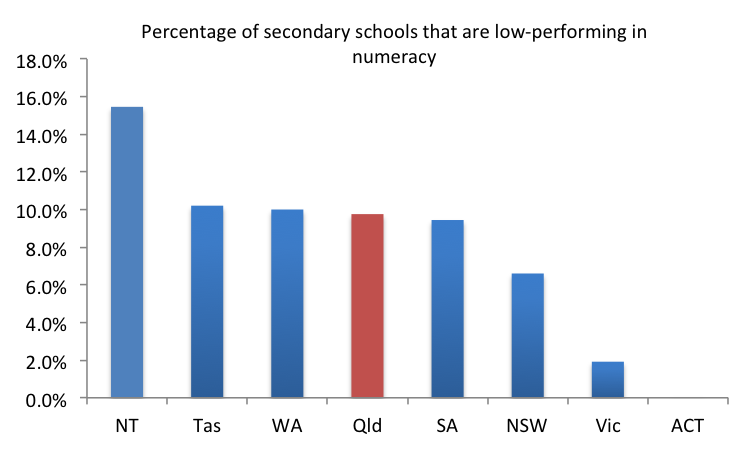
One major challenge the current Queensland Government faces is the need to reform a school system that historically has had a disproportionate number of low-performing schools. The extent of poor performance among our secondary schools is pretty clear in data presented in the recent Grattan Institute report Turning around schools: it can be done (Table 1 from p.4 is copied and pasted below). Based on NAPLAN results, Grattan estimates Queensland has 44 low-performing schools in reading and numeracy, compared with 43 in NSW, which has a much larger number of schools than Queensland, and 7 in Victoria, which also has more schools than Queensland but obviously has an excellent education system compared with ours.

Grattan table

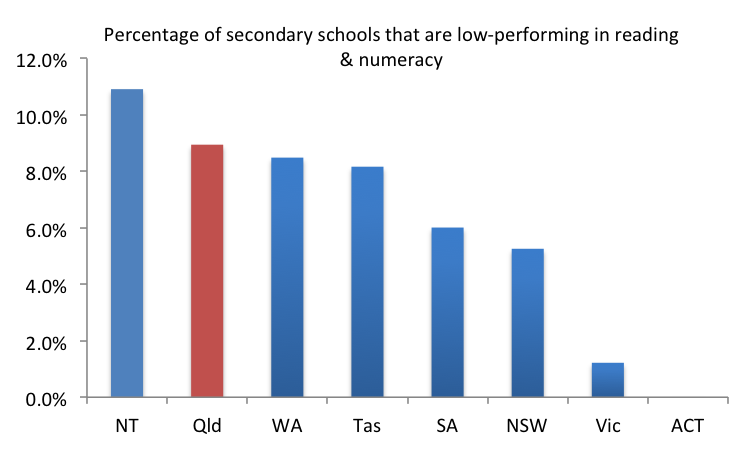
Grattan has defined a low-performing school as one where the average student NAPLAN results (over 2008 to 2012) are two years below the Average Australian student for that year level. That is, a school would be low-performing if its year 9 students had the reading and numeracy results of year 7 students (or worse). As noted above, there are 44 Queensland secondary schools where this is the case. To help convey just how disproportionate the number of low-performing schools in Queensland is, I’ve charted the percentage of Queensland secondary schools (including combined primary and secondary schools in the denominator as well) that are low-performing in reading, numeracy and both reading and numeracy below.

reading_numeracyreadingnumeracy

To some extent, Queensland’s poor performance may be due to a number of schools in remote and regional areas with relatively disadvantaged student populations. Understanding the nature of our low-performing schools should be an urgent task of the Education Department’s. It’s too early to judge the performance of the current Queensland Government on education, and I very much hope they can improve outcomes in Queensland’s low-performing schools.


Posted in Education | Tagged , , , , , | 13 Comments

BCC still needs to fix up paid parking in the Brisbane CBD

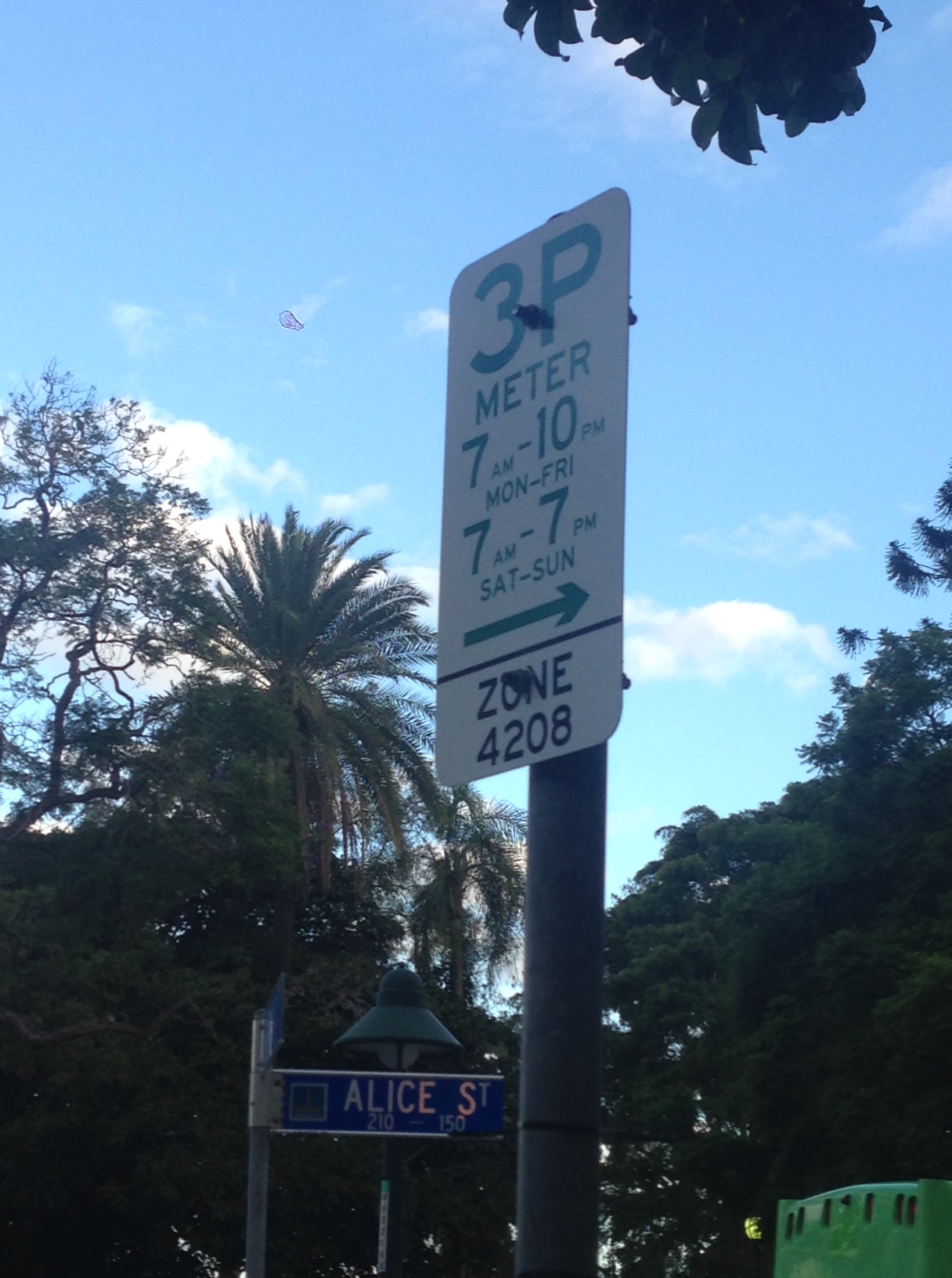
photo-11Last August I posted on how changes to paid parking  arrangements in Brisbane CBD have adversely affected CBD businesses, particularly in the southern part of the CBD – the part of the CBD which finds it tough enough already owing to its distance from the mall and bus and railway stations (Paid parking affecting work and play in Brisbane CBD). Earlier today I chatted with Jessica Pugh, Events Manager at Restaurant II on Alice St, one of the businesses most severely impacted by the new paid parking regime. Jessica told me the following:

  • Restaurant II held 45 wedding receptions last year but this year is only expecting 30. Wedding organisers always ask Jessica about the parking situation and many are put off by the fact their guests would have to pay for parking nearby. They find it easier to book one of the many reception venues in the suburbs where you don’t have to pay for parking.
  • The paid parking restrictions have contributed to the closures of a number of businesses in the CBD and surrounds over the last year, including Ortiga and Lady Lamington in the Valley, and Jessica understands the once thriving, high-end lingerie store Arianne on Edward may be about to shut up due to a huge drop off in trade.
  • In addition to damaging restaurants that rely on night-time trade, the paid parking restrictions have really hit fashion retailers, because people don’t want to worry about the parking meter when they’re trying on outfits.

BCC should review its current paid parking regime in the CBD as a matter of urgency. Edward St in particular doesn’t need to lose any more businesses, because there are already a number of empty shops such as these between Mary and Margaret Streets:

photo-10

As I’ve posted on before, there are already enough government policies adversely affecting small businesses:

Hospitality suffering under IR regime

N.B. At the end of our chat, Jessica disclosed that she is the Labor candidate for the State seat of Mt Ommaney. Nonetheless I think she was being completely objective in her criticism of BCC.

Posted in Brisbane, Retail trade | Tagged , , | 3 Comments

Is employment a lagging indicator of the economy?

A tendency has developed among commentators to dismiss the relevance of discouraging employment data, based on the view that the labour market is a lagging indicator of the economy (e.g., a recent post by a prominent Australian economic commentator: Crappy jobs data, but it is a lagging indicator). As I posted on early last week, I don’t believe this is true (Sorry to tell you, QTC, but the labour market is not a lagging indicator). Some of the misunderstanding among commentators possibly relates to the somewhat complicated fashion in which employment and GDP are related.

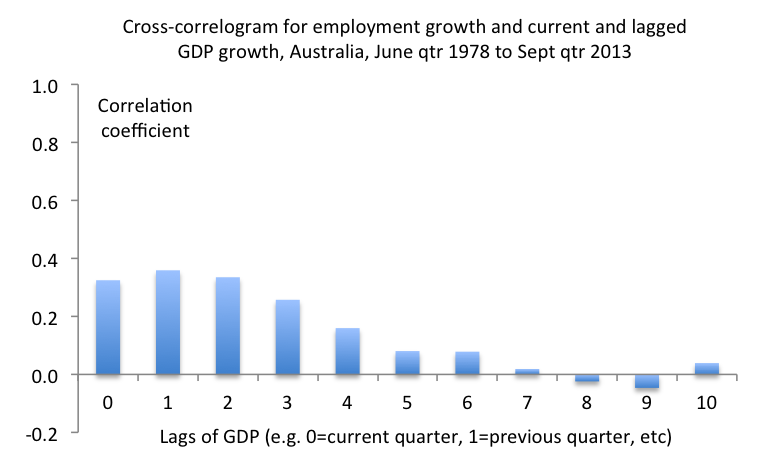
The growth rates of employment and GDP are correlated in the current quarter, but employment growth in the current quarter is also related to GDP growth in, at least, the three previous quarters. That is, employment reacts to current economic conditions, but only partially, and the adjustment to current conditions continues in future quarters. In Australia, this lagged impact is reasonably strong, based on the correlations between quarterly Australian employment growth and GDP growth in current and previous quarters reported in the chart (a cross-correlogram) below.

gdp_empl

Note: In this chart, the value at lag 0 is the correlation between current employment growth and current GDP growth, the value at lag 1 is the correlation between current employment growth and GDP in the previous quarter (i.e. GDP growth lagged one quarter), and so on. (Note that from lag 4 onwards, the correlation is not statistically significant).

Nonetheless, employment growth is significantly related to GDP growth in the current quarter, and hence I maintain it is incorrect to suggest the labour market is a lagging indicator. Current employment growth may indeed be telling us something important about current economic conditions.

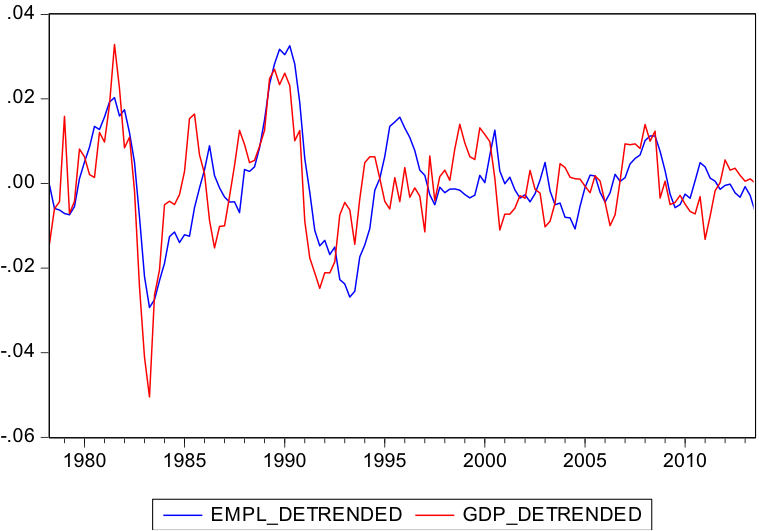
This chart of de-trended Australian employment and de-trended GDP (generated using the Hodrick-Prescott filter) confirms that employment and GDP often plunge or rebound in the same quarter, although I acknowledge there are occasions where a lagged relationship appears to exist:

detrended

I’m willing to concede that the employment and GDP relationship is complicated, but I won’t accept that employment is typically a lagging indicator of the economy. While I’m not too worried yet, it is very possible the labour market is telling us the economy is not currently in good shape, and recent employment data shouldn’t be quickly dismissed.

Posted in Labour market, Macroeconomy | Tagged , , , , | 2 Comments

CPD recommends endowment fund – forgets Qld has projected debt of $80 billion

The Centre for Policy Development’s new report All Boom, No Benefit? Why Queensland needs a new economic strategy ignores some important facts about the Queensland economy and contains some half-baked policy recommendations. The report is getting media attention because it criticises Queensland’s reliance on the resources sector (Queensland’s mining focus threatening wages, report warns), and raises concerns about future coal royalties, but it ignores the fact LNG exports will commence next year and there will be a big boost in royalties from production associated with those exports (see my post from last year Qld’s economic future bright if we look beyond short-term). Given our endowment of resources, Queensland has a comparative advantage in mining compared with other States, and I expect mining will be important to our economy for the forseeable future.

Another important fact the report ignores is that Queensland is projected to have
$80 billion of debt within the next few years. Hence I’m unsure where the surplus funds required to “Establish an endowment fund to manage renewable natural resources for the long-term”, one of the report’s recommendations,  are going to come from. It’s not like the Government has surplus cash to park in funds such as the one proposed. The fund may be worthwhile depending exactly on what type of natural resource management is proposed – the report is light on detail on this aspect – but a strong case would need to be made to divert money from other priorities such as health and education.

Regarding another recommendation in the report, I agree the Queensland Government should review its support to the mining industry to ensure it’s not unfairly advantaged relative to other industries. Indeed, as discussed last week (Scope to cut Qld Government industry assistance), I support a wide-ranging review of Queensland Government industry assistance.

Regarding the report’s final recommendation, “Convene a State Economic Summit to identify growth opportunities”, I fear this would be a useless, costly talk-fest and wouldn’t generate any useful economic policy outcomes. Hence I don’t support this recommendation.

I welcome the CPD’s interest in the Queensland economy, but it really needs to get a better grasp of important facts about our economy if it is to produce something of relevance to the Queensland economic policy debate.

Posted in Budget, Mining, Uncategorized | Tagged , , , , , | 7 Comments

Sorry to tell you, QTC, but the labour market is not a lagging indicator

I’m glad Queensland Treasury Corporation (QTC) remains optimistic about the economic outlook, even after last week’s discouraging labour force data, but I’m afraid one reason behind its optimism is unfounded. In its Weekly Market and Economics Review sent out via email this afternoon, QTC notes:

Employment fell by a surprising 3,700 in January, with full-time employment falling by 7,100. The unemployment rate rose from 5.85 per cent to 5.98 per cent—a ten-year high—while the participation rate was steady at 64.5 per cent. The only encouraging element of the labour force report was that hours worked rose strongly in the month and are rising steadily in trend terms, which may be a positive sign for future employment. While the labour market is clearly soft, it is worth remembering that it is a lagging economic indicator. [emphasis added]

Unfortunately, it’s incorrect to say the labour market is a lagging indicator, as explained in the US context in an excellent article by Henry Blodget in 2009:

Employment is NOT a lagging indicator

While the unemployment rate can be a lagging indicator, for reasons well explained by Blodget, employment is clearly a coincident indicator, and changes in employment tell us something about current economic conditions. This is why economic commentators typically pay close attention to employment growth in the ABS’s labour force data.

QTC appears to have misunderstood the information conveyed by recent labour force data, and it may have downplayed the significance of the fall in employment in its assessment of current economic conditions and the future outlook.

Posted in Labour market | Tagged , , , , , , , , | 9 Comments