NQ and Mackay region builders the least optimistic

buildingindustryoutlook

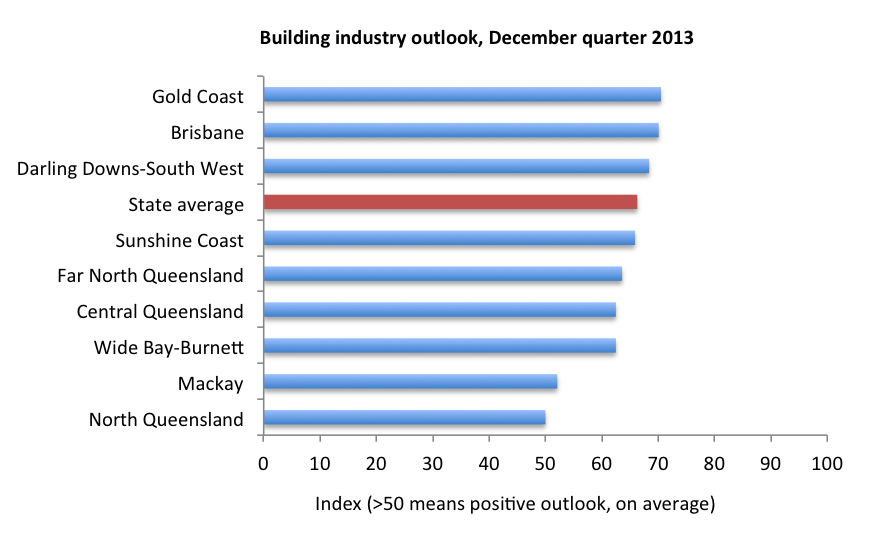
I just noticed Master Builders Queensland released its latest survey of industry conditions last week. While it shows a positive outlook on average across all regions, the outlook is only just positive in the North Queensland and Mackay regions (see chart above). In contrast, Brisbane, the Gold Coast and Darling Downs-South West have relatively high levels of confidence. The lukewarm confidence in the Mackay region is probably related to the slowdown in the resources sector in that region, but the lukewarm confidence in North Queensland is less easy to explain. Townsville builders obviously aren’t convinced by commitments made by political leaders over the years to the further expansion of the city, which both sides of politics have designated as Queensland’s second capital (see e.g. Community Cabinet comes to Townsville).

Posted in Housing, Mining, North Queensland, Townsville | Tagged , , , , , , , , | 6 Comments

Qld’s falling share of international tourism in Australia

Mark Beath at Loose Change (Folks are dumb where I come from!) has noticed there is now a record low proportion of international visitors to Australia declaring the State they spent the most time in was Queensland (N.B. data only available since 1991). In recent years, Queensland has lost significant market share to Victoria (see chart below).

State_most_time

While international tourism to Queensland is recovering (International Tourism Snapshot), clearly it would be recovering more strongly if we could reverse the loss of market share. I’ve previously posted on how:

Qld should look to Victoria for tips on tourism promotion

Posted in Tourism | Tagged , , , | 4 Comments

Removing second-hand car import restrictions could significantly lower car prices

I was happy to learn from a former Canberra colleague yesterday that I’m cited in the Productivity Commission’s January 2014 Position Paper on the car industry, regarding the benefits that would come from removing the restriction on second-hand car imports. The Productivity Commission notes (Box 3.6, page 101):

Pawson (2012) reported that the entry of vehicle imports from Japan ‘gave New Zealanders access to well-priced late model cars, further increasing the country’s high level of car ownership’.  A survey by Tunny (2011) of prices for second-hand Toyota Corollas (2006 automatic hatchback model) in Australia and New Zealand found that vehicles of similar mileage were on average almost 20 per cent cheaper in New Zealand than in Australia. [emphasis added]

Tunny (2011) is my article in the CIS’s Policy journal from that year: Carr’s Car Cash and Australia’s reform malaise.

I’ve previously posted on the benefits that would come from freeing up second-hand car imports:

Let in those cheap second-hand Japanese cars

The second-hand car import restriction is a protectionist measure that has been maintained as part of agreements by successive Commonwealth Governments with the car industry. Now that the car manufacturers are leaving Australia, any rationale for maintaining it has been removed.

Also on industry policy matters, I’d recommend listening to Steve Austin’s interview of Queensland Treasurer Tim Nicholls yesterday morning (Are Government subsidies worth it?), which appears to have been inspired by my post from yesterday morning regarding State Government industry assistance (Scope to cut Qld Government industry assistance).

On yesterday’s discouraging labour force data from the ABS (see the Treasury information brief), I’ll continue my policy of not reacting too much to one month’s figures, but would note that the Queensland data are consistent with my view that the jobs market has remained sluggish in recent months and that the apparent downward trend the ABS was reporting was illusory.

Posted in Industry policy, Labour market | Tagged , , , , , , , , , , , , | 5 Comments

Scope to cut Qld Government industry assistance

Queensland Treasurer Tim Nicholls did a good job of dampening expectations for this year’s Queensland Budget yesterday:

Queensland Treasurer Tim Nicholls says there will be no over-spending in the last budget before the election

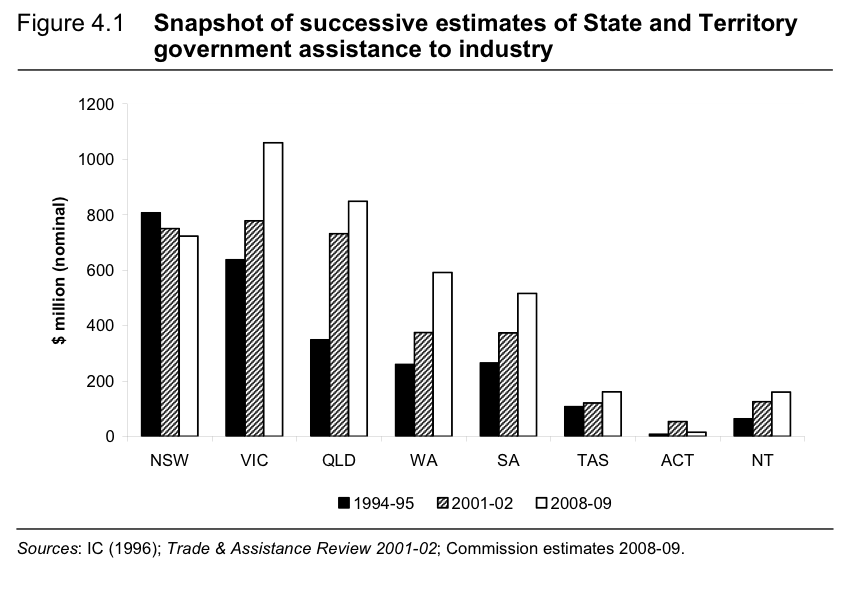
While the Government is rightly investigating asset sales, it should (and I expect it is) also rigorously review its expenditures in areas where government support is not compelling, such as assistance to industry (a.k.a. corporate welfare), including to tourism, agriculture and the film industry, for example. The most recent estimates of Queensland Government industry assistance (at around $850 million in total) appears to be from the Productivity Commission but unfortunately the estimates, which are for 2008-09, are a bit old now (see chart below). Queensland Treasury should make it a priority to produce up-to-date figures to inform the Government and the Queensland community.

StateIA

I’ve previously commented on the Productivity Commission’s estimates of State industry assistance:

Qld Government provides $850 million of industry assistance ($190 per capita)

Previous relevant posts of mine include:

Drum opinion piece – Taxpayer money wasted chasing film productions

Does Queensland need trade commissioners?

Qld should look to Victoria for tips on tourism promotion

Posted in Industry policy, Tourism | Tagged , , , , , , , , | 5 Comments

Top twenty largest cities and towns in Queensland by population

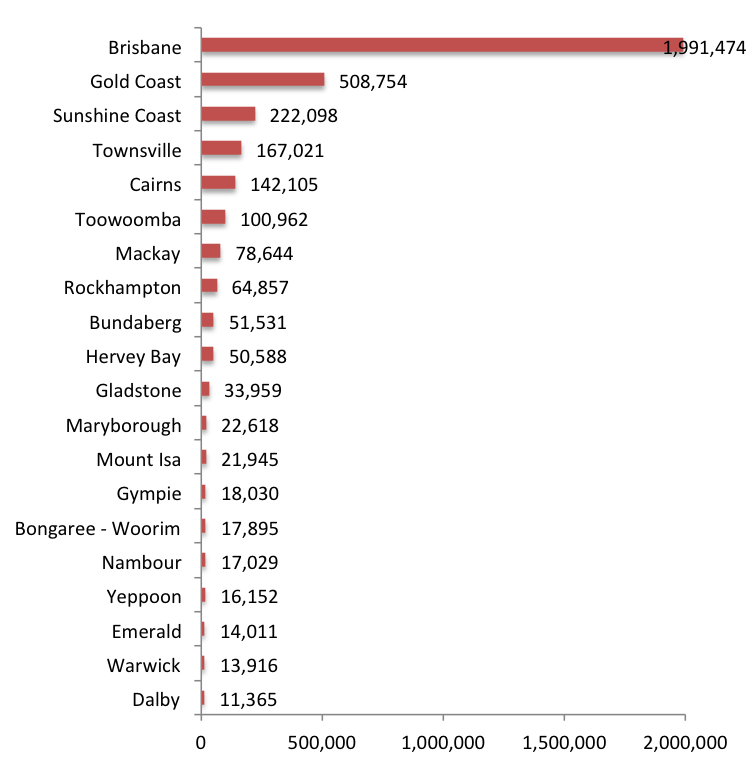
I get quite a few hits on my blog from people searching for the populations of Queensland cities, particularly Townsville, given an old post of mine: Is Townsville or Cairns the capital of North Qld?. Hence I’ve decided to chart Queensland Treasury’s estimates of the 2012 populations of Queensland’s urban centres and localities (see chart below based on the Treasury data). For those interested in the pointless debate about the capital of North Queensland, Townsville is clearly ahead of Cairns on the Treasury data.

Population

Update: As discussed in the comments on this post, the Queensland Treasury data I used in this post rolled Ipswich, Logan, Redlands, and Moreton Bay into the Brisbane “urban centre”. For a presentation of the data by local government area, see my post:

Qld councils & the 80:20 rule – 81% of Queenslanders live in just 12 out of 78 LGAs

Posted in Cairns, Population, Townsville | Tagged , , , , , , | 12 Comments

ABC Brisbane radio interview on Toyota departure

This morning, Steve Austin from 612 ABC Brisbane interviewed me regarding Toyota’s departure and the demise of car manufacturing in Australia:

How will Toyota’s departure affect the local economy?

I reiterated a number of points I’ve made previously, including in my post from yesterday:

Minimal threat to Qld economy from car industry shutdown

Posted in Industry policy, Macroeconomy | Tagged , , , , , , , | 5 Comments

Minimal threat to Qld economy from car industry shutdown

The demise of Australia’s car manufacturing industry was always inevitable, but even I have been surprised at the pace with which Ford, GM Holden and now Toyota have announced their plans to cease production in Australia. While the plant closures will have significant impacts in some regions, particularly Geelong, Melbourne’s western suburbs and Elizabeth, SA, the overall macroeconomic impact should be small and I expect minimal flow-on impacts to Queensland.

Jobs at risk in Queensland due to plant closures down South would mostly be in the motor vehicle and parts manufacturing sub-sector, particularly jobs in businesses in the supply chains of the car manufacturers. According to the Automotive Environmental Scan 2013 (p. 32), there were 7,500 people employed in this sub-sector in Queensland in June 2012, which is only around 0.3% of all employed persons in Queensland. Even if half these jobs were lost, it would be hard to distinguish the impact on the unemployment rate from the usual noise you get in the data.

My previous posts on Australia’s car industry have included:

New Government should reject car industry begging

Future of Australian car industry depends a lot on the exchange rate

Posted in Industry policy, Labour market, Macroeconomy | Tagged , | 6 Comments

Hospitality suffering under IR regime

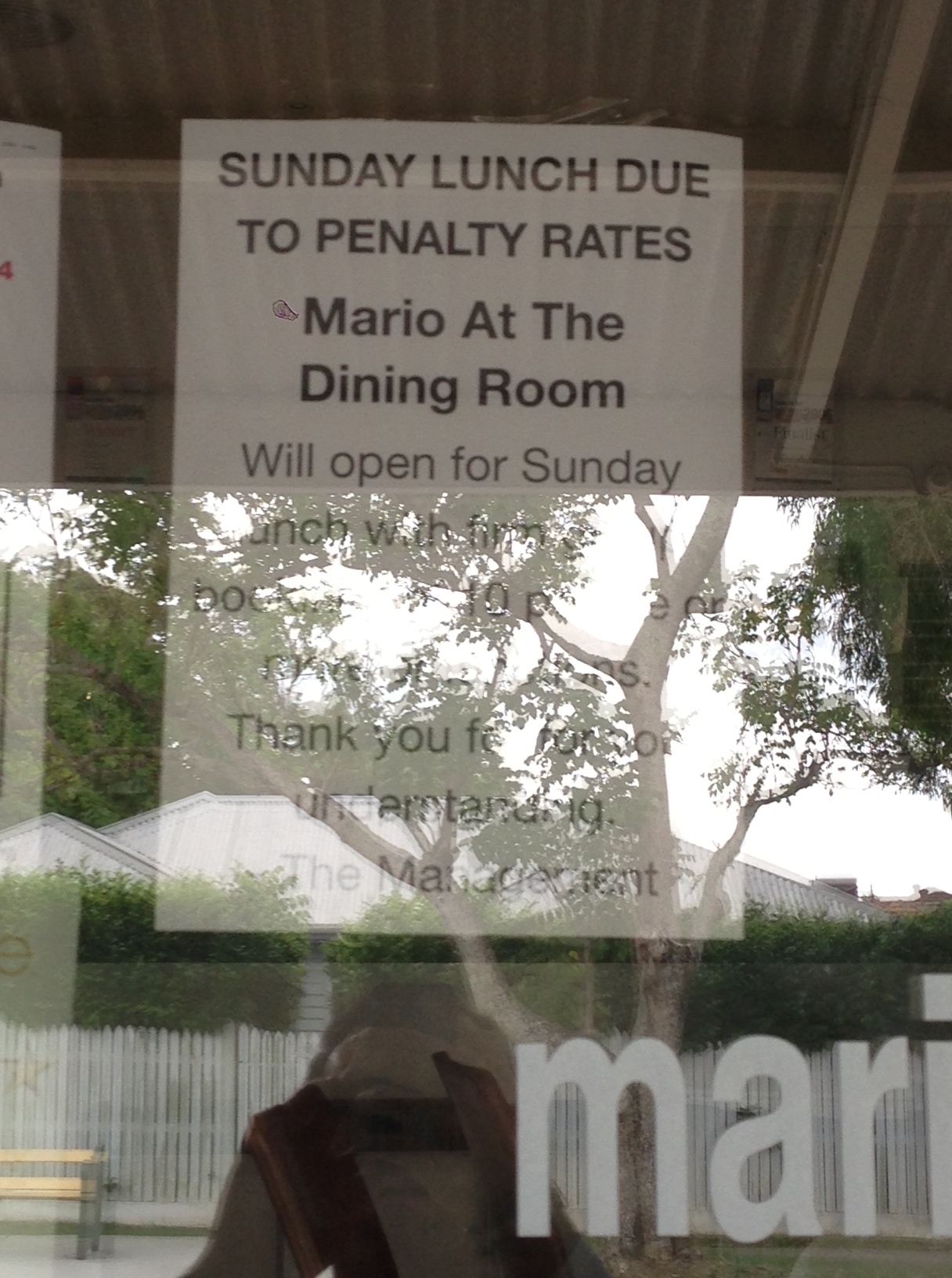
On my way back from the Boondall ice skating rink this morning I stopped in at my favourite north side cafe, Dandelion & Driftwood, and while walking back to my car I noticed this sign on the neighbouring restaurant:

photo-9 The sign basically says that Mario will only open on Sundays if he gets a confirmed booking for at least ten people because otherwise he can’t afford the penalty rates. I had a brief chat with Mario and he told me to quote him as saying “Because of Fair Work Australia there are eight people who now don’t have a job on Sunday.”

I believe in fair wages and protecting workers’ conditions, but the hospitality sector appears to be struggling under the IR system. Let’s hope the current review into the Modern Award system can strike an appropriate balance (see Union offers olive branch on IR reform).

Posted in IR | Tagged , , , , , | 8 Comments

Qld businesses more optimistic than current conditions suggest they probably should be

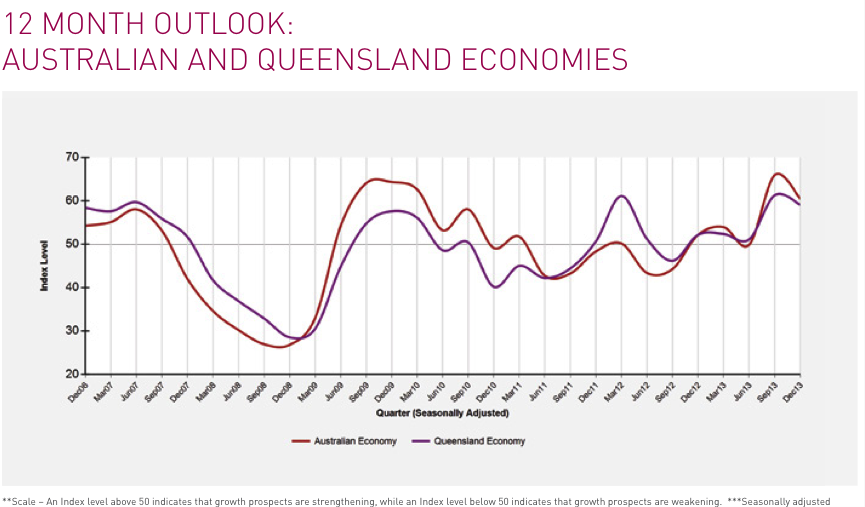
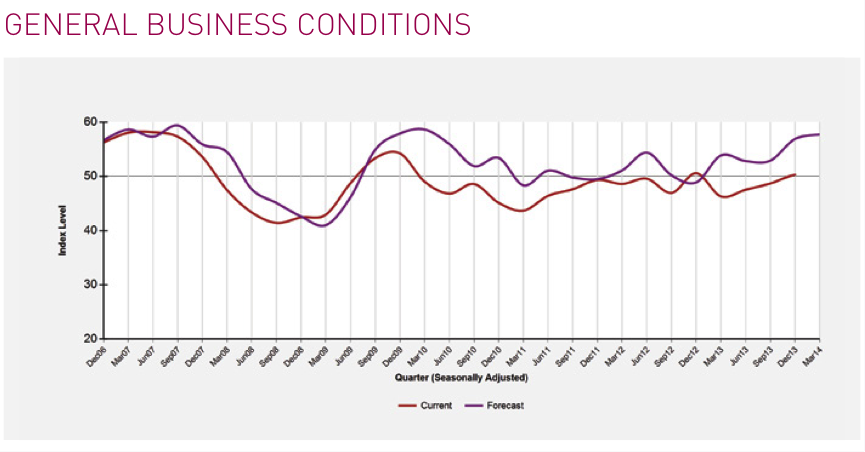
The December quarter edition of the timely and very useful CCIQ-Westpac Pulse Report released yesterday confirms reasonably high levels of confidence among Queensland businesses and a continuing improvement in business conditions. While CCIQ considers confidence is no longer running ahead of business conditions (see the CCIQ media release), I’m unsure if this is the case. Charts in the Pulse Report show confidence and forecasts of business conditions are relatively high, but actual current business conditions are only average (and profitability remains weak):

outlook

conditionsThat said, the story told in the Pulse Report about improving confidence among Queensland businesses strikes me as true given what I’m hearing around town. Whether that confidence holds up will depend on whether actual conditions continue to improve over the coming months.

On the disconnect between confidence and performance at a regional level, see Pete Faulkner’s commentary on the Pulse report for the Far North:

The optimistic Far North

On other economic news, retail turnover continues to grow at a reasonable rate, although slower than in other States, as summarised in Queensland Treasury’s information brief on the latest ABS data:

Retail trade, December 2013


Posted in Macroeconomy, Retail trade | Tagged , , , , , , , | Leave a comment

Further TAFE job cuts likely in new contestable training market

The effective corporatisation of TAFE Queensland last year (see Qld TAFE to become statutory body) and the push for greater contestability in training funding – both of which I support – will no doubt lead to a rationalisation of Queensland TAFEs and further job cuts as TAFEs struggle to compete with private providers such as Sarina Russo. There have already been a number of job cuts at TAFEs since TAFE Queensland was corporatised (e.g. About 50 jobs to go at Brisbane North TAFE,  Union airs fears over TAFE north Qld job cuts) and I expect further cuts over the next few years.

TAFEs in other States appear under pressure, too, given this report out of NSW today: Job cuts feared at Hornsby TAFE after fine art department axed. I’m unclear about the rationale for the axing of the fine arts departments at the Hornsby TAFE, but it would either be because it’s a high cost course or demand is shifting to other courses, or a combination of both.

Cuts to arts courses at TAFE are probably not a big deal for the economy, given that arts courses at TAFE typically have relatively poorer outcomes that other courses in terms of getting students into jobs. See, for example, Table 10 on page 15 of the Student Outcomes Survey 2013. I expect creative arts courses, particularly fashion design which has pretty poor employment outcomes, will face significant cuts in Queensland, too.

Posted in Education, VET | Tagged , , , , , , , | Leave a comment