Weekend reading: CIS Policy mag featuring my article on film industry subsidies, available at good newsagents

Policy_Autumn_17

If you’re looking for something to read this weekend, you could try the latest issue of the Centre for Independent Studies’ magazine Policy, which includes some excellent feature articles. These include an article on the worrying levels of public debt we are seeing worldwide from former IMF Fiscal Affairs Director Vito Tanzi, as well as an article from me, “Special rates for special mates.” This is an expanded version of the article I posted earlier this year on the outrageous subsidy Australian taxpayers are providing to the Aquaman film production on the Gold Coast:

Should the Aquaman film production on the Gold Coast get a $22M tax break?

The magazine also features an interview of UK Conservative Member of the European Parliament Daniel Hannan, one of the architects of Brexit, by Tom Switzer, and articles by William Coleman, Stephen Kirchner and Wolgang Kasper, among others. Highly recommended.

Posted in Industry policy, Tax, Uncategorized | Tagged , , , , , , , , , , , | Leave a comment

Qld economy should be resilient to Cyclone Debbie

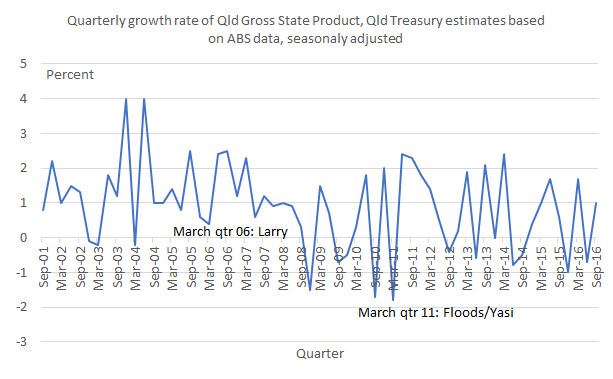
While we are still to learn the full extent of the damage and economic disruption of Cyclone Debbie, we should be reasonably confident that any adverse economic impact, such as through lost crops, tourism, or disruption to coal mining and exports (see this ABC News report), is temporary, and the State economy will likely recover quickly from it, as it has from previous natural disasters. Indeed, it is expected that capital works during the reconstruction effort will provide a temporary stimulus to affected regional economies. This is what happened in particular after the 2010-11 natural disasters: the floods and Cyclone Yasi (see chart below).

QldGSPgrowth_qtrly

Keep in mind that the State economy is frequently subjected to a wide range of shocks, such as changes in the exchange rate which affect tourism and exports, and changes to global commodity prices which affect mining investment and operational decisions. Natural disasters are another type of shock, which can have a large negative impact on gross state product (GSP) growth in one quarter, but typically do not have a long-lasting adverse impact on the economy. See my 2011 post on Recovery from natural disasters, which quotes John Stuart Mill on the long-observed phenomenon of rapid recovery from natural disasters.

The State Budget will no doubt take a significant hit from Cyclone Debbie, as coal production and royalties may be temporarily lower and as the Government needs to undertake emergency disaster relief measures. I expect our hard-working Queensland Treasury officials, already in the middle of State Budget preparations, will be spending even longer hours in the “Tower of Power” at 1 William St, working out the impact of Debbie on the Budget bottom line.

Posted in Cyclones, Macroeconomy, North Queensland, Uncategorized | Tagged , , , , , , , , , , , | 4 Comments

Selling QIC highly desirable and would avoid allegations of political interference regarding mega mine infrastructure

First, my thoughts and prayers are with the people of North Queensland as they wake up to the devastation from Cyclone Debbie.

In his extraordinary eulogy for Marie Antoinette, the Anglo-Irish statesman Edmund Burke lamented that the French Queen had not been adequately defended: “I thought ten thousand swords must have leaped from their scabbards, to avenge even a look that threatened her with insult.” Luckily for the government-owned Queensland Investment Corporation (QIC), the Courier-Mail was quick to pull its sword from its scabbard to defend QIC from the threat of insult. In an editorial  yesterday, the paper implored QIC critics to “Leave QIC alone over Adani.” The editorial followed on from a story earlier in the paper that QIC may consider investing in infrastructure associated with the Adani Carmichael mega mine, such as the rail line needed to connect the mine with the existing network (see QIC eyes investment in Adani Carmichael megamine infrastructure).

While I have no reason to doubt that QIC is acting independently of the Government and is maintaining the highest of standards, the paper surely must admit that the optics of any QIC investment in Carmichael mine infrastructure would be terrible. Environmental groups, and possibly some market commentators sceptical of the mega mine’s viability, would, rightly or wrongly, allege the Government has used its influence over QIC to invest in a project that may not otherwise secure finance and proceed.

Due to the hundreds of millions of dollars of coal royalties per annum the mega mine would inject into consolidated revenue, and the thousands of jobs it would support in regional Queensland, the Government is keen for the project to proceed. Indeed, the current Government deserves credit for the strong effort it has made to progress the mine’s development. But if QIC invests in the mine, and especially if it uses any funds invested in it by the Government, then the Government will be exposed to the allegation of political interference in QIC, due to its very strong interest in the project proceeding. Given the potential for financial mischief by QIC, which manages a huge pot of money on behalf of the Government so it can meet its super liabilities, it is very important that QIC is independent from Government. But the involvement of QIC in a controversial government-supported project would put the perception of QIC’s independence at risk.

The Government could avoid this exposure to criticism by divesting itself of QIC, which incidentally could raise many hundreds of millions of dollars, possibly up to $1 billion. QIC is highly profitable (around $90M per annum of pre-tax profit) but to earn that profit it takes risks that ultimately are borne by the Queensland taxpayers who own the business. As I have argued several times before, the Queensland Government should not be in the funds management business. There are plenty of private sector operators out there, and a government-owned funds manager, with an implicit government guarantee, has an unfair competitive advantage over private sector funds managers. See my previous post:

Government ownership of QIC becoming less appropriate every day

The 2013 Queensland Commission of Audit rightly recommended the sale of QIC. And, as I discovered in my research for the book I’m currently writing on the history of Queensland’s public finances over the last few decades, the 1996 Commission of Audit, led by highly respected economist Vince Fitzgerald, recommended the Government consider QIC for privatisation (see chapter 16 of the Fitzgerald CoA report vol 2). Alas, the wheels of government can turn slowly.

Posted in North Queensland, Queensland Government, Uncategorized | Tagged , , , , , , , | Leave a comment

Qld’s lacklustre population and jobs growth have gone hand in hand over the current decade

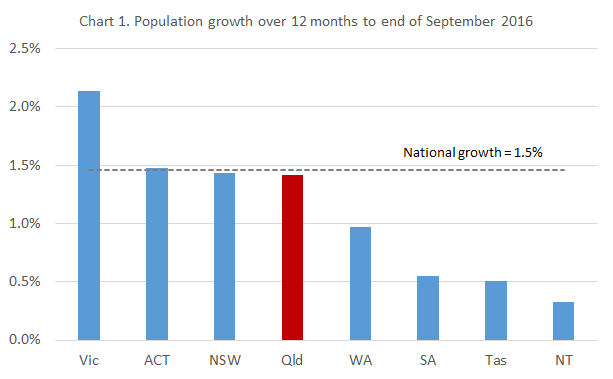
Queensland’s population, now at around 4.9 million, increased 1.4% in the year to 30 September 2016, a growth rate slightly below the national growth rate of 1.5%, but significantly below Victoria’s stand-out growth rate of 2.1% (Chart 1 based on the latest ABS data). Victoria has performed strongly in terms of both population growth and employment growth in recent years. Victoria’s economy has no doubt benefited from the feedback between jobs growth and population growth, as jobs growth attracts new migrants, increasing the population, which in turn supports further jobs growth, and so on. For Queensland, in recent years, the story has been much different, with below average population and jobs growth.

Pop_Sep16_chart1

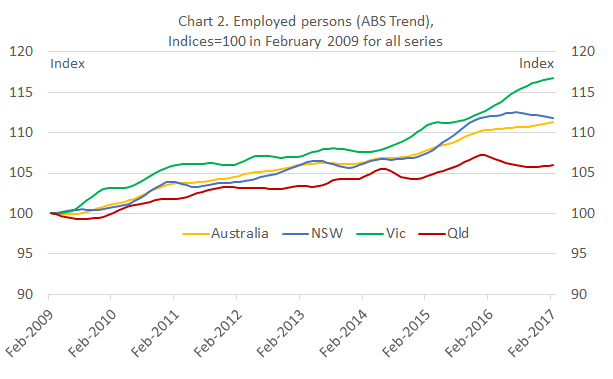
The number of employed persons in Queensland has increased by only around 6% since February 2009 (a date chosen because it was around then that our population growth rate started to fall) compared with an increase in employment in Victoria of around 17% (Chart 2).

Pop_Sep16_chart2

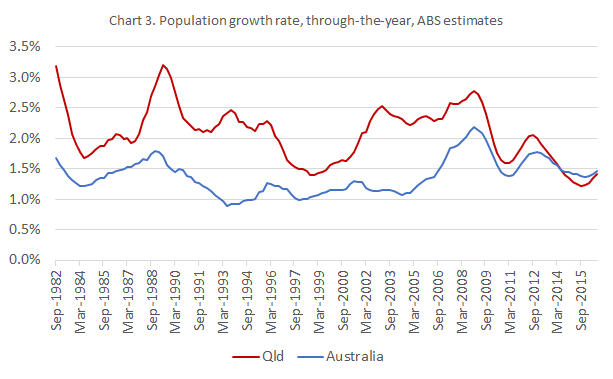
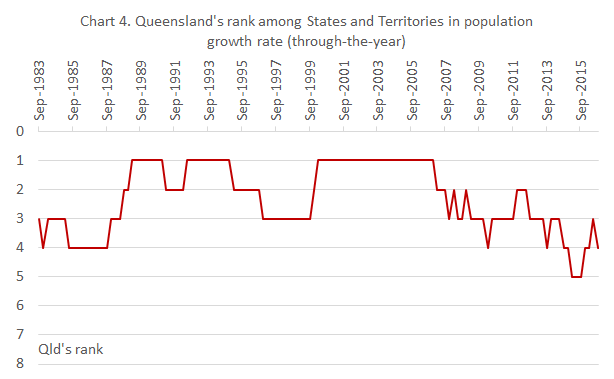
The Sunshine State’s middle-of-the-pack population growth rate is much lower than it has been historically (Chart 3) when Queensland, at times, ranked as the number one State for population growth (Chart 4).

Pop_Sep16_chart3

Pop_Sep16_chart4

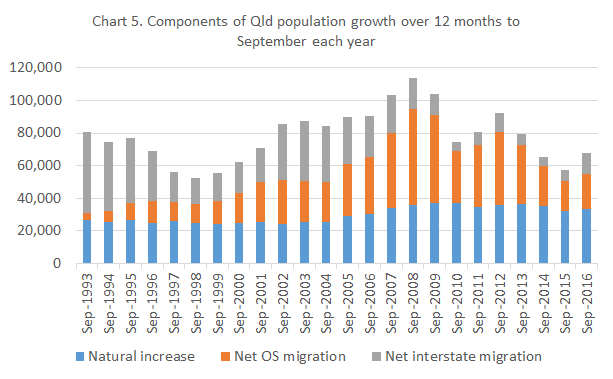
Queensland’s relative decline in population growth since the mid-to-late 2000s is due to falls in both net overseas migration and net interstate migration (Chart 5). In the current decade, it has been the fall in net overseas migration that has been most substantial. Consider that, at its peak in calendar year 2008, net overseas migration to Queensland was almost 63,000 people, but, in the year to 30 September 2016, it was only around 21,500 people. A decade ago, net overseas migration to Queensland accounted for around 20% of the total for Australia, but that has subsequently almost halved to the 11% share Queensland receives now.

Pop_Sep16_chart5

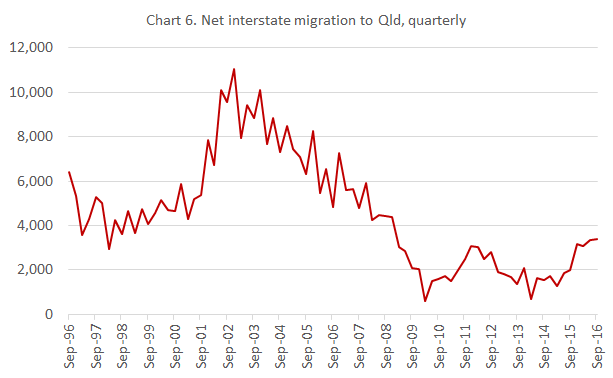
While net interstate migration has recovered somewhat from its trough in 2013-14 (Chart 6), at around 13,000 people in the 12 months to 30 September 2016, it remains well below levels experienced during the early 2000s and 1990s. In the early 2000s, Queensland experienced yearly net interstate migration figures of around 30,000 to 35,000 people. In the early 1990s, yearly net interstate migration peaked at around 50,000 people.

Pop_Sep16_chart6

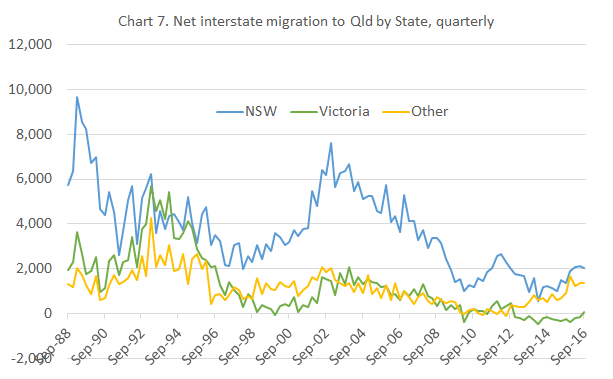
I have previously commented on the net loss of people Queensland has experienced to Victoria in recent quarters (see my post on the previous data release). Thankfully, net migration from Victoria has finally turned positive, albeit only to a net gain of 38 people, after fifteen consecutive negative quarters (Chart 7). This may have something to do with the improvement in economic conditions Queensland experienced over the second half of 2016, but let us wait and see how long it lasts before getting too excited.

Pop_Sep16_chart7

Posted in Labour market, Population, Uncategorized | Tagged , , , , , , , , , , , , , | 1 Comment

Qld economy not generating enough jobs for uni, VET & school leavers

Market economists do not appear too concerned about the new ABS jobs figures released yesterday showing the national unemployment rate increased to 5.9% in February from 5.7% in January. There is a recognition that there is a lot of noise in the data and that other economic indicators, such as business confidence and job ads, are more positive (e.g. see Bloxo blames jobs on numberwang at MacroBusiness). We should be even more cautious about reading too much into the even noisier State-level data, which for Queensland were very disappointing, as Pete Faulkner noted in his post yesterday:

“In Queensland things were weaker still. The headline data showed a loss of 11,500 jobs with full time positions up 5,100 (after more than 30,000 were lost in Jan). The seasonally adjusted unemployment rate has jumped to 6.7% (from 6.3%); this puts Queensland in the unenviable position of having the highest rate of unemployment (seasonally adjusted) in the nation. Over the last 12 months the state has lost 38,500 (or 3,200 per month) with full time jobs down 66,100 (an average loss of 5,500 per month).”

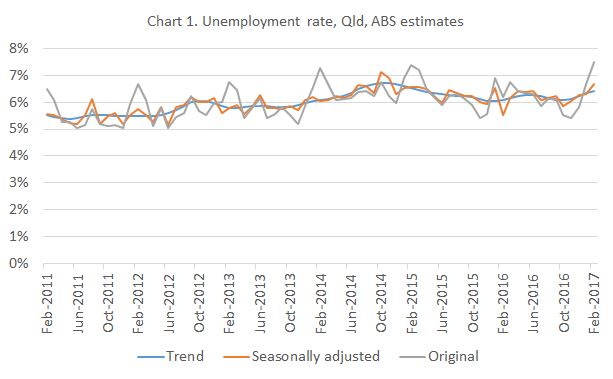
The Queensland Treasury’s preferred ABS Trend measure of the State unemployment rate has increased to 6.4% (Chart 1), which must be worrying for the Government as it gears up for the next election.

LF_Feb17_Chart1

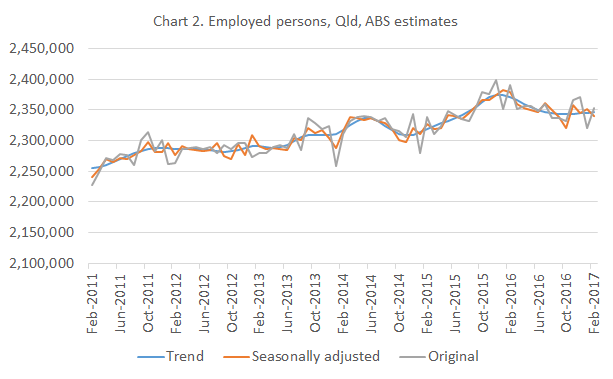
The latest data confirm that the Queensland economy overall is not generating the jobs that are needed to employ all the new labour market entrants (e.g. uni, VET and school leavers) and re-entrants (e.g. parents with young children who wish to re-enter the workforce). After falling over the first half of 2016, employment has plateaued since then (Chart 2).

LF_Feb17_Chart2

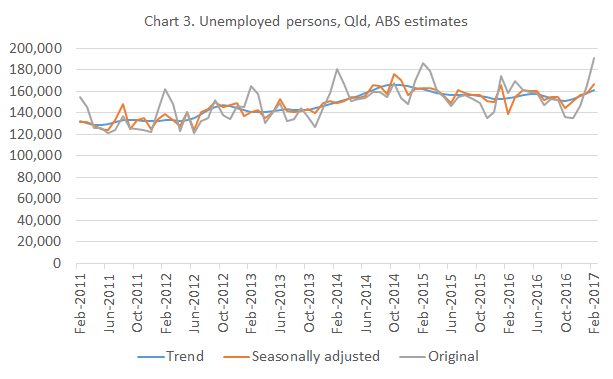
The latest surge of new entrants into the labour market in early 2017 has pushed up unemployment markedly in the original un-adjusted data (Chart 3). It is possible that the expected seasonal influx of new entrants has not been fully filtered out in the seasonally adjusted data, so the jump in Queensland’s seasonally adjusted unemployment rate to 6.7% may be over-stated. Again, we should be cautious reading too much into one month’s data. This is especially the case given Queensland had such substantial State Final Demand growth in December quarter. In other recent positive news, international tourism is at a record high in Queensland (see TEQ’s International Tourism Snapshot), with international visitors to Queensland increasing over 10% in 2016 to 2.6 million visitors.

LF_Feb17_Chart3

Posted in Labour market, Macroeconomy, Uncategorized | Tagged , , , , , , , | Leave a comment

RBA making it up as it goes along

After a speech by Assistant RBA Governor Michele Bullock yesterday, there is speculation about the RBA pushing APRA to instruct banks to further restrain their lending to housing investors- strengthening the so-called macro-prudential regulation that has had only limited success in cooling the property market to date (See this morning’s Australian). I now have the uneasy feeling that the RBA is making it up as it goes along, that it has lost control of macroeconomic management.

The RBA forced the cash rate to a record low to help the economy adjust to the end of the mining investment boom (see chart below). Its easy money policy certainly contributed to a dwelling investment boom, and it has also helped inflate a property price bubble in Sydney and Melbourne, a bubble which has been obvious for some time (see Sydney & Melbourne property prices defy rational explanation), but which the RBA only now appears to realise is a threat to macroeconomic stability.

policy_rates

The RBA should have realised the full implications of then Governor Glenn Stevens’ observation about “crazy” Sydney house prices in June 2015, almost two years ago. Now we have even more heavily indebted households, at substantial financial risk from interest rate increases, and we risk a large housing price correction and an adverse shock to consumer confidence and spending when interest rates start rising.

Australian interest rates will come under pressure to rise as the US Federal Reserve increases the Federal Funds Rate further and faster than previously expected. Morgans Chief Economist Michael Knox has an excellent analysis of the Fed’s likely interest rate hikes over 2017 in his latest note Plain speaking from Janet Yellen:

“…to stabilize the US economy at full employment (and we are now at full employment) the Fed needs to move the Fed Funds rate to 1.74%. Right now the effective Fed Funds rate is 66 basis points. The startling conclusion is that to reach the neutral Fed Funds rate, the US now needs four rate hikes. This suggests a rate hike in March, a rate hike in June, a rate hike in September and maybe a rate hike in December.

Janet Yellen is telling us that the period of pretend rate hikes is now behind us. The Fed is beginning to tighten on a regular fashion. By the end of this cycle, the Fed Funds rate should reach 3%.”

The US Federal Reserve Board is currently undertaking its two-day March meeting, over Tuesday 14 and Wednesday 15 March, so news of the March rate hike is not far away. The RBA’s macroeconomic management task will soon become even more challenging.

Posted in Housing, Macroeconomy, Uncategorized | Tagged , , , , , , , , , , | 6 Comments

Greater labour mobility a better way to assist PNG than budgetary support

Last Thursday, ABC News reported that Papua New Guinea has asked for a re-direction of Australia’s foreign aid program towards direct contributions to PNG’s health and education budgets. PNG, a country already struggling with high population growth and public health challenges, such as a high rate of HIV infection, has recently suffered an economic and budgetary crisis due in part to lower commodity prices.

I expect Australian officials will be wary of the proposal from PNG, particularly given Australian officials would have little say in how the money would be spent. And rather than building up the nation’s capabilities, it would run the risk of turning PNG into a mendicant state forever. Arguably, a better way to assist PNG would be to further open up Australia’s labour market to workers from PNG, who would benefit their economy immensely through the flow back home of remittances.

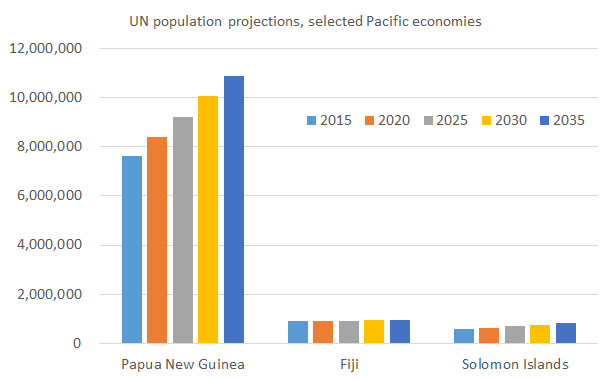
Earlier this month, the Australian Foreign Minister Julie Bishop launched a report from the Menzies Research Centre, Oceans of Opportunity, which may well serve as a blueprint for how Australia and our Pacific neighbours, including PNG with its burgeoning population (see chart below), can mutually benefit from greater labour mobility. I particularly like the report’s recommendation (see p. 18) to establish two new visa streams: Pacific Connect (Skilled) for skilled migrants from the Pacific and Pacific Connect (Labour exchange) which:

“would allow employers, primarily in the tourism and hospitality sector to forge links with like businesses across the Pacific and establish an exchange of skilled and experienced workers.”

This would supplement the existing Seasonal Workers Programme which allows people from selected Pacific nations to work temporarily in the agricultural sector.

I hope the Australian Government seriously considers the recommendations of the Oceans of Opportunity report, given the mutual benefits to Australia, from a supply of additional workers that could work in sectors and regions with labour shortages, and to the Pacific nations themselves, through the remittance of much needed income.

UN_pop_projns

Posted in Agriculture, Labour market, Tourism, Uncategorized | Tagged , , , , , , , , , | 2 Comments

Townsville getting $250M Super Stadium, but running out of water

One definition of economics is that it is the study of the allocation of scarce resources to competing uses. It says each additional dollar should go to the use which provides the greatest additional benefit. As such, it looks very odd that our State and Federal Governments have funded an arguably unnecessary $250 million Super Stadium in Townsville (see Joe Branigan’s excellent guest post from last year), but the city continues to face a water supply crisis, as reported in the Townsville Bulletin this morning:

‘Developer Robert Zammit said water restrictions were holding back landscaping at the former Townsville General Hospital in North Ward and a lack of action was destroying business confidence.

“The biggest issue is the lack of water because that’s a real downer among people,” he said. “It affects people on every level from retail to property developers looking for new developments.

“When we started the old hospital development we were in water restrictions – everyone was worried but as soon as we got a big rain that was it.

“Now we’ve got the same issue again and it’s obvious no level of government is treating it with the respect it deserves.”

Mr Zammit said the city could not go forward without a solution to the water crisis.

“Until we get the rain it doesn’t matter what happens with mines, the lift in sugar prices or the arrival of troops from Singapore,” he said. “What’s keeping Townsville down? It’s the confidence and that’s linked to water supply.”’

It is a ridiculous distortion of priorities and a huge public policy failure to fund a football stadium prior to sorting out Townsville’s water crisis, whether via water supply augmentation (e.g. Haughton pipeline duplication) or demand management measures. In part, the prioritisation of the Super Stadium reflects the political clout of the NRL, which is a major financial beneficiary of the new Townsville Super Stadium, and until recently had former Queensland Treasurer Andrew Fraser as a senior executive.

Townsville residents suspect their water crisis is not being taken seriously by politicians in Brisbane and Canberra. Perhaps it is time for a North Queensland regional government that would provide greater decision making power, responsibility and accountability to local people. Given the severity of the water crisis in Townsville, I suspect that they would prioritise water over footy.

In other news, the economic outlook in North Queensland’s other major city, Cairns, is looking promising, according to this report in Tropic Now:

38 reasons to get excited about the Cairns economy in 2017

Posted in Townsville, Uncategorized, Water | Tagged , , , , , | 7 Comments

Guest post from Rod Bogaards: Trading hours’ report fails to make the case for continued regulation in Qld

I am delighted to publish this guest post from my fellow economist Rod Bogaards, currently a consultant to the World Bank, on the recent Queensland trading hours review by John Mickel. GT

Trading hours’ report fails to make the case for continued regulation in Queensland

by Rod Bogaards

The Mickel Report recommendations are a step in the right direction to address the over-regulation of retail trading hours in Queensland. But given less restrictive retail trading hours are in place in most other Australian jurisdictions, it begs the question: Did the report go far enough?

Following the release of the report, the Queensland Government was quick to announce its support for nearly all of the recommendations.

Unfortunately for Queensland, the report’s recommendations do not appear to be the result of a dispassionate assessment of the viable reform options, but a negotiated outcome of special interest groups. That is, analysis appears to have taken a back seat to consensus.

This is perhaps not surprising, given the Trading Hours Review Reference Group comprised representatives from business associations and unions:

  • National Retail Association
  • Chamber of Commerce and Industry Queensland
  • Master Grocers Australia
  • Queensland Tourism Industry Council
  • Shop, Distributive and Allied Employees’ Association
  • Australian Workers’ Union
  • United Voice
  • Queensland Council of Unions.

The most notable omission was a consumer representative to counter interest group arguments. This omission is problematic, given consumers are the most affected group in the community when it comes to retail trading hours. They bear the costs of the regulations. In particular, they bear the costs of being unable to shop at locations and times suited to their requirements and the higher prices they pay because of the reduced competition arising from restrictions on retail trading hours.

Instead of having a seat at the table, consumers had to make do with their views being conveyed via a survey (or for the highly motivated, an individual submission). Nevertheless, when given the opportunity to have their say, the survey evidence was clear that the majority of Queensland consumers don’t want regulated retail trading hours and, even more so, they don’t want large retail shops to be constrained by Sunday or geographic restrictions (Mickel Report, p. 75).

So what happened? How did Queensland end up with an independent report that recommended to continue regulating trading hours when the majority of Queensland consumers don’t want it and many independent inquiries across Australia, some dating back to the 1980s, have presented solid evidence supporting deregulation?

The report does detail the evidence from the Productivity Commission and others knocking out the arguments to regulate trading hours to protect some small businesses from competition. However, the main flaw is that the report fails to identify a problem that would require regulation. It also misses the key step of analysing and comparing the impacts of different options so that any trade-offs can be made explicit.

The inquiry recommended retaining regulated trading hours so some retail employees will not have to work outside ‘traditional’ hours. In effect, it places the interests of some full-time retail employees above the interests of consumers, retailers, part-time/casual retail employees (who are more likely to self-select into working ‘unsociable’ hours) and unemployed job seekers.

But why? Restricted trading hours apply to only some retail businesses (non-exempt stores) and therefore to only some retail workers. Why should those retail workers be protected from ‘unsociable hours’ but not the 90 per cent of non-retail workers in the state? If there really are significant benefits from restricting trading hours, why apply them to only retail workers? Why shouldn’t all workers — in restaurants, hotels, nightclubs, airports and many white collar jobs — be able to share in the benefits of not working ‘unsociable hours’ in Queensland?

The community would be better served by the Queensland Government receiving more objective reports on policy issues. Such reports should, at a minimum, undertake base-level regulatory review and provide evidence of a policy problem requiring regulation and some analysis of options, rather than views of the beneficiaries of regulation.

Rod Bogaards is an economic consultant to the World Bank and former Director of the Productivity Commission.

sorry_were_closed

Posted in Uncategorized | Tagged , , , , , | 2 Comments

Residential construction at peak in current cycle in Qld

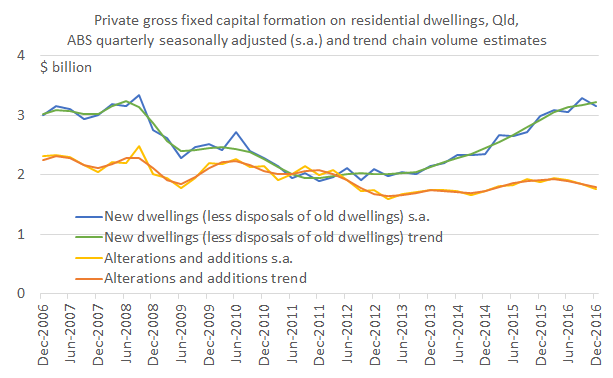
The mini-boom in residential construction, of both inner Brisbane apartments and detached houses in outer-lying areas in SEQ, such as Ripley, Springfield and Yarrabilba, has been important to the economy over the last couple of years. This mini-boom now appears to be at (or possibly past) its peak. However, in his media release on the December quarter National Accounts, the Queensland Treasurer, referring to the robust growth in State Final Demand in December quarter, noted:

“This result shows an increase in household consumption drove the solid outcome in the December quarter and was backed up with construction of new dwellings which rose 1.1 per cent and total dwelling investment was 3.2 per cent higher over the year, reflecting the strong growth in construction work done on medium to high density dwellings.

“A strong pipeline of housing work yet to be done suggests ongoing strength in Queensland dwelling investment in 2016-17…”

The Treasurer is correct that there is a strong pipeline of work yet to be done, but the December quarter growth statistics he cites are based on the smoothed backward looking ABS trend data, which can hide turning points that may be apparent in the (albeit noisier) seasonally adjusted data. According to the seasonally adjusted data, gross fixed capital formation (i.e. construction or renovation) of dwellings fell 4.2 percent in the December quarter (see chart below), suggesting we may have passed the peak of residential construction activity in this cycle.

dwelling_dec16

So residential construction is no longer a driver of growth in the Queensland economy and I expect it will slightly detract from growth over the next year as it declines (moderately) from its recent peak. Based on the most recent National Accounts and exports data, I expect the major drivers of growth in the Queensland economy over the next year to be a reinvigorated resources sector, which is likely contributing to a noticeable pick up in investment in machinery and equipment (up 5.7% in December quarter) and, for better or worse, State Government capital works expenditure, which was a strong contributor to the growth in demand in the last quarter (see yesterday’s post).

Posted in Housing, Macroeconomy, Uncategorized | Tagged , , , , , , , | 2 Comments