Sweetheart deal to lure Land 400 “war machine” contract winner to Qld undesirable

If we want the most efficient and productive economy possible, with the largest number of sustainable jobs, then we should aim to minimise the taxes and charges on all businesses, not just the favoured few which have the resources to lobby governments and can play them off against each other in interstate bidding wars. Alas, the Queensland Government is getting into an interstate bidding war with Victoria to attract the winner of what the Courier-Mail has labelled a “lucrative multibillion-dollar war machine contract”, the Land 400 contract with the Australian Defence Force (for further information on the contract see Nick Behrens’s post Land 400 ADF Contract a must have for Queensland Manufacturing). While it would be terrific for the Queensland economy if the winning bidder invested in Queensland, the Queensland Government should avoid cutting a sweetheart deal with the winner.

Deputy Premier Jackie Trad has committed Queensland to do “whatever we can” to lure whichever multinational defence contractor, Rheinmetall Defence or BAE Systems, wins the contract. Doing “whatever we can” likely means exemptions from payroll and land taxes for several years. Previous governments have also done whatever it takes to lure investment, including most famously the Beattie Government in luring Virgin to Queensland, but that does not make it right. In its comprehensive 2015 Review of Industry Assistance in Queensland, the Government’s independent economic adviser, the Queensland Competition Authority, provided strong advice against engaging in interstate bidding wars (on pp. 32-33 of the Final Report, Volume 1):

…interstate bidding wars to attract investment and major events…are unlikely to provide long-term benefits to a state.

Queensland could engage in such activities and could conceivably ‘win’ at the expense of other states. But these potential gains would be at a significant cost to Queensland taxpayers. There is also no guarantee that a project will deliver expected economic gains, or remain in the jurisdiction once the inducements cease. The empirical evidence from overseas tends to suggest that at best, the losses tend to cancel out the wins.

Research shows that firms tend to base locational decisions on the rate of return they can achieve on an investment. The location decision is largely driven by general economic factors based on a range of cost drivers, as well as social and political factors (e.g. transport, energy and labour costs, infrastructure, workforce skills and social and political stability). Government assistance plays an insignificant role, if any, in a firm’s location decisions.

I applaud the Queensland Government for its commitment to jobs and admire the Deputy Premier for her fierce advocacy for the State, but I would suggest the Government should heed the lessons contained in the QCA’s Industry Assistance Review.

330px-Kim_Beazley

The Qld Government has recruited Kim “Bomber” Beazley to help it lure a multi-billion dollar defence manufacturing contract to Queensland
Posted in Queensland Government, Uncategorized | Tagged , , , , , , , | 6 Comments

ID scanning law a risk to night time economy and Brisbane’s growing international reputation

When I picked up the most recent issue of Monocle, I was pleased to see Brisbane in the list of the world’s top 25 cities, but I suspect Tyler Brule and his Monocle staff would be aghast at Queensland’s new ID scanning law, and they would reassess Brisbane’s status. The ID scanning law, which requires venues in the City and Valley trading after midnight to scan patrons’ IDs, has received some heavy criticism this week, in the Brisbane Times (see Winemakers turned away from top bar due to ID laws) and in the Courier-Mail by Paul Syvret, who considers it a nanny-state measure (For an allegedly modern capital city approach to party precincts is just plain dumb). The ID scanning law has become a risk to the night time economy and Brisbane’s growing reputation among international travelers.

The Queensland Government needs to urgently re-think the ID scanning policy. It was adopted as a compromise after the failure of the Government’s 1am lockout law which was repealed earlier this year. But it appears to have been hastily implemented without the benefit of a sound public policy process to ensure it delivers net benefits (i.e. it passes a cost-benefit analysis test) and that it is a proportionate response to the problem.

As reported in the Brisbane Times earlier this year, night time economy spokesman Nick Braban had hoped that the ID scanning law would only apply to the larger beer barn-type venues and not to “smaller, boutique venues”. But, given the law now applies at the sophisticated city bar the Gresham, it would appear it is not well calibrated and is a disproportionate response to the risk.

As an economist, I am disappointed that there does not appear to have been an economic study, including both a cost-benefit analysis and an economic impact analysis, performed on the ID scanning policy before it was adopted. A publicly available Regulatory Impact Statement (RIS) would have been highly desirable given the significant costs the policy is is imposing on the industry, through ID scanners costing thousands of dollars and which each require a staff member to operate, and the risk the policy poses to the night time economy and our international reputation. Such a RIS, which could be subject to rigorous review by the Queensland Productivity Commission, would compare the ID scanning law with more nuanced and likely more cost-effective options, such as increasing the fines for venues which serve intoxicated patrons or which fail to provide sufficient security to manage their large crowds.

I do not deny Queensland has a problem with alcohol fueled violence, but we should find a proportionate and cost-effective response to it, and sound economic analysis is essential in developing that response.

Posted in Tourism, Uncategorized | Tagged , , , , , , , | 3 Comments

Vacancies data support improving employment outlook in lead up to Qld election

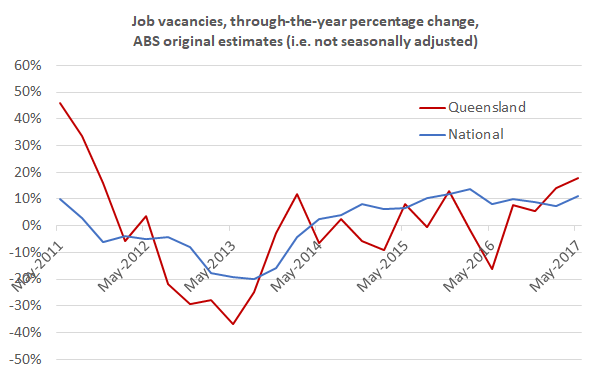
Economists and market watchers were very excited yesterday by the May job vacancies data released by the ABS. Nationally, job vacancies were 1.6 percent higher (in seasonally adjusted terms) in May than in February, the time of the previous quarterly reading, and 11.4 percent higher through-the-year (e.g. see Pete Wargent’s post). The ABS does not seasonally adjust the state-level data, but we can examine the trend using the through-the-year change, and it is very positive for Queensland, with vacancies in May 2017 being 17.8 percent higher than in May 2016 (see the chart below). This is further evidence of an improving labour market in Queensland in 2017 (see my post on the May labour force estimates from the ABS).

vacancies_May17_chart1

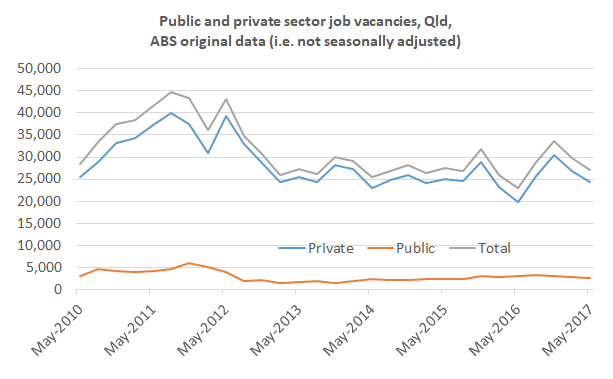
The ABS estimates that the bulk of job vacancies are in the private sector (see chart below). How can this be reconciled with the common view that the State public sector has been responsible for the bulk of new jobs in the Queensland economy? To do so, it needs to be recognised that job creation and destruction are occurring at the same time in the private sector, and some sectors can be expanding while others are contracting. In recent years, some sectors, particularly mining, have been shedding large numbers of jobs. So, on balance, job creation in the private sector has appeared weak and, at times, government jobs have appeared to be dominating employment growth in the aggregate data (e.g. see my post from last July Were 80% of new jobs in Qld public service jobs?).

vacancies_May17_chart2

Posted in Labour market, Uncategorized | Tagged , , , , | Leave a comment

Population Growth – Queensland’s recent slump (Guest post from Alistair Robson)

I am delighted to publish a guest post from my friend and fellow economist Dr Alistair Robson on the slowdown in Queensland’s population growth in recent years. GT

Population Growth – Queensland’s recent slump

By Dr Alistair Robson

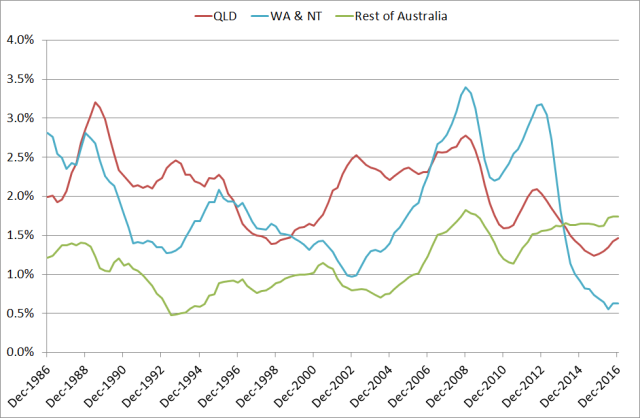
Queensland has traditionally had a relatively high population growth rate compared with the rest of Australia, with the exception of Western Australia and the Northern Territory. But recently this has not been the case. As shown in the recent Queensland Budget papers, Queensland’s population growth has been historically low recently. The Figure below shows the current population growth rate in historical perspective.

Figure 1: Population Growth by Region of Australia

AR_Chart1

Source: ABS, 3101.0

Continue reading

Posted in Population, Uncategorized | Tagged , , , , , , , , | 2 Comments

Growing interstate migration to Qld reflects improving economy & relatively more affordable house prices

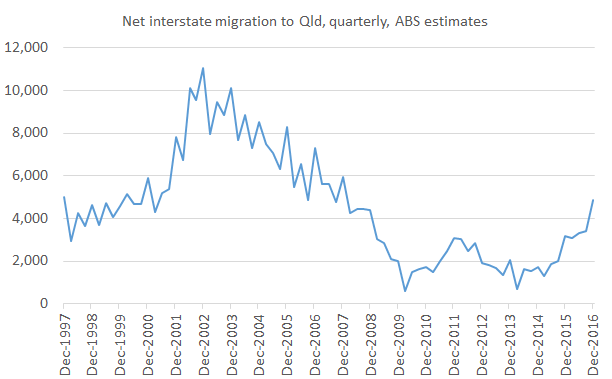
As well as releasing the first batch of 2016 Census data, the ABS also updated its quarterly population estimates yesterday, and I was very pleased to see net interstate migration to Queensland is picking up nicely (see chart below). This likely reflects both the improving economic conditions in Queensland since mid-2016 and the increased relative affordability of housing in Brisbane compared with Sydney and Melbourne.

NIM_Dec16

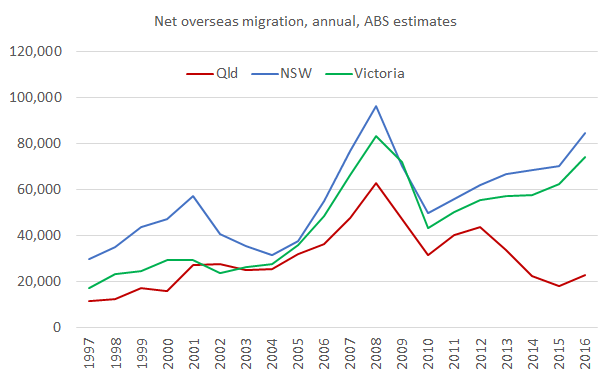
Queensland’s total population is growing at 1.5 percent per annum, just below the national average of 1.6 percent (see the Queensland Treasury brief). Queensland has fallen below the national population growth rate as we have not had the rebound in net overseas migration seen in other States (e.g. see chart below; NB I’ve presented this in annual terms because the quarterly data are highly seasonal).

NOM_16

Spare a thought for State and local officials in NSW and Victoria who are having to manage the large absolute population growth that is occurring down there. As property market guru Pete Wargent noted yesterday:

Melbourne population growth blows the blinkin’ doors off

Posted in Population, Uncategorized | Tagged , , , , , , , , | 2 Comments

CEDA report highlights AI & cloud threat to traditional accountants, with Xero and Bean Ninjas thriving

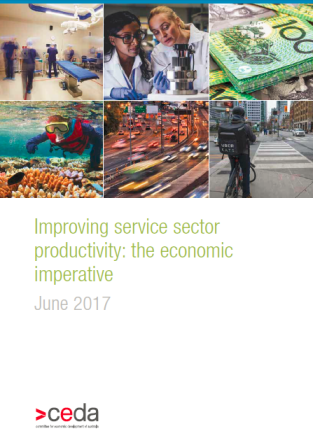
A new CEDA report I attended the Brisbane launch of at BCEC yesterday, Improving Service Sector Productivity, highlights the threat to accountants from machine learning, a type of artificial intelligence (AI), a topic that I posted on last year (see my post The future of the professions). As many accountants are already aware, AI means they will have to become insightful business advisers offering more than the usual number crunching for reporting and tax purposes. In a highly informative chapter of the report, “Productivity in accounting services”, Karen McWilliams of Chartered Accountants Australia and NZ surveys recent developments and offers some hope to accountants that they can survive the advance of machine learning.

In her article, McWilliams provides a good example of the use of AI by cloud-based NZ accounting services company Xero, quoting its founder Rod Drury:

“Because accounting is a fairly low vocabulary, tight domain, (Xero) is getting extraordinary results from basic machine learning. So much so that we think over the next few years we can get rid of coding. Small businesses won’t need to code transactions anymore.”

After analysing more than three million transactions – and correcting the data that had already been collected – Xero Founder, Rod Drury says Xero is nearly in a position to offer automatic coding.

In Drury’s brave new world, the accountant’s role becomes one of quality control and certification of the automatic accounting processes, rather than that of number cruncher.

Xero and similar cloud-based services are major threats to traditional accounting businesses. However, they do provide opportunities for businesses with new business models, such as the Gold Coast-based Bean Ninjas which provides fixed-fee bookkeeping services for businesses using Xero.

Our economies will still need accountants, but probably many fewer accountants in the future given improvements in AI. Ultimately, we should all be better off, as AI makes our economies much more productive, and new jobs will eventually be created to replace those rendered obsolete. But there is no doubt AI will cause massive disruptive changes, not welcomed by many, to accounting and other professions over the next few decades.

Other chapters I would highly recommend in the new CEDA report include the chapter on tourism productivity by my former Treasury colleague, Dr Andreas Chai, now at Griffith Business School, and a chapter on road congestion charging by Michele Huey of Transurban.

Finally, thanks to Griffith Business School for inviting me along to the report launch.

CEDA_report_cover

Posted in Tourism, Uncategorized | Tagged , , , , , , , , , , | Leave a comment

NSW winning fiscal State of Origin

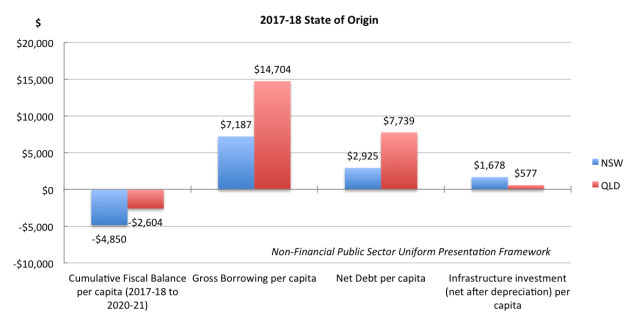
My former Treasury colleague and old friend Joe Branigan, now at Cadence Economics and SMART Infrastructure Facility, was quick to tweet a State-of-Origin themed chart yesterday following the release of the NSW State Budget (see Joe’s chart below).

Fiscal_State_of_Origin

As noted in the budget papers, NSW is running “healthy surpluses” on its operating account, with a net operating balance forecast at an average of $2 billion over the budget forward estimates. Due to its privatisation program and healthy stamp duty receipts from a booming property market (which the NSW Treasury now expects to cool), NSW has been able to fund a massive infrastructure program, with (net) infrastructure investment per capita nearly three times higher in NSW than in Queensland, according to Joe’s calculations. NSW has been able to do this while keeping per capita debt figures under control and well below Queensland’s. (Note that, as a result of its large infrastructure program, NSW’s recorded fiscal deficits will be larger than Queensland’s over the forward estimates.)

In Queensland, with a State Government that is ideologically opposed to privatisation, and an Opposition that has given in to the public aversion to asset sales and has now ruled them out, there is little prospect of Queensland matching NSW’s record on infrastructure any time soon.

Posted in Budget, Uncategorized | Tagged , , , , , , , , , , | 4 Comments

Open data workshop at the Queensland Startup Precinct in TC Beirne Building

In the 2017-18 Queensland Budget handed down last Tuesday, among a large number of measures is the “Open data policy and action plan”, to which the Government is allocating just over $1 million over two financial years (see Budget Paper 4 Budget Measures on p. 18). Arguably this is money well spent, as there are huge opportunities for businesses and community groups to make use of the vast amount of data that is hidden away in government agencies.

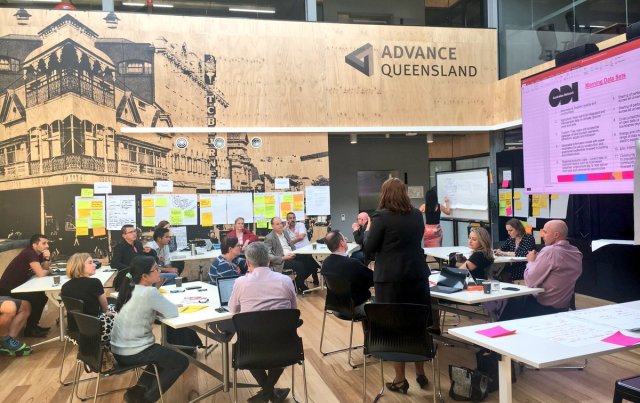
Significant progress has already been made on open data in Queensland, including by the current and previous State governments, and you may be aware that various data sets are already available on data.qld.gov.au, and that one practical application of open data has been the Brisbane Bus and Train app. But there is widespread recognition that more needs to be done, and hence the Open Data Institute, a non-profit company, held a workshop on Data to drive innovation and advance business on Friday 16 June at the Precinct in the TC Beirne Building in Fortitude Valley, Brisbane. The workshop took place in the Precinct’s so-called Stair Stadium, where you can sit on the steps of over-sized wooden stairs, similar to those in the State Library.

ODI_workshopData custodians and workshop facilitators debriefing and developing actions plans after the 16 June morning workshop with industry representatives (Image from the Office of the Queensland Chief Entrepreneur’s tweet).
The workshop was facilitated by local PR business Articulous Communications and brought together data custodians from various Queensland Government agencies and local councils and industry representatives from a range of sectors. Well supplied with the customary sharpies, sticky notes and pieces of butchers paper, we came up with lists of opportunities for greater use of government data by businesses throughout the whole economy and within specific sectors such as agriculture, construction and tourism. There were many interesting and practical suggestions made, including the suggestion by a plumber in the Wide-Bay-Burnett region that his local council create an online portal, so he can automatically access maps showing the locations of water and sewerage pipes on properties where he has upcoming jobs.

I grabbed the microphone a few times during the workshop and made the following points:

  • The more frequent publication of Queensland Government royalties and taxation data (e.g. monthly or quarterly) by the Queensland Treasury would provide opportunities for us to better “nowcast” the economy;
  • It would be desirable to drill down further than is currently allowed (by Budget papers and annual reports) into the Government’s expenses to discover exactly what it is spending on particular programs, including by expense item (e.g. travel and accommodation, consultancies, etc) and by region, for example;
  • A common view among participants was that it is unclear exactly what data the Government holds, and hence we need to improve our meta-data (i.e. information about data) and to make that meta-data widely accessible; and
  • Follow through on the opportunities and actions identified at the workshop is absolutely critical as, sadly, all too often these community or industry engagement forums end up going nowhere (e.g. the Rudd Government’s 2020 Summit).

In case you are wondering, the Queensland Startup Precinct is a flexible contemporary space designed for start-up businesses. It is designed to foster collaboration among startups, and hence has lots of common areas and a large kitchen with an industrial-scale Nespresso machine. The Precinct also houses the office of the Queensland Chief Entrepreneur, the highly successful Mark Sowerby, the founder of Blue Sky Alternative Investments. The Precinct was established by the Queensland Government last year and you can read more about it at:

Queensland Startup Precinct

Posted in Queensland Government, Uncategorized | Tagged , , , , , , , , , | Leave a comment

Qld labour market continues to improve, but part-time jobs account for bulk of employment growth

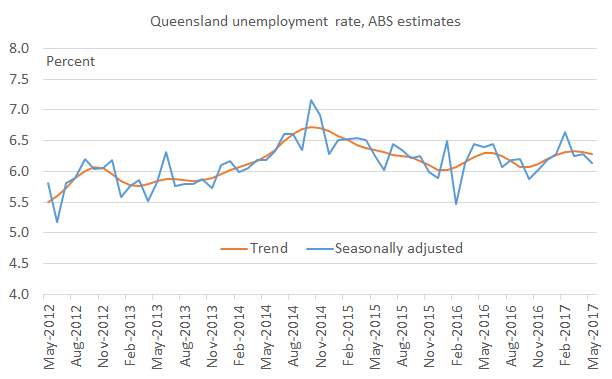
Based on the latest labour force figures released by the ABS yesterday, the Queensland labour market appears to be improving nicely, which must be very pleasing to the State Government in the lead up to the next election. While the unemployment rate (at 6.1 percent seasonally adjusted) remains higher than the national rate (5.5 percent seasonally adjusted), it is trending down (see chart below). This is despite a downswing in the construction sector. Luckily other sectors are growing, and I suspect tourism is a major contributor to jobs growth, particularly given much of the recent jobs growth has been part-time, as noted by John McCarthy in the Courier-Mail this morning. (Also see Pete Faulkner’s post Strong jobs numbers but full-time in QLD are at a standstill).

urate_May17

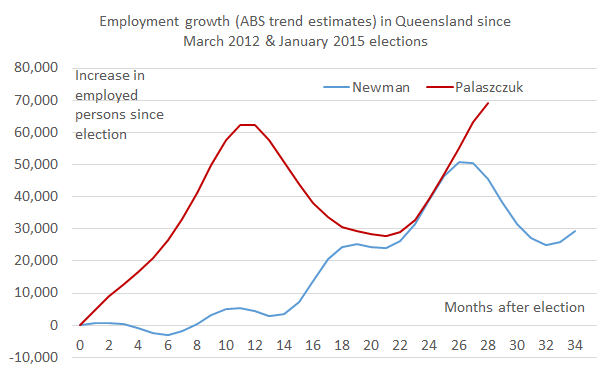
The major contribution of part-time jobs to recent employment growth can be clearly seen in my charts below tracking jobs growth since the last election. Here is the chart for total employment, showing an increase in total employment of around 69,200 since the last election:

Total_jobs_since_election_May17

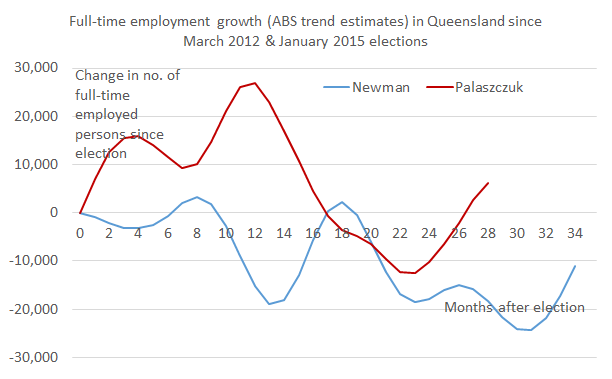
But the increase in full-time employment since the last election has been nowhere near as large, with an increase of just 6,200:

FT_jobs_since_election_May17

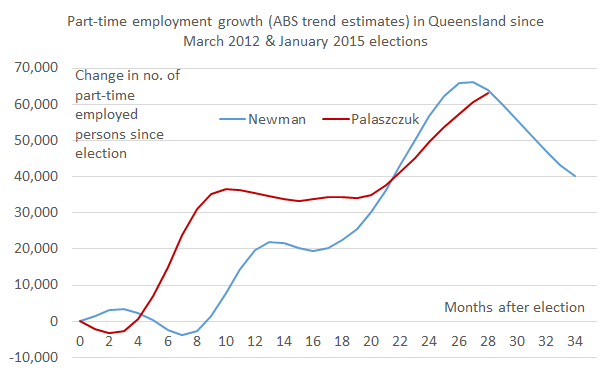
Most of the additional jobs since the last election have been part-time, with an additional 63,000 part-time employed persons:

PT_jobs_since_election_May17

Finally, I should note the Economic Society of Australia (Qld) of which I’m the Secretary has a lunchtime event next Wednesday featuring Queensland Treasury’s chief economic forecaster Greg Uptin on the State’s economic outlook:

Post-Budget briefing on economic forecasts by Queensland Treasury

Posted in Labour market, Uncategorized | Tagged , , , , , , , | 2 Comments

Huge regional disparities in Qld Government capital spending per capita

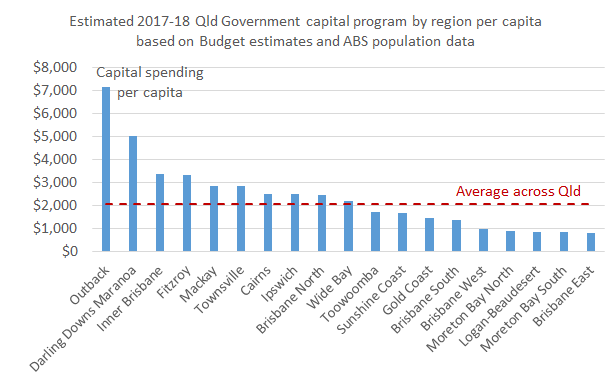
The Queensland Government’s $10.2 billion capital program in 2017-18 is heavily skewed to regional areas outside SEQ and towards inner city Brisbane, but away from other areas in SEQ (see the chart below which I’ve created based on data in Tables 3 and 4 of Budget Paper 3 and extrapolations of ABS population data).

Regional_capital_spend

It would be good for future Budget papers to include analysis of regional per capita capital spending, explaining the reasons for any disparities. For example, the Government may be funding infrastructure to complement economic development in under-populated areas such as the Queensland outback and Darling Downs-Maranoa. But the large per capita funding differences between well-funded regions, such as Fitzroy and Inner Brisbane, and relatively poorly funded regions, such as Brisbane’s eastern, southern and western suburbs and Logan-Beaudesert among others, appear excessive to me.

Posted in Budget, Uncategorized | Tagged , , , , , , , , , | 4 Comments