Qld Treasurer confirms Govt’s immense fiscal challenge with royalties write down of $3 billion

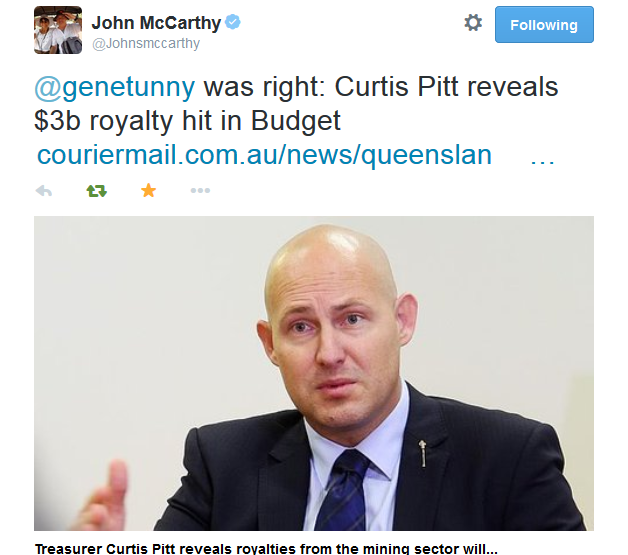
twitter_pic_royalties

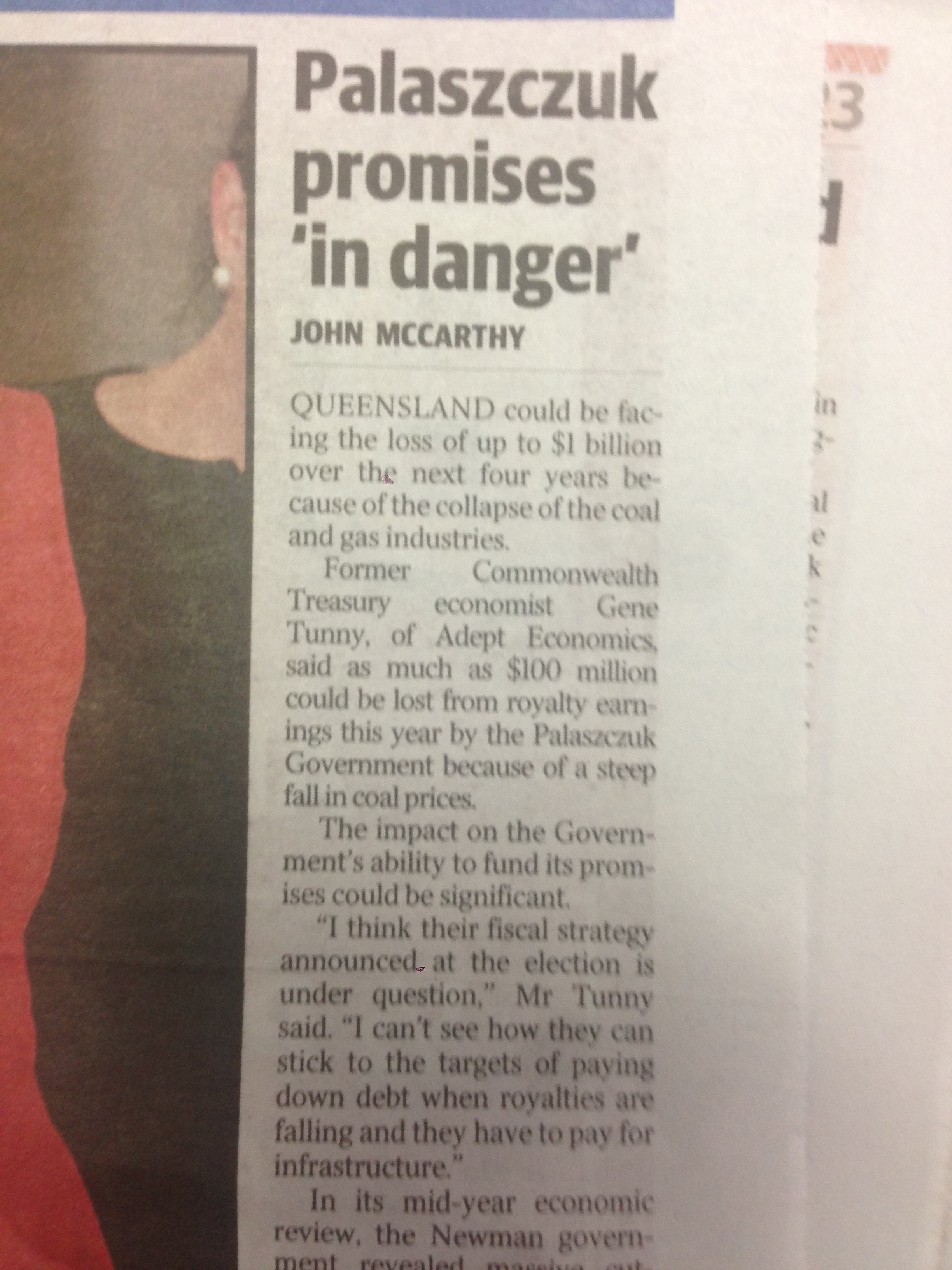
I wasn’t surprised when Treasurer Curtis Pitt today revealed there would be a write down in mining royalties of $3 billion over the Budget forward estimates (i.e. 2015-16 to 2018-19), due to both lower prices and volumes than previously forecast (see this Courier-Mail report). As John McCarthy of the Courier-Mail acknowledged in his tweet reproduced above, I had previously forecast a major royalties write down (see Courier-Mail story on Qld Govt’s fiscal challenges). As I’ve commented many times before, the Government faces a big (if not impossible) challenge in sticking to the fiscal strategy it announced at election time, which included a commitment to paying down debt without asset leases, albeit at a slower rate than the previous Government had committed to (e.g. listen to my ABC radio interview on the first day of the new Parliament).

Posted in Budget, Mining | Tagged , , , , , | Leave a comment

Everybody’s talking about tax

With the Commonwealth Government currently undertaking a major tax review, it is timely that there are two events on tax reform being held in Brisbane next month, both supported by the Economic Society of Australia (QLD), of which I’m the Secretary. The events are:

  • Tax policy panel discussion at the Australian Conference of Economists (details here) on the afternoon of Wednesday 8 July, featuring leading Australian economist John Freebairn as chairperson, and including Paul Abbey from PwC, my old boss Graeme Davis from Commonwealth Treasury, Alex Robson from Griffith and Miranda Stewart from ANU as panelists, and
  • a panel discussion on tax reform on Wednesday 22 July with Judith Sloan from the Australian and Alex Robson from Griffith.

I have no doubt the discussions will be wide-ranging, interesting and entertaining. Obvious issues include the very topical negative gearing (and the concessional tax treatment of capital gains), superannuation tax concessions, and the GST.

Judith-SloanJudith Sloan, among many others, will be talking about tax reform in Brisbane in July

Posted in Tax | Tagged , , , , , , , | Leave a comment

Pockets of very high unemployment in Logan, Brisbane South West and Ipswich

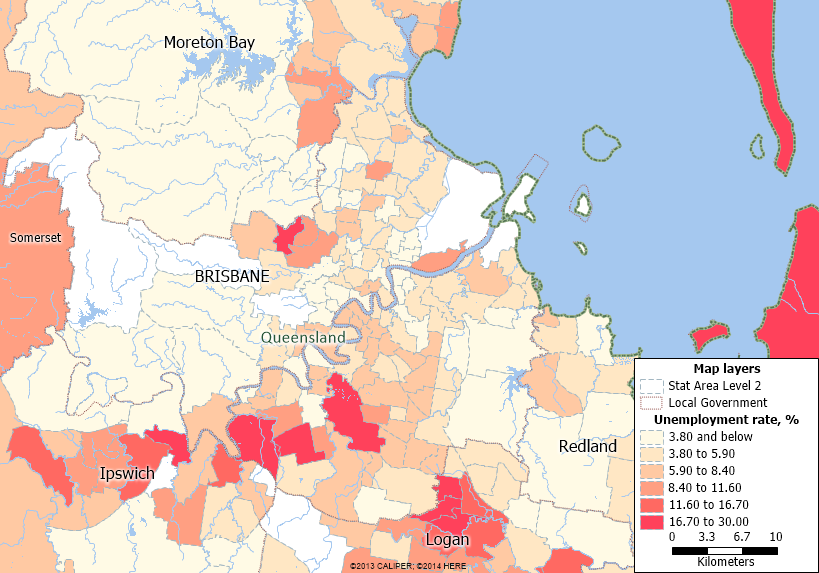
I’ve produced the map of unemployment rates for local areas in the Brisbane metro area below based on the latest small area labour markets data for March 2015 from the federal Department of Employment. The data show that pockets of very high unemployment continue to exist in Logan, Brisbane’s South West and Ipswich (e.g. unemployment rates of nearly 25% in Logan Central, over 21% in Wacol, and over 18% in Riverview in Ipswich). Unemployment has fallen from even higher rates in the middle of last year in Brisbane’s South West and Ipswich, but unemployment in Logan has continued to increase. I suspect there is a combination of factors behind Logan’s very high unemployment, including its distance from areas with better employment opportunities, which may be difficult to access via public transport from Logan, and a relatively disadvantaged population with low education and literacy levels.

SALM_Mar15

Pete Faulkner has posted on the small area labour markets data for North and Far North Queensland:

Small Area Labour Market data supports improving jobs story in Q1 for Far North

Posted in Labour market | Tagged , , , , , , | Leave a comment

Impact Academy fostering local social enterprises – out to prove Milton Friedman wrong

Normally associated with such pursuits as kayaking, paddle boarding and rock climbing,  Riverlife at Kangaroo Point was the location for a showcase event for Peter Ball’s Impact Academy, an incubator for emerging social enterprises, on Thursday evening. The basic idea of a social enterprise is that it does good and makes money at the same time; it appeals to both the noble and base motives of investors. Also, ideally, it should be scalable. Recent examples include Buffed and Suit of Change. A social enterprise is not necessarily a non-profit. Indeed, some of the businesses pitching for funding at the Riverlife event look like they could make their investors substantial amounts of money if they are successful. For example, I was particularly impressed by the business models presented by:

  • ThankBank, which is hoping to inspire so-called slacktivists into action (see Startup ThankBank wants to incentivise people to donate blood),
  • Drag Drop Give, which helps businesses advertise to those people who truly might be interested in their products, rather than annoying the bulk of internet users, and
  • Getabout, which supplies wheelchair-accessible motor trikes; top marks to Getabout for bringing along a demonstration model to the showcase (photo below).

trikeTime will tell whether the worldwide euphoria over social enterprise and impact investing is justifiable. I recall Milton Friedman’s skepticism about corporate social responsibility, and his intensely logical argument that the only social responsibility of business is to maximise profits (see my post Milton Friedman was right, but that doesn’t excuse a lack of ethics). Ultimately a business has to make money to be sustainable and provide profit and jobs, and I expect many social enterprises will face difficult tradeoffs between making money and doing good.

That said, social and environmental objectives are important to many consumers and investors, and they appear willing to reward those companies that pursue them, even if that means consumers have to pay slightly higher prices or investors have to accept slightly lower returns. For this reason, social enterprises are likely here to stay, and I wish the Impact Academy every success in fostering successful social enterprises into the future.

For those interested in learning more about impact investing, I recommend this book:

The Impact Investor

Disclaimer: It goes without saying that this does not constitute investment advice…

Posted in Brisbane | Tagged , , , , | Leave a comment

Cafe culture & tourism helping Qld endure end of mining boom

empl_ind_May15

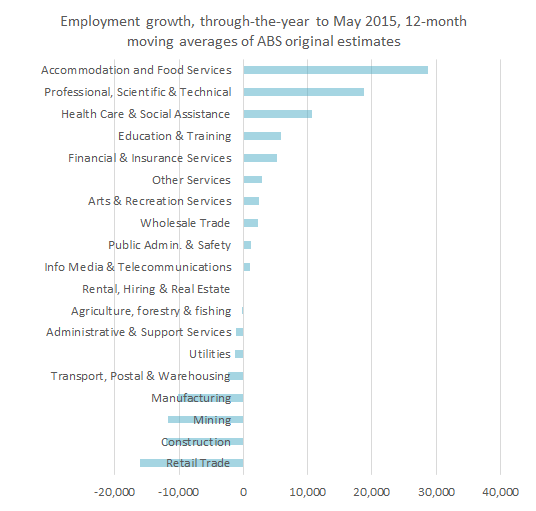
May 2015 employment-by-industry data published by the ABS yesterday confirm some points I’ve been making for the last couple of months (see chart above), particularly that Queensland is enduring the shock from the end of the mining boom relatively well, and that the boom in cafes and the recovery in tourism, due to a lower exchange rate, are making important contributions in that regard. Earlier relevant posts of mine include:

Qld bouncing back nicely after technical recession in 2014

Qld economy enduring shock from end of mining boom as well as could be expected

Also see John McCarthy’s nice writeup of yesterday’s data in the Courier-Mail:

Tourism sector picks up jobs lost in Queensland mining industry

One obvious point is that, largely, it is probably not people who’ve lost jobs in mining who are picking up jobs in tourism and in cafes. Also, the new hospitality jobs would typically be lower paid than the lost mining jobs.

Posted in Labour market, Mining | Tagged , , , , , , , , | Leave a comment

Great initiative from Qld Treasury to explain forecasts in Economic Society seminar

As Secretary of the Queensland branch of the Economic Society of Australia, I’m very pleased that, on Wednesday 15 July, the day after the Treasurer delivers the State Budget, a senior Queensland Treasury official, Greg Uptin, will give a briefing on the Budget’s economic forecasts at a lunchtime ESA (QLD) seminar in Brisbane CBD:

Post-Budget briefing on economic forecasts by Queensland Treasury

With the Queensland economy going through a large transition at the end of the mining boom, it will be fantastic to get some insight into the Treasury view on the economic outlook. At the time of the mid-year Budget update in December, the Treasury was forecasting economic growth of 2.5 per cent in 2014-15 and 5.75 per cent in 2015-16. It is likely these numbers will be revised downward, possibly by a lot.

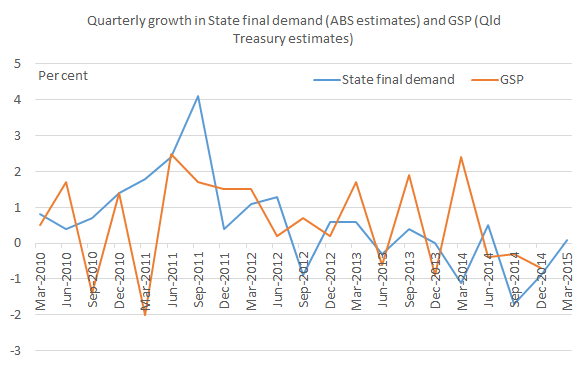
Regarding 2014-15, the Queensland State Accounts show a fall in gross state product (GSP) of around 1 per cent for the first two quarters, and growth would need to be super strong in the first half of 2015 to make up for that fall. That said, state final demand (which does not include net exports) was slightly positive in March quarter according to the ABS National Accounts, and there are good signs our exports are picking up nicely (see chart below and Qld economy enduring shock from the end of the mining boom as well as could be expected).

economicgrowth_Mar15

Regarding 2015-16, and its current high growth rate forecast, much will depend on whether the momentum of recovery is sustained and whether the LNG projects in Gladstone aren’t subject to further delays in production and export. Treasury will also need to consider the impact of the much lower oil price, which influences the LNG price through a formula based on the Japanese Crude Cocktail.

All these issues and more I hope Greg will cover in his presentation. Following his presentation, a panel of economists, including Morgans’ Chief Economist Michael Knox and me, will provide some commentary on the forecasts. And then it is the audience’s turn to offer views and ask questions. If you’re based in Brisbane, or in town for the day, I hope you can make the seminar.

Posted in Macroeconomy | Tagged , , , , , , , | 1 Comment

Stamp duty has to go – time to consider greater reliance on land tax & GST

stampdutyrevenue

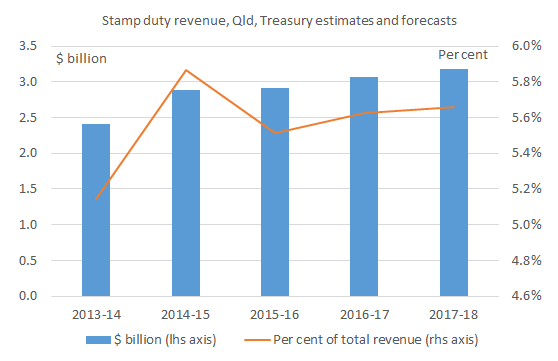
It is lamentable that our State Governments are so reliant on a source of revenue, stamp duty, that is very costly to the economy and has no defenders outside of State Treasuries who would greatly miss the money if it were gone (see figure above). Stamp duty is almost universally regarded as a very bad tax that:

As I’ve commented many times before, stamp duty involves very large efficiency losses, and it should be eliminated, and greater reliance should be placed on land tax and GST, which are less inefficient (see my post Inefficient State taxes).

Posted in Housing, Tax | Tagged , , , , , , , , | 6 Comments

Courier-Mail story on Qld Govt’s fiscal challenges

CMarticleI was quoted by John McCarthy in an article in today’s Courier-Mail (see image above) regarding the Queensland Government’s fiscal challenges. I’ve previously commented on the big challenge the Government has of sticking to its fiscal strategy announced at the election (see ABC radio interview on the fiscal challenges facing the new Qld Government), and my comments to the Courier-Mail are consistent with previous statements. The Courier-Mail reports:

“I think their fiscal strategy announced at the election is under question,” Mr Tunny said. “I can’t see how they can stick to the targets of paying down debt when royalties are falling and they have to pay for infrastructure.”

What I should have added is that I expect the Queensland Treasury will find creative ways to avoid the appearance of breaching the Government’s stated fiscal strategy. For example, the Government has been clear that the debt figure it will focus on is general government debt, currently estimated at $46 billion, rather than the total government debt of around $80 billion that the previous Government was focussed on. Broadly speaking, general government debt includes the debt attributable to government departments such as health, education, etc, and does not include the debt of government-owned businesses (e.g. Energex, Seqwater, Queensland Rail).

Boldly, the Government could claim to be reducing general government debt (its preferred metric) gradually over time, while blowing out total government debt, by borrowing for new infrastructure projects outside of the general government sector. For instance, the Government could direct some of its existing Government-owned businesses to borrow for new projects, or it could create new Government-owned businesses to borrow money to deliver new projects, and it could do so without increasing debt in the general government sector. The challenge is that it would have to prove that any new Government-owned business would be aiming to earn a commercial rate of return – otherwise it should strictly be in the general government sector. To do so, you would expect it would need to levy user charges (e.g. tolls).

Also, I wouldn’t rule out equity injections into a new Government-owned entity from Government-owned financial bodies such as QIC, for example. Or new, interesting variants of the public-private partnership (PPP) infrastructure model which has earned such a poor reputation with private investors due to multiple failures of the model in recent years.

Finally, I would note that I have great faith in the ability of our Treasury officials to find creative ways of funding new infrastructure off-Budget. Reading the 2015-16 State Budget is sure to be a lot of fun!

Posted in Budget, Infrastructure, Queensland Government | Tagged , , , , , , , , , , | 1 Comment

Nice words from Chris Joye in the AFR regarding my question to the RBA Governor

Leading financial economist Chris Joye has written a great piece in the Australian Financial Review on the issue of how long interest rates may stay at the very low levels they are now (RBA’s Glenn Stevens wrong on low rates for long). I’m very pleased he quotes the question I asked Governor Glenn Stevens at his lunchtime address at the Brisbane Hilton on Wednesday. I, the “canny interlocutor” referred to in the AFR, was questioning the Governor’s view that rates could remain low for a long time. From the AFR:

A canny interlocutor questioned Stevens’ rubbery logic. Over the years the governor has, after all, laboured the message that nobody can forecast the future. Cue our sharp audience member: “Governor, on that question of the return to more normal interest rates, which is obviously important, you say it won’t happen any time soon. But given your views on the accuracy of forecasts, would you agree this is not something you can really forecast and, when it does happen, it will happen abruptly?”

Stevens conceded: “I certainly agree with the premise that you can’t forecast very well”. “What will we be doing in a year, I don’t know,” he admitted. So maybe it is prudent to ponder the possibility of a steep path back to “normal” borrowing costs, wherever they lie.

Posted in Macroeconomy | Tagged , , , , , | Leave a comment

Qld bouncing back nicely after technical recession in 2014

employment_May15

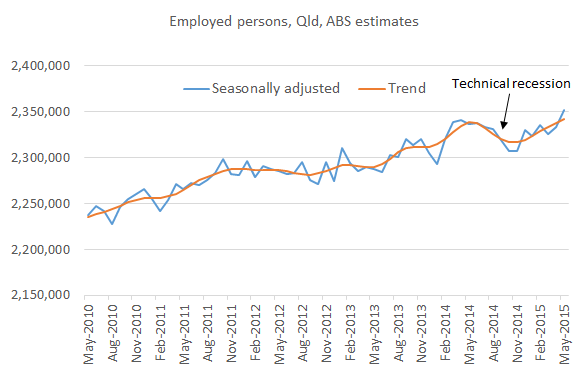
The ABS labour force data for May give me much greater confidence that Queensland is bouncing back nicely from the technical recession we experienced over much of 2014 due to the end of the mining boom (see chart above). Queensland’s seasonally adjusted unemployment rate fell from 6.6 per cent to 6.3 per cent in May. The data, which were positive at the national level, too (with unemployment falling from 6.1 per cent to 6.0 per cent seasonally adjusted), also suggest the RBA Governor was wrong to call for greater levels of public infrastructure investment to offset the impacts of the end of the mining boom. Infrastructure investment should not be used as a macro-stabilisation tool, but instead projects should be approved and funded based on their merits, after comprehensive cost-benefit analyses.

Also, see Pete Faulkner’s post, which offers a slightly less optimistic assessment than mine:

Very strong jobs numbers, but focus on revisions and the Trend and it’s less exciting

I recognise Pete’s point about the volatility of the seasonally adjusted data, but I’m also conscious of the backward looking nature of the trend estimates.

Posted in Labour market | Tagged , , , , , | 2 Comments