Is it nonsense to talk about a “GDP per capita recession”?

My colleague Nick Behrens from QEAS is critical of recent references to Australia’s “GDP per capita recession” by the media and the federal Opposition in his latest post A GDP per capita recession is nonsense. Recall that the December quarter 2018 National Accounts data released by the ABS last week revealed that Australia has now recorded two consecutive quarters of declining GDP per capita (-0.1% in Sep-18 and -0.2% in Dec-18, as shown in the chart below).

gdp_pc

I agree with Nick to some extent. We should be careful calling a “recession” based on the GDP per capita numbers, as the economy may still pull out of this recent slowdown, but I do think it is useful to consider the GDP per capita numbers nonetheless. If an economy is not growing faster than the population, then it’s likely it’s not performing well.

Australian Treasury economists Robert Ewing and John Hawkins acknowledged the value of GDP per capita data in their outstanding 2006 Conference of Economists paper Business Cycles in Australia. Ewing and Hawkins recognised that GDP per capita is more relevant to individuals than GDP on p. 26:

We use GDP per capita partly as it is more related to welfare than is aggregate GDP.

Due to our high rate of immigration, Australia has a relatively high population growth rate for an advanced economy. This is good for Australia’s GDP growth rate, a point Nick Behrens makes in his interesting post, but it’s not necessarily good for Australians, in my view. We need to consider the pressures that high population growth places on infrastructure, for example. Too high population growth could lead to greater congestion, a fall in productivity growth, and lower GDP per capita growth than otherwise. Population growth is not necessarily a good thing just because it boosts GDP.

We shouldn’t fool ourselves into thinking our economy is performing better than it is by ignoring the contribution of population growth to GDP growth. And now, when GDP growth is falling below population growth, we should recognise the economy is not performing well at all.
Posted in Macroeconomy, Uncategorized | Tagged , , , , , , , , | 2 Comments

Grattan 2019 Budget panel discussion I’m participating in at Qld State Library

I’m really pleased to have been invited to be one of the panelists in the Grattan Institute’s upcoming panel discussion on the 2019 federal budget on the evening of Tuesday 9 April, one week after the budget, at the Queensland State Library in South Brisbane. The other panelists are Danielle Wood, a program director at the Grattan Institute, and Sarah Amos, a Director in PwC’s Brisbane office. Here is the blurb:

Set to take place a week after the federal budget (and on the cusp of a federal election), this State of Affairs event will ask what does it all mean? Will the budget finally get to surplus and does it matter? What will be the longer-term economic implications for Queensland and the nation? And what impact might it have on the imminent federal election? Join our panel of experts to hear their analysis and insights.

You can register via the Grattan website:

2019 Federal Budget: unpacking the economics and politics for Queensland and Australia

I hope to see a few of my Brisbane-based readers there.

perspectives-treasury-building-post-486x324

Posted in Budget, Uncategorized | Tagged , , , , , , , , | Leave a comment

My question to Chris Bowen on Treasury

Former Westpac CEO David Morgan’s interview with the Financial Review, in which he laments political interference with the Treasury, reminded me that I asked Shadow Treasurer Chris Bowen a question at his McKell Institute speech on Wednesday regarding how he would deal with the Treasury. In his speech, Bowen had said he was concerned about the independence of Treasury under the current government. At this point, I should note the real issue is whether Treasury is non-partisan. It is certainly not independent of the government, as it has to work for the government of the day.

I asked Chris Bowen whether his concerns about Treasury relate solely to the appointment of Phil Gaetjens, Peter Costello’s former chief of staff, as Treasury Secretary? He said it was more than that, and he was concerned about all the Treasury analysis of Labor’s policies appearing in the media (this Guardian article may be an example of this), and he said Labor never did that while in government. Bowen’s claim may well be correct. I recall from the year and a half I was in the Treasury during the Rudd government that the Treasury was flat out working on the Rudd government’s massive agenda rather than analysing Opposition policies, but I’m sure we would have analysed them if the government requested such analysis. After all, Treasury works for the government of the day. So I’m unsure Bowen has a legitimate complaint here. I’m also unsure why the Opposition is so opposed to Phil Gaetjens, who always struck me as extremely professional. Possibly it’s because he was too good at his job while Costello’s chief of staff.

In his response to my question, the Shadow Treasurer said he would visit the Treasury on his first working day in the job and tell the Treasury staff he will respect them and he wants them to be frank and fearless. I suspect that prior to that he would probably ring up Phil Gaetjens and tell him his services were no longer required.

So who will be the new Treasury Secretary in a Shorten government? In my view, the likely short list includes my old boss and current Treasury Deputy Secretary Maryanne Mrakovcic, former Queensland Treasurer Andrew Fraser, who acts as Bowen’s debating practise partner, former Rudd economic adviser Andrew Charlton, and IMF economist and former Swan adviser Amanda Sayegh.

GT@Deloitte

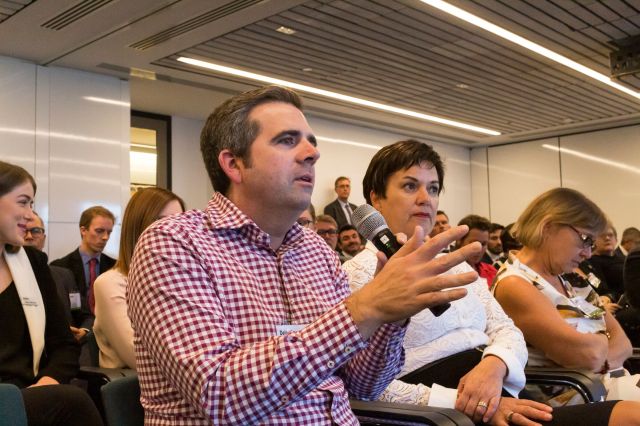
Asking Chris Bowen my question regarding Treasury at the McKell Institute function at Deloitte, Brisbane, Wednesday 6 March 2019

Posted in Uncategorized | Tagged , , , , | 6 Comments

Qld economy was goosed up by gov’t spending in final quarter of 2018

Australia’s weak 0.2% GDP growth in December quarter has prompted talk of a “per capita recession”, as our economy has now been growing at a slower rate than the population for two consecutive quarters (see this SMH report). The national economy is slowing, as housing construction falls, now the apartment building boom has ended, and as household consumption is no longer being supported by capital gains associated with once rising house prices.

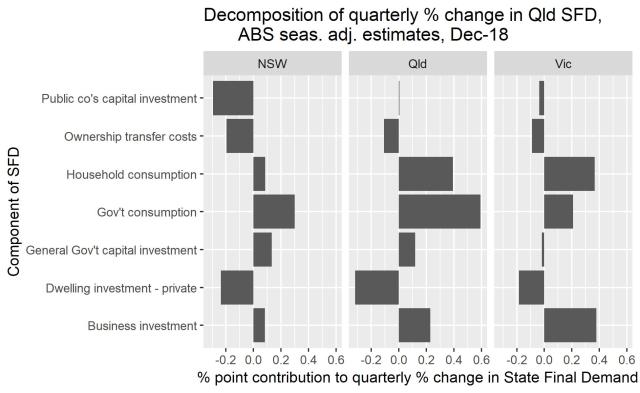
Oddly, Queensland recorded a respectable growth in state final demand of 0.9% in December quarter, compared with 0.6% in Victoria and -0.1% in NSW (see the ABS summary). The ABS data reveal there was a very large increase in government consumption expenditure in Queensland in December quarter of 3% (an annualised rate of 12.6%). This contributed around 0.6 percentage points to the 0.9% growth in Queensland’s state final demand in December quarter (see chart below).

contr_dec19

The $520 million government consumption spending increase in Queensland in December quarter was made up of an increase of $201 million from the Commonwealth and $319 million from the state and local government sector. I expect it’s largely related to Commonwealth NDIS spending and the state government’s ever-growing public service workforce.

Posted in Macroeconomy, Uncategorized | Tagged , , , , , , , , , | 6 Comments

How you can automate ABS data analysis and charting using R – preview of my upcoming course

In my latest video, I demonstrate how I use the freeware programming language R to automate my analysis and charting of economic data, using the December quarter business indicators data published by the ABS yesterday as an example.

I am running an intensive training day in how to use R to analyse and visualise ABS economic data in Brisbane on Friday 12 April:

Data science with R: Introduction with a focus on ABS economic data

If you regularly analyse and chart ABS data, I would recommend attending my training day and learning how you can save huge amounts of time in your data analysis and charting.

Posted in Macroeconomy, Uncategorized | Tagged , , , , , , , | Leave a comment

Qld construction industry outlook for 2019 discouraging despite #BNE2025 projects

My colleague Nick Behrens from QEAS has published an informative post on the major projects, such as Cross River Rail and Brisbane Live, which will boost construction activity in Brisbane in future years:

The BNE 2025 projects represent a renaissance opportunity for Brisbane

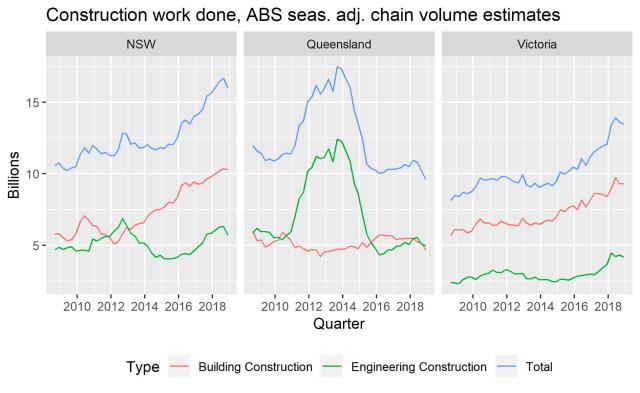
Of course, not all of these projects are “shovel ready”, as they say, and won’t help us much in 2019. As I’ve noted in earlier posts, the short-term outlook is discouraging as the ABS’s December quarter 2018 construction work done estimates published last week confirmed (e.g. see chart below). We now appear to be in the downswing part of the cycle.

cwd2

In its Building Industry Outlook 2019 published earlier this year, Master Builders Queensland wrote:

Looking ahead, 2019 will be a challenging year as the total amount of work falls still further. The tightening access to finance is going to affect all parts of our industry…The effects of the government’s new restrictive building industry legislation is also likely to affect the viability of new construction, causing further concern…

…Master Builders forecasts 40,000 dwelling commencements in 2019. This will be a 3 per cent drop on the anticipated total of 42,000 dwellings for 2018 and a further moderation of the record highs of the past few years. In the long-term there will be modest recovery, possibly beginning as early as 2020, but more likely 2021…

…2019 will see a fall in the demand for non-residential construction work as a number of key sources of demand move past their peak.

Regarding civil construction, QMCA’s 2019 Major Projects Pipeline Report should get a lot of media when its released on Wednesday 13 March, as it will most likely report on a discouraging short-term outlook for major projects (i.e. projects larger than $50 million which generally include large civil/engineering construction components such as major earthworks, road, rail, bridge or tunnel construction.

For more on the outlook for construction, see my posts:

Qld: hot or not?

Housing industry round table with Treasurer Frydenberg

Finally, the chart above was produced using Hadley Wickham’s amazing R package ggplot2. If you’d like to learn R and how to crunch and visualise data, you may be interested in this one-day-intensive training day I’m running on 12 April:

Data Science with R: Introduction with a focus on ABS data

Posted in Housing, Macroeconomy, Uncategorized | Tagged , , , , , , , , , , , | Leave a comment

Qld mining CAPEX up 13% or by over $1 billion in 2018

CAPEX_private_Dec18

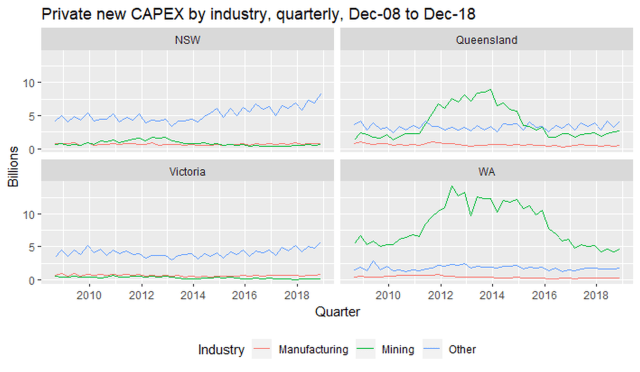
The December quarter capital expenditure data published by the ABS today have beaten expectations (e.g. see Business investment rebounds in otherwise cooling economy), which means the GDP figures which will be released next week will very likely be better than expected. In Queensland, mining capital investment has been growing strongly, with $9.55 billion of private capital expenditure in the industry in 2018 compared with $8.46 billion in 2017. Nonetheless, I’m still concerned about the economic outlook given recent data we’ve seen on building approvals and business sentiment (e.g. see Qld: Hot or not?).

If you’re interested in learning how to create facet plots like the one in this post, please consider enrolling in my one-day intensive workshop on 12 April in Brisbane:

Data Science with R: Introduction with a focus on ABS data

Posted in Macroeconomy, Mining, Uncategorized | Tagged , , , , , , , | Leave a comment

Trad right on thermal coal – Qld should prepare for possible future decline of industry

Queensland Deputy Premier and Treasurer Jackie Trad is quoted in the Courier-Mail today on the future of thermal coal in Queensland:

QUEENSLANDERS working in thermal-coal mines should start reskilling now to prepare for the decline of the industry, according to Treasurer Jackie Trad…

…“The fact of the matter is, economics is moving away from thermal coal, communities are moving away from thermal coal, nation states are moving away from thermal coal,” she said. “What we need to do as a coal exporter is understand that and equip our communities with the best possible chance of reskilling, and that’s why we’re focused on other materials.”

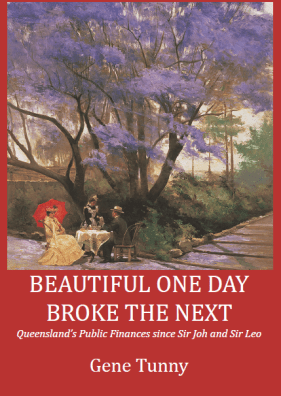
This sounds pretty sensible to me and consistent with recent developments globally which I discussed in my most recent QEW Week That Was video. While I have been critical of the state government for its flip-flopping approach to the Adani Carmichael mine (e.g. from p. 212 of my book Beautiful One Day, Broke the Next), this latest statement from the Treasurer is economically sound.

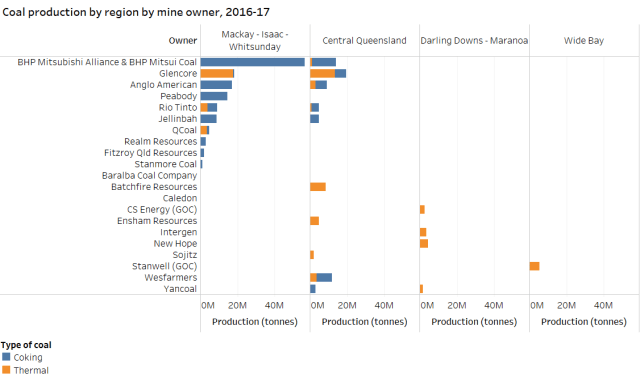
I’ve previously posted on this issue (Coal, climate change, solar & batteries – why Qld Treasury wanted to offload the state’s energy assets), and have noted that the Mackay and Central Queensland regions are especially vulnerable to any changes in global sentiment and demand for coal (see chart below).

Coal production x owner x region

Posted in Mining, Uncategorized | Tagged , , , , , , , , , , , , | 8 Comments

QEW week that was video – coal, negative gearing & the economic outlook

Posts from me and other commentators mentioned or alluded to in this video include:

Housing industry round table with Treasurer Frydenberg at Parliament House

Latest Qld wages growth and Qld labour market summary from Nick Behrens

WTF happened to BNE-CNS? from the Cairns Economy blog

And I’d encourage you to watch 7.30’s excellent report on the Opposition’s franking credits policy from Monday 18 February while it’s still available on ABC iview. Watch out especially for Chris Richardson’s entertaining and thought provoking commentary.

Posted in Cairns, China, Climate change, Housing, Uncategorized | Tagged , , , , , , , , , , , , , , | 1 Comment

Ten years since Queensland lost its AAA credit rating

Ten years ago, on 20 February 2009, then Queensland Treasurer Andrew Fraser released the Economic and Fiscal Update which forecast lower revenues, large deficits and burgeoning debt. S&P promptly downgraded the state of Queensland from a AAA credit rating to AA+ (see this Brisbane Times report). Ten years later, while we have an ever increasing state debt, on a trajectory to around $83 billion by 2021-22, there is little hope of regaining a AAA rating any time soon.

In my book published at the end of last year, Beautiful One Day, Broke the Next, I tell the story of Queensland’s public finances since the late 1980s, and the loss of the AAA credit rating is an important part of that story. I should note that, since the book was published, I have received many comments from readers regarding people or topics I now wish I had covered in the book.

For example, I wish I would have mentioned some of the outstanding Queensland public servants in the post-war era outside of the Treasury who were Sir Leo Hielscher’s contemporaries, such as Sir Sydney Schubert, who served as the state’s Coordinator-General during the 1970s and 1980s, those critical decades in Queensland’s economic development.*

cover

Also, if I were writing the book again, I would have a closer look at the Bligh government’s massive $15 billion privatisation program in 2009-10, after it finally realised the need to correct its fiscal course. What has been referred to as a fire sale of state assets may have resulted in some of the assets being sold or leased out for much less than their fair values, costing Queensland taxpayers millions. The 99-year lease of Queensland’s forest plantations has been identified by a former forestry official as a bad deal for the Queensland taxpayer. In 2010, the Gympie Times reported:

QUEENSLAND taxpayers have been dudded with the sale of major forestry assets, including in the Gympie Region.

That is the view of ex-Gympie resident, private forestry advocate and environmental academic, Gary Bacon…

…He said the government in May announced the sale of a 99-year lease on Forestry Plantations Queensland freehold property to the North American based Hancock Timber Resource Group.

While the land will remain in government hands, the right to grow and harvest trees on it is worth an estimated $1370 million, according to Prof Bacon.

The sale price to Hancock was $603 million, he said.

This could be a very interesting case study with major lessons for what makes a successful or unsuccessful privatisation program, and I would certainly cover it if I get the chance to produce a revised edition. So I’d encourage any reader who hasn’t purchased my book yet to buy a copy, so the publisher can sell out of this print run and we can print a revised edition.

*Please note that in my book I do acknowledge the high level of corruption that Queensland was notorious for in the post-war years up until the Fitzgerald Inquiry reforms. 

Posted in Budget, Uncategorized | Tagged , , , , , , , , , , | Leave a comment