Qld has three of top five regional areas with most expensive residential lots

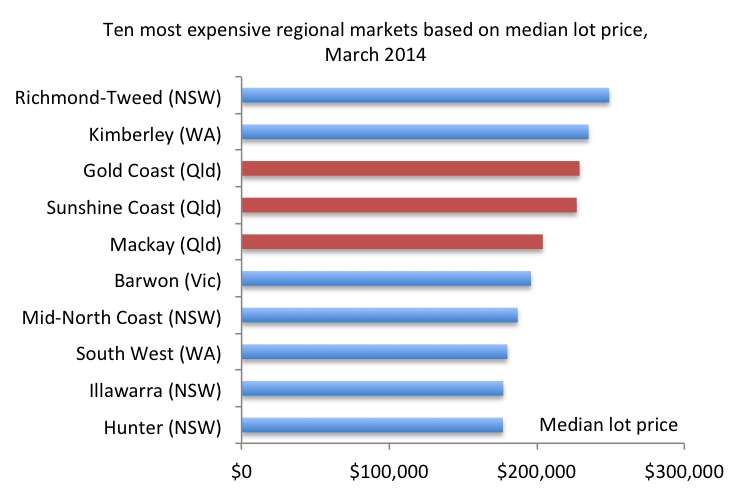
The Housing Industry Association released a very interesting note today on median lot prices in capital cities and regional Australia (i.e. non-Capital City Australia): Land price pressures signal policy failure. The data should prompt a number of Queensland Councils to review their planning policies, to see if they are unnecessarily constraining development. Given how important housing construction will be to the strength of the Queensland economy in coming years, it’s somewhat concerning to see three Queensland regions represented in the top five regional markets for most expensive residential lots (see chart below). Of course, these are all attractive regions to live in, but three Queensland regions in the top five seems excessive.

medianlotprice

Posted in Gold Coast, Housing, Mackay | Tagged , , , , , , , , , | 2 Comments

Reality check for Townsville – no metropolis of 1 million before end of century

Judging by recent articles in the Townsville Bulletin, Townsville appears obsessed with the idea it will grow to 1 million people from its current population of just under 200,000. The Townsville Bulletin reported yesterday (Townsville tipped to hit 1 million people):

WHAT would Townsville look like if there were a million people living in the city?

That’s what Townsville Enterprise hopes to find out through a concept design competition it is running to find the best ideas for ensuring the city retains its great lifestyle as it grows.

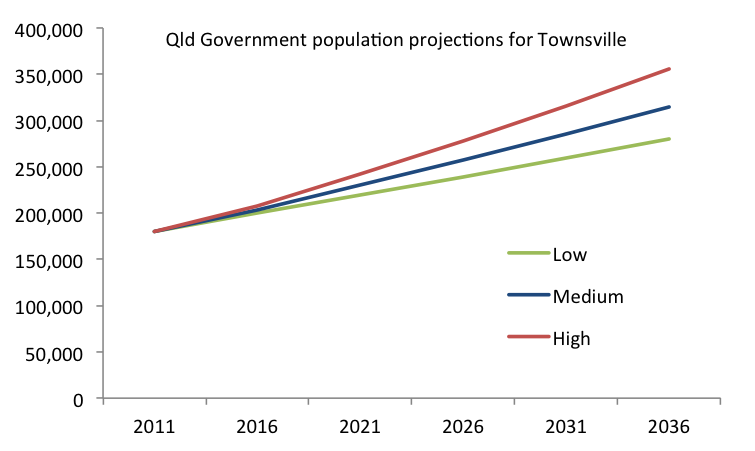
Townsville Enterprise deserves some credit for being so forward-looking and visionary, especially given current Queensland Government population projections only have Townsville growing to around 300,000-350,000 people over the next couple of decades (see the chart below with projections for low, medium and high population growth scenarios). If you (crudely) extrapolate from these projections, Townsville wouldn’t reach 1 million people until around 2081 at the earliest and most likely not until around 2101.

So Townsville Enterprise is being very visionary indeed. As well as thinking about the very long-term, I hope Townsville Enterprise is also focussing on the pressing need to promote business development in a city that is over-reliant on Government and defence jobs.

Townsville

Posted in Townsville | Tagged , , , | 4 Comments

Wise words from the PC on capital/asset recycling

I’ve been a strong supporter of the Queensland Government’s privatisation agenda, but have been unimpressed by the Strong Choices campaign promoting the agenda, which is uninformative and based on questionable logic. In its just-released Public Infrastructure Inquiry Report, the Productivity Commission nicely explains the logical problems with the capital/asset recycling argument that partly underpins the Strong Choices campaign (p. 262):

Capital recycling involves the linking of two separate decisions; the decision to privatise state-owned assets, and the decision to invest in a new infrastructure project or set of projects. While the linking of the two decisions may be a useful mechanism to alleviate community resistance to privatisation, this should not replace the need to undertake these sets of analyses separately. Ideally, both sets of decisions would be made within a transparent decision-making environment, where a robust cost–benefit analysis is undertaken…

The main risk from the capital recycling model is the potential for it to distort either of these decisions. In particular, an arrangement where the proceeds of sale are automatically hypothecated to investment in new infrastructure projects may create risks for over-investment in new greenfields infrastructure…

…A further potential risk with capital recycling is that the availability of funds from privatisation may mute the incentives for state governments to properly consider the extent to which user charges can be used to ‘fund’ the new infrastructure…

…A final problem with capital recycling is that it might cement in the public a view that the only time an asset should be privatised is if there is some new infrastructure project in which to invest — that is, that privatisation is not of benefit in and of itself.

This is what I’ve been saying all along. Privatisation is potentially good because it improves the efficiency of privatised businesses and the productivity of the economy overall. Budgetary impacts should be considered, but are not necessarily of primary importance.

I’ll say more on these issues at an upcoming panel discussion in Brisbane at Griffith’s Southbank campus Wednesday night next week:

Productivity and privatisation – panel discussion

Posted in Budget, Queensland Government | Tagged , , , , , , , | Leave a comment

Carbon tax repeal good news for Qld economy

I’m very pleased the Senate will allow the repeal of the carbon tax (Carbon tax to be abolished on third attempt), given that:

  • Queensland would have been disproportionately affected due to our heavy reliance on coal-fired power generation; and
  • it never made any sense for Australia to undertake signficant, unilateral greenhouse gas mitigation (i.e. in the absence of any action from the major economies of the US, China, Japan and the EU). It was always wishful thinking to suppose that other nations would be impressed by the example of Australia wearing a hair shirt.

My earlier posts criticising the carbon tax include:

UQ study confirms carbon tax will hit Qld the hardest

Carbon tax will disproportionately impact Qld, so Newman has good reason to oppose it

Queensland has to make the biggest adjustment to carbon price

Posted in Climate change, Tax | Tagged , , , , , , , | Leave a comment

Qld doing poorly at attracting interstate visitors (as well as international visitors)

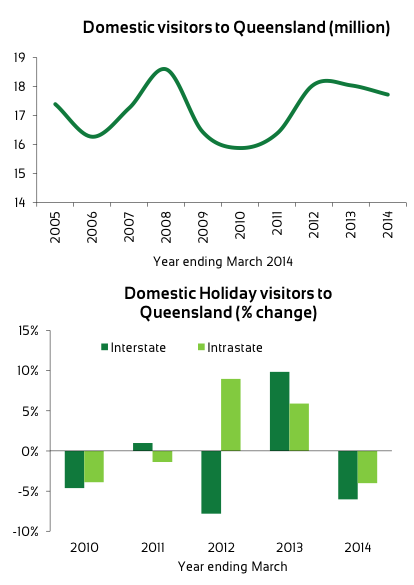
According to new National Visitor Survey data, Queensland is doing poorly at attracting interstate visitors, compounding the difficulties faced by our tourism sector, which isn’t seeing growth in international visitors (see my post from Monday, International visitor numbers increasing – but Qld doing poorly in attracting them). Furthermore, Queenslanders don’t appear excited about visiting other regions in Queensland, with intra-state holiday visitor numbers down. I’ve copied and pasted the relevant charts below from the latest Tourism and Events Queensland Domestic Tourism Snapshot.

domvisitorsThis is somewhat concerning given the significance of tourism to the Queensland economy  – indeed it’s referred to as one of the four pillars (see my earlier post How important is tourism to the Qld economy?). The only qualification I’d make is that the year ending March 2014 data don’t include the 2014 Easter, which, anecdotally, saw strong visitor numbers in Queensland holiday destinations. That said, it seems reasonably clear to me that Queensland’s current tourism promotion efforts have failed and it’s worth considering whether tourism funding could be put to better uses.

Pete Faulkner also covered today’s new tourism data:

Domestic travel result good for TNQ but poor for Qld


Posted in Tourism | Tagged , , | 1 Comment

International visitor numbers increasing – but Qld doing poorly in attracting them

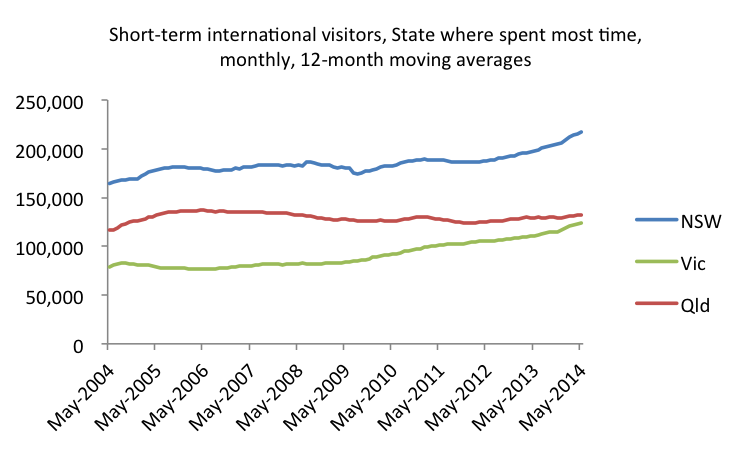
Pete Faulkner has a good post today on the new ABS overseas arrivals and departures data for May 2014: Arrivals hit new highs as China continues to grow. While arrivals to Australia hit new highs, Queensland doesn’t appear to be picking up much of the growth in visitor numbers (see chart below). As I’ve posted on before, Queensland’s share of international visitors has been declining in recent years (see Tourism & Events Qld deserved funding cut). As part of its current industry assistance review, the QCA should undertake a thorough review of Tourism and Events Queensland to determine whether its tourism promotion activities could be better directed, whether that be to other promotional campaigns or to more pressing Government priorities in health and education.

Intl visitors

Posted in Tourism | Tagged , , , , , , | Leave a comment

Brisbane to have a denser inner city, but urban sprawl as well

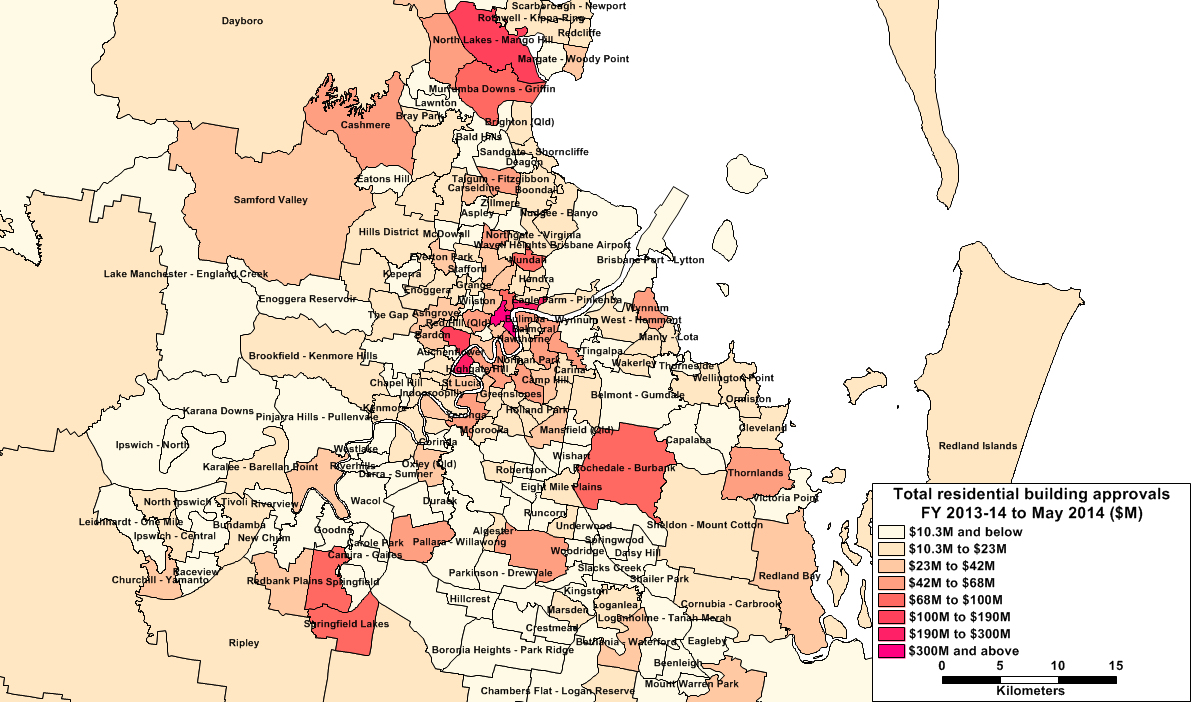
I’ve written before about how residential building development is being concentrated in a few former commercial areas in the inner city and outer suburban areas such as North Lakes and Springfield (Where is residential development occurring in the Brisbane metro area?). This pattern was confirmed by the most recent building approvals data (for the 11 months to May 2014) released by the ABS last week (see map below). As before, I’m a bit concerned about the pattern of approvals and I wonder if there might be a better spread of approvals across Brisbane suburbs if heritage restrictions were relaxed.

Building approvals May 2014_Brisbane snapshot

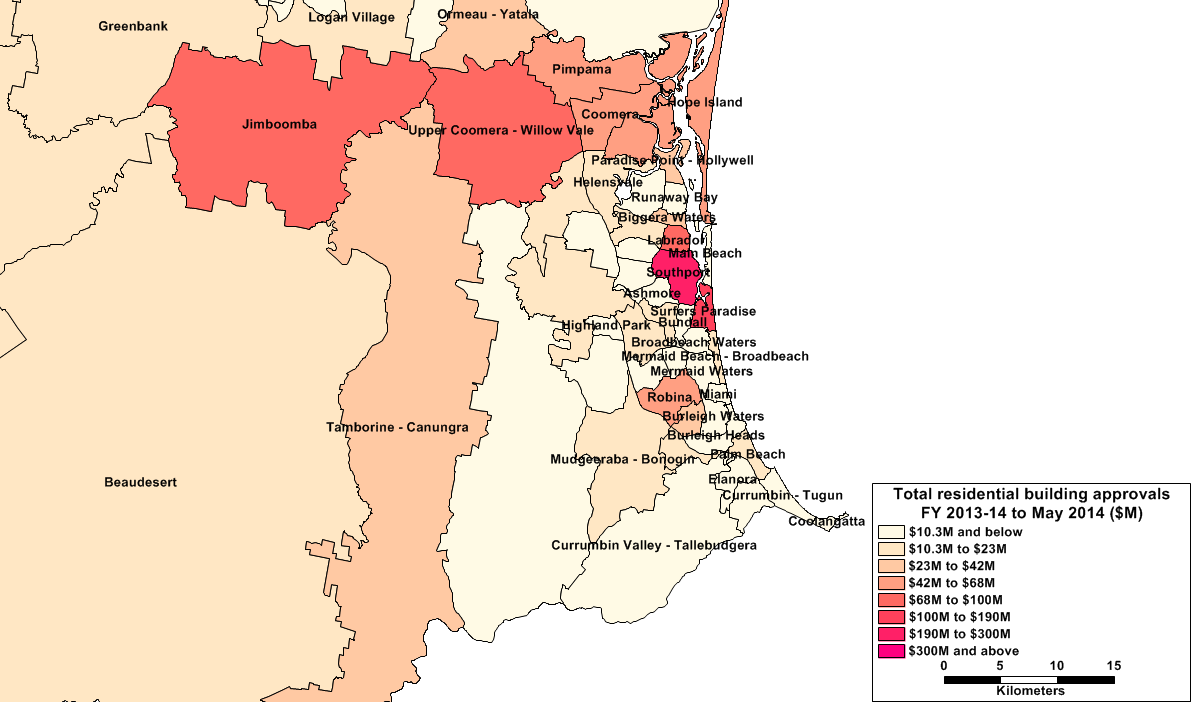
Another thing I found interesting in last week’s new building approvals data was what appears to be reasonable prospects for the building industry on the Gold Coast, where the industry has struggled in recent years, but which is looking forward to significant Commonwealth Games-related activity in the next few years.

Building approvals May 2014_Gold Coast snapshot

Posted in Housing, Uncategorized | Tagged , , , , , , | Leave a comment

Tax and Federation White Papers sound promising on GST and stamp duty

I was very pleased to read in the Courier-Mail this morning that:

Speculation is mounting the Abbott Government’s white papers on tax and federation reform, due by the end of next year, will include broadening the GST, and encouraging the states to dump inefficient taxes such as stamp duty.

I’ve previously commented on the need to broaden the GST (by removing exemptions on fresh food and some health and education items) and to cut inefficient taxes such as stamp duty which State Governments are reliant upon. My previous posts include:

New Treasury modelling supports change in tax mix towards GST

Dr Parkinson right that the GST should be broadened

GST changes should be considered as part of wide-ranging tax and expenditure review

Government has to rely on inefficient taxes to fix budget – GST reform needed

Posted in Tax | Tagged , , , , , | 2 Comments

Public benefits of BIFF and BAPFF questionable

With pressing needs in health and education, it seems obvious to me that there is little public benefit from supporting film festivals, whether in the form of the former Brisbane International Film Festival (BIFF) or its replacement, the Brisbane Asia Pacific Film Festival (BAPFF). Hence I’m mostly unmoved by former BIFF Director Richard Moore’s opinion piece in the Brisbane Times Death of BIFF a mortal blow to Brisbane’s film community, although at least he is right to avoid an economic justification for supporting BIFF, instead focussing on its cultural benefits.

In an article on film industry assistance published in Policy last year, Moochers Making Movies, I argued the only possible legitimate reason to support the film industry is to promote the development of Australian content that helps tell the Australian story. So Richard Moore might have a point, in that BIFF was more likely to provide public benefits than BAPFF will be, given that BAPFF appears less focussed on local filmmakers and more on filmmakers from elsewhere in the Asia Pacific. However, I’d much rather re-direct the money now going to BAPFF to health, education or tax cuts, which I think would yield greater public benefits.

Also see my ABC Drum article on the film industry:

Taxpayer money wasted chasing film productions

Posted in Industry policy | Tagged , , , , , , , , | 2 Comments

Government right to worry about State credit rating, not that of generators

I’m underwhelmed by a report in the Brisbane Times that the credit ratings of Queensland Government-owned power generators CS Energy and Stanwell will drop if they are privatised:

Credit ratings agency Fitch has given the Electrical Trades Union its latest ammunition in its fight against the government’s privatisation plan.

Last week, Fitch announced it had revised the outlooks of state-owned electricity generation companies CS Energy and Stanwell from stable to negative, warning that a sell-off of the gencos could lead to a loss of the companies’ AA credit rating.

“The Outlook revision reflects a weakening in the strategic linkages between the State of Queensland (QLD, ‘AA’/Stable) and the company, should the entity be privatised, as viewed under Fitch’s parent-subsidiary rating methodology,” the credit ratings agency reported.

It would be unsurprising if their credit ratings fall, as their borrowings would no longer be guaranteed by the Queensland Government. If their credit ratings fall and borrowing costs rise, they would end up borrowing at a rate that is consistent with the risks the generators face in the market, which would lead to more efficient investment decisions. Also, the Government is correct to focus on its own overall credit rating, and I’m unsure why it should worry too much about the credit ratings of the generators. I see no problem with the Government divesting itself of assets that bring commercial risks onto the Government’s balance sheet, which the generators are obviously doing. Finally, by selling the generators, the Government would raise funds that would help pay down debt and restore Queensland’s AAA credit rating, which, in my view, would yield significant benefits to the State.

Posted in Energy, Queensland Government | Tagged , , , , , | Leave a comment