Paul Romer backs Galt’s Gulch for Northern Australia

AtlasShrugged

In her 1957 novel Atlas Shrugged, Ayn Rand imagined a libertarian community, Galt’s Gulch in Colorado, in which capitalists were free to live unconstrained by Government regulations and didn’t have to pay taxes to support the “moochers.” One of the world’s leading economists, Paul Romer, has recently proposed a Galt’s Gulch-lite for Northern Australia, as reported in the Townsville Bulletin yesterday (Future fund to develop the North):

New York University economist Professor Paul Romer said northern Australia should push for a special economic zone to trial reforms instead of providing tax incentives for companies to set up.

“A tax concession zone is likely not to be allowed constitutionally,” he said.

“The real question is whether a policy reform zone would be allowed, and on my reading (of the legislation) it might.

“It could provide enormous benefits for the region.”

I like the idea of setting up a zone for experimenting with policy reforms, particularly for reforms that reduce costs to business, and I suspect IR reforms would be a top priority there. Indeed, policy experimentation is often advanced as one of the advantages of a federal system of Government, and one can imagine the Northern part of Queensland eventually becoming its own State. One benefit of a policy experimentation zone in the North would be that, if it is successful, it may drive policy reforms in other parts of Australia. I’ve previously expressed some skepticism about special economic zones (Government right in rejecting northern economic zone), but I’m coming around to a view that competition between regions might promote desirable economic outcomes across Australia. 

By the way, a real Galt’s Gulch, using Bitcoin as currency, has been founded in Chile, as reported last year by the Economist:
Bitcoin paradise

Posted in North Queensland | Tagged , , , , , , | 2 Comments

Government should wait for QCA Report before committing to new industry assistance

It’s unfortunate the Queensland Government has entered into a thirty year deal with the Tatts Group while the QCA review of industry assistance is underway, a review which might be informative on the relative costs and benefits of supporting the racing industry (see Brisbane Times coverage). The deal appears to commit the Government’s statutory body Racing Queensland to around $100 million in infrastructure spending, but it would have been good to have first seen some analysis from the QCA as to whether a Government body should be investing in the racing industry. Unfortunately, the QCA has only recently assumed a Productivity Commission-type role, so many Government policies that assist industry haven’t been subject to the scrutiny they deserve. Finally, it seems unwise to enter into a thirty year deal, given it ties the hands of future Governments.

My earlier posts on the QCA’s industry assistance review include:

QCA should investigate V8 Supercars funding in industry assistance review

QCA issues paper shows large potential savings in industry assistance

Here are the relevant extracts from last Friday’s media release from the Treasurer and Racing Minister:

Multi-billion dollar deal secures bright future for Queensland racing

The future for 30,000 jobs supported through the Queensland racing sector is brighter after the State Government reached a new 30-year wagering agreement.

Racing Minister Steve Dickson said the Queensland Government would undertake an exclusive retail wagering licence with Tatts Group, expected to provide over $4.5 billion to the Queensland racing industry…

…“Importantly, country racing and infrastructure investment will both be supported, as a key part of the agreement includes $97 million for infrastructure development and $5 million over five years for country and regional racing…

…Treasurer and Member for Clayfield Tim Nicholls said the Government was restoring confidence and growth in the Queensland racing sector, “Strong negotiations over past months have resulted in a much better and bigger deal for the Queensland racing industry; with an extra $850 million funding in addition to the $130 million per year revenue the industry currently receives under existing arrangements with Tatts,” Mr Nicholls said.

Additionally Tatts will also invest more than $74 million in the racing industry by increasing Queensland marketing activities and expanding its retail network across various hotels, clubs and pubs across the state.

Posted in Industry policy | Tagged , , , , | 2 Comments

Lacklustre labour market gives added urgency to regulatory reforms

vacancies

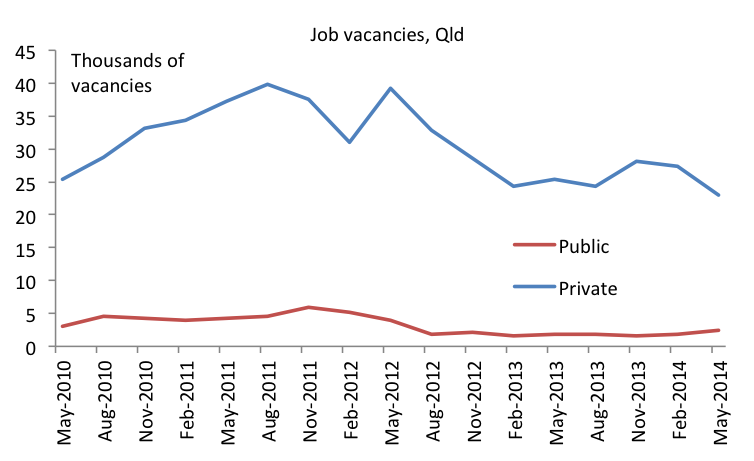
Job vacancies data released by the ABS yesterday suggest the Queensland labour market will remain relatively weak over the next few months at least (see chart above). The data are also consistent with Queensland Treasury’s forecast in the Budget that unemployment will remain at around 6% in 2014-15. Given the lacklustre labour market, it is even more important to reform regulations that are restraining opportunities for trade, one egregious example being restrictions on retail trading hours.

Hence I’m pleased to see Woolworths is continuing to push for longer trading hours in regional Queensland, as reported by the Toowoomba Chronicle yesterday:

The grocery giant has told a Productivity Commission inquiry that Queensland’s trading hours are too restrictive and complicated and costing the state’s economy tens of millions of dollars a year as well as local jobs.

Woolworths wants to stay open longer on some weekends and trade on Boxing Day, Easter Sunday and Labour Day…

“Trading hours in Queensland are regulated by (an Act that) runs over 57 pages plus eight pages of regulations,” Woolworths said in its submission.

“On Saturdays, shops in southeast Queensland must close by 5pm but in inner-city Brisbane by 5.30pm, in the city heart of inner-city Brisbane by 7pm, in New Farm by 9pm and in the Gold Coast tourist area by 10pm.

“Stores are not able to vary trading hours in response to customer demand arising from local conditions such as seasonal variations, weather events and community festivals.”

Woolworths highlighted 20 regional towns across the state where it was prevented from opening on Sunday.

Retail trade is a big employer of young people, who tend to suffer the most in periods of labour market weakness, and hence they would be major beneficiaries of trading hours reform. My previous comments on trading hours are contained in several posts, including:

Reduce youth unemployment through improved regulation – e.g. of penalty rates, taxis

OBPR recommends fast-tracked review of trading hours restrictions

Posted in Labour market, Macroeconomy, Retail trade | Tagged , , , , , | Leave a comment

Privatisation debate continues

It’s unsurprising that former Queensland Treasury supremo Sir Leo Hielscher supports asset sales (as reported in the Brisbane Times today), given that as one-time head of the Treasury Corporation he was very concerned with actually finding the cash to pay the bills – a practical matter that is arguably more challenging than the more abstract task of preparing Government Budgets. During the financial crisis, Treasury officials in Queensland, and no doubt their counterparts in other States, were very worried about where they’d find the cash to pay the bills – i.e. they were worried about whether investors would buy their bonds. Ultimately the Commonwealth stepped in with a temporary borrowing guarantee and their fears were allayed, but no doubt the concern about the availability of cash is still front of mind for many Treasury officials.

As many readers will know, over the last year or so I’ve been a strong supporter of asset sales, and I will once again present my views at an upcoming seminar for the Queensland Branch of the Economic Society on 23 July:

Productivity and Privatisation – Panel Discussion

My previous comments on privatisation include:

7.30 Qld interview on asset sales

Government should just sell Energex, Ergon and Powerlink

Brisbane Times article on asset sales

Posted in Budget | Tagged , , , , , | 2 Comments

Health, fitness and software publishing are promising sectors for new Qld businesses

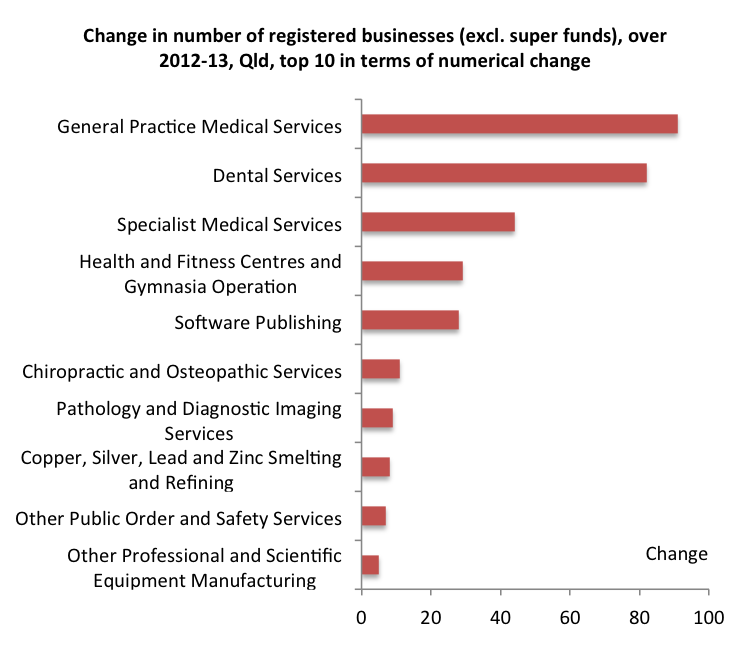
Over the year to June 2013, which saw a decline in total business numbers according to ABS Business Counts data, some Queensland industry sectors nonetheless saw growth in business numbers, particularly health, fitness and software publishing (see chart below based on data which have been available for a few weeks now, but which I just noticed yesterday).

businesscountsI’ve previously commented on how health is expected to be a major source of jobs in the future, and I expect this will be the case even taking into account likely further job losses at public hospitals as a result of recent efficiency reviews:

Qld’s economic future bright if we look beyond short-term

Posted in Health | Tagged , , , , , , | 2 Comments

Illogical to reject Uber over safety concerns

It’s disappointing the Queensland Transport Minister Scott Emerson has been swayed by the taxi industry’s argument that safety regulations and supply restrictions (i.e. a limited number of taxi licences) are both needed to ensure passenger safety (Brisbane no closer to Uber app approval). The argument is illogical because you can have safety regulations without supply restrictions. The Government can regulate industry standards and require criminal checks, but it doesn’t have to limit the number of taxi licences as it does now. With taxi licences costing hundreds of thousands of dollars, it’s pretty clear that licences are valuable because they earn super profits for licence holders. Licences would cost much, much less (possibly only several hundred dollars each) if the licence fee simply had to cover the cost of Government safety regulation.

In a 1999 research paper on the taxi industry, the Productivity Commission pointed out that safety regulations can be implemented without massively restricting supply, which simply increases the profits of licence owners (pages 11-12):

The Commission acknowledges that there is a role for regulation in specifying minimum safety standards for taxis. This reflects the very limited ability of passengers to determine the mechanical condition of the taxis they use, as well as concerns about the safety of third parties. But the most efficient way to pursue safety objectives is by targeting them directly — not indirectly through income support measures. These latter measures provide no guarantee that safety will be improved. This is most evident in the case of leased plates where the higher income is appropriated by the owner of the plate, not the taxi operator — the person responsible for vehicle safety. [emphasis added]

I’ve previously commented on the Uber confusion. And my friend and colleague Brad Rogers has made some interesting comments on the Queensland taxi industry in recent months:

Queensland taxi licences and drunken violence

Brad’s radio interview on taxi deregulation

Posted in Transport | Tagged , , , , , | Leave a comment

Interstate migration to Qld remains low – overall gain, but net loss to Victoria continues

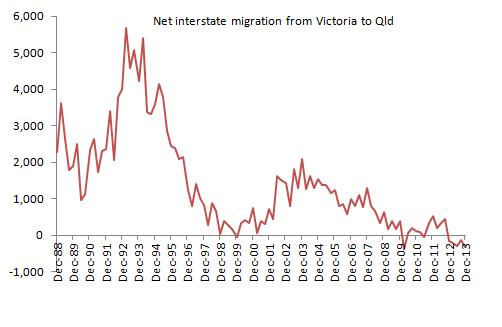
The new population data released by the ABS yesterday (see the Queensland Treasury brief) show interstate migration – a major source of growth in the 1990s and early 2000s – continues to make only a small contribution to Queensland’s population growth, and the leakage to Victoria continues (see chart below of quarterly net interstate migration from Victoria to Queensland).

Vic_QldSee my previous posts on interstate migration:

Interstate migration to Qld remains low, probably reflecting sluggish labour market

When will interstate migration to Qld recover?

Posted in Migration, Population | Tagged , , , | 2 Comments

Lack of consumer confidence reflected in new vehicle sales – but trend towards SUVs continues

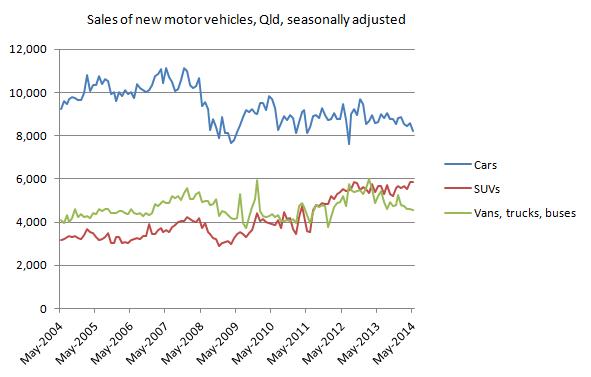
Anxious consumers and businesses remained reluctant to purchase new motor vehicles in May, with new vehicle sales 2.1% lower than in April and 4.3% lower than in May 2013 (see ABS summary). Both vehicles for personal and business use appear to have experienced drops in sales, although a plunge in demand for passenger vehicles (which I have labelled cars) has been partially offset by the continuing upward trend in demand for SUVs. While a decade ago there was one SUV sale for every three car sales, now there are two SUV sales for every three car sales. In another five to ten years time, it may be that SUV sales equal car sales.

motorvehicles

Posted in Macroeconomy | Tagged , , , , , | Leave a comment

Qld Govt recognises importance of coal to economy and budget

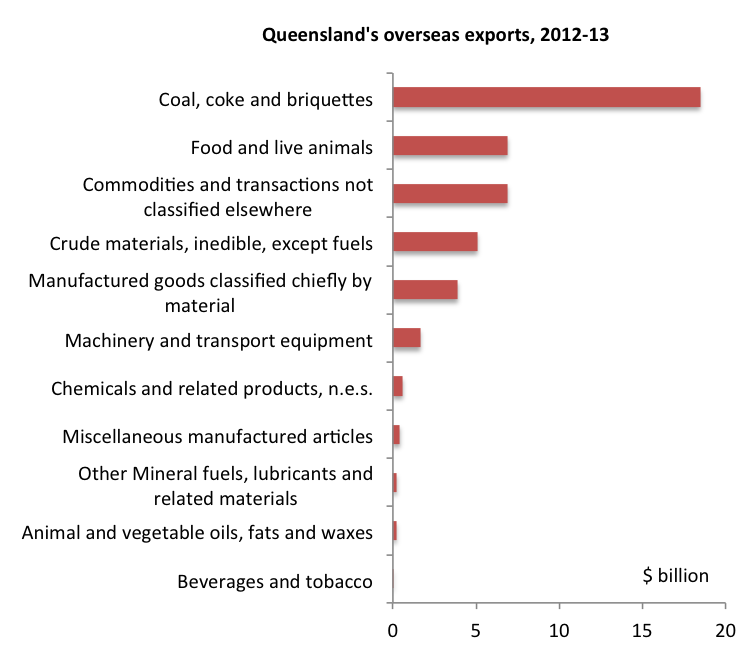
Reading the Courier-Mail story today about how the Government looks set to favour coal miners over farmers in Central Queensland,  I recalled a chart my friend and colleague Brad Rogers once showed me of the contributions made by different commodities to total exports. In Queensland, coal is king, and dwarfs the contribution from agriculture (see chart below based on data from the Government Statistician’s website).

exports

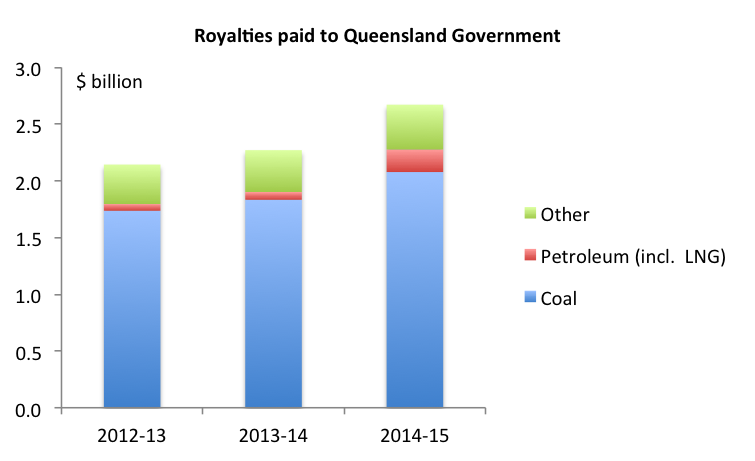
As well as considering the contribution of coal to the economy, the Government is also aware of the significant contribution coal makes to the Queensland Government Budget (see chart below based on data from the State Budget).

Royalties

Posted in Mining | Tagged , , , , , | 1 Comment

Minimum wage reduces retail jobs available for young people

Walking around the newly renovated Indooroopilly Shoppingtown in Brisbane’s western suburbs recently, I was struck by how many high-end clothing and jewellery stores there now are in the centre. Partly this would be because high-end shops would be more likely to earn enough to afford the rent and also to cover the wages of staff, while lower margin businesses are struggling in today’s highly competitive retail environment, in which big box stores and online retailing are growing strongly.

Labour costs, in particular, are very important to retail businesses. As the Productivity Commission notes in its recent Interim Report on the Relative Costs of Doing Business in Australia: Retail Trade,  “labour costs tend to be the single largest area of expense for retail businesses.” The Commission also notes:

The key issues are higher minimum wages, as well as factors such as penalty rates, the lack of flexibility under the industrial relations system and level of superannuation.

ABS and industry data reported by the Commission suggests labour costs account for 40-50% of the costs of retail trade businesses. Given the importance of labour costs to the retail sector, and other sectors as well, I’m surprised MacroBusiness featured an article yesterday on Why the minimum wage is good for business. This runs counter to economic theory, the views of industry (which admittedly may be biased) and the recent Productivity Commission report. I’m unconvinced by the argument in the article that, because there are other countries with lower minimum wages and higher unemployment, minimum wages don’t affect employment. To reach any conclusion based on cross-country data, you would need to control for a wide range of differences in the economies, taking into account the fact that many OECD economies have had weak economic conditions ever since the financial crisis.

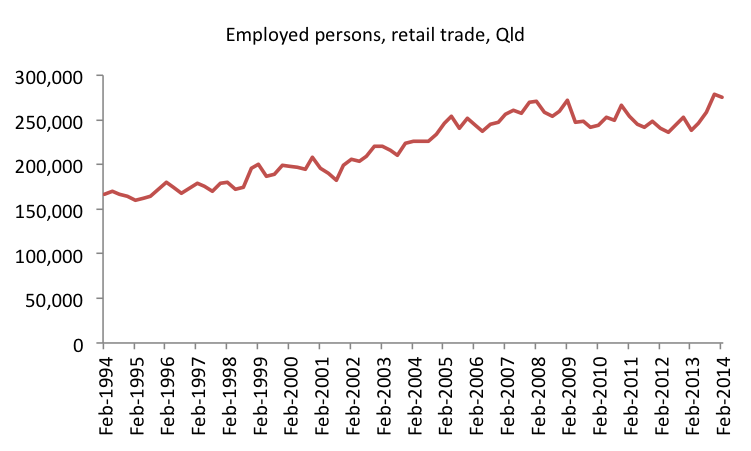
I’d note the Federal Government is doing its best to encourage young people to earn or learn, but I’m worried that Australia’s relatively high minimum wage and other regulations, such as restricted trading hours, are limiting opportunities for young people, particularly in retail, which is traditionally a big employer of young people. The ABS data show employment in retail trade has been relatively flat in recent years (see Chart below). With the recent Productivity Commission report highlighting the huge significance of labour costs to the retail sector, IR reform should once again become a priority.

retailtradeemploymentA related earlier post of mine is:

Reduce youth unemployment through improved regulation – e.g. of penalty rates, taxis


Posted in Labour market, Retail trade | Tagged , , , , | Leave a comment