G20 had only minor impact on Brisbane’s profile worldwide, suggests Google Trends

I was pretty skeptical about the long-term impacts of the G20 on tourism to Brisbane (e.g. see Link to ABC radio interview on G20 and Expo 88) and Google Trends suggests my skepticism was correct. While there was a small blip in Google searches for “brisbane” (or “Brisbane”) at the time of the G20 summit in mid-November, it was smaller than the spike in interest in Brisbane generated by late November’s super storm (see the first screen shot below showing search volume over the last 90 days; the blip after the “A” is over the G20 weekend, and the spike at the end of November is on the day of the super storm). And the G20 blip was much smaller than the huge spike in interest generated by the 2011 flood (second screen shot below showing monthly search volumes since 2004; the big spike is in January 2011).

Brisbane_past90days

Brisbane_since2004

Posted in Brisbane, Tourism | Tagged , , , | 4 Comments

Qld waiting for LNG exports to boost economic growth, as internal demand falls away

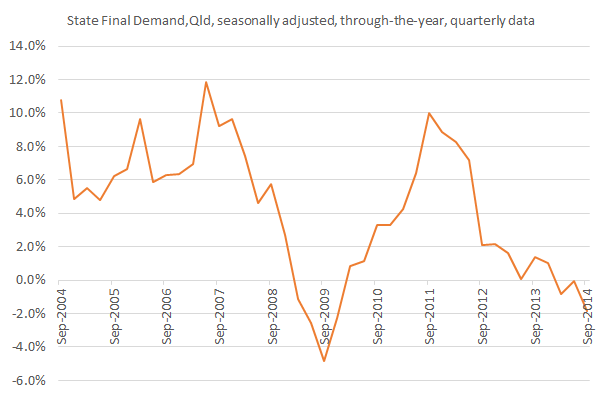
The first exports of LNG from Curtis Island off Gladstone are expected to occur later this month, and they can’t come soon enough for the Queensland economy, with our current economic weakness confirmed by State Final Demand estimates in yesterday’s National Accounts data (see chart below). The drop in State Final Demand (which doesn’t include exports) is due to the well-known drop off in heavy construction work associated with the resources sector. This is a big shock to our economy, and our successful recovery from it will depend a lot on how quickly LNG exports can boost economic growth and how much of the export earnings end up being retained in our economy. It’s unclear to me just how much Queensland will benefit at this stage. While there are jobs associated with the LNG exports, there are far fewer jobs than the jobs involved in the construction phase. And while the Queensland Government will capture some of the benefits via royalties (some $1/2 billion a year), large shares of the profits associated with the export of LNG are likely to flow overseas or interstate. So, even though Gross State Product will boom due to LNG exports in the next couple of years, the actual impact on employment and incomes of Queenslanders may be less exciting.

sfdtty_Sep14

Posted in Macroeconomy, Mining | Tagged , , , , , , , , | 2 Comments

Privatisation scoping studies should be released to inform public debate

If it hasn’t already been sent, I expect an email will be sent around Ergon Energy today decreeing that all whiteboards must be erased after meetings, after the embarrassing disclosure of privatisation planning to union officials via a whiteboard (see the Brisbane Times article Ergon privatisation notes discovered on whiteboard). The incident raises an issue I’ve touched on before: the amount of information available in the public debate on privatisation, which alas is less than necessary to have a properly informed debate (e.g. see my post from October Strong Choices plan mostly good policy, but light on detail of budget impacts).

The Government could make a large contribution to the quality of public debate on its proposal to lease out assets by releasing the scoping studies that were prepared by investment banks and corporate advisers such as Bank of America Merrill Lynch and Lazard. At the time of commissioning these studies last year, Treasurer Tim Nicholls noted “their findings will form the basis for a considered and mature conversation with Queenslanders about the future of these businesses.” But I’m unsure this considered and mature conversation has occurred yet. Not having seen the scoping studies, it’s hard to know to what extent their findings have entered the public debate.

The Government will not release the scoping studies to the public because it is claimed they are commercially sensitive. Certainly some aspects could be, particularly market soundings, where the advisers have tested the potential appetite of different investors. But a lot of parts of the scoping studies wouldn’t really be commercially sensitive – although, of course, they may be politically sensitive. I’d particularly like to know whether the scoping studies (or any other commissioned studies) contain an assessment of current inefficiencies in the different Government-owned businesses such as Energex and Ergon, and what steps could be taken, such as shedding excess labour, to improve the businesses. Information such as this would be of great interest to communities in regional cities such as Townsville and Gladstone, which may be impacted by efficiency measures.

The Government could release the scoping studies with truly commercially sensitive information blacked out. The commercial sensitivity defence for not releasing the studies seems dubious to me, particularly when you consider the major Government businesses being privatised, Energex and Ergon, are monopolies in electricity distribution with no competitors who could gain market advantage from the disclosure of sensitive information.

So the Government’s defence must depend on the risk that disclosing information in the scoping studies would result in lower bids from potential lessees of the assets. There is possibly a risk of this, although I’m sure any bidder would be well-informed by a number of consultants who are highly experienced in the operations of the relevant Government-owned businesses. So I think the risks arising from releasing the scoping studies are low. In any case, it is in the public interest for the studies to be released, so we can have a better informed debate on the benefits and costs of leasing out assets.

Posted in Budget, Energy | Tagged , , , , , | 2 Comments

Brisbane City Council’s 15 minutes free parking policy is economically dubious

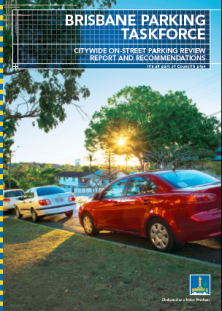
Parking_Taskforce_Report

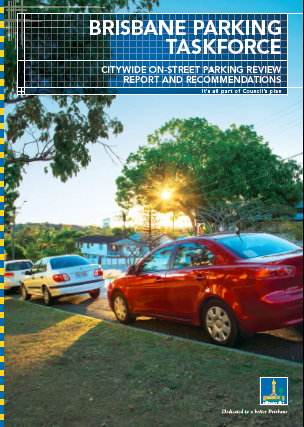
Economists usually worry when something is provided free, because the price of $0 typically doesn’t reflect the cost of providing the good or service, and demand will increase to inefficient levels – i.e. levels where the value people place on the good or service is lower than the cost to society of its provision, a socially inefficient outcome. For this reason, policies such as a GP co-payment, which force people to place some non-trivial value on a publicly provided good or service, are a good idea, and policies which don’t, such as Brisbane City Council’s new 15 minutes free parking policy at some inner city locations, typically aren’t. (Regarding this new policy see the report from the Brisbane Parking Taskforce.)

The Council’s policy is superficially attractive, and will possibly benefit some inner city businesses, but its disregard for basic economics means it’s unlikely to be beneficial from the point of view of the whole community (particularly when you consider the loss of revenue to Council that will have to be made up elsewhere).

As I’ve commented before, free parking can make sense in times where there isn’t any scarcity of car parks (Paid parking affecting work and play in Brisbane CBD), but it doesn’t make sense in peak hours where there is genuine scarcity and my use of a car park, even temporarily, results in a cost to another motorist who misses out. We may see an increase in the number of motorists traveling to the inner city due to the attraction of free parking, but many of these additional motorists may place a lower value on the trip than other motorists. If they take a free parking space, they may be taking it away from someone who would value it more highly and would be willing to pay for it. A better, more efficient outcome would be achieved if the Council charged parking fees reflecting the scarcity of car parks in peak times.

While the Council is right to consider the benefits to local businesses of greater turnover of car parks that would arise from 15 minutes free parking, it seems to have ignored the benefits to motorists that would arise from a system where pricing reflects scarcity, and car parks go to those who value them most. Indeed, if there are large numbers of people who currently struggle to find parks in the inner city in peak hours, it might even be sensible for Council to significantly increase its parking charges in the inner city. This would certainly promote the turnover of parking spots.

Instead, the Council is attempting to increase the turnover of car parks by encouraging people who would have previously paid for parking, and for more than 15 minutes, to now park for less than 15 minutes through the lure of free parking. This may work to some degree, but its impact on the turnover of car parks may not be large. Expecting large impacts on the turnover of car parks would be to assume there are a lot of people currently paying for parking who are wasting time when they make a short visit to an inner city location, and they would hurry up and do their business in less than 15 minutes if there was the possibility of free parking. It seems to me that a more effective way to increase the turnover of car parks would be to increase parking charges, rather than to provide free parking for 15 minutes.


Posted in Brisbane | Tagged , , , , | 2 Comments

Are GPs resistant to cost-effective health care for regional and remote Australians?

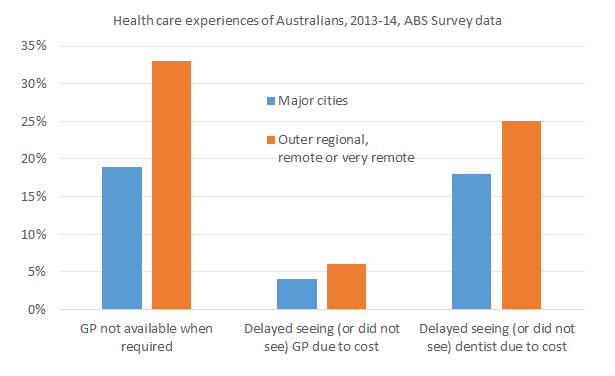
patient_experiences_13_14There are large differences in access to health care between Australians living in major cities and those living in regional and remote areas, as confirmed by 2013-14 ABS survey data on patient experiences published last Friday (see chart above).  Of course, some differences are to be expected, as it would be very costly to ensure the same level of medical services across the whole country, but it’s likely there are cost-effective measures that can be taken to improve health care in regional and remote areas.

At an Economic Society of Australia Queensland branch seminar earlier this month, Dr Abby Kamalakanthan of Grant Thornton spoke about the economics of regional and remote service delivery. In her talk, Abby referred to a nice paper from Grant Thornton on  rural and remote health care, Making it work: Sustainable solutions for rural and remote primary healthcare. The paper notes (on p. 3):

Medicare funding is needed to make the employment of NPs [Nurse Practitioners] and PAs [Physician Assistants] worthwhile, to enable them to provide after hours care, and to reduce GP resistance to alternative types of primary health care professionals.

It appears that the Australian Medical Association (AMA) has been resistant to physician assistants, in particular, claiming they take clinical placements away from trainee doctors (see Turf war over physician assistants). This may be the case, but would suggest a need to fund more training positions in hospitals, rather than for abandoning the physician assistant concept, which appears one way of delivering cost-effective health care to regional and remote Australians. Perhaps the GP co-payment (if it actually goes ahead) could be used to fund more training positions for doctors and physician assistants, and for expanding Medicare coverage for work undertaken by nurse practitioners and physician assistants? This would probably be a better use of the money than the massive $20 billion medical research fund that was proposed by the Government.

Posted in Health | Tagged , , , , , , , , , | Leave a comment

Qld Government likely to go into election campaign with weak economy

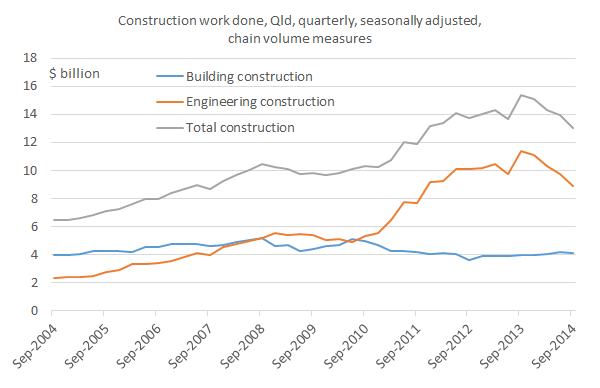
New ABS data released today show a large drop in engineering construction activity – i.e. the heavy construction activity that has been largely associated with the resources sector in recent years. At the same time as this drop is occurring, building construction activity isn’t replacing engineering construction as a source of demand (see the chart below and Pete Faulkner’s post Qld leads the way in construction work done slowdown). Although data from earlier this month show building approvals are trending upwards, there’s no reason to expect a big surge in building construction anytime in the near future. Taking into account other facts, such as the weak labour market evidenced by a 7% unemployment rate, it’s looking very likely the Queensland Government will go to the next election, expected late February or March next year, with a relatively weak economy. Treasurer Tim Nicholls will be very busy next election campaign. He will need to sell both the asset leases plan and a new credible economic strategy in place of the now redundant Four Pillars Plan.

Construction_Sep14

Posted in Housing, Macroeconomy, Mining | Tagged , , , , , , , , , | 10 Comments

Over 255,000 regulatory requirements imposed on Queenslanders

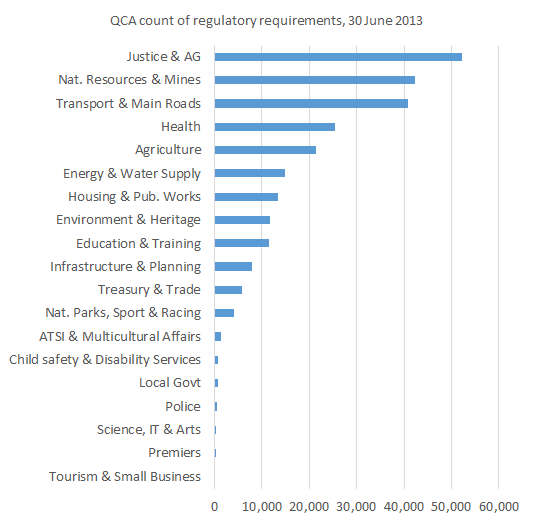
I was reminded the other day about the massive counting exercise the Queensland Competition Authority (QCA) has commission regarding the burden of regulation – an exercise that has found over 255,000 regulatory requirements imposed on Queenslanders across State Government portfolios (see chart below). The estimate for 30 June 2013 (the latest currently available) is some improvement over the baseline at the start of the Newman Government of around 265,000 regulatory requirements, but it would appear desirable to further reduce this number. Of course, some regulation is necessary to protect the community and environment from harm, but too much can unnecessarily constrain economic activity at a high cost. As I posted on previously, we need to get our regulations right so we can improve our productivity and living standards (Productivity push from Qld Govt needed as living standards growth stalls).

Regcount

The data I’ve used in this post are available from the QCA website on the page containing the Office of Best Practice Regulation’s Annual Report.

Posted in Productivity | Tagged , , , , , , , , | 2 Comments

Productivity push from Qld Govt needed after living standards growth stalls

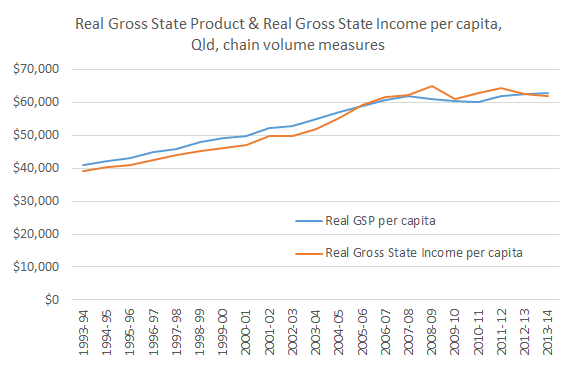
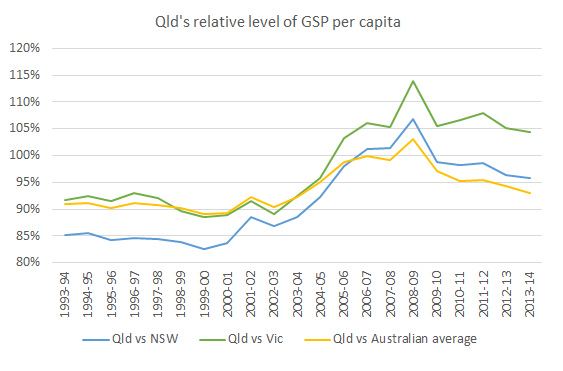
Queensland Treasury econocrats should start investigating measures to improve our productivity performance, after ABS State Accounts data released on Friday confirmed a big slowdown in living standards growth over the last decade or so – measured, roughly I admit, by real Gross State Product and Income per capita (see charts below). This is not just due to the mining slowdown, given that mining was still a major contributor to the economic growth that did occur in 2013-14 (see Pete Faulkner’s post Mining & construction led Qld GSP in 2013-14 in which Pete explains why real Gross State Income actually fell in 2013-14). Instead, in my view, much of it probably reflects the slowdown in productivity growth that has occurred (across Australia) due to a slower pace of economic reform than in the eighties and nineties. Hence, a renewed focus on productivity by all levels of Government would be welcome.

GSP&GSI

RelativeGSP

Regarding what the Queensland Government should do, it should:

  • continue with its red-tape reduction agenda (e.g deregulate retail trading hours and the taxi industry and push for local governments to relax heritage and other development restrictions), and provide further information to the public on its progress so it can be kept accountable, and
  • continue with its proposed leasing out of State assets, but use the proceeds wisely – i.e. avoid wasting Government money on vote-buying infrastructure investments in regional areas, such as the proposed Townsville Super Stadium.

On the taxi industry, I’ve been very pleased that the Transport Department is turning a blind eye to Uber, because Uber use appears to be growing rapidly and is posing a big threat to the protected positions of Yellow and Black & White Cabs.

Posted in Macroeconomy, Productivity | Tagged , , , , , , | 10 Comments

Productivity Commission has scope to consider student visa rorts

One of my loyal readers often says to me that “Australians love a good rort”, and indeed there are several government policies and programs that allow rorting to various degrees. So I’m pleased that the fiercely independent Productivity Commission is reviewing the international education services market in Australia and that, as part of its research program, it will consider the:

Link between student visa policies and the incentives created for education service providers particularly in relation to quality.

In other words, it will look at whether universities, TAFEs and other training providers are rorting the system by enrolling lots of overseas students in dubious courses, knowing that many of the students simply want to get into Australia and don’t really care too much about course quality. Anecdotal evidence on this issue is pretty strong and I recall allegations of dubious practices made against one Queensland university a few years ago (see Foreign students ‘don’t pay to pass’).

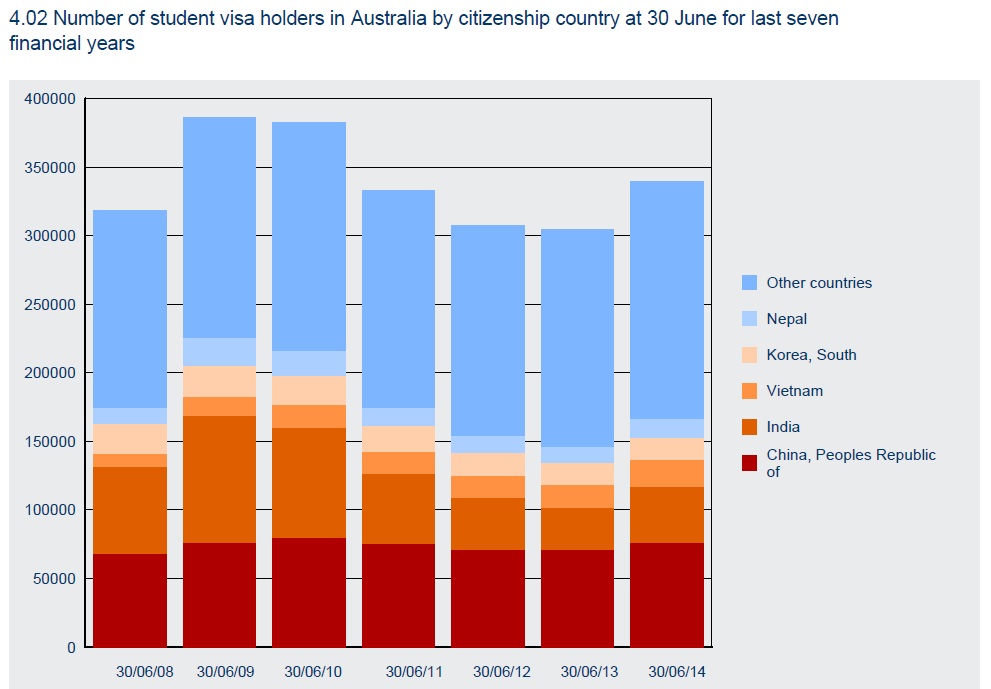
This research project by the Commission is timely, given that international student numbers appear to be recovering after the post-financial crisis slump (see chart below I’ve copied and pasted from an Immigration Department report available from the student visa statistics site), and we’d like to consolidate these gains.

studentvisas

Posted in Education | Tagged , , , , , , , | Leave a comment

Nice introduction to business opportunities in China and elsewhere

photoThe Australia-China free trade agreement is great news for the Queensland economy, with scheduled reductions in Chinese tariffs on coal and agricultural products from Australia. It will also provide opportunities for people in professional and financial services (see Max Mason’s handy analysis Who wins in Australia-China free trade agreement?)

A nice discussion of how to take advantage of opportunities in China is contained in Airport Economist Tim Harcourt’s latest book Trading Places. It appears Tim was in Adelaide only a few days before I was last week and managed to sign a few copies of his book at Adelaide Airport, one of which I picked up to read on the flight back to Brisbane. My favourite bit of advice in Tim’s book is this:

Try the second-tier cities – Chengdu, Wuhan, Chongqing, etc. Really it’s not a matter of if you’re not in Shanghai, you’re camping out.

That’s very true. I recall that one of the facts Dr Parkinson used to stun us with when he was Executive Director of Treasury’s Macroeconomic Group was that there were over 100 cities in China with more than one million people. There are certainly huge opportunities over there for Australian businesses.

Posted in Agriculture, China, Mining, Trade | Tagged , , , , , , , | Leave a comment