Good set of policy principles (mostly) from new Queensland think tank AiP

New Queensland think tank the Australian Institute for Progress (AiP) has released a set of high-level policies for the Queensland election, which are mostly consistent with sound public finance and the promotion of free markets (see Our priorities for Queensland election). I agree with the AiP on the need to repair the budget, privatise assets and many of its other policies, but I question the seventh policy:

Enabling and promoting the industries where Queensland has a competitive advantage, specifically mining, agriculture and tourism.

Does the AiP really believe in an interventionist industry policy where the Government favours particular sectors over others? The AiP appears to have simply adopted the Government’s Four Pillars policy and knocked down one of the pillars: construction. But why shouldn’t the Government promote construction, or any of the other industries not listed? The Queensland economy is much more than three or four pillars, as I’ve noted in a previous post:

What is the four pillars’ share of the Queensland economy?

If it wants to promote growth and employment, the Government should not pick winners and discriminate between industries, but let market forces determine the optimal industry structure, a point that was repeatedly made by Ken Henry during the resources boom. I suggest the AiP should revise its seventh policy and replace it with something along the lines of: reducing the burden of regulation on all industries and only intervening where there is a clear case of market failure.

That said, I think it’s great that AiP has injected itself into the election campaign, and I support its call for a truthful campaign.

Disclosure: I was a participant in the foundation workshop for the AiP back in August 2014, but I’m not a member.
Posted in Budget, Industry policy | Tagged , , , , , , , , | 6 Comments

Earlier election better for the Queensland economy

It’s good news for the Queensland economy that the Premier is expected to announce a late January or early February election today. The CCIQ September quarter Pulse Survey report notes that uncertainty around the upcoming election has affected business expectations, which are negative for the next twelve months. The significance of the contribution of election uncertainty to the weak outlook is unclear and possibly minor, but at least the election will remove any adverse impact. Also, the election will allow the Government, assuming it is re-elected, to expedite its leasing out of assets and to direct $8-9 billion of the lease proceeds to infrastructure projects that will provide a welcome injection of activity to many regions of Queensland.

Previous posts of mine that are relevant to the upcoming election include:

Queensland economic outlook for 2015

Strong Choices plan mostly good policy, but light on detail of budget impacts

Privatisation proceeds should be spent wisely

Posted in Budget, Macroeconomy | Tagged , , , , , , , | Leave a comment

Remarkable cost-cutting performance from Queensland Government

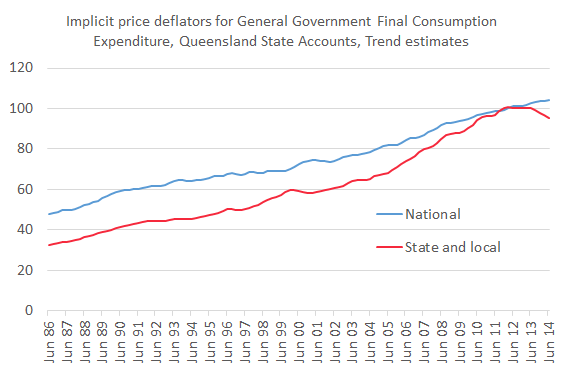
Average input costs for Queensland Government activities appear to have declined by up to 5 per cent since mid-2012, based on State Accounts data from Queensland Treasury, assuming State Government activity mostly drives the State and local general government consumption implicit price deflator (i.e. price index) in the chart below. This average cost reduction would largely be associated with labour savings through leaner, less top-heavy bureaucracies. It confirms the Government’s remarkable performance in limiting expenses growth reported in the Mid-Year Fiscal and Economic Review (see my post from last week).

ipd_qld_sa

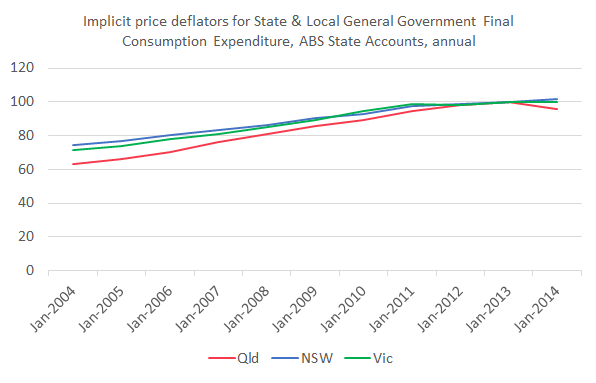
ABS data also show a drop in average input costs for State and local governments in Queensland (see chart below).

ipd_abs

Posted in Budget | Tagged , , , , , , | 6 Comments

Queensland economic outlook for 2015

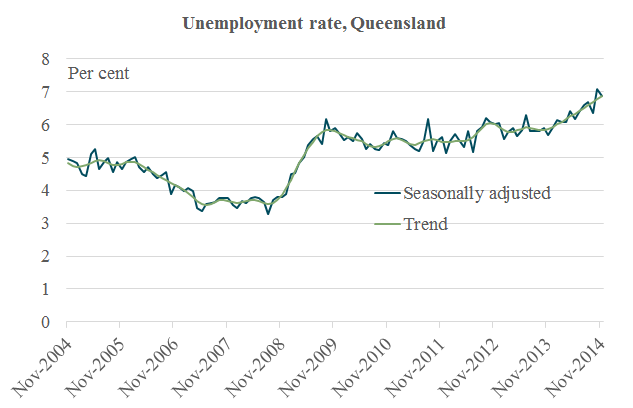
It became clear toward the end of 2014 that the upcoming Queensland election would be fought in a relatively weak economy. 2014 unfortunately saw an increase in Queensland’s unemployment rate from around 6 per cent to around 7 per cent (see chart below), giving Queensland the highest unemployment rate on mainland Australia.

unemploymentrate_Nov14_Qld

Important forward indicators such as business surveys (e.g. CCIQ Pulse Survey) and job vacancies don’t suggest a strong recovery in the Queensland economy any time soon, although building approvals are more positive. Building approvals have recovered from dismal levels, but remain below highs in the 2000s, and will take a long time to reach former highs unless interstate migration recovers from its current low levels. Because of our low rate of interstate migration, Queensland is now growing at a slower rate than the national average (see Queensland Treasury’s information brief).

Continue reading

Posted in Macroeconomy | Tagged , , , , , , , , , , , , , , | 1 Comment

2014 wrap up – Qld Govt excelled on budget management, but Adani & Tatts deals questionable

The Queensland Government’s major economic policy achievements in 2014 included:

  • strong budget management, particularly through expenditure restraint, with the Mid Year Fiscal and Economic Review reporting that expenses in 2014-15 are expected to now be $720 million lower than budget estimates (although this money could evaporate as we move closer to the election); and
  • maintaining a commitment to privatisation of government-owned assets, even though it has had to back down from outright sales to leasing out assets instead, partly because the original Strong Choices campaign was weak and unconvincing.

The Government, however, failed to distinguish itself on two major issues.

First, the 30 year exclusive retail wagering (re. TAB shops) deal with Tatts Group is bad policy. As I noted in a post earlier this year, it was unwise for the Government to lock itself in to such an agreement prior to the QCA completing its industry assistance inquiry. The deal restricts competition and provides monopoly profits for Tatts Group. It hardly seems justifiable on social policy grounds because it doesn’t appear to limit the possibility of harmful gambling in any way. In its 2010 gambling inquiry report, the Productivity Commission noted (p. 38):

A more diverse retail wagering sector would increase the benefits that consumers receive from greater competition and greater choice. This need not increase overall community access to gambling, and new entrants would, at a minimum, be subject to the existing industry harm minimisation requirements.

While Tatts Group has committed to providing some funding for the racing industry as part of the deal, the Productivity Commission has correctly noted there are alternative funding models (e.g. a product fee/levy) and there is no reason to restrict competition in retail wagering.

Second, there is an unclear basis for the Government’s strong commitment of several hundreds of millions of dollars (exact amount unannounced) to Adani’s Galilee basin projects, with some critics arguing the projects are unviable (e.g. see the Brisbane Times report Newman to back Galilee projects with infrastructure spending).  I’m not in a position to comment on the viability of the projects, but I would note that, if it’s the case they would be viable for Adani only with Queensland Government support, the question is then whether a cost-benefit analysis would show a net benefit to Queensland of the Government’s investment.

A cost-benefit analysis would need to consider the benefits to Queenslanders from the additional economic activity, which would partly be realised as greater royalty revenues, but would also need to consider the full cost of the Government’s investment and any environmental impacts. Also, in assessing benefits, it is important to consider that Adani is a foreign company and profits would be repatriated overseas. It’s possible the Government’s investment may pass the cost-benefit test, but I’d like to see the analysis before committing.

Posted in Budget, Mining | Tagged , , , , , , , , , , , , , , , , | Leave a comment

Strong December sales needed after lean year for Queensland retailers

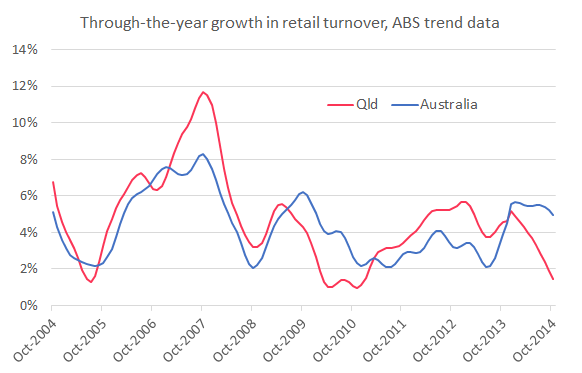
I’m looking forward to this morning’s Boxing Day sales in Brisbane CBD, which hopefully will live up to expectations of big crowds and high turnover, as historically low interest rates and lower petrol prices free up cash for discretionary spending (see Boxing day sales expected to draw big crowds). Queensland retailers need to record very strong December results after a relatively lean year, in which turnover has grown less than the inflation rate (see chart below and Queensland Treasury’s information brief from earlier in the month).

retail_tty_oct14

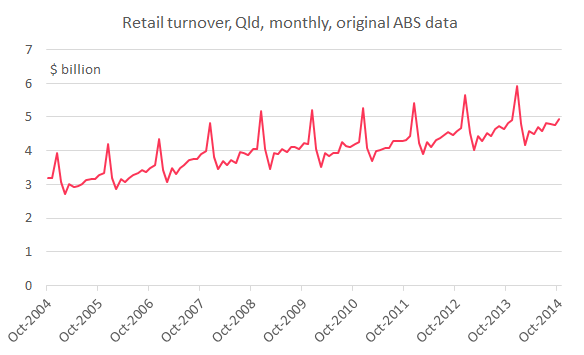
Traditionally, December is an important month for retailers, with 10-11% of total annual retail turnover occurring in the month (see chart below showing a regular spike in December).

retail_original_Oct14

Also see my post from October:

Economic weakness hits Qld retailers

Posted in Retail trade | Tagged , , , , , , | Leave a comment

Queensland mid-year Budget update – Nine News interview

Katherine Feeney of Nine News Brisbane interviewed me yesterday regarding Queensland’s mid-year Budget update, which significantly downgraded Queensland’s fiscal outlook, largely due to lower coal and LNG prices in the forecast period. Katherine and the Nine team did a good job summarising the main points and issues. Here’s a link to the story:

Queensland economy struggling

Posted in Budget | Tagged , , , , , | 4 Comments

Boys under-performing at Queensland State Schools

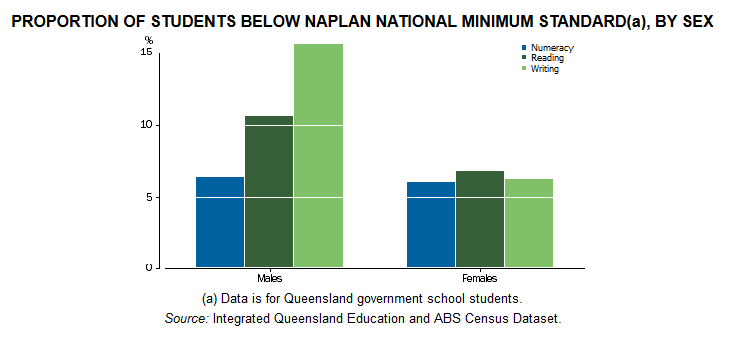
A new ABS study on educational outcomes at Queensland State Schools confirms the importance of socio-economic factors in school performance, and also reveals a surprisingly large gap in NAPLAN performance between boys and girls (see chart below I’ve copied and pasted). More boys are failing to meet minimum standards than girls. The data are for 2011, so possibly the situation has improved since then, but I doubt it. The gap between boys and girls doesn’t appear to be a problem solely in Queensland, although the gap appears larger than at the national level (based on ABS data from the 2000s which suggests a 5 percentage point gap rather than the nearly 10 percentage point gap we see in Queensland on writing performance). The Queensland Education Department should further investigate this gap in performance between boys and girls and consider whether policy changes are required, such as single-sex classes, which have previously been successfully trialled in Queensland (as reported in the Courier-Mail).

naplan

Posted in Education | Tagged , , , , , , | 4 Comments

Budget blowout highlights risk of permanent deficits without major spending cuts

With today’s Mid-Year Economic and Fiscal Outlook expected to reveal a blowout in this year’s budget deficit from around $30 billion to $35-40 billion, the Commonwealth Government is right to be reviewing childcare benefits and the proposed paid parental leave scheme, as reported yesterday (Budget warning: Childcare and family payments explode by $5.6b despite budget cuts). As I’ve noted throughout the year, without major policy changes, there is a big risk the Commonwealth will end up in a state of permanent deficit. The Commonwealth’s spending policies are incompatible with its tax policy settings, which due to income tax cuts in the 2000s generate a smaller tax-to-GDP ratio than previously. To avoid a state of permanent deficit it is necessary to make unpopular cuts to Commonwealth expenditures, which is why I’ve been supportive of the GP co-payment and higher education deregulation, among other policies. My previous posts on the budgetary challenges facing the Commonwealth Government include:

Good Budget strategy, but a mix of good and bad policy measures

 ABC radio interview on the debt tax and paid parental leave

Grattan report shows need for permanent budget measures, not temporary debt levy

Higher education reform important in improving budget balance

Posted in Budget | Tagged , , , , , , , | 2 Comments

The compliance burden of work Christmas parties

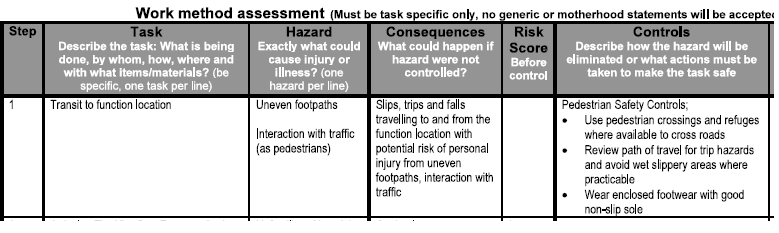
Back in October, Chris Richardson from Deloitte Access Economics pointed out the large costs (up to $70 billion in total p.a.) that businesses are imposing on themselves and other businesses through internal rules, such as those designed to demonstrate the company is complying with safety, environmental or non-discrimination regulations (Businesses burying themselves in billions of dollars of red tape). In some (if not many) cases, the internal rules are probably unnecessary. Today I came across possibly a good example of this phenomenon – a Safe Work Method Statement alerting staff of an international professional services firm with an office in Brisbane CBD of the risks they would encounter on their way to the Treasury Casino for their work Christmas party, and how to avoid those risks (see extract below). For example, regarding “transit to function location”, “uneven footpaths” and “interaction with traffic” are listed as hazards, and staff are advised to “use pedestrian crossings” and “Review path of travel for trip hazards”. The company may fear getting sued by an employee if something occurs on the way to or at the Christmas party, but surely this is overkill?

workmethodassessment

Posted in Labour market | Tagged , , , , , | 6 Comments