ACE 2015 tax policy panel discussion involving Treasury suggests little chance of major tax reform

Tsy_water_bottle The official Treasury water bottle. A pleasant surprise in the ACE 2015 conference bag.

Thanks to Graeme Davis from Treasury, Alex Robson from Griffith, Miranda Stewart from ANU and Paul Abbey from PwC for some informative and stimulating presentations at the tax policy panel discussion on Wednesday 8 July at the Australian Conference of Economists 2015 (ACE 2015), which is being held at QUT in Brisbane. Graeme started off with a memorable observation that an efficient tax system is an oxymoron. Taxes will typically distort behaviour to some extent, and the goal of tax reform is to make the system less inefficient. Graeme was clearly inspired by Jean-Baptiste Colbert’s observation that the art of taxation is in plucking the goose to get the largest amount of feathers with the least possible amount of hissing.

To the distress of at least one audience member, Graeme went on to argue that the tax system is so incredibly complex and affects so many different choices in the economy (e.g. work-leisure, consumption-saving, investment choices, etc), that it is difficult to figure out exactly what reforms would be beneficial. Graeme appeared skeptical of the impact of negative gearing on housing affordability, and blamed State Government stamp duty and council restrictions on development for a lack of affordability.

Notably, the audience member referred to earlier challenged Graeme on his view about the difficultly of understanding tax policy impacts, and noted that extensive modelling has been done in the UK on the economic impacts of the tax system. Graeme replied, correctly, that modelling in Australia has been less extensive, and, in any case, he wouldn’t expect modelling would be able to properly capture the complexity of the system.

Overall, assuming Graeme’s comments are consistent with the Treasury line on tax reform, I expect there is very little prospect of changes to negative gearing or the tax treatment of capital gains, or regarding company tax, and I’d note the Government has already ruled out changes to super tax concessions. Hence, I expect the Commonwealth will instead focus its attention on pressuring the States to reform their own taxes (especially cutting stamp duty) and to accept a broader GST, possibly with a higher rate, with the Commonwealth clawing back some grant funding.

Other highlights from the session included:

  • Alex Robson noting the problem with the Commonwealth Budget is that spending relative to GDP is higher than the historical average, not that revenue is low relative to the average;
  • Miranda Stewart noting 2015 is the 100th anniversary of federal income taxation in Australia, as federal income tax was introduced to help fund our involvement in the First World War; and
  • Paul Abbey noting that, if we are to have fundamental tax reform, the big end of town (my words) will need to give up something, a fatted calf, to show its commitment to reform and that it is bearing the burden, too – e.g. changes to negative gearing, the taxation of capital gains, or super tax concessions.

Posted in Tax | Tagged , , , , , , , , | 2 Comments

ACE2015 careers session on a day in the life of a professional economist

ACE2015The 2015 Australian Conference of Economists (ACE2015) has commenced in Brisbane at QUT’s Gardens Point campus. Yesterday I participated as a panelist in a session at the PhD Colloquium on a day in the life of a professional economist, along with Fabrizio Carmignani from Griffith, Ben Mitra-Kahn from IP Australia and Peter Tulip from the RBA.

The session was designed to provide economics students some careers guidance. I gave much the same advice as I’ve given previously in a couple of speeches, particularly that you should do something you’re passionate about and that the best places to start an economics career are at national institutions such as the Treasury, the RBA, Productivity Commission or ACCC. Even if you eventually want an international job in the UN, World Bank or IMF, it’s probably better to start in a national institution because the experience and international linkages are a great help in moving on to an international body.

While there was some friendly disagreement among panelists – particularly between Fabrizio and I about whether purely theoretical work is valuable – one thing we could all agree on is that depth of knowledge and specialisation in at least one particular subject area was a key to success.  I gave the example of former Treasury Secretary Ken Henry, whose deep understanding of Australia’s tax system and how it affected economic decisions and impacted different groups in the community, made him invaluable to the Government. Of course, breadth of knowledge is also important, as basically there is no substitute for being the smartest person in the room, as Ken Henry nearly always would be, but it is undeniable that deep knowledge of one particular area pays high dividends.

Other points I made included:

  • in today’s hyper-competitive world, CVs are for ordinary people, and what you really need are tangible examples of how remarkable you are (e.g. a brilliant paper, video, or reference from an influential person), a point made by Seth Godin; and
  • your biggest problem is no one knows who you are, so you should do as much as you can to get noticed by networking and getting involved in the public debate, a point made by Grant Cardone.

A big thank you to Cameron Murray for facilitating what I thought was an enjoyable and informative panel discussion.

Previous relevant posts of mine include:

Economics: Keeping the World in Business – speech to high school students at UQ

Speech to UQ Economics School Scholarships and Awards night

Posted in Uncategorized | Tagged , , , , , , , , , , | Leave a comment

Undoubtedly China crash bigger risk to Australia than Grexit

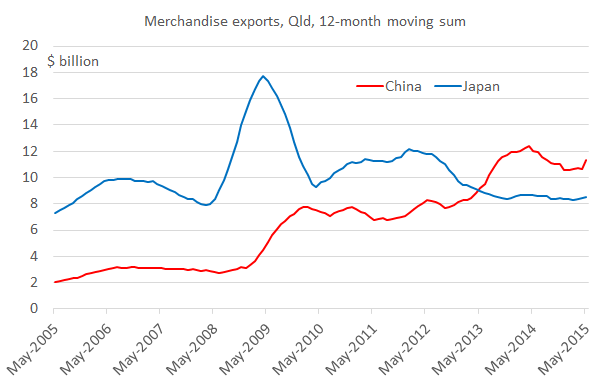
The news.com.au finance reporter Frank Chung is right to note the risks to Australia from a possible crash in China are much greater than the risks from the Greek crisis (see Chinese chaos worse than Greece). We are much more exposed to the Chinese economy than the Greek economy. Indeed, China is Australia’s largest trading partner, and indeed it is a big contributor to Queensland’s economy, having taken over from Japan in recent years as our largest export destination (see chart below, in which I haven’t bothered to plot exports to Greece because they are negligible). I’m reasonably confident Grexit won’t cause huge financial and economic turmoil, as the country is a minor player in the world economy and the fear of financial contagion is the result of over-active imaginations, but I’m less confident about events in China, which we need to watch closely.

exports_china_japan_May15

Posted in Macroeconomy, Trade | Tagged , , , , , , , | Leave a comment

Strong LNG-led export growth means Qld should record economic recovery in first half of 2015

exports_May15

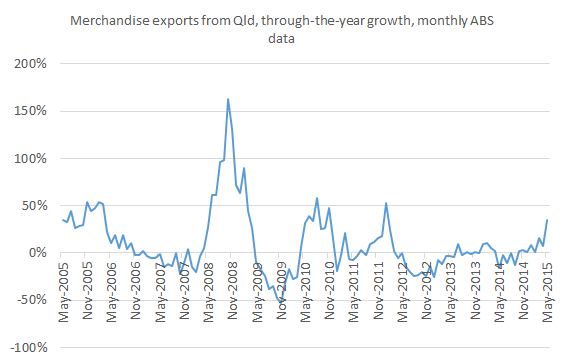
Queensland appears on track to record a recovery from the technical recession of the second-half of 2014, due to a large increase in exports in recent months, in part associated with the LNG now being shipped out of Gladstone (see chart above). The value of merchandise exports out of Queensland was 35% higher in May 2015 than in May 2014. While this looks small compared with the massive through-the-year growth rates recorded in late-2008, when Queensland benefited from super-high coal prices, it is still an outstanding performance and will no doubt provide some comfort to Queensland Treasury. A media release from Treasurer Curtis Pitt on Friday noted:

“Growth over the year was driven by increases in the value of minerals, coal and meat exports, as well as the continued ramp up of LNG exports”….

…“Coal exports rose 6.9 per cent over the year to $6.2 billion, while LNG exports from the Port of Gladstone have totaled $648 million so far in 2015.

Incidentally, Queensland Treasury will be presenting on the economic forecasts underpinning the upcoming State Budget at an Economic Society of Australia (Qld) seminar on Wednesday 15 July:

Great initiative from Qld Treasury to explain forecasts in Economic Society seminar

Posted in Exports, Macroeconomy | Tagged , , , , , , | Leave a comment

Ethanol mandate should not proceed without cost-benefit analysis

Before the Queensland Government commits to the 2 per cent ethanol mandate proposed in the biofuels discussion paper, it should commission a cost-benefit analysis to ensure that the costs the mandate will impose on motorists, estimated at over $4 million annually, are justified by the suggested environmental and regional development benefits.

It is very important that a cost-benefit analysis is done, because some back-of-the-envelope calculations suggest the ethanol mandate will, at a minimum, cost Queensland motorists $4 million per annum, and this cost will rise to nearly $7 million per annum when the new excise of 12.5 cents/litre applies to ethanol in 2020. It may be that the benefits of the ethanol mandate exceed the cost to motorists, but the Government should not commit to the mandate unless a cost-benefit analysis proves this is the case.

Any cost-benefit analysis would need to recognise the potential drawbacks of ethanol-blended fuels. The US Environmental Protection Agency has noted (see Economics of Biofuels):

Potential drawbacks include changes to land use patterns that may increase GHG emissions, pressure on water resources, air and water pollution, and increased food costs. Depending on the feedstock and production process and time horizon of the analysis, biofuels can emit even more GHGs than some fossil fuels on an energy-equivalent basis. Biofuels also tend to require subsidies and other market interventions to compete economically with fossil fuels, which creates deadweight losses in the economy.

All these factors would need to be considered in a cost-benefit analysis, along with the $4 million plus cost to Queensland motorists from an ethanol mandate.

The cost to motorists is estimated in the following way.

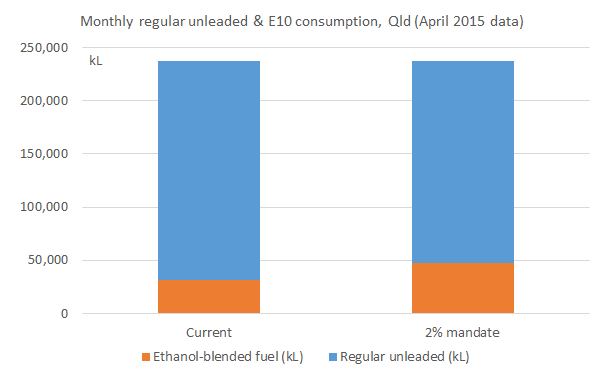
Currently, the ethanol content of the total volume of regular unleaded plus ethanol-blended fuel is around 1.3 per cent. Even though ethanol-blended fuel is around 13 per cent of the total volume of fuel, only 10 per cent of the ethanol-blended fuel is actually ethanol, and the rest is regular unleaded (i.e. as is typically assumed, we are assuming all the ethanol-blended fuel is E10, which appears reasonable given it is the dominant ethanol-blended fuel type).

Given the ethanol share is currently 1.3 per cent, the 2 per cent mandate would imply over a 50 per cent increase in ethanol-blended fuel consumption in Queensland or around an additional 16 mega-litres per month, based on April 2015 Australian Petroleum Statistics (see chart below). That is, ethanol-blended fuel would then have to make up 20 per cent of total regular unleaded and ethanol-blended fuel sales.

Now, the cost to motorists comes from the apparent saving on a litre of E10 being insufficient to compensate for the fuel efficiency loss. The price advantage of E10 to regular unleaded is only around 2 cents per litre (see p. 3 of the Biofuels discussion paper), a saving of less than 1.5 per cent at current fuel prices, compared with the fuel efficiency disadvantage of 3 per cent (i.e. E10 has 3 per cent less energy content than the same volume of regular unleaded). So currently any motorist who fills up with E10 is losing money, and must really value the purported environmental benefits of E10 to make it worthwhile. I estimate the loss to consumers per litre of E10 purchased at around 2 cents per litre, based on an assumed unleaded price of $1.45 per litre. This is consistent with the point made by the RACQ in its Ethanol-blended Fuels Policy April 2015:

In Brisbane in January 2015 the price of E10 was 2.3 cpl less than RULP. While E10 appears a cheaper fuel option, cars use about 3% more E10 compared to RULP [Regular unleaded petrol]. For most cars, the cost of increased fuel consumption will be greater than the savings from buying E10. At current prices, E10 would need to be 4.5cpl cheaper than RULP before it became more economical to buy.

In other words, the RACQ is saying the E10 would have to be around 2 cents per litre cheaper than it actually is for it to become economical to buy.

Based on an estimated 2.1 cents per litre loss on E10 fuel, and the additional E10 consumption required to achieve the 2 per cent mandate, i.e. over 16 mega-litres per month or around 195 mega-litres per annum, I estimate that the ethanol mandate would cost Queensland motorists over $4 million per annum. Hence any environmental or regional development benefits that the Government considers would justify the mandate have a significant hurdle to get over already.

To make things even more difficult, the annual loss would be expected to increase as excise is progressively applied to domestically produced ethanol and E10 becomes more expensive. My calculations suggest the annual loss to Queensland motorists from the ethanol mandate could be $6-7 million by 2020, as the excise potentially increases the cost of E10 by 1.25 cents per litre in 2020, according to the biofuels discussion paper (p. 3).

I have not even considered the possible substitution into premium unleaded by motorists that might occur if a particular service station has run out of (or will not stock) regular unleaded and the choice is between E10 and premium—a substitution that has occurred on a large scale in NSW as a result of its ethanol mandate. Arguably, many motorists who switch to premium unleaded may not value the improved performance, and the implications of this should be considered in any cost-benefit analysis.

I hope this note makes it obvious that a comprehensive cost-benefit analysis of the Queensland Government’s proposed ethanol mandate is required before any decision is made.

ethanol

Note: the above is a draft of a submission to the Queensland Department of Energy and Water Supply on the biofuels mandate, which I intend to lodge later today (Friday 3 July 2015).

Posted in Industry policy | Tagged , , , , , , , , | 2 Comments

Curtis Island LNG projects more-or-less doubled heavy construction activity in peak period

Engineering_Mar15

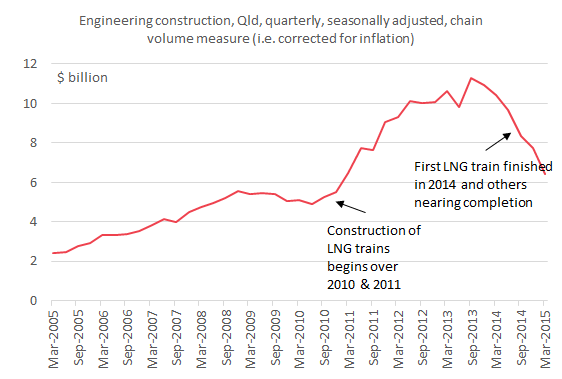
About the great American mountain-man Jim Bridger, Johnny Horton sang “That he was making history never once occurred to him.” I wonder if the men and women who have worked on the Curtis Island LNG plants have realised that they themselves have been making history. The huge scale of the projects, at around $70 billion in total over 5-6 years, has meant that they more-or-less led to a doubling of heavy construction activity in Queensland during the peak financial year of 2013-14 (see chart above based on latest ABS data for March quarter 2015 released today).

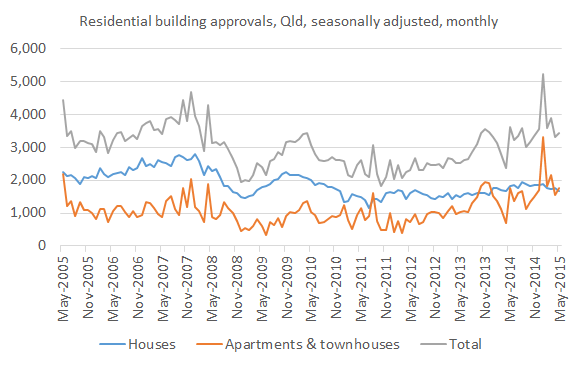
It is natural, therefore, that, as the projects wrap up, the level of engineering construction activity measured by the ABS declines. The large decline in engineering construction is, of course, a big shock to the economy, but, as I’ve commented previously, Queensland appears to be enduring the shock relatively well (see Qld economy enduring shock from end of mining boom as well as could be expected). The tick up in residential building approvals (seasonally adjusted) in Queensland in May (see chart below based on today’s new ABS data) also gives me confidence, although I’d note Pete Faulkner is less optimistic in his post on the new approvals data.

approvals_May15

Regarding the massive scale of the Curtis Island LNG projects, I’ve previously noted they are using the equivalent of 13 Eiffel Towers of steel (see my post on the 2013 Energy Skills Qld conference). See also:

What it takes to build $70 billion worth of LNG plants: Bechtel construction facts

Regarding the historic default by Greece on its IMF loan repayment, I’m reasonably confident that, even though its exit from the Eurozone appears inevitable, and financial markets will over-react, the Greek crisis is a sideshow as far as the global economic outlook is concerned, as I commented in my ABC radio interview on Monday.

Posted in Housing, Macroeconomy, Mining | Tagged , , , , , , , , , , | Leave a comment

Michael Willis on interstate migration – Qld may benefit from trickle-down of housing price booms in Sydney & Melbourne

Regular Queensland Economy Watch reader Michael Willis sent me his thoughts on the interstate migration issues I’ve been covering recently. His thoughts are posted below.

Your recent posts, confirming that public sector job cuts contributed to the turning of the tide in Queensland’s intestate migration, are deadly accurate. Allow me to suggest a few reasons why.

The professional and managerial sector is far more mobile than other employees, because of their skill transferability. Remember that many of these people have been recent migrants into Queensland themselves. So moving out is not a big problem for them, if their aspirations for their lifestyle and family cannot be met here.

Unlike the tradies who commuted by car from the Sunshine Coast and Gold Coast to near-subsistence jobs in Brisbane during the GFC and tourism downturns, these professionals are able to pull up stumps and take their families and spouses interstate to government and professional roles in Sydney and Melbourne more easily, often assisted by employer relocation expense reimbursements.

Further, the reduction in government spending on outsourced professional services – lawyers, accountants, business advisors and consultants – compounding the cuts in salaried public servants, has exacerbated this reduction in the state’s employment growth and economic energy. The availability of white collar clerical roles and some professional roles in Queensland professional services firms has been pulled right back, with professional services firms tightening their belts.

I also worry about the number of firms that were planning to expand in Queensland for the assets sales and privatisations being planned ahead of this year’s election – only to pull those plans or close their local offices. That is likely to mean an extended employment recession in the high-income and high spending end of the employment spectrum.

I would add that this group has a significant multiplier effect as a result of their redundancies and interstate migrations. They are (or were) large discretionary spenders, who spent their funds on private schools, child care, restaurants, housing improvements, holidays  and other discretionary items typical in the spending patterns of upper-middle income families.

The loss of their spending power has been very difficult for Queensland’s local economies, mainly in Brisbane and the major provincial centres. Private school enrolments are a great barometer of economic confidence, and anecdotal evidence is that growth in this schooling sector has slowed substantially, especially at the higher fee end of the market.

A perception in industry that the new government is not yet ready to run the state – whether true or not – is also not helping the confidence of businesses in Queensland, or their willingness to hire professional staff.

However, there are two potential bright spots that I see for our economy. One is the opportunity to attract tourism numbers from interstate and overseas as a result of the weaker dollar. The other is the possibility of a trickle-down effect of the housing price booms in Sydney and Melbourne. If we can convince some Southerners that Queensland is an affordable place to live, and there might be some good jobs here, we may recover a little faster than I fear is likely.

Some good news on the drought will also help rural Queensland, but that is in the hands of the gods, as they say!

We may not want to remember this message from the ill-fated Newman government, but we really need these other three pillars of the economy (tourism, housing construction and agriculture) to fire, because the mining sector, our fourth pillar, has run its course for a while.

And, as your earlier story notes, fiscal limitations have forced the hidden fifth pillar of Queensland’s economy, being our “government spending”, to be cut dramatically. Given our state and federal fiscal situations, I suspect this pillar will not fire up quickly either.

Michael Willis is a Senior Advisor at Effective Governance Pty Ltd. He is also the Honorary Treasurer of Independent Schools Queensland. The opinions expressed here are his own.

Michael Willis_4

Posted in Migration | Tagged , , , , , , | Leave a comment

Qld public service redundancies likely contributed to spike in migration to NSW & Victoria

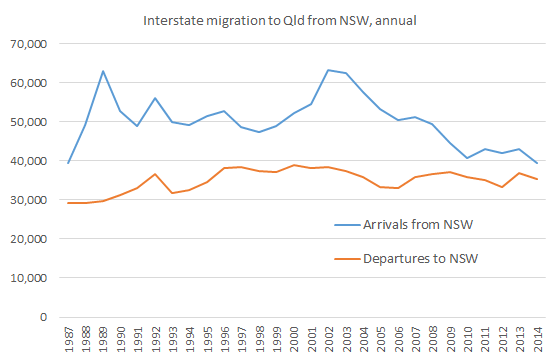
Following the ABC radio and online news coverage I received yesterday on the interstate migration issue, a friend of mine pointed out that redundancies in recent years, notably in the Queensland public service (which I thought were necessary for efficiency reasons, by the way), would have been a significant contributor to out-migration to southern states. Indeed, departures to NSW and Victoria experienced a spike in 2013, in the middle of the previous Queensland Government’s term of office (see charts below). It was the spike in departures to Victoria in 2013 that led Queensland to record a net loss of people to Victoria for the first time.

IM_NSW_Dec14

IM_Vic_Dec14

A big hat tip to my friend, affectionately known as Toad, for suggesting the importance of public service redundancies to the interstate migration patterns.

Posted in Migration | Tagged , , , , , , , , | 7 Comments

Queenslanders leaving for professional jobs in Victoria

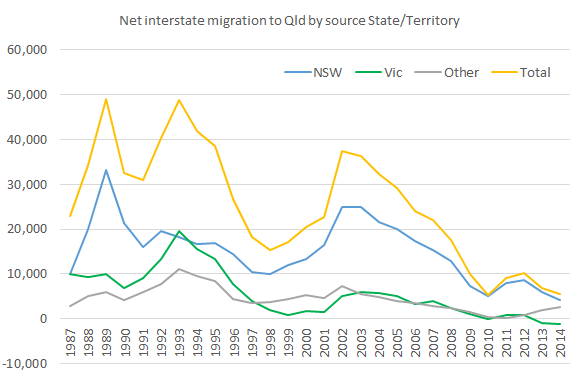
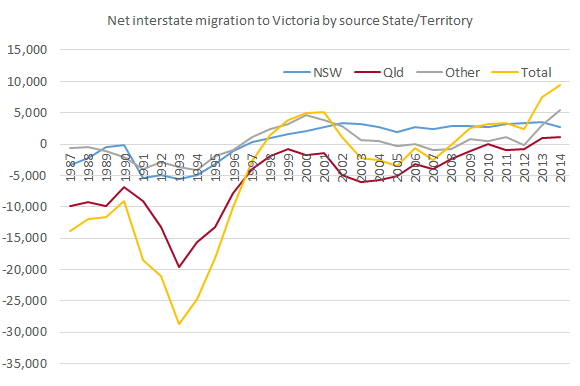
For over two years now, Queensland has been a net loser of people to Victoria, as the historically reliable net migration of people from Victoria to Queensland has reversed (first chart below). The conditions for mass migration out of Victoria into Queensland, such as a big gap between property prices and high unemployment in Victoria, are no longer there, and it appears Victoria’s advantages, such as lifestyle factors and professional jobs, are dominating. Indeed, Victoria is gaining people from all over Australia, and, as the ABS noted in a recent media release, 2014 was a record year for net interstate migration to Victoria (second chart below).

NIM_Qld_14

NIM_Vic_14

I suspect we could waste a lot of money in Queensland trying to match Victoria’s cultural and sporting attractions, so I wouldn’t recommend that, but I think we could improve our attractiveness to companies looking to locate or expand in Queensland by cutting payroll tax (and finding offsetting savings in expenses), for example. This, of course, would be politically very difficult, given the budget situation, so I don’t expect it would happen anytime soon.

But it appears highly desirable to improve our attractiveness to business investment. Otherwise, we’ll keep losing talented people who can find better employment opportunities outside Queensland. Over the five years to June quarter 2015, 16% of new professional jobs in Australia were located in Queensland, meaning we under-performed compared with our population share of around 20%.  In start contrast, Victoria over-performed, with 29% of new professional jobs in Australia compared with its population share of around 25%.

Posted in Migration | Tagged , , , , , , , | 2 Comments

QIC takeover of GOCs is a very bad idea

As suggested in the Courier-Mail this morning, it is possible the Queensland Government will try to appear it is meeting its fiscal strategy and paying down debt through some creative accounting, involving government-owned corporations (GOCs) (e.g. Energex, Stanwell, Gladstone and Townsville Ports) being taken over by the Queensland Investment Corporation (QIC). QIC could purchase or invest in the assets of GOCs using some of the money the Government has invested in QIC – some $30 billion of assets which are meant to cover the Government’s long-term defined benefit superannuation liability. I suggest this would not be a good use of funds the Government is investing to meet its long-term liabilities.

That said, I can understand why the Government might find the dubious idea attractive. A QIC takeover of GOCs could provide the Government with much-needed cash it could use to fund new infrastructure or pay down debt. Also, I suspect the Government would no longer have to report the debts of taken-over GOCs on the total government balance sheet reported in the Budget, because it relates only to the non-financial public sector, and the GOCs would now sit on the balance sheet of QIC, which is a public sector financial corporation. (I’d note the Government would no longer be able to count the dividends of the taken over GOCs in its operating statement, because they would now belong to QIC.)

The big problem I have with the QIC GOC takeover idea is that QIC should be making the best investments it can in order to ensure it gets the best possible return on the money the Government has invested to meet its long-term defined benefit super liability. But why would investing in a GOC the Government has directed QIC to purchase be the best possible investment? There would surely be much better investments than an inefficient GOC hamstrung by Government ownership. A QIC GOC takeover would compromise the Government’s ability to manage its long-term liabilities.

The only positive that might come from a QIC takeover of a GOC would occur if QIC forced the GOC to become more efficient and act like a privatised entity. But I suspect the Government would say this is not a privatisation and jobs in the GOC would be protected. So there probably wouldn’t be any efficiency gains from a QIC takeover. Also, I doubt such a move would enable Queensland to regain its AAA credit rating, as I doubt it would impress the ratings agencies, which would see right through it.

A QIC GOC takeover would be an audacious, tricky move and extremely bad policy. The Commission of Audit was right to have recommended the sale of QIC. It would certainly have prevented a dubious move of this sort. I really hope the Government isn’t considering this, because this is the type of thing that can give a government a reputation for financial mismanagement for years to come.

Finally, I’d note there is the slightly less creative tactic available of having the GOCs borrow more money and having them pay for new infrastructure or forcing them to pay the Treasury a bigger dividend, which allegedly occurred in some Queensland Budgets a decade or so ago. I can’t wait until 14 July to find out exactly what clever moves the Treasury has come up with to try to convince us the Government really is repairing the Budget, even though indications to date are that it won’t be able to improve the State’s financial situation in any real sense.

Posted in Budget | Tagged , , , , , , , | 2 Comments