GST much more efficient way to raise revenue than income tax

Flavio Menezes, Economics Professor at the University of Queensland, has an interesting piece at the Conversation fact checking a bold claim by federal MP Andrew Leigh that the GST is as economically inefficient as the income tax and less equitable as well. I think everyone agrees the GST is less equitable,  and hence a GST hike may require some compensation for low-income earners, so let us focus on the economic efficiency issue, on which I disagree with Andrew Leigh.

Flavio, however, concurs with Andrew Leigh, noting that he has correctly cited a recent Treasury finding regarding the economic efficiency costs (a.k.a. deadweight losses or excess burdens) of the GST and income tax, both around 20 cents for every dollar raised. These efficiency costs come from the distorting impact that taxes have on economic behaviour, particularly through decreasing the attractiveness of work relative to leisure, which both the income tax and GST do (as the GST raises the prices of goods and services purchased using income typically derived from working).

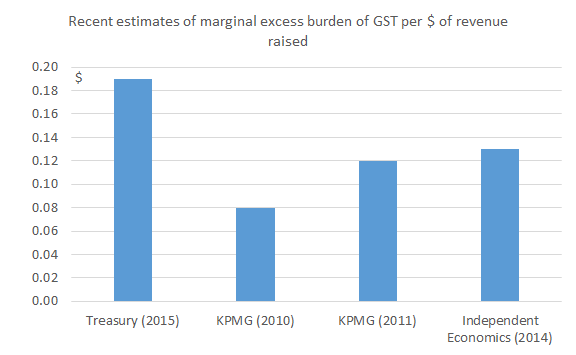
The problem with relying on the recent Treasury study is that, as the Treasury itself acknowledges in the paper, its estimate of the efficiency loss from the GST is much higher than previous findings (e.g. a range of 8 to 13 cents per dollar raised in studies from KPMG and Independent Economics as shown in the chart below). The Treasury cannot explain the reason for this discrepancy, noting rather obscurely (on p. 39 of the Treasury working paper) that “subtle variations in model calibration can affect the relative marginal excess burden of the GST.” My reading of the Treasury working paper is that the Treasury is not particularly confident in its finding. Hence, I would suggest that Andrew Leigh should not be relying on it to make such a bold claim about the GST.
meb_gst

It is clear from basic economic logic that a GST would be a more efficient way to raise revenue than the progressive income tax that Australia has. Economists have long known that raising revenue using a broader base with a lower tax rate is more efficient. This is because the efficiency cost of a tax increases more-than-proportionately with the tax rate, as John Freebairn notes in his review of Flavio’s fact check. For example, a 20 per cent tax rate has more than twice the efficiency cost of a 10 per cent tax rate. Broadly speaking, this is because as tax rates increase they start discouraging greater amounts and increasingly more valuable amounts of economic activity.

The virtue of the GST is that it extracts taxation revenue from a very large number of Australians using a relatively low tax rate. The vice of the income tax is that it extracts great amounts of revenue using a relatively high tax rate from a much smaller number of Australians than the GST. As the Treasury Secretary recently noted in his Australian Conference of Economists 2015 lunchtime address:

Currently, the top one percent of taxpayers who pay the top marginal rate contribute 17 per cent of all personal income tax.

And the top 10 per cent contribute 46 per cent of all personal income tax.

Over the next decade more Australians will move into the top tax brackets.

The proportion of taxpayers in the two highest tiers is expected to increase from 27 per cent to 43 per cent in 2024-25.

The Treasury Secretary noted that this discourages labour supply at the top end, encourages talented Australians to work and take their valuable innovations overseas, and encourages aggressive tax planning to minimise tax. It seems obvious to me that raising revenue through our current income tax regime comes at a very high cost, and that we should consider a change in the tax mix, with greater reliance on the GST.
Posted in Tax | Tagged , , , , , , , | 2 Comments

Lessons from John Howard’s GST reform suggest current tax reform process will most likely fail

At a panel discussion on tax reform in Brisbane last night, there were some important insights for the current taxation debate made by former PM John Howard’s economic adviser Peter Crone, Australian newspaper contributing editor Professor Judith Sloan, and Griffith’s Alex Robson. Peter noted that one of the motivating factors for the State Governments having accepted the GST in the late 1990s was that they were faced with a huge loss of revenue, some $5 billion, from a 1997 High Court case that ruled some so-called business franchise fees were actually excise taxes and constitutionally invalid for the States to impose. So there was a real urgent and obvious need for a GST from the perspective of the States. Given the lack of a similar historical context at the moment, in my view, any changes to the GST are highly unlikely, and indeed GST reform is being opposed by the Victorian Government, practically ruling it out in the short-term.

Peter provided five lessons based on his experience in John Howard’s office during the development and implementation of the GST:

  1. Use the economic and political cycle – i.e. do it when people are not anxious about the economy and the Government has political goodwill and vigour in its early years (my words in interpreting Peter’s point),
  2. Get the case right and use the evidence – i.e. do the number crunching and explain it to the public,
  3. Policy proposals have to be debated and there must be community consultation,
  4. Compensate the losers, but not too much – e.g. the Howard GST reform compensation package broadly matched the expected and ultimate CPI increase from the GST, and
  5. economic reform demands leadership, courage and communication – i.e. qualities that politicians of a past age such as John Howard and Paul Keating were blessed with, but which seem sadly lacking in today’s politicians (again, my words in interpreting Peter’s lesson).

Judith Sloan picked up on Peter’s last point and noted that she rejects the view politicians need to be careful they do not spend all their political capital on reform. She argued that instead they need to build up political capital by developing and prosecuting the case for reform. Judith also noted that with tax reform “the devil is in the detail”, and argued we need to distinguish between a debate over changing the tax mix (a legitimate debate) and increasing the tax burden (a debate we should not have, given the tax burden is already high).

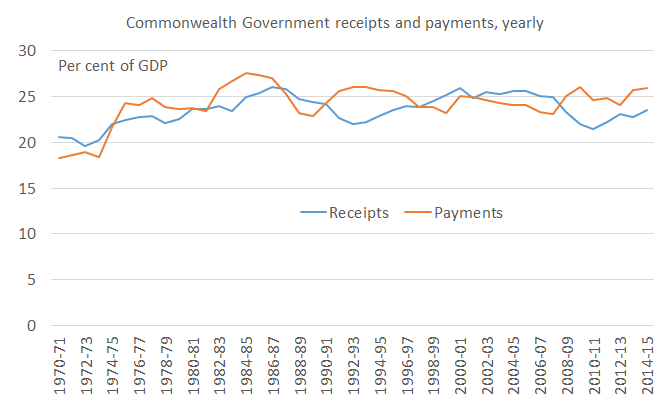
On whether Australia has a revenue raising or spending problem, Alex Robson earlier in the night reiterated the point he made at the Conference of Economists a couple of weeks ago that the problem is not revenue, which for the Commonwealth was around its long-term average (since the early 1970s) of around 23.5 per cent of GDP, but expenditure, which at around 26 per cent of GDP in 2014-15 has been higher than the long-run average of 24.2 per cent (see chart below).

Commonwealth_receipts_payments

Posted in Uncategorized | Tagged , , , , , , | Leave a comment

RBA to address ESA Qld seminar on recent labour market developments

wage_price_index_Mar_2015

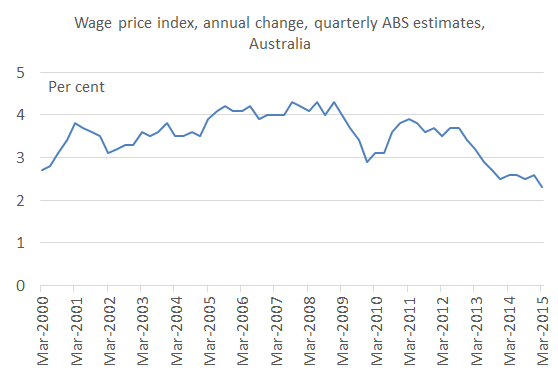
As Australia has experienced below-trend economic growth recently, and the unemployment rate has crept up to around 6 per cent, reducing the bargaining power of employees, wages growth has fallen (chart above). This in turn has contributed to relatively low inflation, giving the Reserve Bank of Australia some scope to cut the cash rate further, although it would need to consider the risk of further inflating the Sydney property price bubble. Given this context, it would be timely to hear from the RBA on recent labour market developments, and it so happens that a senior RBA official, Christopher Kent, is scheduled to address an Economic Society of Australia (Qld) lunchtime seminar on Friday 14 August:

Christopher Kent – Recent Labour Market Developments

The registration fee for the seminar will be $15 for members and $25 for non-members, which will help cover the costs to ESA (Qld), of which I’m the Secretary. You can register by getting in touch with the Secretariat (admin@esaqld.org.au).

Posted in Labour market, Macroeconomy | Tagged , , , , , , , , | Leave a comment

Qld Govt expenditure growth has resumed after extraordinary period of austerity

The debate over the 2015-16 Queensland Budget continues, with the Courier-Mail publishing an opinion piece by State Political Reporter Steven Wardill, Today’s problems in Queensland bigger tomorrow after Budget, say economists, quoting me and fellow economist (and friend and former colleague) Joe Branigan. I have previously expressed my concern about several of the Government’s budget measures, such as the accounting trick of transferring general government debt to government-owned businesses. Also, I’ve criticised unnecessary and avoidable expenditures (e.g. $100 million for the Townsville sports stadium) and the resumption of growth in public service numbers, at a rate of 3,000-4,000 extra public servants each year.

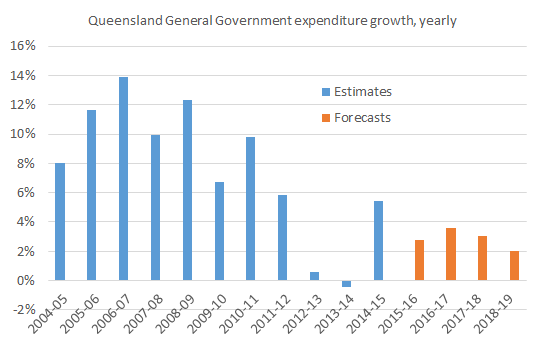
While forecast expenditure growth seems modest compared with the unsustainable growth over much of the 2000s (see chart below), in my view it should be much lower so the Government can generate the large surpluses it needs to substantially pay down debt. The previous Government showed that extreme expenditure restraint is possible, although two years of practically zero expenditure growth probably contributed to that Government’s eventual election loss, so I doubt any Government will be that courageous in the future.

Qld_gg_spending

Posted in Budget | Tagged , , , , , | 6 Comments

Right diagnosis from Qld Treasury on Qld’s debt problem, but wrong prescription

The Review of State Finances (see p. 80) produced by Queensland Treasury to inform the 2015-16 Budget is clear that Queensland Government “debt is too high.” The Treasury acknowledges that the State’s balance sheet is not “in a position to absorb a significant shock without a credit rating reaction and/or the need for corrective measures.” Treasury is also concerned that our borrowing costs could blow out when interest rates return to more normal levels.

Having acknowledged Queensland’s serious debt problem, oddly, the Treasury recommends a very slow, medium-term, ten-year debt reduction strategy, implying a lack of urgency and raising the likelihood the necessary debt reduction is never achieved. This is especially the case given the possibility of a shock within the next ten years that compromises our balance sheet (e.g. what if there is an economic or political crisis in China?). Treasury should have recommended strong expenditure restraint over the forward estimates and should have resisted the surge in public service numbers.

I was interviewed by Steve Austin on 612 ABC Brisbane radio yesterday morning concerning my reaction to the State Budget:

Queensland Budget reaction

Posted in Budget | Tagged , , , , , , , | Leave a comment

Qld economy propped up by residential building as business investment slumps

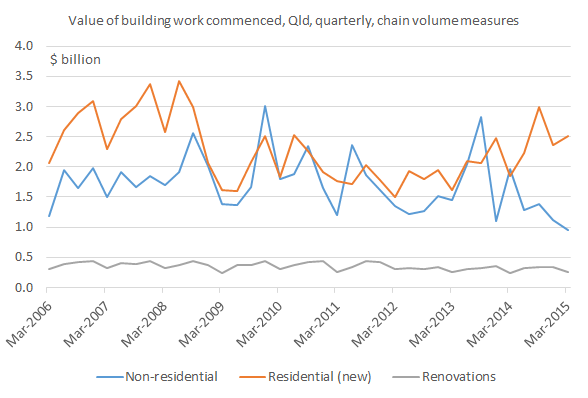
The Brisbane Times has a report this morning on the well-known slump in business investment in Queensland, due partly to the completion or near completion of the LNG projects at Gladstone and partly to relatively low business confidence (see Qld Budget papers show business investment nosedives). Fortunately, residential building is recovering (see chart below based on new ABS data released yesterday), and this is helping Queensland avoid a further economic downturn that would see the unemployment rate increase above the stable rate of 6.5 per cent that Queensland Treasury is forecasting for the next two years.

workcommenced_Mar15_chart1

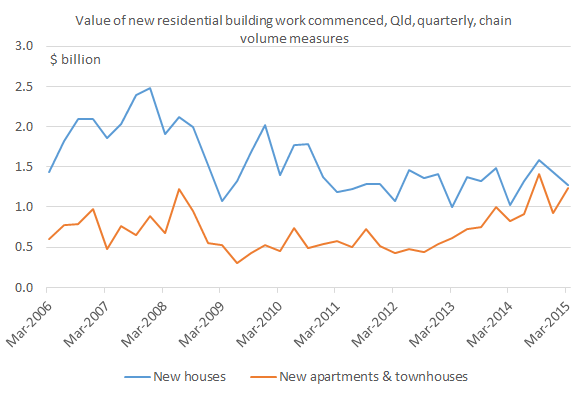
As you might expect from all the cranes over Milton, West End and Newstead in Brisbane, the residential building recovery is driven by construction of apartments and townhouses (see chart below).

workcommenced_Mar15_chart2

Posted in Housing | Tagged , , , , , , , , , , , , | Leave a comment

Qld Government opts for accounting tricks rather than true budget repair

In the 2015-16 Queensland Budget, the Government has shown it subscribes to the maxim that one might as well be hanged for a sheep as for a lamb. The Government is undertaking at least three measures of dubious merit, including the superannuation contributions holiday, tapping into money set aside for long service leave, and transferring $4 billion of debt to government-owned corporations (GOCs) from the general government sector. Further, the Government has flagged it is investigating the dubious option of investing funds set aside to meet the defined benefit super liability in GOCs, which I discussed on Steve Austin’s 612 ABC Brisbane radio program on Budget day.

As I’ve commented on Steve Austin’s program and on Ben Davis’s 4BC Drive program in recent days, the Government has failed to engage in the true budget repair that is required to get us out of the debt trap and restore our AAA credit rating. Instead, the Government continues to spend money on non-urgent, avoidable items (e.g. a netball centre and football stadium, as well as 3,000 extra public servants) and has resorted to shifting money around on its books to create the illusion of paying down debt, well at least general government sector debt which has been manipulated via dubious accounting measures. That is, the Government is resorting to sleight of hand, smoke and mirrors, or rearranging the deck chairs on the you-know-what. The failure of this Budget to address the State’s fiscal challenges is demonstrated by the total Government debt in 2018-19 projected to come in at close to $80 billion, at $78.8 billion. Regrettably, this Budget fails to address Queensland’s long-term fiscal challenges.

My 612 ABC Brisbane interview on Budget day is available from here:

Advancing Queensland through Curtis Pitt’s maiden budget

Posted in Budget | Tagged , , , , , , , | 2 Comments

QIC could still invest Govt super funds in GOCs, while Govt would argue it hasn’t technically raided super

I recalled a great scene from one of my all-time favourite movies All the President’s Men when the Queensland Government today issued what may be a “non-denial denial” regarding the alleged Budget plan to use super funds to pay down debt. The alleged Budget plan was first suggested in a Courier-Mail article a couple of weeks ago, an article which was the inspiration for a post of mine setting out how the Government might pull it off (see QIC takeover of GOCs is a very bad idea).

There is nothing in the Treasurer’s statement today that would rule out the Government indirectly taking advantage of the funds it has set aside for the defined benefit superannuation liability, using the means I described in my post from two weeks ago. That is, the Government could direct QIC, which it owns, to invest part of the $30 billion or so it has invested with QIC (to fund the super liability) in government-owned corporations (GOCs). For example, QIC might buy Gladstone Port or Townsville Port, or invest in Energex or Ergon.

QIC would pay the Government for its new assets using money currently invested to help meet the Government’s super liability, giving the Government cash to pay down debt. The Government would save on its interest bill, but dividend payments it could previously have used to help pay its expenses would now go to QIC and be saved and re-invested to help meet the Government’s defined benefit super liability. Further, QIC would have traded whatever return it was earning on the Government’s funds in alternative investments (e.g. shares) for the GOC dividends, and there is a big question about whether this would be a sensible investment strategy, as I discuss below.

The Government is correct to say super entitlements wouldn’t be affected, because it is legally required to pay the defined benefit super payments regardless. It could also argue it hasn’t withdrawn money from super, and that the funds it has invested in QIC remain the same, as QIC has simply substituted its new GOC investments for whatever investments it previously had the Government’s funds invested in. The problem, of course, is that investing in GOCs might not be the best use of the Government’s funds. As I noted in my previous post:

The big problem I have with the QIC GOC takeover idea is that QIC should be making the best investments it can in order to ensure it gets the best possible return on the money the Government has invested to meet its long-term defined benefit super liability. But why would investing in a GOC the Government has directed QIC to purchase be the best possible investment? There would surely be much better investments than an inefficient GOC hamstrung by Government ownership. A QIC GOC takeover would compromise the Government’s ability to manage its long-term liabilities.

There is a precedent for this plan in the Bligh Government having sold Queensland Motorways to QIC in 2011 for $3 billion. Queensland Motorways was later sold by QIC for $7 billion, but I wouldn’t expect any future QIC investments in GOCs to be anywhere near as profitable, especially given the Government’s aversion to privatisation.

I really hope the Government doesn’t do something tricky with the funds it has invested in QIC, but I think it’s still possible and not necessarily ruled out by today’s statement. Tomorrow will end the speculation, of course, and we will find out exactly what the Government has planned. It’s sure to be a very interesting Budget!

Posted in Budget | Tagged , , , , , , , , , , | Leave a comment

Government right to consider migration for aged care, child care and disability care jobs

UN_pop_projections

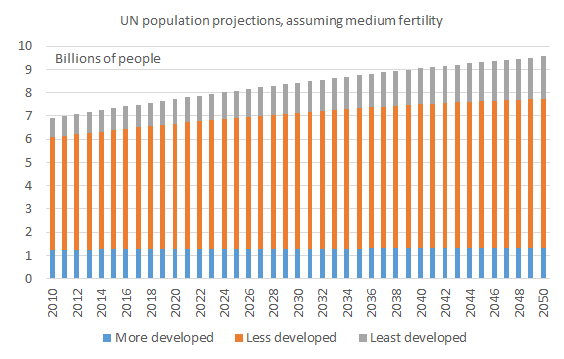
One of the most interesting things I did while at the Treasury was to help develop the program for the first G20 meeting in Australia, which was a workshop on Demographic Challenges and Migration, held in Sydney in August 2005, and chaired by my Executive Director, Dr Martin Parkinson. The workshop made it abundantly clear to me that the growing demographic imbalance in the world, between the developed economies, with slowly growing or declining populations, and the developing economies, with much faster growing populations, implied a huge win-win opportunity for greater labour mobility (see chart above).

In coming decades, the rich, developed economies face a shortage of workers, particularly taking into account the growing demand for carers associated with ageing populations, while developing economies will have a surplus of workers, who could fill jobs in developed economies and benefit their home nations through remittances and eventually knowledge transfer. This, of course, requires a more enlightened attitude and more liberal policy settings regarding international labour mobility and migration.

Hence, I welcomed the news I read in the Sunday-Mail this morning that the Commonwealth Government has asked the Productivity Commission to investigate the merits of boosting migration, permanent and temporary, to meet future labour needs, particularly in aged care, child care and disability care (see Importation of migrants considered for aged, child and disability care roles).

A high-level discussion of the issues relating to enhancing international labour mobility as a means of correcting demographic imbalances is contained in the summary note Treasury prepared on the G20 workshop in Sydney, a note I had a part in drafting:

Demographic challenges and migration

Posted in Migration | Tagged , , , , , , , , , , , | 7 Comments

Accounting trick wouldn’t improve Qld Government’s real financial position

Today’s Courier-Mail features an exclusive from State Political Reporter Steven Wardill on “Pitt’s Debt Trick.” It suggests the Government intends to transfer $4.1 billion of debt from the General Government sector (i.e. the government agencies such as health and education) to government-owned corporations (GOCs), particularly the energy companies. This will allow the Government to reduce the interest bill in the General Government sector by a reported $600 million over the next four years, allowing it to report a better budget balance, even though it would simply transfer the interest bill with the debt to the energy companies. The debt and associated interest bill haven’t disappeared, and the Government’s real financial position hasn’t improved.

While the Government can argue it is General Government debt that really matters, because GOC debt is covered by the earnings of the companies, this does not mean that any debt originally incurred by the General Government sector and transferred to GOCs doesn’t matter. The debt in question was originally incurred to help cover budget deficits in the General Government sector, and has not at all provided any capital to the GOCs that could generate a rate of return. So the Government has increased the debt of GOCs and their interest bills without actually giving them any additional capital that might earn a return to pay the interest bills.

The Government has two genuine ways available to improve its financial position, assuming no tax increases:

  • carefully managing expenditures to improve its budget balance; and
  • improving the efficiency of GOCs to cut costs so they can pay the Government higher dividends.

Accounting tricks such as the one reported on the front page of the Courier-Mail are not genuine. They do not improve the Government’s real financial position. Suspicious people may consider it “smoke and mirrors”, and, at the moment, it is hard to think that it isn’t.

It may well be the case that the energy companies have lazy balance sheets with relatively low debt and there is scope to increase their gearing. But that should be a business decision. It shouldn’t be driven by a political need to appear compliant with a possibly unachievable fiscal strategy given the write-down in royalties.

The Government will find it very hard to convince the public that this is sensible policy and that it has a real plan to improve the State’s finances. Queensland needs genuine budget repair, not accounting tricks.

Posted in Budget | Tagged , , , , , | Leave a comment