Good & bad news on Qld economy – avoids worst effects of property bust, but remains reliant on gov’t spending

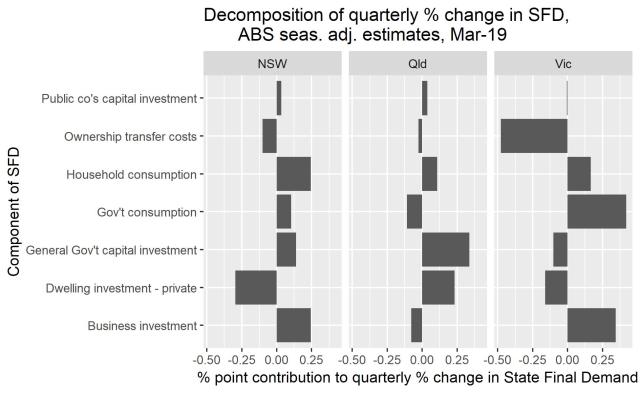
Queensland state and local general government capital expenditures increased 13% in March quarter, rising to $2.79 billion, helping Queensland to record 0.5% growth in State Final Demand, the second highest growth rate in Australia (second to Tasmania with 0.7%). Part of the increase in state and local capital expenditure was probably related to recovery from the floods in North Queensland earlier this year. Queensland’s State Final Demand increase of 0.5% was higher than increases of 0.4% in NSW and 0.2% in Victoria, according to the latest ABS National Accounts estimates, which have been widely reported as showing a sluggish Australian economy. My former Treasury colleague John Kehoe, now a Senior Writer at the AFR, sums it up nicely in his article Soft GDP needs consumer pick up:

Government spending and resources exports are keeping Australia afloat, but domestically the rest of the economy is pretty soft.

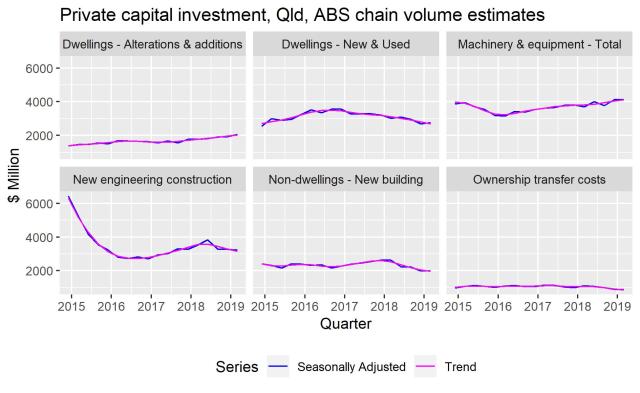
One of the problems the Australian economy is facing is the property market bust. We have seen falls in dwelling investment, and also in commissions for real estate agents and stamp duty, which are picked up in “Ownership transfer costs”. Queensland, luckily, never experienced the huge property boom that occurred in southern states, so we have managed to avoid much of the pain from the bust. While there was over-investment in inner city apartments, the state’s population growth has helped absorb any excess supply, and dwelling investment now appears to be picking itself up and is contributing to economic growth once more (see chart below). Both investments in new dwellings and in alterations and additions to existing dwellings increased in March quarter. Partly, increases in dwelling investment could be related to recovery from the floods, but I suspect that would only be a small part of the story.
contr_Mar19

While the dwelling investment story is an encouraging one for Queensland, we aren’t seeing any growth in capital spending by businesses (see the chart below), and indeed business investment fell 0.6% in the March quarter. Once again, the Queensland economy is demonstrating it is too reliant on government spending and population-growth-induced housing construction. The state government should review the full suite of its policy and regulatory settings that could be inhibiting business investment. I feel the issue is a broader one than simply the alleged opposition of some members of Cabinet and the bureaucracy to the Adani Carmichael mine.
cap_Mar19

For other commentary on the ABS National Accounts figures from Queensland econ-bloggers, see:

Pete Faulkner’s post GDP slows again in Q1-Qld relying on the public sector

Nick Behrens’s post Qld’s domestic economic activity-March quarter 2019

Posted in Macroeconomy, Uncategorized | Tagged , , , , , | 2 Comments

Pro Bono Econos UQ reading list

Last Friday, I was a panelist at a Pro Bono Econos UQ event on consulting. In my remarks, I mentioned a bunch of resources I thought would be helpful for students, and subsequently several of the students who attended have asked for a list, and hence I’ve prepared this post.

pbeconuq

In my remarks, I emphasised to the students that consulting is simply one means of making a living as a professional, and their focus should be on getting really good at their chosen profession, whether that be economics, accounting, finance, or whatever. In this regard, I mentioned my two favourite books on reaching higher levels of performance:

So Good They Can’t Ignore You by Cal Newport

Tools of Titans by Tim Ferriss

Then I observed that, no matter how good you get, problems will inevitably arise from time-to-time, and one great challenge you may face is coping with stress. So I recommended students consult what I think is the most practical guide to coping with stress I’ve found:

How to Stop Worrying and Start Living by Dale Carnegie

This book emphasises the importance of ‘living in day-tight compartments’. Carnegie opens the book with a story about how a future Oxford medical professor’s life was changed for the better as a young man in 1871 when he read and understood these words from Thomas Carlyle:

Our main business is not to see what lies dimly at a distance, but to do what lies clearly at hand.

As Carnegie notes, many centuries earlier, Jesus had expressed the same wisdom in the Sermon on the Mount:

Take therefore no thought for the morrow: for the morrow shall take thought for the things of itself. Sufficient unto the day is the evil thereof.

I told the students that careers can survive even huge mistakes, as the great man of the twentieth century Winston Churchill proved, so you need to keep things in perspective. For an analysis of Churchill’s many failures, including Gallipoli in 1915 and the restoration of the Gold Standard in 1925 among others, I recommend Boris Johnson’s excellent book:

The Churchill Factor

In the Q&A session at the event, one student asked me if I thought economists were still influential in this current age of populism. I began my response by noting that economists are critical in the modern mixed economy, and I said that has been the case since the Great Depression in the 1930s, and I recommended they watch John Kenneth Galbraith’s excellent TV series from the late-seventies, particularly the episode on John Maynard Keynes:

The Age of Uncertainty, episode 7: The Mandarin Revolution

Then I went on to say that the current US-China trade war provides a major opportunity for economists to be influential, as the trade war is contrary to basic economic principles. In my view, economists can be influential despite populism, but they need to sharpen their communication and presentation skills. Milton Friedman was probably the most articulate and persuasive advocate for free trade in living memory, and I recommended this episode of Friedman’s early 1980s TV series Free to Choose, an episode which featured Donald Rumsfeld, Jagdish Bhagwati, and Helen Hughes as discussants in the episode’s second half:

Free to Choose, part 2: The Tyranny of Control

Finally, I noted widespread concerns over the very narrow, highly theoretical training of modern US economists and why it’s important to remain practical. During the financial crisis, only a few US economists, such as Paul Krugman, Larry Summers, and Brad Delong, were able to speak intelligibly about the crisis, as the models many other US economists were working with were deficient. A few years ago, Paul Romer wrote an excellent paper on the The Trouble with Macroeconomics which is well worth reading.

I would also refer students to my posts:

The 7 habits of highly effective economists (1-3)

The 7 habits of highly effective economists (4-7)

Recommended reading: This is Marketing by Seth Godin

Posted in Uncategorized | Tagged , , , | Leave a comment

City of Brisbane Investment Corporation should be shut down

In a victory for transparency, Brisbane ABC reporter Tim Swanston has finally got hold of PwC’s scathing review of Brisbane City Council’s City of Brisbane Investment Corporation, its so-called future fund. I recall discussing the rumoured existence of a damning review of the CBIC with Tim when he covered my views on CBIC in March last year (see this ABC News report). Fourteen months later and BCC has finally had to hand the PwC review over to the ABC.

In his just published article Brisbane City Council investment arm a ‘substantial risk’ to ratepayer money, report says, Tim reports:

The Brisbane City Council’s investment arm is facing calls to be shut down, with Right to Information documents revealing “fundamental and systemic issues” with the fund and a “substantial risk” to ratepayer money…

…The document, by financial services firm PwC, warns the fund’s board has limited property expertise and there is a risk ratepayer money might be lost.

Great work getting hold of that report, Tim. It’s time for BCC to shutdown CBIC. For more of my views on the CBIC, see my post from last year:

CBIC’s peculiar investment philosophy

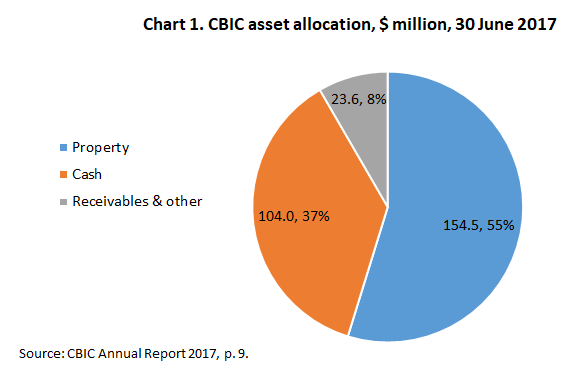
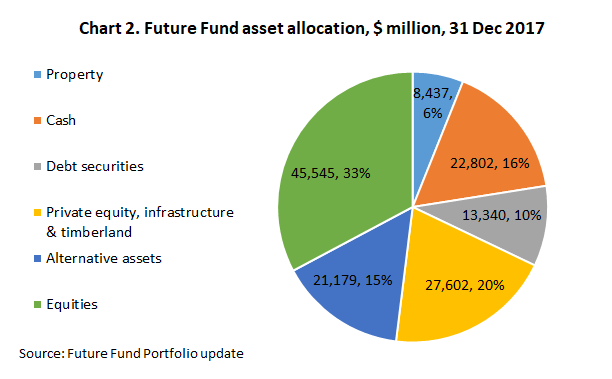
In that post, I noted that a comparison of CBIC to the Australian Government Future Fund is inaccurate, as the CBIC is heavily invested in property and nowhere near as diversified as the Future Fund (see charts below, which I need to update with the latest data, although the story won’t have changed).

Chart1_CBIC

Chart2_FutureFund


Posted in Brisbane, Uncategorized | Tagged , , , | Leave a comment

Trad’s Cross River Rail & state budget plans wrecked by Coalition victory

Queensland Deputy Premier and Treasurer Jackie Trad and her senior Treasury officials will be vexed by the implications of the shock federal Coalition victory yesterday for Cross River Rail funding and the state budget. I expect Trad and state Treasury were counting on a couple of billion dollars from a Shorten federal government to help pay for Cross River Rail. The state government will now have to borrow more money if Trad wants to fund the project. On Friday, Mark Ludlow from the AFR speculated:

Prime Minister Scott Morrison’s decision to deny funding for Queensland’s number one infrastructure project, the $5.4 billion Cross River Rail in Brisbane, could hurt the Coalition as it attempts to hold a string of key seats in the state’s south-east corner in Saturday’s election.

When Bill Shorten and Labor last year committed $2 billion to the congestion-busting project in Brisbane’s CBD, there was an expectation the Coalition would eventually match it, even as late as during the election campaign.

It appears that very few Queenslanders care about Cross River Rail in inner city Brisbane. Many more Queenslanders were obviously concerned about proposed changes to negative gearing and the taxation of capital gains, and the refundable nature of franking credits. Labor’s perceived opposition to the Adani mega mine also appears to have played a role in its defeat in regional Queensland.

The federal election result is devastating to Trad’s fiscal plans. Given that recent upward revisions to coal royalties (see this QRC media release) have been offset by reductions in stamp duty revenues associated with a slowing property market (see this ABC News report), I expect the state government is still on a path to $80-85 billion of debt in the early 2020s. Trad has been relying heavily on a change of federal government and will now have to revise her plans. The state budget is due to be handed down on Tuesday 11 June. State Treasury officials should be expecting some long days at the office over the next few weeks.

crr_map

The Cross River Rail project in inner city Brisbane

Posted in Budget, Transport | Tagged , , , , , , , , , , , , | 2 Comments

Qld Premier’s Export Awards launch at the Tower of Power

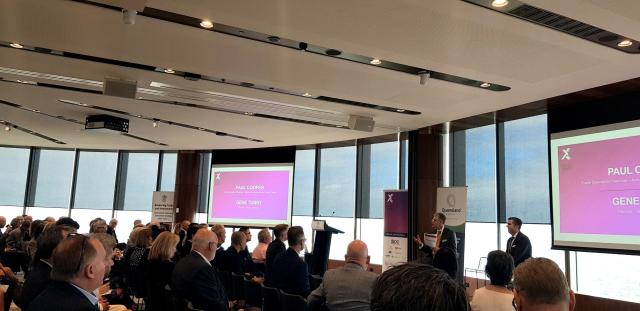
I had a great time helping launch the Premier of Queensland’s Export Awards 2019 at 1 William St, a.k.a. the “Tower of Power”, in Brisbane earlier this week. Paul Cooper, Chairman of the Advanced Manufacturing Growth Centre, and I spoke about technological and economic developments affecting exports, after being introduced by acting CEO of Trade and Investment Queensland Paul Martyn. I referred, of course, to the extraordinary growth in exports we’ve seen over the last few years in Queensland, largely but not entirely due to coal and LNG, with yearly merchandise exports having grown from around $50 billion three years ago to nearly $85 billion today. Add in services exports such as tourism and international education and exports are nearly $95 billion.

event

Paul Cooper of the Advanced Manufacturing Growth Centre addressing the audience at the Premier of Queensland’s Export Awards 2019 launch at 1 William St, Brisbane, Monday 13 May. I spoke after Paul.

I told the audience some of the lessons I’ve learned working with successful exporters. For example, I talked about Queensland’s sole synthetic turf manufacturer Urban Turf Solutions, which is rapidly growing its NZ exports and looking to expand even further internationally. The lesson I took from UTS is that to be a successful manufacturer and exporter in Australia, you need to invest in R&D and in optimising your production process to ensure your product is as high quality as possible. For instance, UTS has undertaken R&D to test the water permeability and surface temperature in use of its product.

I also referred to a vertically-integrated NSW-based beef business I’ve been working with, and noted that one of the ways it distinguishes itself is by demonstrating the provenance (or traceability) of its product, from “paddock to plate”. The business has its own stud farm, feedlot and it has an abattoir prepare its beef under contract so it can sell it as a premium branded product. The Chinese market is hugely important and hence the business has an office in Hong Kong. The growth of the Asian middle class obviously offers huge opportunities for agribusiness, and the Wagner Wellcamp Airport at Toowoomba can be an important element of taking advantage of those opportunities. I noted that the state government has encouraged the Wagner Group to prepare a business case for an Agricultural Export Centre at the airport to assist in that endeavour (see this Media Statement).

Of course, I couldn’t have finished speaking without referring to the US-China trade war, regarding which I share the pessimism of many economists regarding its possible adverse global economic repercussions. However, I should note that, while the macroeconomic impacts are expected to be negative, it may well be the case that some Australian exporters can benefit from the US-China trade war. Scott McDouall, GM of Meat & Livestock at Mort & Co., a previous Premier’s Export Awards winner, said that Mort & Co. has increased its exports to China as a result of Chinese customers buying less US product.

Incidentally, I noted the current trade war illustrates a basic lesson of economics that we’ve known since David Ricardo, and which was perhaps best explained by Milton Friedman (e.g. in Episode 2 of Free to Choose), that tariffs can end up hurting your own country just as much as other countries. Thousands of US solar installation jobs have been lost and US soybean exports have fallen 75%, from $12 billion to $3 billion annually, as reported recently by the Financial Times (pay-walled, sorry).

In conclusion, if you export your goods or services overseas, you should consider applying for the Export Awards. There are 16 award categories, including categories for small businesses, emerging exporters, creative industries, and agribusiness, among others, so there should be an award you can apply for, no matter what you export or your level of turnover. As I noted in my closing remarks, given their large economic contributions in terms of value added and jobs, and in earning the foreign exchange that helps us all buy imported goods, our exporters deserve our praise and respect.

Posted in Exports, Uncategorized | Tagged , , , , , , , , , , , , , , , , | Leave a comment

Suncorp-CCIQ Pulse Report reveals “trepidation of a change in the Federal Government” felt by many Qld businesses

In the lead up to the federal election, the Chamber of Commerce and Industry Queensland (CCIQ) has included some bold commentary in its latest Suncorp CCIQ Pulse Survey report (on p. 16):

The key factor influencing sentiment within the Queensland small business community during the March quarter was emphatically the trepidation of a change in the Federal Government.

Quotes from businesses included in the report suggest federal Labor is generally perceived as less business-friendly than the Coalition, and at least one respondent appeared concerned about the Opposition’s policies on minimum wages and penalty rates.

The Courier-Mail in its article The business stats of “serious concern”: Report nicely summarised the CCIQ report’s findings yesterday:

HALF of Queensland’s small and medium businesses saw profits fall in the first three months of this year.

The latest Suncorp-CCIQ Pulse survey, released today, shows that business confidence is continuing to languish in the doldrums.

The survey of 400,000 firms found 51 per cent reported declining profitability in the March quarter.

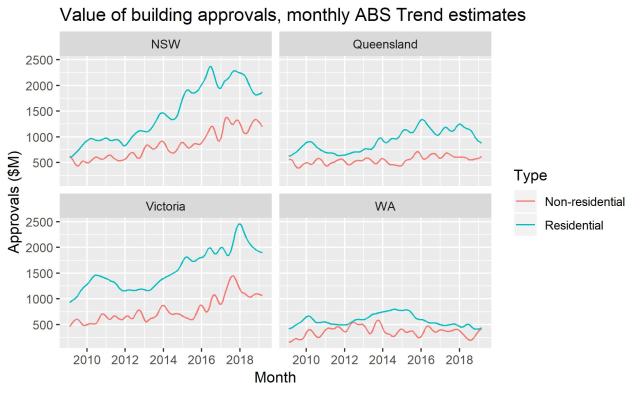
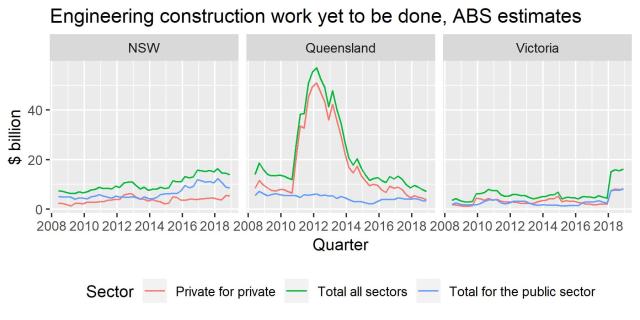
These findings are unsurprising to me. As I’ve noted in several presentations this year, leading indicators of activity, such as levels of business approvals and expected heavy construction activity, have been discouraging. Here are the latest building approvals estimates from the ABS up to March:

res_vs_nonres_Mar19

And here is engineering construction work yet to be done (but intended to be done) in December quarter last year.

Eng_wytbd_Dec18

Well done to CCIQ for releasing such a frank and fearless report representing its members in the middle of an election campaign.

Posted in Housing, Uncategorized | Tagged , , , , | Leave a comment

ABC Brisbane radio interview on Qld Councils

I had a nice chat with 612 ABC Brisbane’s Steve Austin on his Drive program yesterday afternoon regarding my most recent post New round of council amalgamations should be considered following Logan & Ipswich sackings. I began by telling Steve that, when I first heard the news about Logan, Rahm Emanuel’s dictum came to mind, that “You never want a serious crisis to go to waste.” You can hear my conversation with Steve from 46:20 at:

612 ABC Brisbane Drive program – Friday 3 May 2019

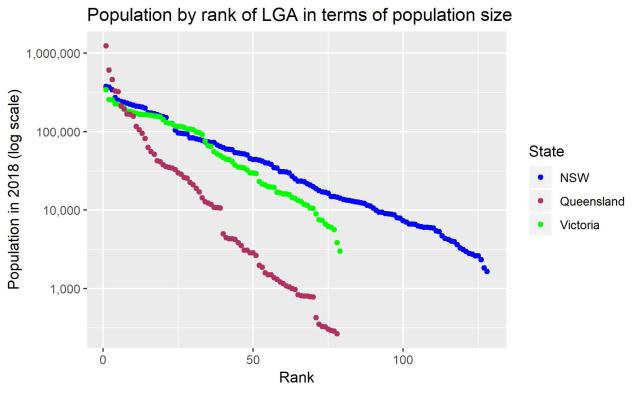
Regarding Queensland’s disproportionate number of tiny councils, one of the issues discussed in our conversation, consider the scatter plot below.

LGA_pop_scatter


Posted in Uncategorized | Tagged , , , , , , , , | 2 Comments

New round of council amalgamations should be considered following Logan & Ipswich council sackings

Queensland now has two councils, Logan and Ipswich, with state government-appointed interim administrators. The stench of corruption coming out of both council chambers was overwhelming, and Local Government Minister Stirling Hinchliffe has acted appropriately in both cases, appointing Logan’s interim administrator today and Ipswich’s in August last year.

Listening to Steve Austin’s 612 ABC Brisbane Drive program this afternoon, I was fully in agreement with one interviewee who highlighted the problem of declining media coverage of local government matters. Not enough light is being shone on many councils.

We all know that the internet has undermined the business models of traditional media. Newspapers we once relied on for coverage of local politics, such as the Courier-Mail and the Queensland Times, have shed many staff over the last decade, and their coverage of local politics has suffered accordingly. We have the ABC, for sure, and Tim Swanston has been doing a great job of keeping an eye on Brisbane City Council (BCC)—indeed Tim interviewed me following my criticism of the City of Brisbane Investment Corporation last year—but there is generally insufficient coverage of most other councils in Queensland, until the stench of corruption is too strong to ignore.

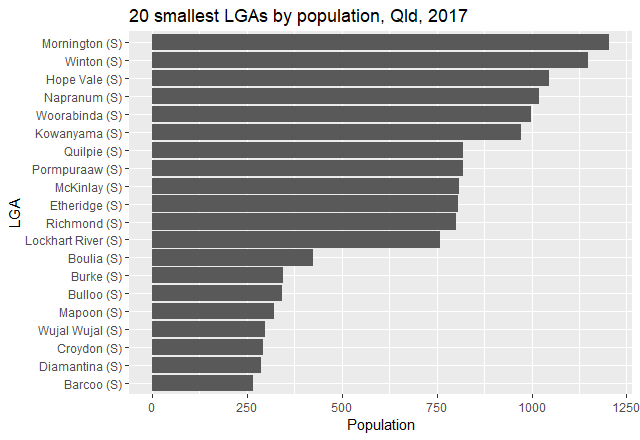
Queensland needs fewer councils and fewer local politicians. With fewer and larger councils, it would be easier for journalists, ratepayers associations, bloggers, and other concerned citizens to keep an eye on them. Since I started blogging in 2010, I have advocated for more council amalgamations. Queensland has too many small, financially vulnerable councils, so it would be a good start to amalgamate many of these (see chart below).

Pop_post_chart_2b

Ipswich and Logan, of course, are not small councils. They have several hundred thousands of residents. It appears that even councils of that size are not subject to  sufficient public scrutiny, and, hence, they are at significant risk of corruption. It may be desirable to have much larger councils, each covering at least one million residents, as BCC does, in which case we should start thinking about regional governments, rather than local governments. Perhaps we could divide Queensland into a handful of regional governments and do away with local governments altogether. I myself have previously commented extensively on the prospect of a new state of North Queensland (see the ABC news article on “Nexit”).

The current local government debacles should prompt us to consider whether there are more desirable governance arrangements than those we currently have.

On the need for a new round of council amalgamations, see my posts:

Council amalgamations may not have gone far enough

Qld councils and the 80-20 rule

Regarding my criticism of the City of Brisbane Investment Corporation, see my posts:

City of Brisbane Investment Corporation’s peculiar investment philosophy

4BC Dora the Explorer interview and ABC News coverage of my CBIC analysis

Posted in Uncategorized | Tagged , , , , | 4 Comments

Forty years after Thatcher’s election – CIS event in Brisbane on Thursday 2 May

This Friday, the 3rd of May, is the 40th anniversary of the 1979 UK election which saw Margaret Thatcher become Prime Minister. It is doubtful that any UK Prime Minister since Thatcher will loom as large in our collective memory in forty years’ time as Thatcher still does today—certainly not Tony Blair who has been disowned by his own side of politics due to the Iraq war.

Thatcher’s government led the way worldwide with the privatisation of government-owned businesses such as British Telecom and British Airways, and her “big bang” financial deregulation in 1986 helped secure London’s role as the preeminent financial centre in Europe. Australia was one of the many countries that was influenced by Thatcher.

Thatcher’s rise to power was almost inevitable given the industrial chaos Britain experienced in the late 1970s, particularly during the so-called “winter of discontent” in 1978-79. The photos from the time of Leicester Square being used as a rubbish dump, because the garbage men among other public sector workers were on strike, are almost unbelievable today.

Thatcher also capitalised politically on the “stagflation”, the pernicious combination of high inflation and high unemployment, that afflicted Britain and other advanced economies in the 1970s. The Conservatives’ “Labour isn’t working” billboards with an image of a long dole queue were devastatingly effective.

It turned out Thatcher’s economic cure, a heavy dose of Monetarism, was almost as bad as the disease. The monetary squeeze brought down inflation from over 20% when Thatcher assumed office to around 5% by 1983, but the cost was even higher unemployment, at around 12%. Leading economists who have studied Thatcher’s monetarist experiment have concluded that the policy was a huge blunder. It could have been even worse if Thatcher hadn’t decided on a change of course in Autumn 1981, a story told by Welsh MP Hywel Williams in an illuminating 2007 Guardian article The Lady was for turning.

The Thatcher-era remains of immense interest to economists, and hence I am very glad the CIS is hosting events exploring Thatcher’s legacy in Sydney and Brisbane this week:

Forty years after Thatcher’s election

At the Brisbane event on Thursday 2 May, to be held at the Ovolo Inchcolm Hotel on Wickham Terrace, CIS Executive Director Tom Switzer will interview Tim Montgomerie, a British conservative commentator and activist and former editorial page editor of The Times, regarding Thatcher’s legacy. The blurb for the event notes:

With Britain’s ruling Conservative Party in disarray, and against the backdrop of a chaotic British exit from the EU, there is a real danger that Britain is lurching to the left. Join us to get an in-depth analysis of the British Conservative crisis and the rise of millennial socialism, at this event in Brisbane.

It’s sure to be an illuminating and entertaining discussion which I’m very much looking forward to. Ticket sales end very soon so book today if you’re interested in attending.

Margaret_Thatcher_cropped2

Photo by Chris Collins / Margaret Thatcher Foundation, CC BY-SA 3.0, https://commons.wikimedia.org/w/index.php?curid=5197479

Posted in Macroeconomy, Uncategorized | Tagged , , , , , , , , , , | 2 Comments

My comments in Saturday’s Courier-Mail on payroll tax concessions—e.g. for BrewDog & Disney

With the possible exception of President Trump, the most interesting American politician at the moment is the millennial, freshman member of the House from New York, Alexandria Ocasio-Cortez (AOC). She is one of the main players is what The Economist earlier this year described as “The rise of millennial socialism”. AOC has been criticised heavily by conservatives for her proposed Green New Deal and her apparent belief in so-called Modern Monetary Theory. But at least one of her policy positions has been sensible from an economic perspective: her rejection of tax breaks and other financial incentives to lure big companies to invest in particular regions.

Rightly, AOC opposed NYC and NY State offering Amazon $3 billion in financial incentives to build its second headquarters in Queens. Now that HQ is going to be built in Arlington, Va., but AOC was right to oppose the deal. Regional governments around the world need to stand up to the game-playing corporations who are trying to play different governments off against each other to secure the best financial incentives they can.

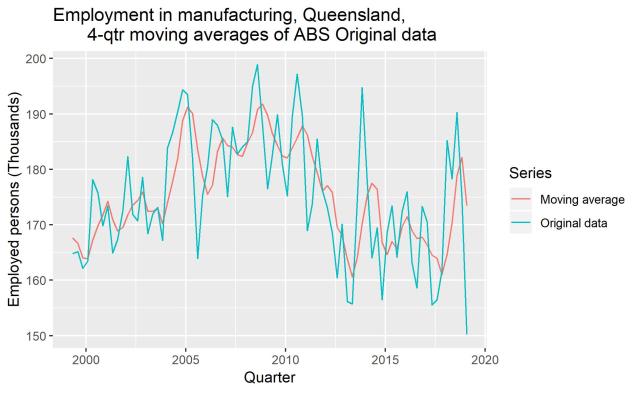
Unfortunately, the Queensland government has, from time-to-time, given in to the demands of companies for financial sweeteners to induce them to invest here. As I recently mentioned to Steven Wardill from the Courier-Mail, who quoted me in his article Manufacturing sector sheds 18,000 jobs under Palaszczuk Government (also see figure below), it has been a failed strategy:

Mr Tunny said the Palaszczuk Government was going the wrong way about creating the private sector jobs needed to pay for an ageing population.

“They are doing things through payroll [tax] like discounts for movie studios and breweries,” he said.

“Yet the way to do it is through the education system.

“We need to encourage young people to be innovative because they are the ones that are going to create the new industries.”

For a good example of the failure of industry attraction efforts, consider that, in 2001, the Beattie government provided financial incentives to lure Berri Fruit Juice to move some of its manufacturing operations to the state, but 12 years later Berri shut down its juice manufacturing operation in Queensland (see p.28 of the QCA’s excellent 2015 Industry Assistance Review Final Report). Instead of wasting time and money chasing footloose businesses, we should instead focus on getting the basic policy settings right, particularly in taxation and in the education system.

One prominent recent example of a dubious Queensland government financial incentive to business was the one provided to BrewDog, the Scottish craft brewer, which Nick Behrens and I were critical of early last year:

Comments on BrewDog being lured to Brisbane in the Broadsheet

As Nick pointed out in his QEAS blog post, the state government was effectively subsidising a foreign-owned brewer to set up and compete with 20+ local brewers. To minimise the political damage, the state government had to scramble to develop a craft brewing strategy for the whole industry. Now it turns out BrewDog’s level of investment in the state is being scaled back, raising a big question about the bang-for-buck of whatever exact incentives were provided by the state government:

BrewDog scales backs Brisbane plans

Regular readers will know I’ve also been critical of film industry assistance provided by both the state and federal governments:

Fact check on PM’s comparison of GC film industry to tourism in economic contribution terms

manuf

Posted in Industry policy, Uncategorized | Tagged , , , , , , , , , , | 4 Comments