Cost of schooling will keep increasing under current model

It’s no surprise to see another report on escalating private school fees (Queensland private schools announce fee hikes of up to 7 per cent for 2013), given that, under the traditional schooling model, the potential for productivity gains in schools is limited. Now, although schools can’t increase their productivity much, productivity is increasing in other sectors of the economy – e.g. manufacturing, agriculture and wholesale trade – and this drives up wages in other sectors, which schools will be forced to compete with. This phenomenon is known as Baumol’s cost disease, after the great US economist William Baumol. A very good explanation of the phenomenon was provided by Rumplestatskin at Macro Business last year (Australia has Baumol’s disease). Rumplestatskin noted:

Education is the other area where governments need to acknowledge that cost escalation is unavoidable.  While I don’t want to give governments an excuse to waste money operating schools inefficiently, but there are limits to productivity growth in this area.  Teachers will still teach classes of roughly the same size, irrespective of the computing and associated technology which supports them.

This is true if the existing model of schooling is retained, which I expect it will be in the short to medium-term. However, in the long-term, we may move away from bricks and mortar schools and embrace e-learning, which obviously would bring major productivity gains. The way forward just may be contained in a brilliant book by Salman Khan, The One World School House: Education Reimagined, which I recommend to readers.

Posted in Education | Tagged , , , , , | 2 Comments

Qld should look to Victoria for tips on tourism promotion

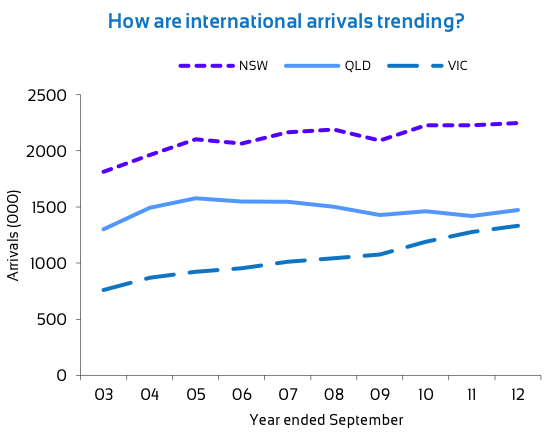
Tourism Queensland released its handy Overseas Arrivals and Australian Departures Data Sheet yesterday (basically a repackaging of ABS data), and it highlighted to me that Queensland’s tourism promotion is failing and that we can learn something from the quirky, interesting campaigns the Victorians run, such as Play Melbourne.  It is concerning that Victoria is quickly catching up to Queensland in overseas arrivals:

Posted in Tourism | Tagged , , , , | 5 Comments

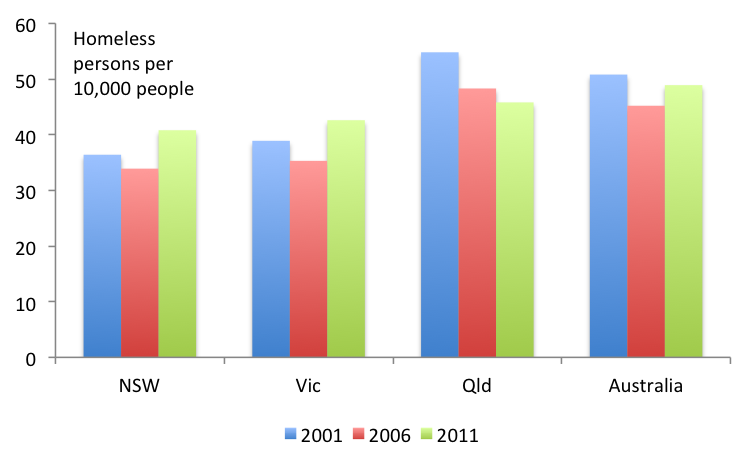
Large decline in rate of homelessness in Qld over last decade

I have no idea whether this is due to good luck or good management, but ABS Census data released today show Queensland’s rate of homelessness has fallen over the last decade to be comparable with rates in NSW and Victoria:

Posted in Housing | Tagged , , , , , , | Leave a comment

White gold and white meat

Cotton can be a very profitable crop for farmers and is often referred to as white gold. Hence it was good to see the report in the Toowoomba Chronicle today that Darling Downs gins smash cotton record:

Queensland Cotton regional manager John Robinson said this year’s pick had smashed all previous records.

“Across our gins on the Darling Downs we produced more than 730,000 bales of cotton,” Mr Robinson said.

“The previous record was about 425,000 bales.

As I’ve noted in a previous post (Asian growth boosts our agricultural sector), there is a large demand from Chinese clothing manufacturers for Australia’s high quality cotton.

In further encouraging news for our agricultural sector, which the Government considers one of the “four pillars” of the Queensland economy, it appears there is a large untapped export market for poultry, according to a report in Queensland Country Life today (Missing the Asian Century rush). I found this statistic very interesting:

…60pc of the frozen chicken sold in Singapore comes from Brazil.

Clearly there are large opportunities for Australian farmers in the Asian century.

Posted in Agriculture | Tagged , , , , , , , , , , , , | Leave a comment

Temporary weakness due to public sector restraint continues

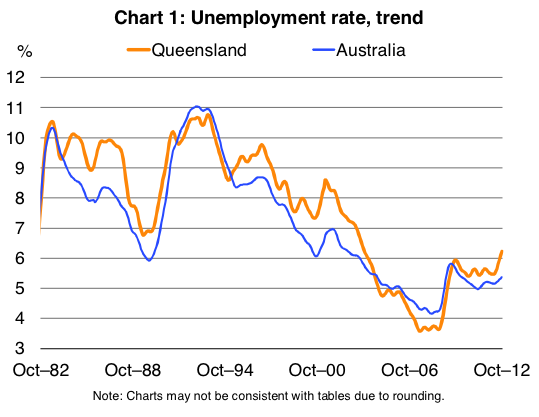
Today’s ABS labour force data weren’t encouraging for Queensland, with the unemployment rate remaining significantly higher than the national average, as shown in this chart from OESR’s labour force brief:

I remain of the view that Queensland’s higher unemployment rate is due in large part to the public sector restraint we’ve experienced over the last six months, and the labour market will recover soon, though maybe not until a few months into the new year.

Observations by other Queensland econ bloggers on the latest labour force data can be found at the links below:

Unemployment rate stays at 5.4pct, but QLD still weak

The Queensland participation rate cliff

Posted in Labour market | Tagged , , , , | 1 Comment

Eclipse tourism boost for Far North Qld

From Tourism Queensland’s news room (60,000 to make eclipse pilgrimage to Queensland’s Tropical North):

Tropical North Queensland is preparing to welcome an estimated 60,000 people to witness the region’s first total solar eclipse in more than 1,300 years.

Minister for Tourism, Major Events, Small Business and the Commonwealth Games Jann Stuckey said hot air balloons, Great Barrier Reef islands, cruise ships, dive boats and palm-fringed beaches are just some of the vantage points visitors will use to view the eclipse.

“At 6.38am Queensland time on Wednesday November 14 all eyes will be on the 200km stretch between Innisfail and the Daintree as it experiences its first total solar eclipse since 710AD,” Ms Stuckey said.

“Between 50,000 and 60,000 scientists, astronomers, astrologists, eclipse chasers and other visitors will make the pilgrimage to Queensland’s Tropical North and the region’s tourism operators are ready to greet them.”

Cairns-based econ blogger KS wrote an amusing, irreverent post last week on the Eclipse Euphoria!

Posted in Cairns, Tourism | Tagged , , , , | Leave a comment

Better late than never for TAFE rationalisation

It’s long been recognised by observers of our education system that Queensland TAFEs are under-utilised and that many of them are sitting on valuable land that would fetch a high price from developers. Hence I’m glad to see the Brisbane Times article Queensland TAFEs set to close which reports on the muscular recommendations in an excellent report from the Queensland Skills and Training Taskforce released yesterday.

If the Government adopts the report’s recommendations it would expect to reap several tens of millions of dollars from the sale of TAFE properties, and obviously it would save on future operating and capital refurbishment costs. For this reason, I expect the recommendations will be very attractive to the Government.

The highlight of the report for me was the discussion of the inflexible HR rules in TAFEs which limit the ability of TAFEs to utilise their facilities in the evenings – i.e. when a lot of people already in the workforce might want to use them. The report notes:

A common finding of all recent reviews of TAFE Queensland is the need for institutes to have more flexibility in terms of staffing and industrial relations provisions to meet the increasingly diverse needs of VET sector clients.

The TAFE teachers’ award prescribes a 36.25 hour week, only 32 hours of which can be programmed for duties related to teaching delivery. Of the 32 programmable hours no more than 21 hours can be programmed in any one week for teaching. Typically, all teaching hours in excess of 21 hours incur additional overtime payments to teachers. An additional provision which contributes significantly to the low utilisation of TAFE facilities in the evening is that an hour of teaching after 6.00 pm is counted as 1.5 hours toward the weekly total of 21 hours – or else is paid at time and a half.

The Government would be well advised to adopt the recommendations in the report.

Posted in Education | 1 Comment

Melbourne Cup day rate cut undesirable and unlikely

Jessica Irvine makes an impassioned case for a Melbourne Cup day rate cut from the RBA (Giddy up Reserve Bank and give us an interest rate cut), but I don’t think the RBA Board will provide one. Data in recent weeks, including stronger CPI growth than expected and an incipient recovery in building approvals, suggest the economy will be back to trend rates of growth over the next year or so. Also, with the emerging recovery in the US and strong recent jobs data, prospects for the global economy appear much better than even a month ago.

Chris Joye at Aussie Macro Moments and the AFR has excellent coverage of the ongoing debate over a November rate cut – e.g.

November rate cut prospects fading

Westpac’s Bill Evans and 19 other economists: RBA to cut *again* in November! Really…

Posted in Macroeconomy | Tagged , , , , , | Leave a comment

OBPR recommends fast-tracked review of trading hours restrictions

The Queensland Government’s new Office of Best Practice Regulation – Queensland’s mini Productivity Commission – released its interim report on Reducing the Burden of Regulation today, and I was very pleased to see it has recommended fast-tracking a review of trading hours restrictions as well as regulations in some other areas such as housing, mining and OHS. Regarding trading hours regulations the OBPR notes:

To the extent that the purpose of the restrictions is to protect workers, the rules are questionable because workers are protected by workplace relations laws, minimum wage and penalty rates governed by Commonwealth legislation.

An unstated objective of the Act may be to assist small business by restricting larger businesses operating times. If this is in fact an objective, this restriction on competition should be made explicit and the benefits assessed against the costs.

My previous posts on Queensland’s archaic retail trading hours restrictions include:

Setback for Qld consumers as extended Saturday trading hours bid is dropped

Easy way to make Brisbane more liveable

Retail trading hours restrictions holding back retailers

Posted in Retail trade | Tagged , , , | 1 Comment

Ipswich to lead building industry recovery

There is more encouraging news for the building industry today, with a report that Queensland’s biggest housing development, at Ripley Valley 5km south-west of Ipswich CBD, has commenced, as reported in the Queensland Times:

AFTER more than five years of delays Queensland’s biggest housing development is under way.

Ecco Ripley, the new name of the Ripley Valley development, will have 50,000 houses and 120,000 people in the next 15 years.

To be developed by Sekisui House, the largest homebuilder in Japan, Ecco Ripley had the first sod of dirt turned on the site yesterday.

Sekisui House Australia president and managing director Toru Abe said Ecco Ripley was the company’s biggest development outside of Japan.

“Ripley Valley is a very exciting development for us as an organisation as it represents a site and scale of development in this country that is almost unheard of,” he said.

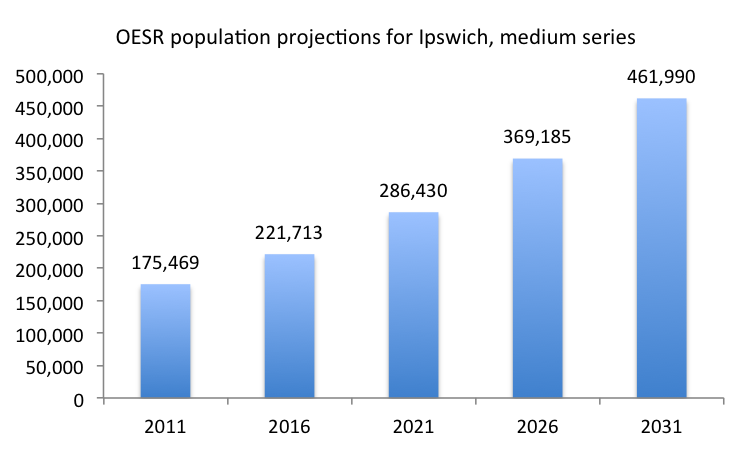
Ipswich, as the focus of the Brisbane metro area’s western growth corridor, is set to experience strong growth over the next couple of decades:

Posted in Housing, Ipswich | Tagged , , , , | Leave a comment