Building industry recovery looking more likely – more evidence last RBA rate cut unnecessary

Today’s new ABS building approvals data have generated much excitement at the prospect of a building industry recovery, although Queensland’s increase in September was much lower than NSW’s. The Housing Industry Association notes in a media release today that:

“Today’s building approvals data shows September 2012 provided a second consecutive monthly increase – up by 7.8 per cent in seasonally adjusted terms,” said HIA Economist, Geordan Murray…

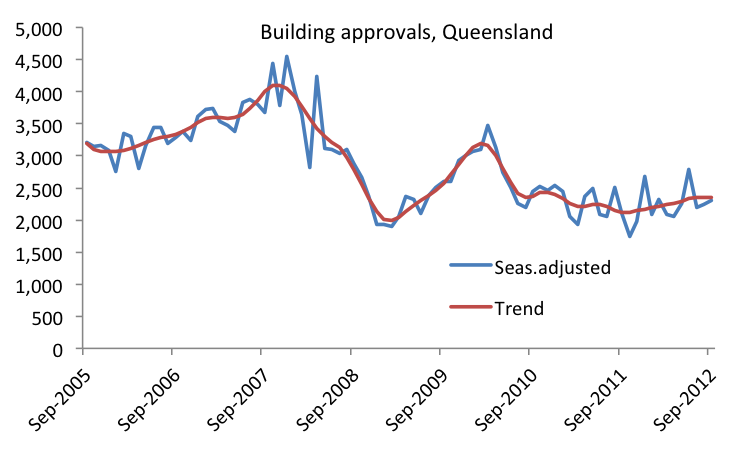
…In September 2012 total seasonally adjusted building approvals increased by 22.8 per cent in New South Wales, 5.2 per cent in Victoria, and 2.6 per cent in Queensland. Building approvals fell by 1.4 per cent in South Australia, 2.4 per cent in Western Australia, and 9.6 per cent in Tasmania.

While Queensland’s recovery doesn’t appear spectacular, there is a marked improvement over the situation one year ago, as shown in the chart below.
I agree with Pete Faulkner’s conclusion in his post Good news on building approvals that:

Although one month of positive data is not enough to be drawing conclusions from, it would appear at least possible that we turned the corner on construction earlier this year.

In other encouraging news today, reported in the Tourism on Q newsletter:

Cairns has welcomed the first China Eastern Airlines passengers flying direct from Shanghai on a new route which could potentially inject millions annually into the local economy. Tourism Minister Jann Stuckey and Deputy Premier Jeff Seeney were at Cairns Airport today to greet the inaugural service and China Eastern Airlines VIPs. The China Eastern Airlines deal was the first announced under the Queensland Government’s $8 million Attracting Aviation Investment Fund.

I worry about the long-term sustainability of the direct flights from China to Cairns if the Government has provided a subsidy through the Attracting Aviation Investment Fund. That said, let’s hope the direct flights provide a stimulus to the Cairns economy.
Posted in Cairns, Housing | Tagged , , , , , , | Leave a comment

Queensland leads Australia on obesity

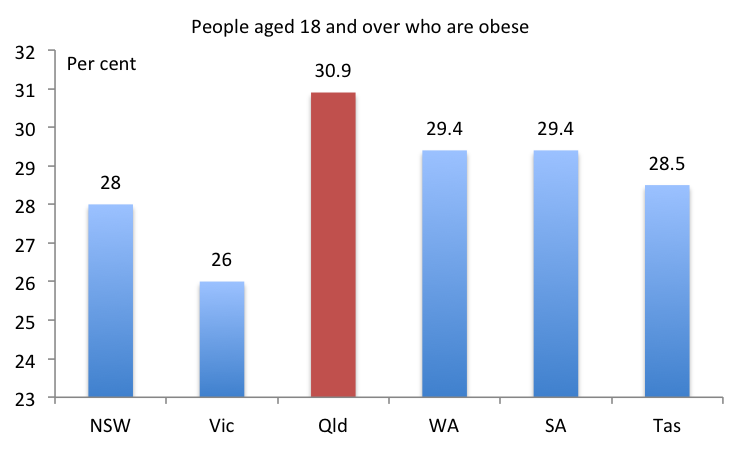
Given the high costs of obesity on the health system, today’s new Australian Health Survey data for 2011-12 from the ABS should be concerning to the Queensland Government, with Queensland leading Australia in obesity (a Body Mass Index of 30 or more) (see chart below). Of course, it’s not just a Queensland problem, with high and increasing obesity rates across Australia. Unfortunately, our sprawling cities mean people get far too little exercise, with very few people walking or cycling to the shops, work or school. Once Government budgets recover, it would be wise for Government health agencies to amplify their public information campaigns on healthy living and to investigate the potential for a junk food tax.

Posted in Health | Tagged , | 4 Comments

Was Maxine McKew asleep during the Rudd Government?

Maxine McKew was a great journalist, but her time in politics has been marked by naivety and hero worship for Kevin Rudd, against all the objective facts. As a Treasury official during the first eighteen months of the Government I  was very unimpressed by its chaotic approach to policy development, and I wasn’t shocked when the coup came and had indeed expected it sooner. Gillard, Swan and the other players were actually very patient with Prime Minister Rudd. The undeniable fact was that the Cabinet process had completely broken down and this led to very poor decision making – for example, the approval of one of Australia’s largest ever infrastructure projects, the National Broadband Network, with no cost-benefit analysis or public consultation. The more experienced and savvy members of the Government understand this well, so I don’t expect Rudd will ever return as Labor leader.

Posted in Uncategorized | Tagged , , , , , , , | Leave a comment

Interesting links this week

Pete Faulkner warns against over-analysing the recent CPI data that surprised on the up-side: An attempt to dismiss Q3 CPI

James Falk cites a previous post of mine in his piece on Analysis serving ideology

Seth Godin has a brilliant post on The only purpose of “customer service”, which desperately needs to be read by whoever manages the Officeworks on Adelaide St, Brisbane

Flavio Menezes, head of the UQ Economics School, dreams of a fundamental reform of business taxation that I doubt will happen this century in A lost opportunity for business tax reform

Posted in Uncategorized | Tagged | Leave a comment

Pre-mixed concrete production remains well below pre-GFC high

The Cement, Concrete and Aggregates Australia (CCAA) industry body has a nice summary of the importance of concrete in our lives on its website:

The heavy construction materials industry produces concrete and its constituent parts – sand, aggregate and cement – which are quite literally the foundations upon which our modern lives are built. Without concrete we would not have our roads, footpaths, schools, hospitals, workplaces and our homes.

The industry must be hoping the Newman Government’s transformation of the Brisbane CBD (e.g. 1 William St, a new casino) begins soon, as according to new ABS data pre-mixed concrete production remains subdued (see chart below).

Posted in Uncategorized | Tagged , , | Leave a comment

Company tax timing trick is costly for business

Sinclair Davidson has a great article at the Conversation explaining the implications of requiring companies to pay company tax monthly rather than quarterly (Timing is everything), a measure announced in yesterday’s Mid-Year Economic and Fiscal Outlook (MYEFO). Highlights include:

The government is very careful to tell us that “this measure is estimated to raise $8.3 billion on an underlying cash basis over four years”. That may sound like a lot of money, but the government expects to raise about $317 billion in corporate income tax over the same four-year period. The next thing to note is that this is a cash-basis analysis. The corporate sector will not pay any more money to the government; it will just pay some money earlier and not later.

This matters because the government faces timing problems. $5.5 billion of the $8.3 billion gets paid in 2013-14, pushing the budget into surplus for that year. That is if everything else goes to plan. That the 2013-14 budget is a surplus only due to a timing change indicates trouble.

He goes on to point out the increased compliance costs of having to pay company tax on a monthly basis. Corporate Australia is not happy about this, and earlier today the Woolworths CEO criticised the change, as reported in the AFR (paywalled) earlier today:

Mr O’Brien said Woolworths was currently calculating how the monthly tax payments would impact on earnings and cash flows.

“Naturally it’s a cost because its going to affect our cash flow and therefore our cost of funding and it will cost us in terms of administration,” he said.

“It [will be] an impediment on our business as it will be on all businesses paying company taxes in the years ahead, then that’s an impediment by any description.”

This is bad policy, but once introduced I doubt any future Government will reverse it, as it will make Government cash management a lot easier, and it will provide more timely information on the state of corporate Australia and the broader economy.


Posted in Tax | Tagged , , , | Leave a comment

MYEFO mystery – weird negative contingency reserve continues

I share the skepticism of many commentators about the budget forecasts in today’s Mid-Year Economic and Fiscal Outlook (MYEFO). Certainly the revenue grab from increasing the frequency of company tax payments seems tricky, and I wonder if it really will yield $8 billion in extra revenue over the forward estimates. But the weirdest thing in today’s MYEFO is the continuation of the negative contingency reserve, now at -$2.8 billion in 2012-13 (see p. 69).

Now the contingency reserve should be positive, because it is supposed to act as a buffer – it reflects the long-observed tendency of Governments to end up spending more money than they originally budgeted. Indeed, the contingency reserve is forecast to be positive from 2013-14 onwards.

The negative contingency reserve in 2012-13 is convenient for the Government as it helps generate the budget surplus, as the negative contingency reserve subtracts $2.8 billion off estimated Government spending and the surplus is only $1.1 billion.

In explaining the negative contingency reserve in response to a question on notice at the Budget Estimates hearing earlier this year, the Treasury observed:

The Contingency Reserve balance is negative in the budget year primarily owing to the inclusion of revised economic parameters received late in the Budget process which reduced overall spending.

Given the timing, these adjustments were not able to be allocated to individual agencies or functions. This is consistent with longstanding practice.

A negative Contingency Reserve balance in the budget year has a precedent in the MYEFO publications, but it has not previously occurred in the Budget since at least 2000-01.

Will Treasury offer the same explanation this time? If it does, what confidence can we place in budget estimates if it can’t revise expenditure figures in time to reflect the latest economic forecasts?

Posted in Budget | Tagged , , , | Leave a comment

Govt Actuary finds insurers struggling to understand catastrophe risk

North Queensland apartment owners will have to put up with the massive insurance premium increases (e.g. more than 300%) they have experienced in recent years after an Australian Government Actuary report concluded the premium increases most likely reflected the market waking up to the higher level of risk posed by disasters such as Cyclone Yasi. The Actuary’s report, however, contains some brilliant commentary on the insurance industry’s practices, suggesting it doesn’t really have much of an idea how to price the risk from major natural disasters in premiums. For example:

…catastrophe reinsurance costs are now increasingly allocated in line with the assessed risk presented by the underlying policy. Having said that, catastrophe modelling remains an inexact science…

…in the insurance market, the cost of the product being sold (this refers to the value of the underlying risk) can only be estimated and often only quite poorly. This makes ‘accurate pricing’ of some business segments difficult. Strata title in NQ is one such small business segment.

Given these doubts about the science of insurance premium pricing, it’s possible the premiums NQ residents are paying are higher than justified by the true risks involved. KS at Loose Change has coverage of this issue, too, and he is skeptical about the Government’s suggestion that property owners should negotiate a higher excess in exchange for lower premiums:

Stop Press: Strata Whitewash!

Posted in Cairns, Climate change, Cyclones, North Queensland | Tagged , , , , | 3 Comments

Stop Not Till the Goal is Reached

The developer of Springfield, Maha Sinnathamby, thinks like a winner. No matter what difficulties life throws at him – the collapse of his first property empire or the near collapse of his second, Springfield – he faces each challenge with the recognition that, if he works hard enough, he just might beat the odds. And he did, at least the second time around, and we have the continued growth of Springfield as a result.

You can read all about Mr Sinnathamby’s life and personal philosophy in the biography Stop Not Till the Goal is Reached, which he spoke about at a packed UQ Business, Economics and Law alumni function at Customs House, Brisbane today. I was lucky to secure a free copy of the book and can highly recommend it.

Mr Sinnathamby is a great story teller. He is a master salesman, and he obviously owes a lot to the timeless wisdom of Napoleon Hill. Mr Sinnathamby has never missed a chance to tell his story and sell his dream. I well remember the time he came to my high school in Ipswich in the early 1990s to address the assembly about his grand vision for a new city, halfway between Brisbane and Ipswich, Springfield. He told us his story, and told us to tell our older brothers and sisters and mums and dads, even though, given the depressed economy in Ipswich at the time, a sizeable fraction of them would have been unemployed.

Mr Sinnathamby was not going to die wondering whether he could have made Springfield a success if he had just addressed one more school assembly. He is a master salesman, second to none.

Posted in Brisbane, Housing, Ipswich | Tagged , , , | Leave a comment

Skilling Queenslanders for Work probably less effective than claimed

After reading the Deloitte Access Economics report on the Skilling Queenslanders for Work (SQW) program, I have significant doubts about whether the program generated the large benefits claimed. Earlier today, the Brisbane Times reported (Jobseeker program axed, then praised):

Queensland’s employment minister axed a program a week before his department received a report praising the scheme to help disadvantaged jobseekers…

…The SQW program, introduced in 2007, delivered targeted grants-based labour market programs that aimed to reduce unemployment and under-employment among disadvantaged groups.

A report by Deloitte Access Economics said of the 57,000 persons who gained employment through SQW, 8500 of these would not have gained employment without the program. It said about $375 million in wages would be generated by these 8500 persons in 2012-13.

I suspect the 8,500 figure is an over-estimate of the number of people who gained employment due to the axed SQW program and otherwise wouldn’t have. The study estimates this number based on comparing the “treatment group” of SQW participants with a “control group” of jobseekers who participated in Commonwealth employment programs but not SQW. But the comparison is questionable, because when surveyed the SQW participants had had a much longer period in which to have found a job, meaning their employment outcomes would have been better. As explained on p. 83 of the Deloitte report:

The details on the employment pathways of the treatment group come from the OESR survey of SQW participants, conducted 12 to 18 months after the completion of their involvement with SQW…

…The details of the employment pathways of the control group come from the DEEWR Labour Market Assistance Outcomes (LMAO) reports, conducted 3 months after participation in Commonwealth employment assistance. [emphasis added]

A person is much more likely to have found a job after 12 to 18 months than three months, either because they eventually get lucky or lower their expectations. I think the report is incorrect to assert that:

While not perfectly aligned in terms of the period between participation and outcome measurement, any bias in the data could be argued to skew the results either in favour of SQW or against SQW.

In my view, the bias caused by the time difference between the program and the survey will skew the results in favour of SQW. Hence the Government shouldn’t be too concerned it didn’t see the report prior to axing the program.

Posted in Labour market | Leave a comment