The Daily Telegraph today reports some new modelling on the proposed Medicare levy hike undertaken by my old friend and former Queensland resident Ben Phillips, now Principal Research Fellow at NATSEM:
Medicare: Levy hike would cost families $2000 a year more in tax
Regarding the idea that the revenue raised from the Medicare levy hike would help fund future health spending, Ben notes correctly that “As a general statement these ‘hypothecated’ taxes work (politically) as history tells us people are happier to pay taxes that are linked to something of social value such as health, budget repair, guns, floods etc.”
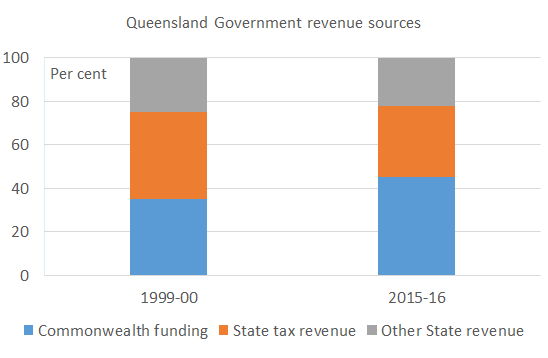
However, I am concerned that the Medicare levy hike may not address the fundamental problem of vertical fiscal imbalance (VFI). This is the gap between the State Government’s own-source revenue and its expenditure responsibilities, a gap which is filled by massive payments from the Commonwealth equivalent to $5,000 per Queenslander per year, and much more in some States and Territories (see chart below). A bit over half of this amount is GST revenue, which is arguably a State tax, but that leaves nearly half of it which is subject to Commonwealth conditions and interference.
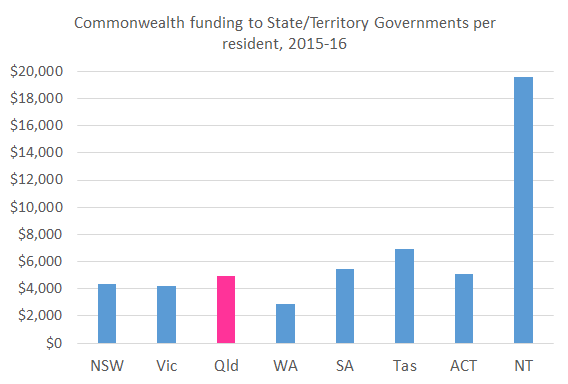
In its Post-Budget presentation slides, Queensland Treasury notes that “excessive VFI”, which I assume the Treasury believes currently exists, can, among other things, “weaken or blur government accountability.” That is, we have a blame game. The Commonwealth can say health and education is a State problem, but State Governments can blame poor health and education services on inadequate Commonwealth funding.
If the Medicare levy hike were hypothecated in some way, and it were allocated to say future health spending under a new agreement between the Commonwealth and States, it would not really do anything to reduce VFI. The States would still be dependent on the Commonwealth and the Commonwealth could impose conditions on the spending, which I expect it would, given that it would have to pass the legislation increasing the Medicare levy and would suffer much of the political pain for it. However, the States would deliver the health services, and the Commonwealth could blame the States for any performance issues, while the States could blame insufficient funding, and the blame game would go on.
Arguably, it would be better to have a clearer allocation of responsibilities within the federation and for State Governments to have sufficient own-source revenues to meet their expenditure requirements. This is what I believe the Queensland Treasury is driving at in its point in its post-Budget presentation (on Slide 53):
“Big opportunity for reform – federalism (roles and responsibility) + tax reform (to address VFI).”
It is great that a federal takeover of vocational education and training (VET) is being considered, but more needs to be done. And tax reform is definitely required. A switch in the tax mix to raise more revenue from the GST (and less from say income tax) would be desirable as it would reduce the amount of revenue the States receive in tied grants – the grants which lead to the blurring of accountability.
It may also be time to seriously debate a State-based income tax, which could replace a portion of the Commonwealth income tax, as raised in a recent Government discussion paper (see this Australian report). Then, if a State Premier wanted to raise income tax to pay for health services he or she could raise the tax rate themselves, and be fully accountable to the public for it. I would like to see a detailed model of how a State-based income tax would work before committing to it, but it is an idea that appears increasingly attractive as we struggle to achieve genuine reform of federal financial relations.