Qld Jobs Growth Summit timely, but needs to be more than a talkfest

Vacancies_Feb16

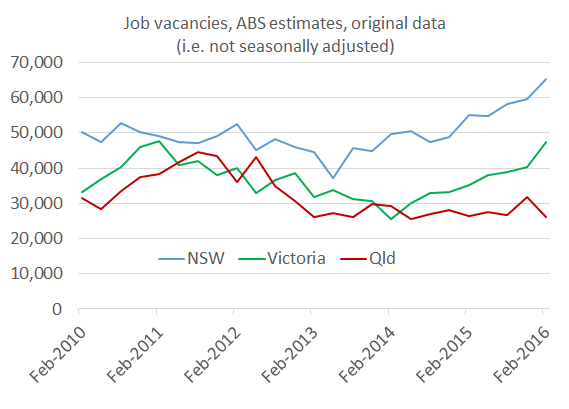
Queensland’s under-performing economy was illustrated by job vacancies data for February released by the ABS today (see chart above). While vacancies have grown strongly over the last twelve months nationwide, especially in NSW and Victoria, they have remained flat in Queensland. Hence the upcoming Queensland Jobs Growth Summit, featuring our Deputy Premier and Environment Minister, as well as other luminaries from academia, unions, peak bodies, and the private sector, is welcome.

The Jobs Growth Summit is on Tuesday 26 April at Parliament House in Brisbane, and you may be able to attend if you register quickly. This excellent initiative is due to the University of Queensland’s School of Economics, where I teach from time-to-time, and the Australia Institute. I am very much looking forward to the Summit, and I very much hope it results in real actions and is not merely another talkfest.

Recently, re-reading John Kenneth Galbraith’s brilliant account of the 1929 stockmarket crash, The Great Crash: 1929, I was reminded of the very human tendency to pretend we are doing things at meetings, while all we are doing is just talking. Regarding the various ineffectual meetings held by politicians and bankers at the onset of the crisis, Galbraith noted in chapter 8:

…there is the meeting which is called not because there is business to be done, but because it is necessary to create the impression that business is being done. Such meetings are more than a substitute for action. They are widely regarded as action.

Let us hope that this Summit is not regarded as action in itself, and that our Deputy Premier and Environment Minister can take some good ideas from the Summit and implement them for the good of the Queensland economy.

Finally, as regular readers are aware, from time-to-time I offer my own views on how to boost Queensland’s economy and create jobs. Indeed, I provided some thoughts to Steve Austin of 612 ABC Brisbane when he interviewed me yesterday morning, as covered in last evening’s post. I would also recommend the leaked Economic Action Plan that was prepared by a courageous public servant from the Queensland Premier’s Department last year. I would not endorse every measure proposed in the Plan, but it does contain a lot of very good ideas, particularly around removing unnecessary regulation and getting out of the way of job-creating businesses.

Posted in Labour market, Macroeconomy, Uncategorized | Tagged , , , , , , , , , | 6 Comments

ABC radio interview on population growth & State income tax proposal

I had an enjoyable chat with Steve Austin on 612 ABC Brisbane radio this morning regarding two topics, Queensland’s underwhelming population growth rate and the State income tax proposal from the Commonwealth Government:

Fewer people moving interstate to Queensland

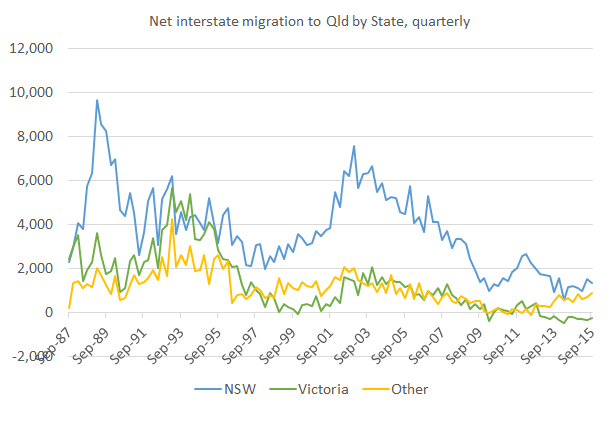
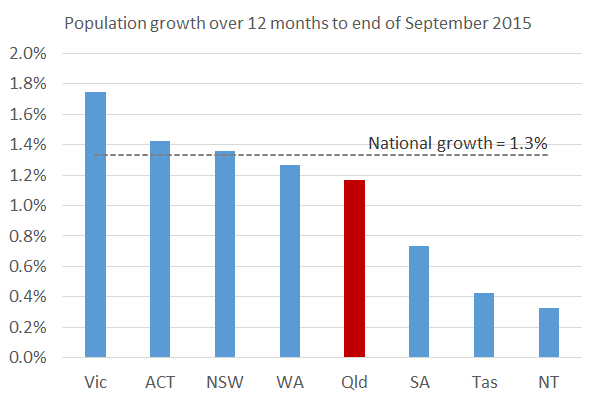
The discussion was prompted by my post on Good Friday afternoon, which observed that, based on ABS population estimates, Queensland has fallen to 5th place in rates of population growth among States and Territories. Yesterday, Steve asked me a good question regarding this post on LinkedIn: “what does this reveal?” I replied that it revealed a few things, including our under-performing economy (related in part to the mining downturn), excessive regulation that is constraining business investment, and a failure to properly manage population growth since the 1990s, which has reduced liveability in Queensland. At the same time, conditions in NSW and Victoria relative to Queensland have improved, meaning we are not seeing the same levels of interstate migration as we once did (see chart below). I expanded on these points and gave some examples in the interview this morning. I suggested South-East Queensland nearly running out of water in the late 2000s is a good example of a failure to properly plan for growth, and it is an example which must have raised doubts about Queensland’s desirability as a place to live in the minds of many people down south.

NIM_by_State_Sep15

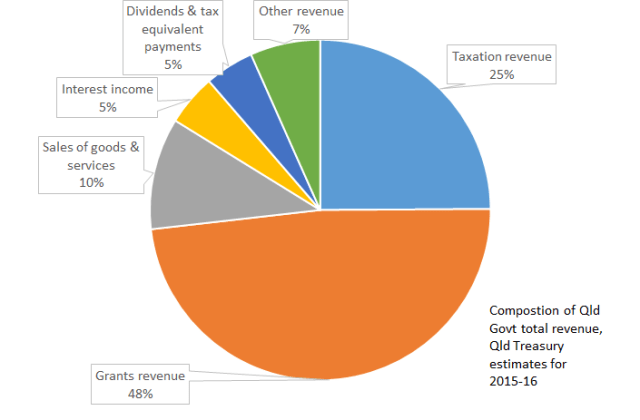
Steve and I also chatted about the Commonwealth Government’s proposal for the States to be given back their income tax powers so they can fund health and education expenditures without Commonwealth assistance. As I told Steve (so long as the Commonwealth reduces its income tax take, so there is no overall increase in income tax revenue) I think this is a good idea. It would end the blame game associated with vertical fiscal imbalance: the large disparity between what the States raise from their own-source revenue and what they spend, with the difference being made up in grants, largely from the Commonwealth (e.g. see the composition of Queensland revenue in the chart below). So the States could no longer blame the Commonwealth for (allegedly) under-funded State services, and the Commonwealth, in response, would no longer have to blame the States for poor fiscal management. As I noted to Steve, this is not a radical new proposal, but rather one that has been discussed in policy circles for several decades, at least since the time of the Fraser Government (1975-83).

Revenue_pie_chart

As well as ending the blame game, the proposal would promote competitive federalism. Better managed States could levy lower State income taxes for the benefit of their residents. While poorly managed States might see people leaving for better managed States with lower tax rates, providing further incentive for good fiscal management.

My old friend and Treasury colleague Joe Branigan greeted the Commonwealth’s proposal with much enthusiasm on Twitter:  “Finally a PM dealing with roots not branches…” Well said, Joe. This is a commendable policy proposal that would substantially improve the governance of our Federation.

Posted in Migration, Population, Uncategorized | Tagged , , , , , , , , , , , , , , | 10 Comments

“Why economics matters” is the theme of ESA Qld Presidency of Prof. Flavio Menezes

With an upcoming federal election that will feature a contest over tax policy, including negative gearing and whatever proposals the Government announces, Australians should brace themselves for an onslaught of economic arguments. The Government will argue the Opposition’s policy will crash the housing market, while the Opposition will counter that negative gearing is distorting the market and providing a tax rort for the wealthy. As always, economists will no doubt be called in for their opinions. As a former Treasury officer, and a participant in a number of public policy debates, I am well aware of the importance of economics in our society. Hence I was pleased that the new President of the Economic Society of Australia (Qld), Professor Flavio Menezes from the University of Queensland, included the following passage in his first note to members in mid-March:

“The perception that the relative importance of economics to inform public policy or business decisions has somewhat diminished over the last two decades needs to be countered by the positive stories that have emerged from the evolution of the discipline, especially over the last three decades. New concepts, techniques and ideas mean that instead of only being able to study societal problems, we can now actually address them. Thus, I want to make the theme of my presidency ‘why economics matters.’ This theme will be explored through greater engagement with the community including in the events we will run in 2016.”

Flavio is certainly correct. There have been great advances in the application of economics to public policy and decision making. Some examples that come to mind include, among others:

  • auction theory and application to, for example, spectrum and liquidity auctions, such as auctions designed by Oxford Professor Paul Klemperer which raised £22.5 billion from the sale of UK 3G spectrum and helped enhance financial market liquidity during the financial crisis (see the Wikipedia entry about Professor Klemperer)
  • the development of market-based instruments designed to cost-effectively achieve policy objectives, including social and environmental objectives (e.g. emissions trading schemes, tender-based approaches to promoting conservation such as the Environmental Stewardship Scheme, as discussed in the Henry tax review, and arguably social impact bonds)
  • behavioral economics, blending psychology with economics (e.g. using “nudges” sent by SMS to get people to pay their taxes on time or changing the default setting and forcing people to opt out of organ donation)
  • availability of larger, more informative data, and the development of econometric techniques, leading to rigorous program evaluation and deeper investigation of policy proposals (e.g. listen to the recent Econtalk podcast Adam Ozimek on the power of econometrics and data)

Of course, these are mostly microeconomic examples. The record on macroeconomics is less illustrious, although I would argue that better understanding of the economy and available policy tools did help western economies avoid a much larger downturn during the financial crisis. Also, inflation targeting, at least in Australia, can be considered a monetary policy success.

As Secretary of ESA (Qld), I very much look forward to working with Flavio in promoting a greater understanding of why economics matters.

Flavio

Professor Flavio Menezes, UQ School of Economics

Posted in Labour market, Social policy, Tax, Uncategorized | Tagged , , , , , , , , , , , | 2 Comments

Qld has fallen to 5th place in rate of population growth among States & Territories

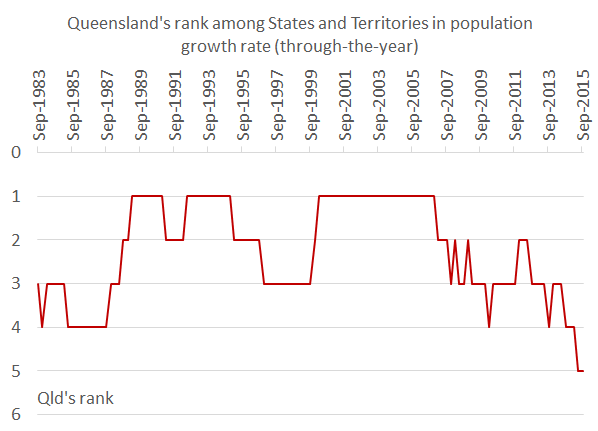
The end of the mining boom and broader economic sluggishness have no doubt contributed to Queensland falling to fifth place in terms of population growth among Australian States and Territories (see chart below based on ABS data released on Thursday).

Pop_post_chart1

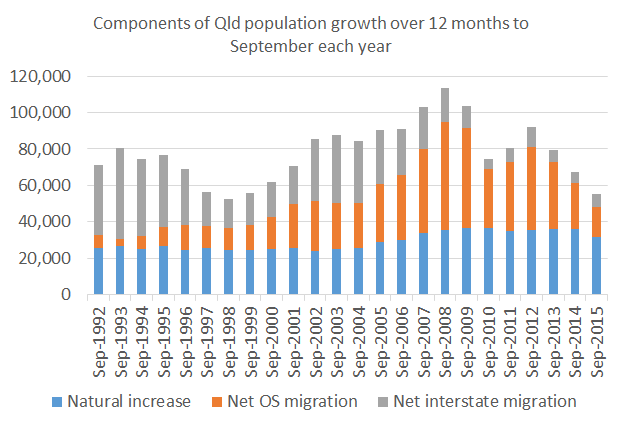
Queensland is not attracting overseas (OS) or interstate migrants to the same extent as it has in the past (see chart below). I have previously commented on how we have actually been losing people to Victoria, a State that we once gained a lot of people from (see Interstate migration to Queensland remains low, and we’re still losing people to Victoria, but note I am still waiting for the latest detailed interstate migration data to confirm the net loss to Victoria is still the case).

Pop_post_chart2

In periods when net migration to Queensland was high, such as several years in the 1990s and 2000s, Queensland was number one in population growth in Australia (see chart below), but, as noted above, we have now fallen to fifth place.

Pop_post_chart3

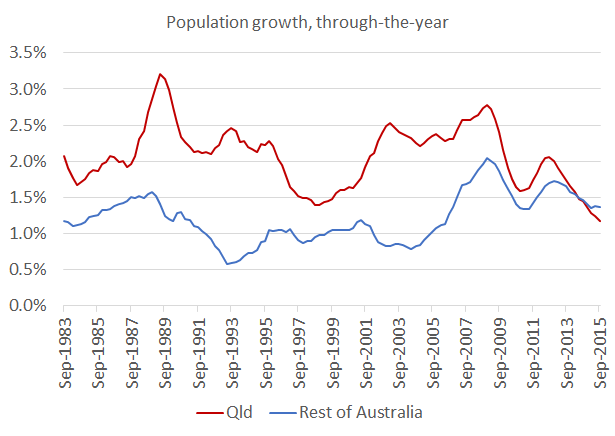
And, since mid-2014, Queensland’s population has been growing at a slower rate than the rest of Australia’s (see chart below). This is all very concerning because, given our natural advantages (e.g. climate, natural resources, environment), we should be growing at a faster rate than other States. It is time for the Queensland Government to look closely at regulations that might be unnecessarily restricting economic development or making us a less attractive place to live.

Pop_post_chart4


Posted in Migration, Population, Uncategorized | Tagged , , , , , , | 8 Comments

Is Apple avoiding tax and what should the tax office do about it? Upcoming seminar may have the answers

Pascalis

Prof. Pascalis Raimondos, QUT Business School

Earlier this year it was revealed that “Apple paid $85 million in Australian income tax last year, despite making almost $8 billion in local revenue”, as reported in the Sydney Morning Herald. It has been alleged that Apple’s Australian operation is minimising its taxable income by paying well above reasonable prices for products for domestic sale that it is sourcing from overseas affiliates. Allegedly, in this way, the profit is transferred to lower-taxing jurisdictions overseas.

Hence it is topical and timely to consider multi-national tax avoidance and how it might be addressed. The Economic Society of Australia (Qld), of which I am the Secretary, is pleased to be hosting an upcoming lunchtime professional development seminar on Corporate income taxes: Theory and Policy by Professor Pascalis Raimondos of QUT. The seminar is sponsored by Deloitte Access Economics and will be held at its Brisbane CBD offices, Level 25, Riverside Centre, on Tuesday 19 April.

Further information and registration details are available on this flyer.

Posted in Uncategorized | Leave a comment

Premier should definitely call early Qld election

The Queensland Parliament is currently unmanageable, and it is no wonder the Premier is considering a snap early election in response to the threat from the Katter MPs and Rob Pyne to block the State Budget, as reported in this morning’s Courier-Mail. The need for an early election has been clear since at least December last year, when the Parliament passed one of the dumbest pieces of legislation passed by a western democratic parliament in decades: the Sugar Industry (Real Choice in Marketing) Amendment Act. This bizarre Act gives sugar cane growers a say in the marketing of the sugar made from their cane, even after they have sold the cane to the mill, creating a weird new property right that has never previously existed (see the Queensland Productivity Commission’s scathing assessment of the policy in the Regulatory Impact Assessment it prepared).

This Act would never have been passed in a normal parliament dominated by either Labor or the LNP. The Opposition, sensing an opportunity to embarrass the Government, sided with Katter Party MPs and Billy Gordon to pass the Act, which the Government opposed. This was a huge blow to the Government, because it showed it had lost control of the Parliament. All the Government could do was write to the ACCC and Federal Government in protest (see the ABC News report). Ever since that time, I have been of the strong view that, in the interests of good government and economic management, Queensland needs a new State election to get a more stable Parliament. The current situation is unsustainable and undesirable.

Posted in Agriculture, Uncategorized | Tagged , , , , , , , , | 8 Comments

Transparency essential in Building Qld cost-benefit studies of infrastructure projects

Last Thursday morning I attended an excellent breakfast seminar on infrastructure organised by the French-Australian Chamber of Commerce and Industry (FACCI) and hosted by Holding Redlich Lawyers in their Queen St, Brisbane CBD offices. The seminar featured highly informative and engaging presentations by Building Queensland CEO David Quinn and Keolis Downer Gold Coast (GC Light Rail operator) CEO Campbell Mason (presentations available for download at bottom of post).

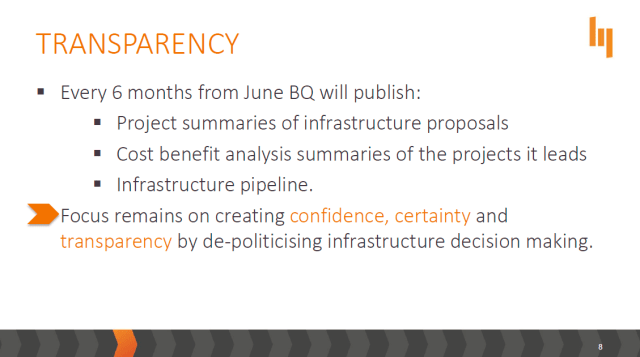
Building Queensland is a statutory authority established by the Queensland Government to provide independent expert advice on infrastructure, which is a worthy mission, given the risks to the budget and economic development posed by poorly conceived or executed infrastructure projects. CEO David Quinn gave a very good account of Building Queensland’s mission and agenda, but I was somewhat concerned by one of the points made in his presentation, that Building Queensland would only publish, and only every six months, “Cost benefit analysis summaries of the projects it leads.” (see “Transparency” slide from Mr Quinn’s presentation reproduced below). Summaries only, that is, not the full cost-benefit analysis reports.

BQ_slide

In question time, I asked Mr Quinn about this, expressing my concern that this is an insufficient level of transparency. In reply, he noted the oft-expressed concern about commercial-in-confidence matters, the disclosure of which might compromise the negotiating position of project partners, which may include the government and private sector players. So Mr Quinn would not commit to releasing full cost-benefit studies, but did promise that cost-benefit analysis summaries would be substantial and would not simply be one-page summaries. While I was somewhat pleased with this response from Mr Quinn, I still think it would be highly desirable for full cost-benefit studies of proposed infrastructure projects to be released.

In its 2014 report on public infrastructure, the Productivity Commission called for full disclosure of cost-benefit studies for projects which receive public support, rejecting the claim that commercial-in-confidence information should be protected:

“It is sometimes argued that there are commercial-in-confidence reasons for not making cost–benefit analyses public. Typically such analyses are done prior to the procurement process commencing and so the data used are unlikely to be commercially sensitive. Accordingly, the Commission is not convinced that there are valid commercial-in-confidence reasons to withhold the release of full cost−benefit analyses. Even where data are provided by private participants, the normal presumption of transparency should prevail as a condition of involvement in government-backed projects.” (from p. 105, volume 1)

I fully agree with the Commission on this point, as taxpayers, whose money is at stake, deserve full disclosure from governments and project proponents.

I have made the presentations from the breakfast seminar available for download:

Presentation by David Quinn, Building Qld

Presentation by Campbell Mason, GC Light Rail

Posted in Brisbane, Gold Coast, Infrastructure, Uncategorized | Tagged , , , , , , , , , | 10 Comments

Guest post from Joe Branigan on fixed four-year terms

I am delighted to publish this guest post on the fixed four-year terms referendum in Queensland from my old friend and former Treasury colleague Joe Branigan. These are Joe’s views and should not necessarily be attributed to me. GT

The fix is in on fixed four-year terms

The fix is in on fixed four-year terms in Queensland – politicians, political staffers, senior bureaucrats, and those academics, businesses and consultants that largely live off the taxpayer will all benefit directly from a yes vote in this Saturday’s referendum on fixed four-year terms.

The political class is asking us for a 33.3% extension of their contracts (from 3 to 4 years) regardless of their performance. A yes vote means that parliamentarians and their hangers-on will get four years on a great salary without a performance appraisal – not bad work if you can get it. Ahh, but there will be more certainty because the election date will now be fixed. So politicians can spend your money with more certainty because you can’t hold them to account as often. And look, as a bonus, you’ll even save some money not having to evaluate their performance as often.

The argument from Labor, the LNP and everyone else in the political class (except the Katters to their credit) is self-serving and dangerous.

First of all, the single-question referendum is fundamentally flawed because it is asking two separate and quite distinct questions. One, do we want fixed terms or not? Two, do we want four-year terms or three-year terms? These questions should be considered separately, not as a single omnibus question – if people answer yes on Saturday, what exactly are they saying yes to? The issue of fixed terms and the length of terms have been purposefully mixed up to trick voters into voting yes.

The Attorney General Yvette D’ath and her shadow Ian Walker went on a road trip this week spruiking their best arguments for extending their contracts by one-third – undoubtedly with more chutzpah than a Donald Trump rally. D’ath argues that “fixed four-year terms will provide greater certainty for the business community and the Queensland economy”. Is D’ath referring to the business community that feeds off government contracts or the business community generally? I am certain that the latter simply wants good government – sensible regulations, value-for-money service delivery, affordable infrastructure, and low public debt. But with four-year terms, a bad government in its third year will likely freeze private sector investment and hiring as business chooses to wait it out until after the next election. With shorter terms, less damage is done to the Queensland economy.

And, with flexible terms, there is an equal likelihood that a bad government will call an early election to ‘save the furniture’ than there is that it will hang on for a glorious annihilation. Fixed terms are too risky without recall provisions – remember the disastrous Iemma-Rees-Keneally Government in NSW that ran full term because the election date is fixed.

D’ath also argues that “fixed four-year terms provide more certainty for all Queenslanders and takes the politics out of choosing an election date”. But this is an argument for fixed terms, not four-year terms.

And the LNP’s Shadow Attorney General Ian Walker is no better when he argues that “Voting ‘yes’ on Saturday will bring Queensland into line with not only local government in this state but the rest of the country”, because he fails to mention that Queensland is the only state in Australia without an upper house.

Three-year terms in the absence of an upper house to act as a check on executive power are vital to prevent governments from going off the rails. Take the Bligh-Fraser Government. Giving that government another year, with their wrong-headed GFC fiscal stimulus capital program and commitment to 6% per year real public sector expenses growth, would have seen Queensland’s gross debt peak at well above (rather than below) $80 billion and potentially could have led to a further credit rating downgrade. The fiscal mess that the LNP Government might have inherited would have been far worse and required far more drastic expenditure restraint.

Some argue that four-year terms are better than three so that good governments can get on with the job. But there is no guarantee whether incoming governments will be good or bad. And the costs of a bad government going an extra year are far greater than the benefits of a good government going an extra year. In our modern market-based economy, there are no miracle reforms left that might immediately, significantly and enduringly increase living standards (public policy reform now is a long hard incremental slog), but there are plenty of disastrous policies that a bad government could adopt that would send productivity falling and unemployment rising. In other words, the risks to Queensland taxpayers are asymmetric and it is, therefore, more important to end bad governments early than to prolong good ones for an extra year (especially given good governments are likely to be re-elected anyway).

It is madness to give the political class access to a further $60 billion dollars (which is the size of the Queensland Budget) to spend in ‘year four’ without holding them to account for the $180 billion already spent over the three years since they were last held to account at a state election.

The single omnibus referendum question should have been separated into two distinct questions to foster an honest debate about political accountability in Queensland. In the absence of an upper house, we should hold politicians to account every three years. And, in the absence of recall provisions, we should maintain the flexibility of variable terms. Vote NO on Saturday.

Joe

Joe Branigan is an economist and former regulator at the Queensland Competition Authority

Posted in Queensland Government, Uncategorized | Tagged , , | 4 Comments

Comment in Courier-Mail on volatile Qld jobs data

With the huge volatility in State unemployment rate estimates, demonstrated by the ABS seasonally adjusted estimate of Queensland’s unemployment rate falling from 6.4% in January to 5.6% in February, and the SA rate increasing from 6.8% to 7.7%, the ABS really needs to invest greater resources into generating better State-level estimates. I did my best to explain what the latest labour force data mean for Queensland to the Courier-Mail yesterday (see Qld February 2016 unemployment rate adjusted to 5.6%):

Economist Gene Tunny, from Adept Economics, said southeast Queensland was cracking ahead while regional areas were struggling.

He said while the volatile figures were hard to read, there definitely was a continuing trend in jobs growth.

“Gold Coast is going well with the Commonwealth Games and Brisbane with construction but other areas have the loss of the resources industry,” he said. “Overall, I think the state economy is really a bit lacklustre.”

On yesterday’s figures, I would highly recommend Paul Syvret’s excellent column in today’s Courier-Mail, in which he too expresses concern about the reliability of the data (Qld unemployment data for February 2016 explained):

The problem we have right now is that the labour force data is wildly erratic, making it hard for policy makers to get a handle on what is actually happening in the real economy.

The volatility in the State-level estimates should add to concerns about the reliability of the national seasonally adjusted unemployment rate, which is a key indicator monitored by the Reserve Bank in advising on monetary policy. The ABS may promote its trend estimates, but they are poor substitutes for reliable seasonally adjusted data. As I have noted before, the trend estimates are simply smoothed, filtered versions of the underlying seasonally adjusted data, and the trend estimates will tend to disguise turning points that may be occurring, because they are smoothing the time series. Eventually the trend data will be revised, and turning points will be revealed, but analysts will miss the turning points when they really need to see them if they rely on the trend data alone.

Posted in Labour market, Macroeconomy, Uncategorized | Tagged , , , , , , , , , , | 3 Comments

Economic outlook & collaborative economy presentation

The first day of the CPA Australia Not-for-Profit Conference was held in Brisbane today and I gave a presentation on the economic outlook and the collaborative economy that I gave in Sydney and Melbourne last week. My slides are available to download, and my speaking notes, which broadly reflect the speech I delivered, are provided below.

Australia’s economic outlook, disruption and the collaborative economy: What it all means for NFPs

Introduction

US President Harry Truman once asked for a one-armed economist, because he was sick of economists telling him “on the one hand this, on the other hand that.” I am sorry but I have to say that, on the one hand, Australia’s economic outlook is reasonably encouraging, and we have reason to be excited about the opportunities created by disruptive technology. But, on the other hand, there are profound risks to the global and domestic outlooks. The UK Chancellor of the Exchequer George Osborne was right earlier this year when he referred to a “dangerous cocktail” of economic risks in the global economy.

This is an important year for Australia, with a looming federal election. Commentators have recently expressed concern about the lack of a clear narrative from the Federal Government, particularly around the economy. And expectations have fallen regarding what the Government might deliver via a tax reform package. Maybe there will be some modest income tax cuts, and some tweaks to negative gearing and super tax concessions, but there probably won’t be much else.

The alleged lack of a narrative is concerning to many because the economy has endured some strong headwinds, with the end of the mining boom having a major adverse impact, although, to an extent, it was expected.

So today I will provide an overview of the economic outlook. And, in this election year, it is also important to consider issues relevant to innovation, a policy area for which the Government has a much better narrative. We will consider the rise of the collaborative or sharing economy, which has the potential to profoundly transform the economy, for many sectors, including for NFPs. Continue reading

Posted in Macroeconomy, nfps, Uncategorized | Tagged , , , , , , , , , , , , , , , , , , , , , | Leave a comment