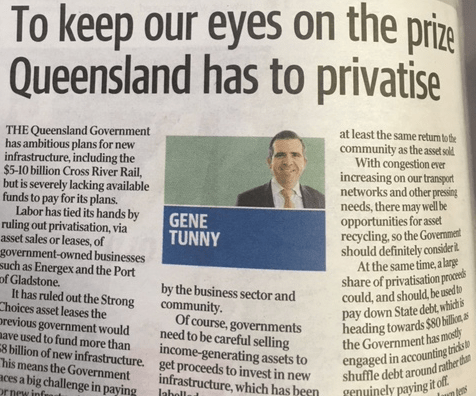
Long-run benefits of privatisation are undeniable

CM_image

Last Friday, in an opinion piece in the Courier-Mail (see image above) that was consistent with its current “Go Queensland” campaign, I re-entered the debate on privatisation:

Privatisation, legalising Uber and deregulating trading hours are first steps towards boosting the economy

To anyone who has worked in both private and public sectors, the higher level of efficiency in the private sector is obvious. It is driven by the strong private sector desire to minimise costs and maximise profit. Hence, for a long time now, I have been in favour of privatising government-owned businesses, with the caveat that the privatisation is well-managed and monopoly businesses are (or remain) appropriately regulated. By well-managed, I mean that the government needs to ensure it gets a good sale price for the business, as privatising an income-generating business obviously affects the budget. Also, the government needs to consider the impacts of any job shedding on local economies, and appropriate labour market and training programs are introduced, if necessary.

My views on privatisation are informed by international literature reviews that were conducted in the wake of the large number of privatisations that began in the eighties, with Margaret Thatcher’s transformation of the British economy, and which then occurred all over the world. The evidence was undeniable that privatisation yielded efficiency gains, and therefore was ultimately good for the economy and living standards. The most comprehensive and authoritative review of the impacts of privatisation was published in 2001, in the American Economic Association’s Journal of Economic Literature, the world’s leading journal for reviewing and summarising the findings of economic studies. The review by US economists William Megginson and Jeffry Netter, titled From State to Market: A Survey of Empirical Studies of Privatization, found among other things:

“Research now supports the proposition that privately owned firms are more efficient and more profitable than otherwise comparable state-owned firms…

…We know that privatization “works,” in the sense that divested firms almost always become more efficient, more profitable, and financially healthier, and increase their capital investment spending.”

So economists have been confident about the benefits of privatisation for at least the last decade-and-a-half. It is time for Queensland to stop being a laggard on privatisation.

Posted in Energy, Infrastructure, Productivity, Queensland Government, Uncategorized | Tagged , , , , , , | 4 Comments

Qld unemployment rate appears stuck around 6%, while national rate falls

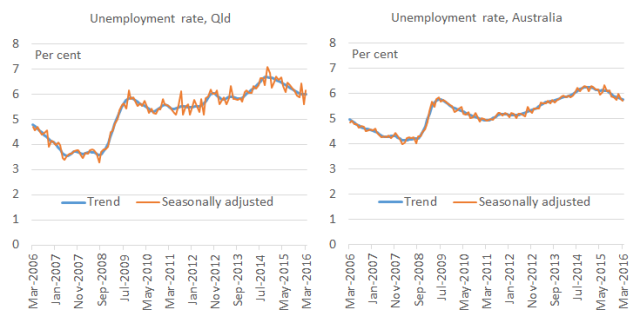
Queensland’s under-performing economy was illustrated by March labour force data released by the ABS today. The State’s unemployment rate appears stuck around 6%, while the national unemployment rate continues its steady decline, with the seasonally adjusted national rate falling from 5.8% in February to 5.7% in March (see chart below). In Queensland, the volatile seasonally adjusted unemployment rate rebounded to 6.1% in March from the unbelievable 5.6% in February, while the trend unemployment rate remained stable at 6.0%.

urates_Mar16

Queensland’s labour force data are difficult to read given the volatility in the underlying seasonally adjusted data, but I think they do confirm my under-performing economy view. While South-East Queensland is doing reasonably well, particularly with strong residential construction activity across the region and the Commonwealth Games’ preparations on the Gold Coast, regional Queensland is suffering profoundly from the adverse impacts of the mining downturn and drought. Combined, these opposing forces are giving us an overall lacklustre, under-performing State economy.

I chatted with Pat Hession this afternoon on Townsville ABC Radio regarding what might be done to help the struggling Townsville economy. I suggested that regional economies have to let go of unviable businesses such as the Nickel Refinery, as we cannot afford to prop up unsustainable businesses. Instead, we should improve our education systems to ensure future workers are competitive in the global economy, invest in productive infrastructure (only if it passes the cost-benefit test, of course), and have growth-promoting tax and regulatory policy settings (e.g. cutting payroll tax and deregulating retail trading hours would be a good start). My comments were consistent with a previous post of mine on regional assistance measures:

Regional rescue packages have a poor record

Regarding today’s jobs data, Pete Faulkner, as usual, has a good post:

Jobs surprise, but QLD bucks the positive trend

Posted in Labour market, Macroeconomy, Mining, North Queensland, Townsville, Uncategorized | Tagged , , , , , , , | 4 Comments

Go Qld is a terrific initiative from the Courier-Mail

Regular readers will know I have been concerned about Queensland’s economic and population trends for some time now, so obviously I welcome the Courier-Mail’s #GoQld campaign which it has launched today, with the paper asking: “What ideas and projects do you think will drive jobs and economic activity in Queensland?” The campaign was launched with a report from demographer Bernard Salt of KPMG which highlighted, among other things, Queensland’s declining rate of population growth and our post-war record low interstate migration. Boldly, Mr Salt predicts interstate migration may even turn negative, which I doubt will happen even though I acknowledge it is possible.

Along with Mr Salt, I was quoted in today’s Courier-Mail on the interstate migration issue (Queensland migration falls to lowest levels since post-war years):

Adept Economics principal Gene Tunny said: “It’s not that we are seeing a huge exodus, it’s that people are not coming because the opportunities that once existed are no longer here.’’

The “underperforming’’ economy was a factor in ­deterring people, but Queensland was paying the price for the earlier flood of arrivals.

“I think the livability of Queensland, especially the southeast corner has reduced with the population growth over the last two decades,” Mr Tunny said.

I discussed my concerns over Queensland’s mismanaged population growth in the 1990s and 2000s with Steve Austin on 612 ABC Brisbane a couple of weeks ago, noting that the past mismanagement of growth has reduced our livability and attractiveness to people in other States. In the interview I noted the water crisis, in which South-East Queensland nearly ran out of water in the late 2000s, was a good example of growth mismanagement (see ABC radio interview on population growth & State income tax proposal).

Regarding ideas to boost jobs and economic activity in Queensland, some easy first steps would be to legalise Uber and deregulate retail trading hours, as I also discussed with Steve Austin two weeks’ ago. Obviously there are many more things to do, and I will write a more extensive post on this issue in the near future.

Posted in Macroeconomy, Migration, Uncategorized | Tagged , , , , , | 5 Comments

Value capture can be desirable, but won’t make bad projects stack up

There was an odd statement about value capture on the front page of Monday’s Australian, in the story about the PM’s grand plan for high speed rail. The statement was that value capture, by which a private consortium would get a share of the potential increase in land values from the project, “would minimise the amount of taxpayer dollars needed to get the much-vaunted project off the ground, and ensure that the cost-benefit analysis for the project stacked up.” Value capture may well minimise the taxpayer commitment, but it will not necessarily make a cost-benefit analysis stack up.

The importance of not getting carried away by the excitement of value capture is put very nicely by my old friend and former Treasury colleague Joe Branigan of the Smart Infrastructure Facility in a submission he made earlier this year to the House of Representatives Standing Committee on Infrastructure, Transport & Cities Inquiry into Transport Connectivity, entitled Value Capture in the Australian Federation: Issues.  Joe notes (p. 15):

“The importance of ensuring the social benefits outweigh the social costs over the life of the infrastructure (in net present value terms) through a robust cost benefit analysis of a transport project is well known. Care is required to ensure value uplift is not a spurious source of additional benefit used to improve the benefit/cost ratio of an unviable project. Estimates of value uplift should be conservative, and net out uplift caused by exogenous factors (such as population growth).”

Broadly speaking, value capture relates to the financing of projects and how its net benefits are distributed, not the overall level of net benefits. It can help with the financing of a project, but it does not necessarily improve a project’s economic viability from the community’s point of view. Value capture is about project proponents, governments or private investors, capturing benefits that would otherwise accrue to others, such as nearby property owners, and thereby helping their financial business cases for the project get across the line.

But the proceeds earned by value capture are not new additional economic benefits from a project; they are a transfer of benefits from one group to another (e.g. from nearby property owners to a project consortium), so they really do not help the cost-benefit analysis. For example, any uplifts in property values attributable to a project would be the capitalised values of streams of benefits into the future, such as travel-time savings to residents or the higher profitability of local businesses, benefits that would (or should) be estimated as part of a comprehensive cost-benefit analysis anyway. If you went and added value-captured revenues to these benefits you would be double counting.

So value capture does not necessarily mean that the overall cost-benefit analysis will reveal a project stacks up from the community’s point of view, and that the project is deserving of public subsidy. Clearly, projects such as Cross River Rail and the PM’s high speed rail project will require heavy public subsidies, even if there is some value capture involved. For a subsidy to be justified for either project, there would need to be net benefits to the community from the project, as established by a cost-benefit analysis.

For readers interested in the economics of value capture, I thoroughly recommend Joe’s submission.

Joe

Joe Branigan,  Senior Research Fellow, SMART Infrastructure Facility, University of Wollongong

Posted in Infrastructure, Uncategorized | Tagged , , , , | 4 Comments

Huge disparities in GST carve up per capita: NT gets $13k per person, WA gets $760

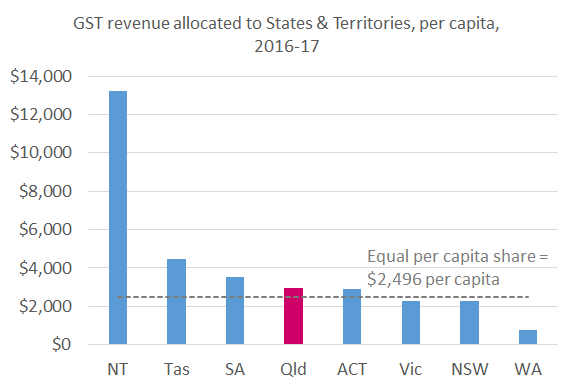
Commenting on my post from earlier today, a colleague noted that, in per capita terms (rather than in terms of total amounts), three States and Territories, the Northern Territory, Tasmania and South Australia, do much better than Queensland in the redistribution of GST revenue (see chart below). If GST revenue were distributed to States and Territories on an equal per capita basis, and not adjusted for fiscal disabilities, each State and Territory would receive just under $2,500 per person in 2016-17, according to the Commonwealth Grants Commission (see 2016 Update Report). NT, however, receives around $13,200 per person, compared with Queensland which receives around $2,900 per person. WA, of course, with its strong mining production, is the biggest loser in the GST redistribution, only receiving around $760 per person in GST revenue.

GST_per_capita

Posted in Tax, Uncategorized | Tagged , , , , , , , , , , | Leave a comment

Qld second biggest winner from GST redistribution

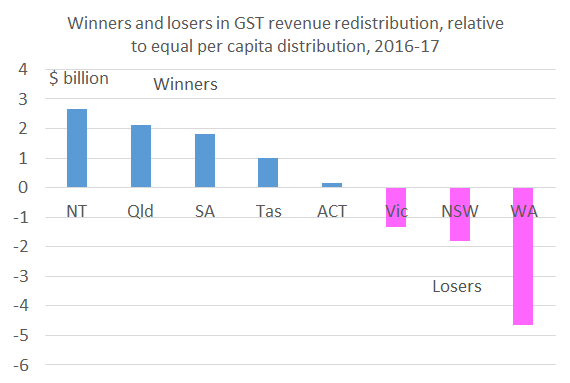
Queensland is the second biggest winner from the carve up of GST revenue that is dictated by the Commonwealth Grants Commission. In 2016-17, Queensland is to receive $2.1 billion more than we would if the GST revenue, which is collected by the Commonwealth on behalf of States and Territories, were shared equally per capita across Australia. That is, Queensland will receive $14.3 billion rather than the $12.2 billion we would receive under equal per capita shares. Only the Northern Territory does better from the GST carve up (see chart below).

winners_losers

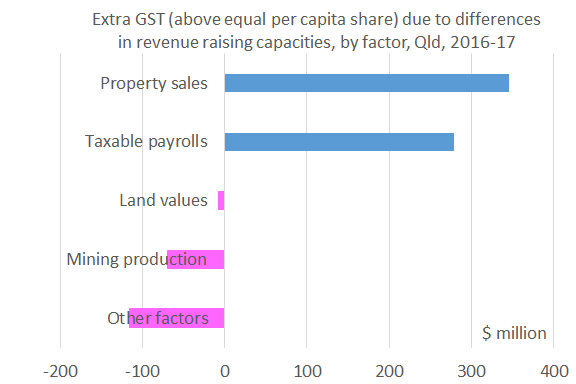
As I noted in yesterday’s post, GST is redistributed among States and Territories depending on their relative revenue-raising capabilities and expenditure requirements. Regarding revenue raising, Queensland is disadvantaged relative to other States and Territories by disproportionately smaller volumes of property sales, affecting stamp duty revenue, and business payrolls, affecting payroll tax revenue (see chart below). These disadvantages are partially offset by some revenue-raising advantages, including relatively substantial mining production (and some other factors that the CGC Update Report does not appear to elaborate on).

revenue_factors

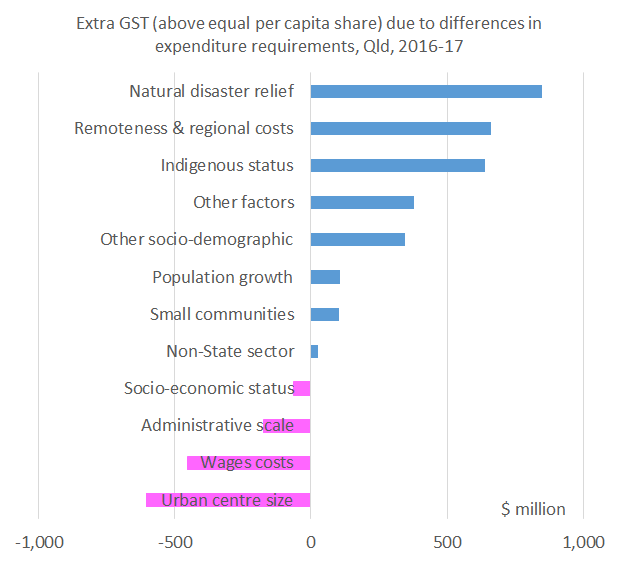
Regarding expenditure requirements that result in Queensland receiving more GST than an equal per capita share would provide, critical factors include our propensity for natural disasters, the remote or regional locations of many of our communities which are hence more costly to service, and our higher Indigenous population share (see chart below).

expenditure_factors

Finally, I need to clarify something I wrote in yesterday’s post regarding the movement of debt from the General Government sector to government-owned corporations (GOCs). When I wrote about debt sitting on GOC balance sheets not being matched by assets, I was referring to the additional transferred debt being unaccompanied by new assets (that is, it is just dumped on the GOCs; they did not voluntarily borrow the money to invest in new assets). I did not mean to suggest that the GOCs have total liabilities greater than their assets, which would imply negative equity, something which is not the case and which I did not mean to imply. I did, however, mean to imply that the GOCs’ financial positions have been compromised by the debt transfer.

Posted in Budget, Queensland Government, Uncategorized | Tagged , , , , , , , | 2 Comments

Extra GST revenue welcome, but Qld still faces big fiscal challenges

The Queensland Government must be pleased the Commonwealth Grants Commission (CGC) has recommended it receive an additional $520 million above what it might have expected from the GST revenue carve up for 2016-17 (see 2016 Update Report). The gain to Queensland is mostly due to a redistribution of GST revenue from NSW, which has higher revenue-raising capacity via stamp duty applied to higher property market turnover.

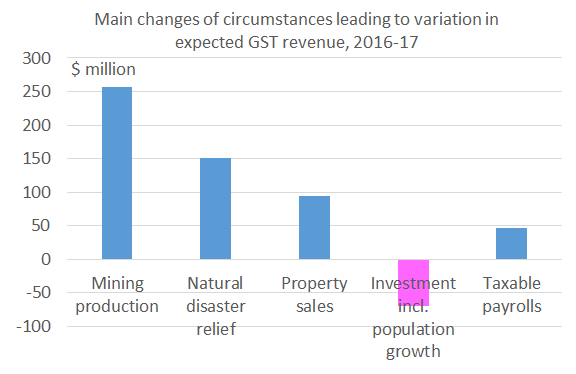
The Queensland Government is receiving additional GST revenue because, in recent years relative to other States and Territories, its revenue-raising capacity has worsened, primarily due to the mining downturn, and because its expenditure responsibilities have increased, primarily due to natural disasters (see chart below based on data in the CGC 2016 Update Report). Note the slight subtraction from the additional revenue due to Queensland’s lower population growth rate in recent years (the pink column below), a topic I have discussed with Steve Austin on 612 ABC Brisbane from time-to-time (e.g. ABC radio interview on population growth & State income tax proposal). Of course, there should be a matching reduction of expenditure by the State Government due to lower population growth, but that is not guaranteed.

CGCpost_1

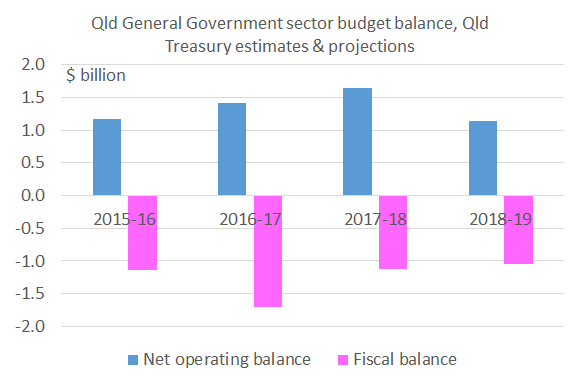
The higher-than-expected GST revenue does not get Queensland out of its budgetary troubles, however, as the fiscal deficit for 2016-17 was projected at $1.7 billion at the time of the Mid Year Fiscal and Economic Review last December (see chart below). The extra GST revenue will reduce this deficit, but the Queensland Government will still run at least a billion dollar fiscal deficit. (Note the fiscal balance is equal to the net operating balance less net capital expenditure.)

CGCpost_2

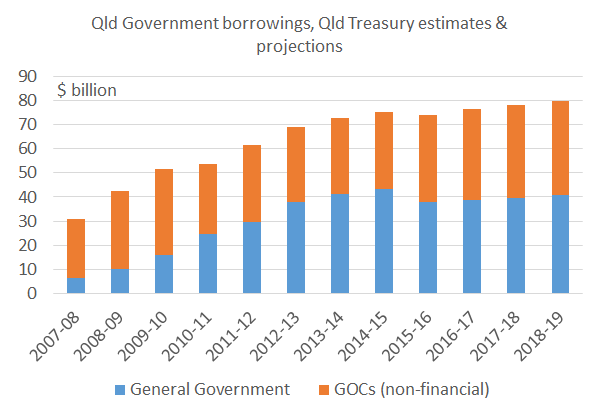
The Queensland Government still does not have a realistic plan for paying down its large amount of accumulated debt, much of which was accumulated to fund, arguably, uneconomic infrastructure, such as water recycling and desalination plants. While the Government claims it is bringing down General Government debt, this is largely due to the debt switch sleight-of-hand I criticised last year, whereby the Government is transferring General Government debt to government-owned corporations (GOCs), but without corresponding assets that would allow them to earn an income to service the additional debt (see Qld Govt expenditure growth has resumed after extraordinary period of austerity). Indeed, total Government borrowings continue to rise over the forward estimates to 2018-19 (see chart below).

CGCpost_3

Clever accounting by State governments past and present means there is a significant amount of debt on GOC balance sheets that does not have matching revenue-generating assets. Hence it is difficult to rely on the General Government debt figures. For this reason, ratings agencies are justified in paying attention to total State government borrowings, not just borrowings accounted to the General Government sector. The Queensland Government needs to focus on restraining expenditures and generating fiscal surpluses, not just operating surpluses, so it can really get debt under control.

N.B. I clarify the comments in the last paragraph in the post Qld second biggest winner from GST redistribution.

Posted in Budget, Infrastructure, Uncategorized | Tagged , , , , , , , | Leave a comment

On Cross River Rail, Government appears confused over meaning of “business case”

In today’s media release on the Brisbane Cross River Rail project, The Queensland Government appears confused about the meaning of the term “business case.” It risks committing the same error that governments (present and past) across Australia have committed when it comes to infrastructure projects. This error was identified by the Grattan Institute in a recent report Roads to Riches (p. 2) as being that “Decisions on particular projects are dubious or made on the basis of weak or undisclosed business cases.” There is obviously the risk that the business case for Cross River Rail could be weak, because the business case for the new route has not even been developed yet! As Transport Minister Stirling Hinchliffe announced today:

“The Palaszczuk Government has fast-tracked the business case for our number one priority infrastructure project and announced plans to establish a delivery authority to ensure the project is built.”

Amy Remeikis of the Brisbane Times nicely summarised the “Yes Minister” nature of this announcement when she noted that:

“The latest incarnation of Cross River Rail has a route and a promise to keep the politics out of it. What it doesn’t have is funding, a business case, or even a plan on how the estimated $5.2 billion project would be delivered.”

The Delivery Authority may well be compared to that hospital in “Yes Minister” that ran much better without patients. And do we expect the Delivery Authority to take a hard-headed, objective view of the merits of Cross River Rail when its very existence depends on the project proceeding?

Cross River Rail may well be a good project, but the Government should not make the final investment decision until it has a full business case and is confident Cross River Rail is the best option to address the looming capacity constraint problem that it is worried about. Options considered should include doing nothing and, arguably, the previous Government’s BaT Tunnel, so we are sure it is best to revert back to the Cross River Rail concept. Billions of dollars are at stake. Queensland deserves much better infrastructure planning than this.

Posted in Transport, Uncategorized | Tagged , , , , , , | 6 Comments

Qld small businesses not as optimistic as those in NSW and Victoria

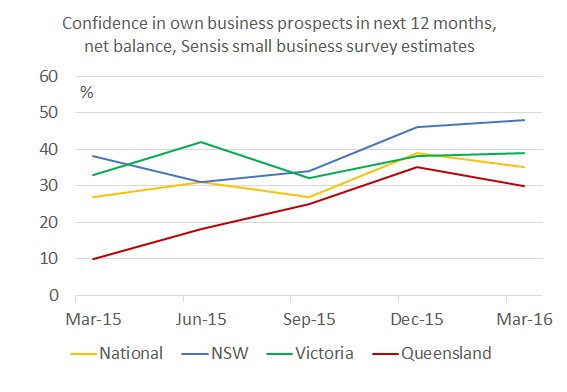
small_business_confidence

Queensland’s lacklustre economy is reflected in our small and medium businesses remaining less optimistic than those nationwide, particularly in NSW, Victoria, Tasmania and the ACT, according to the latest Sensis survey of small and medium businesses, those businesses with fewer than 200 employees (see chart above, which charts the difference between the percentages of optimistic and pessimistic businesses, the net balance). There was a fall recorded in business confidence in Queensland in March quarter, but I am hesitant to make too much of it given there appears to be substantial volatility in the series due to the relatively small sample size (171 Queensland businesses). At least over the last twelve months there has been a substantial improvement in confidence, after the initial shock of the mining downturn. But, as I’ve commented extensively in the past, the economy remains sluggish, and regional areas are struggling, and that is why our performance is below that of other States.

The Sensis data also reveal that the Queensland Government “is now viewed as the least supportive government of all the states and territories” as reported by the Courier-Mail. I have been saying for some time now that State Government policies and regulations need to be improved in the interests of boosting productivity and economic growth. My most recent comments were in my second interview with Steve Austin on 612 ABC Brisbane last week (see Queenslanders struggling to find jobs), in which I again called for legalisation of Uber, deregulation of retail trading hours, and streamlining project approvals.

Posted in Macroeconomy, Uncategorized | Tagged , , , , , , | 3 Comments

Economists and their models

Across Brisbane at the moment there is a huge amount of residential construction activity, particularly of apartment towers. Our understanding of supply and demand suggests this will suppress the growth of unit prices in the near future, or in the worst case cause prices to crash as one QUT academic has forecast (e.g. see my post from last October Is a unit price crash coming?). Economists make extensive use of the supply and demand model in analysing economic issues, and therefore an upcoming lecture, considering the history of the “hallowed supply-demand diagram” among other economic models, is of great interest to me.

The lecture on the evening of Monday 18 April at the University of Queensland, St Lucia is titled Models: Facts, Artefacts or Fictions? It is being given by Professor Mary Morgan of the London School of Economics, the leading international authority on the history of econometrics. As the Secretary of one of the sponsors, the Economic Society of Australia (Qld), I will certainly be attending and am very much looking forward to the lecture and I hope you can come along, too (please register via the link provided above).

Mary_Morgan

Prof. Mary Morgan, LSE

Regarding the usefulness of economic models for understanding economic issues, I would recommend Paul Krugman’s “Models and Metaphors” Ohlin lecture from 1992 (published by MIT Press in 1995 in Development, Geography and Economic Theory). In that lecture, Krugman beautifully summed up the power of economic analysis using prima facie abstract models:

“At base, mainstream economic theory rests on two observations: obvious opportunities for gain are rarely left unexploited, and things add up. (Or as I sometimes put it, $20 bills don’t lie in plain view for very long, and every sale is also a purchase.)…Thinking carefully about how self-interested individuals would act in a particular situation, and how these actions would interact, can often produce powerful and surprising insights.”

Yes, economics is full of surprises, and economic models, and indeed economists, are much more interesting and practical than they may at first appear! Please consider attending the lecture on 18 April. I am sure it will be very intellectually stimulating and interesting.

Posted in Housing, Macroeconomy, Uncategorized | Tagged , , , , , , , , , | 2 Comments