“Responsible economic management & fiscal restraint”-really?

budget_balance_1617

The 2016-17 Budget is very disappointing, but economists and former Treasury officials were always going to be disappointed in an election year. It is also a Budget that is particularly disappointing to the Queensland Government, due to a lack of funding for new infrastructure projects that are high on the Government’s priority list, such as Cross River Rail and the Townsville Super Stadium (both arguably dubious projects, however). Funding has only been allocated for less exciting projects such as the Ipswich Motorway upgrade (overdue and likely a beneficial project) and for pre-construction works and land acquisition for the Melbourne-to-Brisbane Inland Rail project (possibly economic, but I would like to see a decent business case for it).

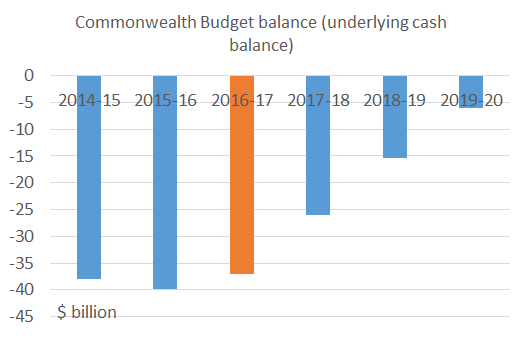
As I commented last year, the Federal Government has basically given up on the task of budget repair. Sure, the Budget balance gradually improves over the forward estimates, but forward estimates are typically too optimistic, as they do not include the unforeseen spending requirements that always seem to emerge. The real indication of the Government’s commitment to “responsible economic management and fiscal restraint”, which it lays claim to in the Budget Overview, is the forecast 2016-17 budget deficit of 2.2 percent of GDP ($37.1 billion) which is only a marginal improvement on the 2015-16 deficit of 2.4 percent of GDP ($39.9 billion) (see chart above). This is a pretty pathetic effort at fiscal restraint.

The Centre for Independent Studies’s media release is a concise and hard hitting summary of the problem with last night’s Budget:

The [2016-17] Budget has no credible plan to reduce expenditure and return the budget to balance, according to policy experts and economists at The Centre for Independent Studies.

“Far from tackling Australia’s spending problem, Treasurer Scott Morrison keeps spending at near record levels,” CIS Research Manager Simon Cowan said.

“Government spending remains at 25.8% of GDP the same level as 2015/16, and only falls to 25.2% by the end of the forward estimates…

…”The Treasurer has repeated his predecessor’s mistake of relying on future revenue increases to return the budget near balance: receipts continue to rise far above their historical average, increasing by 1.2 percentage points of GDP over the next four years.

Why should we worry about this? Because we are now very likely stuck on a path of permanent deficits and ever growing debt, a debt that will increasingly worry the ratings agencies who may well reconsider our AAA credit rating in future years. Also, what happens when we eventually experience a recession? The Budget deficit will blow out even further.

The problem the Government has, like many modern governments, is an addiction to unnecessary spending. Let us consider one egregious example from the current Budget, the Youth Jobs PaTH Program. Under one component of the program, the Government will pay 30,000 young people an additional $200 a fortnight (on top on income support) to undertake a 4-12 week internship with a business that will receive $1,000 to host them. This has rort written all over it! There are already well established internship programs run by universities, and there appears to be many internships already occurring. Indeed, I have benefited from work provided by a number of interns over the years. This part of the  program is a complete waste of money, and I have huge doubts about the merits of the wage subsidy of up to $10,000 that is also part of the Youth Jobs PaTH program. Again there is a huge risk of employers rorting this and getting paid for taking on a young person they would have anyway.

Finally, I should note there are some things I like about this Budget, including the lifting of the middle income tax threshold from $80,000 to $87,000, the crackdown on tax avoidance by multinationals such as Google and Apple, and the tax cuts for small and medium-sized businesses. Michael Knox has written a very good note on the pro-business measures in last night’s Budget:

Economic Strategy for Extraordinary Times

Also, the $171 million in funding for the Great Barrier Reef’s long-term sustainability plan is welcome, even though it is almost certain the Federal Government will have to spend much more than this if we are to avoid the Reef becoming endangered.
Posted in Budget, Uncategorized | Tagged , , , , , , , , | 6 Comments

Go Qld campaign moves on to attack payroll tax and penalty rates

The Courier-Mail’s terrific “Go Queensland” campaign has today moved on to the issues of payroll tax and penalty rates, both of which I covered in my paper for the Jobs Growth Summit last week (see related post). I am quoted today in a (pay-walled) Courier-Mail article covering CCIQ’s case for an increase in the level of payroll, the threshold, above which businesses are liable to pay payroll tax, from $1.1 million to $1.6 million, so many more small and medium-sized businesses are exempt. The Courier-Mail reports (in Payroll tax is ‘discouraging jobs’, according to CCIQ):

Gene Tunny, principal of Brisbane-based Adept Economics, said he would like to see payroll tax scrapped.

“It’s a pretty bad tax which impacts both the employer by eating into profits and the employee through a lower take-home pay or fewer jobs.’’

“It has a pernicious impact. But I realise that it would be politically unpalatable to get rid of it given the billions of dollars it raises.

“What we should ultimately do is increase the GST which is a reasonably efficient tax and do away with things like payroll tax and stamp duty.’’

In the meantime, he said lifting the threshold ‘‘strikes a balance between the economics and the politics’’.

The Courier-Mail also reports (in Lower penalty rates could bring jobs boom) on research by industry bodies Restaurant and Catering Australia and CCIQ which found aligning Saturday and Sunday penalty rates would result in a large increase in the number of businesses opening on Sundays and a related increase in working hours and jobs.

Posted in Labour market, Tax, Uncategorized | Tagged , , , , , | Leave a comment

Exciting week for economy watchers: State of the States, a possible rate cut, and the Budget

CommSec’s latest State of the States Report is out today, and, while I think its placement of Queensland in around the middle of Australia’s States and Territories (5th out of 8) is reasonable, I have some sympathy for Queensland Treasurer Curtis Pitt who has criticised the methodology of the Report. Mr Pitt was quoted in the Brisbane Times as follows:

“CommSec compares select current economic data with an average for the previous decade…It means we are being compared to conditions in the past resources investment and construction boom. This gives an incorrect picture of current performance.”

I agree with the Treasurer that the methodology is questionable, as I noted in a 2010 post.  That said, it nonetheless appears to be placing Queensland around about where it should be based on recent economic performance. As I have noted previously, the Queensland economy is under-performing, particularly compared with NSW and Victoria (see e.g. my Jobs Growth Summit Paper). In talking up the Queensland economy, which of course is part of his job description, the Treasurer has to rely upon forecasts of future good times that have not yet occurred, as reported by the Brisbane Times:

Mr Pitt hoped voters would look to the Deloitte Access Economics Business Outlook, which in March predicted Queensland would be “near the front of the state pack” for growth over the next five years.

This may well be the case, but we have to live and work in the economy as it is today, and that is what CommSec is trying to assess, albeit in an imperfect fashion.

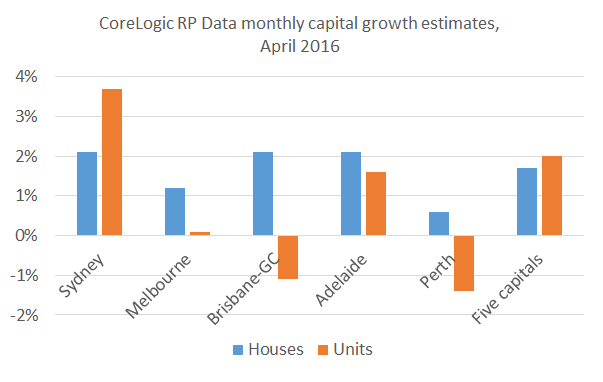
Other economic news today came from CoreLogic RP Data, which released its Home Value Index results for April. SEQ appears to be doing well, and better than Melbourne in the growth in house values, but unit values only increased 0.2% in Brisbane and actually fell 1.1% in the Brisbane-Gold Coast area in April (see chart below). The looming over-supply of units may see a large correction in residential construction activity, currently one of the Queensland economy’s bright spots, over the next couple of years.

capital_growth_April16

The rest of the week will be exciting for economy watchers, with an interest rate cut very possible tomorrow (though arguably unnecessary and undesirable given the national economy appears in reasonably good shape), and the Budget to be released tomorrow night.

Regarding the Budget, it appears that, while Queensland will benefit from higher than previously expected GST revenue (see my April 10 post), we may not get access to funds for infrastructure that are tied to “asset recycling,” i.e. privatisation (see the Queensland Treasurer’s media release from this afternoon). I am a big supporter of privatisation, but I cannot see the public policy rationale behind linking Commonwealth funding for new infrastructure to the privatisation of existing government-owned businesses. The Commonwealth may have wanted to incentivise good policy but, given the strong opposition of Queenslanders to asset sales, it would be bloody minded to deny us funding because our political system will not deliver privatisation.

Posted in Budget, Housing, Infrastructure, Macroeconomy, Uncategorized | Tagged , , , , , , , , , , , , | 2 Comments

Fast-tracking of Uber review is great news – Gov’t has adopted one of my Jobs Growth Summit recommendations

I am very pleased the Queensland Government has brought forward the reporting date of its review into taxi and ride-sharing services, as announced by the Premier yesterday (see Brisbane Times coverage). This followed my call for a fast-tracked review in my submission to Tuesday’s Jobs Growth Summit, and the question I asked the Deputy Premier at the Summit, as covered in my previous post. I do not hold much hope for the Government adopting any of my other recommendations, alas, but good on them for doing this at least.

As covered previously on this blog, the legalisation of Uber and the ending of restrictions on taxi licences would bring large gains to consumers through lower fares, around
$40 million per annum according to a Queensland Department of Premier and Cabinet estimate (see ABC news report). Also there would arguably be benefits through better quality services and a reduction in alcohol-related violence at taxi ranks, as argued by my friend and former colleague Brad Rogers. Relevant posts include:

Cracking down on Uber would come at a high cost to the Qld community

Should Qld taxi plate owners be compensated for the recent disruption to the taxi industry? (guest post by Rod Bogaards)

Queensland taxi licences and drunken violence (at BJR Economics)

Posted in Transport, Uncategorized | Tagged , , , , , | Leave a comment

After Jobs Growth Summit, business groups need to lobby hard for better policies

At today’s Queensland Jobs Growth Summit at Parliament House in Brisbane, I did my best to argue for good economic policy. After Deputy Premier Jackie Trad’s speech, I asked her whether the Government would consider fast-tracking the review of taxi services (so Uber could be legalised) and deregulating retail trading hours. I was very pleased when the Deputy Premier noted she was prepared for the question because she subscribes to this blog, and I was also grateful for her considered and comprehensive reply.

On taxi services and Uber, the Deputy Premier said it is important to take the time to get the new policy settings right, which I cannot disagree with, although I am still surprised the Varghese review was given ten months to do the job. I was pleased the Deputy Premier said she recognised that change in the sector was inevitable due to digital disruption. She noted that the Government faces the difficult issue of what to do with people who had invested a lot of money in taxi licences, and her words suggested to me that the Government is considering compensating licence holders for losses in licence values associated with Uber’s entry into the market. Some compensation appears unavoidable from a political point of view, but there is arguably no sound public policy rationale for compensation, as Rod Bogaards argued in a guest post earlier this year.

On trading hours, the Deputy Premier argued that consumption expenditure is growing at a reasonable pace in Queensland and there thus does not appear to be a need for changes to trading hours’ regulations at the current time. I would have replied that, while it may be so that consumption expenditure is growing, there would clearly still be benefits to consumers if there were deregulation, through the greater product choice and lower prices available at supermarkets which would be allowed to open for longer. Also I would note that, as shown in Queensland Treasury’s latest brief on retail trade, growth in retail trade in Queensland has been significantly below the national average over the last twelve months. So there is certainly room for retail trade to grow further, and deregulated trading hours could assist in this regard.

The Jobs Growth Summit was hosted by the UQ School of Economics and the Australia Institute, and sponsored by my business Adept Economics, among other organisations (see image below). The event featured some notable speeches, in addition to the address by the Deputy Premier, particularly from Saul Eslake, who highlighted Queensland’s relatively low educational attainment and productivity, and from Professor John Quiggin, who argued for a reversal of contestability reforms in vocational education and training (VET). John suggested that the VET reforms across Australia have been, in his memorable words, a “bipartisan disaster area.” Clearly the implementation of contestability has been imperfect, and some rorting has occurred, but I think it would be a mistake to go back to TAFE providing all publicly-funded training as John suggested. When contestability was introduced, there were important market design issues that were not well thought through, particularly regarding appropriate subsidy levels and the required level of oversight, but we should not abandon the important efficiency and student choice benefits that contestability brings.

Finally, as I suggested in an earlier post, the Jobs Growth Summit will not be enough on its own, and there is now a need for action in addition to talk. The Queensland business community needs to continue pushing hard for necessary policy changes (e.g. cutting payroll tax, deregulating trading hours, etc, as I suggested in the paper I prepared in the lead up to the Summit). The structure of the Summit and the very short time given to industry representatives to speak meant that, in my view, important concerns from the business community regarding government policies were not expressed. Queensland needs to hear more from its business leaders regarding the policy settings that are necessary to promote jobs and economic prosperity.

jobs_growth_summit_sponsors

Queensland Jobs Growth Summit Sponsors

Posted in IR, Labour market, Macroeconomy, Uncategorized | Tagged , , , , , | 4 Comments

Guest post from Joe Branigan: A quick refresher course in how to create jobs

I am delighted to publish this guest post from my friend and former Treasury colleague Joe Branigan, who is also attending today’s Jobs Growth Summit at Parliament House, Brisbane (see my previous post Jobs Growth Summit a great opportunity to push for better economic policies). I understand that this guest post, which is effectively Joe’s submission to the Summit, appears in an edited form in today’s Courier-Mail.

A quick refresher course in how to create jobs

Some of Australia’s best public policy minds meet in Brisbane today for the Queensland Jobs Growth Summit.

The summit comes at a time when Queensland’s and Australia’s unemployment rates seem stuck at around 6%, about 2% above the lows achieved by the end of phase 1 of the decade-long mining boom (2003-2012), just before the GFC slowdown and the introduction of the Fair Work Act in 2009.

Politicians like to think they create jobs. That is, they think they can create additional employment and lower the unemployment rate either by employing more public servants or investing in new infrastructure.

For instance, Queensland’s Minister for Training and Skills Yvette D’Ath claims there will be a ‘jobs jackpot’ with the ‘job-generating’ Queen’s Wharf development because it “will significantly stimulate the construction, tourism and hospitality sectors and open new markets and opportunities in this great state.”

Similarly, the Palaszczuk Government is: “building or upgrading 17 world-class facilities for the 2018 Commonwealth Games…that will inject $2 billion into the Queensland economy and support around 30,000 jobs.”

Indeed, Premier Palaszczuk last week took her Working Queensland Cabinet Committee to Charters Towers to sniff out “job creating opportunities” that would merit taxpayer support.

This entrenched idea that governments create new jobs by stimulating demand using taxpayer funds is flawed. This is not to say that governments should not invest in worthwhile public infrastructure projects, but the benefits of those investments are higher incomes not more jobs.

Here’s why.

The problem is that, outside of recessions, a lack of demand is not the problem, rather it is bad regulations restraining employment growth that is the problem.  This brings us to the most important concept in the jobs debate and what should be the focus of the Queensland jobs summit: the ‘natural rate’ of unemployment.

In 1968, Milton Friedman famously wrote: “At any moment of time, there is some level of unemployment which has the property that it is consistent with equilibrium in the structure of real wage rates.” Friedman went on the say that this “natural rate of unemployment” is determined by the characteristics of the labour markets – i.e. minimum wages, the Fair Work Act, state industrial relations regulations, and the efficiency of matching jobs to job seekers, (including the efficiency of transport networks, costs of moving house, and whether we all live in one really big city or whether we live in a demographically dispersed state like Queensland).

Friedman rightly pointed out that many of the labour market characteristics that determine the level of the natural rate of unemployment are “man-made and policy-made” (read: politician-made).

Many studies, including by Australia’s Reserve Bank and the Federal Treasury, have demonstrated Friedman’s proposition. And former Federal Treasury Secretary Ted Evans famously said that Australia’s unemployment rate is a social choice, as opposed to an economic choice, that we make through the political system.

Recent studies by both the Federal Treasury and the IMF estimate that Australia’s natural rate of unemployment is 5.75%. The most recent ABS figure has Australia’s current trend rate of unemployment at 5.8%, basically at its lowest possible level outside of a boom. Our economy is growing at the ‘new normal’ post mining-boom/population-boom trend of 2.75%. It is therefore highly likely that any demand stimulus measures governments might undertake will be either a zero sum game or counterproductive.

The IMF has confirmed this view, finding not only that relatively large public sectors coexist with persistently high unemployment (think France), but also that public employment’s impact on private employment is negative.

One large IMF study concludes that:

“While in the short-run there might be some gains, in the medium to long-run, public employment may well increase unemployment. Public job creation could cause the destruction of private jobs through, for example, increasing labour taxes or exerting competitive pressure on private producers’ output and wages in the labour market in general. We do not find any evidence that public employment reduces the unemployment rate in the medium to long-run. If anything we found some evidence that creation of public jobs may increase unemployment rate.”

So how are jobs created?

Jobs are created because, as the population grows, demand for goods and services grows, and demand for labour therefore essentially grows in line with population growth.

A government’s proper role, therefore, should be to focus on reducing the natural rate of unemployment, which quite clearly has risen since the introduction of the Fair Work Act in 2009.

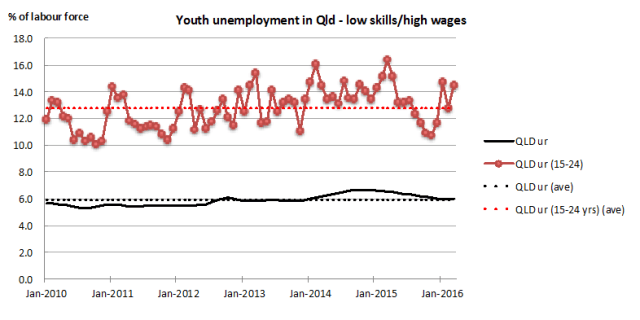
The Turnbull Government must reconsider the Fair Work Act in light of the too-high youth unemployment rate (see chart below). Australia should not tie itself to the mast of a ‘high-wage’ economy, rather we should be an ‘all-wage’ economy where there is a wage for every skill level. Remember, people climb ladders in life if given the opportunity of getting on the first rung. And most often the best way to learn valuable new skills is on the job.

JBjobspost_chart2

At the state level, the Palaszczuk Government should deregulate retail trading hours, which is surely a no-brainer for a Labor Government focused on job creation. In addition, Palaszczuk needs to carefully calibrate her regional policies, not over-investing in thin jobs markets, and not opposing efficient FIFO operations, so as not to create ghettos of unemployment in regional centres. We should better appreciate the job matching advantages of the deep and diverse labour market in the south-east of the state.

And, as part of Federation tax reform, state governments need to reduce and ultimately eliminate transaction taxes, most notably stamp duty on housing that restricts labour mobility.

Our ‘jobs’ objective must be to reduce the natural rate of unemployment by 1% from 5.5-6% to between 4.5-5%.

Federal Treasury modelling (and basic common sense) has shown that such a reduction in the natural rate of unemployment is likely to be associated with significantly higher tax revenues and an increase in national saving.

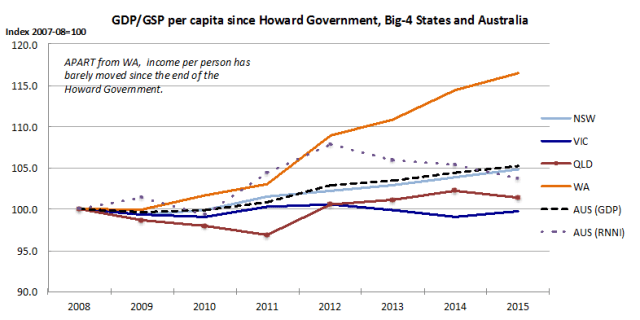
All governments in the Australian Federation must be focused on the dual goals of lowering the natural rate of unemployment and increasing real income per person (see chart below). Together, these two measures define the level and distribution of our living standards.

JBjobspost_chart1

When governments consider new regulations, they should ask: “will this increase or decrease the natural rate of unemployment?” Similarly, when governments consider new spending or taxing policies, they should ask: “will this increase or decrease income per person?”

This is especially the case in relation to multi-billion dollar infrastructure mega-projects like Brisbane’s Cross River Rail. When considering these projects we should not be fooled by the large number of jobs created through the construction phase of projects. These are largely illusory ‘sugar hits’ that cost taxpayers and crowd out private sector activity. The real test of government expenditure is the overall costs and benefits, which not only puts the emphasis on sensible, hard-nosed cost-benefit analysis, but very much puts the emphasis on the long-run benefits of projects.

Joe Branigan is a Senior Research Fellow at the SMART Infrastructure Facility

Posted in Infrastructure, IR, Labour market, Macroeconomy, Uncategorized | Tagged , , , , , , , , | 4 Comments

Tuesday’s Jobs Growth Summit a great opportunity to push for better economic policies

Jobs_growth_summit

On Tuesday, I will be attending the Queensland Jobs Growth Summit at Parliament House, which is being hosted by UQ’s School of Economics (my occasional employer) and the Australia Institute. My business Adept Economics is one of several Summit sponsors. In preparation for the Summit, I have written a short paper which I would be grateful for the views of readers on:

Queensland Jobs Growth Summit: Initial Views and Recommendations

Regular readers will recognise several of the charts, paragraphs and recommendations in the paper. In the paper, I note there are some obvious things that can be done to boost jobs and economic activity in Queensland. All that is lacking is the political will to implement them. The recommendations I make to the Queensland Government in the paper are as follows.

  • Recommendation 1. Fully deregulate retail trading hours across Queensland. At a minimum, it should adopt the National Retail Association’s proposal to harmonise trading hours across South-East Queensland.
  • Recommendation 2. Support the alignment of Saturday and Sunday penalty rates, as recommended by the Productivity Commission.
  • Recommendation 3. Over the next few years, progressively raise the payroll tax exemption threshold from $1.1 million to, say, $2 million. Furthermore, over the longer-term it should push for a reform of Commonwealth and State federal financial relations, so the State Government can ultimately abolish inefficient taxes such as payroll tax and stamp duty.
  • Recommendation 4. Consider changes to the draft Planning Regulation 2016 to ensure that it has sufficient grounds to intervene and override local planning schemes that are unduly constraining development. Furthermore, it should actively review local planning schemes and propose changes to those that are unnecessarily prohibitive.
  • Recommendation 5. Consider privatising government-owned businesses, such as Energex, Ergon, Powerlink and Townsville and Gladstone Ports, by either sale or long-term lease to the private sector, with a view to paying down debt and funding new infrastructure.
  • Recommendation 6. Use the Queensland Productivity Commission’s Industry Assistance Inquiry Report as a guide to wasteful government expenditure that could be cut in the interests of paying down debt and funding new infrastructure.
  • Recommendation 7. Revive its Department of Premier and Cabinet’s 2015 Economic Action Plan, put a new draft out to public consultation, and consider adopting many of the deregulatory measures advocated in the plan.
  • Recommendation 8. Legalise Uber without delay and fast track the new regulatory framework it is developing for taxi services.
  • Recommendation 9. Explore opportunities for the relocation of public servants to regional centres, such as the relocation of WorkCover to Townville, where such a move would not result in inefficiencies of public administration.
Posted in IR, Labour market, Macroeconomy, Queensland Government, Uncategorized | Tagged , , , , , , , , , , , , , , | 2 Comments

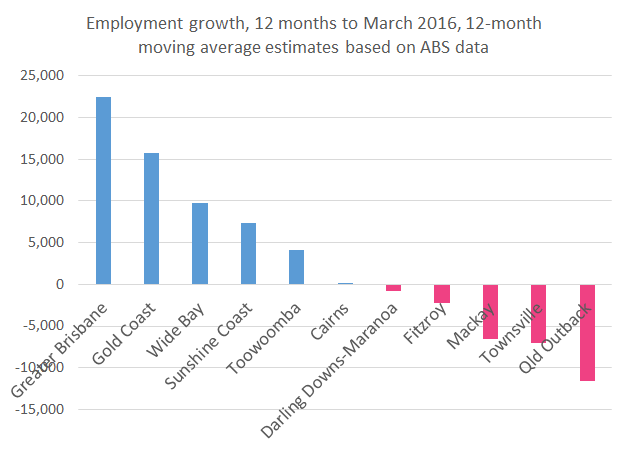
Robust SEQ economy distracts us from weakness in regions, particularly in Townsville

Regional_Mar16_chart1

Townsville-based economist Colin Dwyer is getting very worried about his region’s economy, noting in an email to his mailing list today that:

“Economic conditions have deteriorated in North Australia’s largest city.  The unemployment rate is the worst it’s been for 13 years…The official Townsville region unemployment rate is 12.4% up from 8.8% last month.  The number of unemployed has jumped to 13,100 the highest number since February 2003 (13.5k).”

Colin is referring to the original ABS data, which are highly volatile and unreliable, but that said I think Colin is right about Townsville’s deteriorating conditions, particularly given job losses revealed in the smoothed data preferred by Queensland Treasury (see chart above), and also given the large shock to the regional economy coming from the Nickel Refinery shutdown. As Pete Faulkner notes in his latest post (Regional jobs data is a Tale of 2 Cities in the North):

“…data shows the employment situation in Townsville as unambiguously terrible. Given that the complete fall-out from the QN debacle is yet to be seen in this data we do not expect to see this improving anytime soon.”

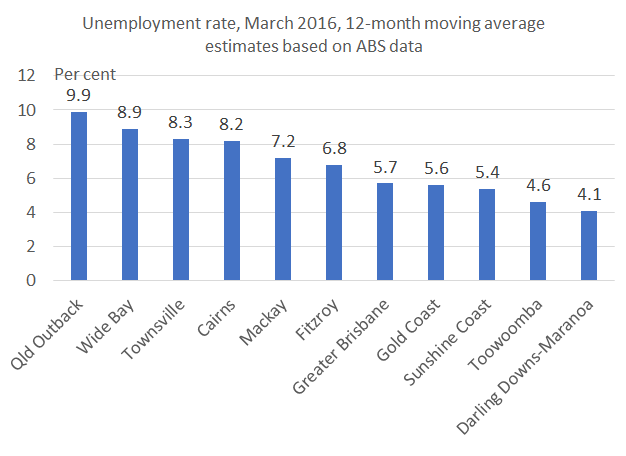
Using 12-month moving averages, Queensland Treasury estimates that Townsville’s unemployment rate is 8.3%, compared with a State average of 6.2% (see chart below and Treasury’s latest briefing note).

Regional_Mar16_chart2

The Townsville economy is clearly in bad shape, and other regional economies are suffering, too. I expect regional jobs will be a major topic of discussion at next Tuesday’s Jobs Growth Summit, which is being hosted by my occasional employer the School of Economics at UQ and the Australia Institute (see my post Qld Jobs Growth Summit timely, but needs to be more than a talkfest). My business Adept Economics is providing a small amount of sponsorship to the Jobs Growth Summit, and I am very much looking forward to the discussion.

Incidentally, earlier today, the Australia Institute released a paper on Queensland’s employment outlook. The paper is much more upbeat about the State economy than I would be at the present time, but it is worth a look nonetheless:

Jobs Growth in Queensland: Trends and Prospects

Posted in Labour market, Uncategorized | Tagged , , , , , , , , | 3 Comments

Post-Budget lunch featuring Michael Knox, Morgans’ Chief Economist

Queensland has already received some good news regarding the upcoming 2016-17 Federal Budget, with the announcement two weeks’ ago that our share of GST revenue will be over $500 million higher in 2016-17 than we previously expected (see my post Extra GST revenue welcome, but Qld still faces big fiscal challenges). But what else will the Budget on the 3rd of May bring? Modest income tax cuts returning some of the bracket creep that has benefited the Government? A lifetime cap on superannuation (e.g. $2.5 million), after which tax concessions no longer apply, as is widely expected, in the interests of long-run fiscal sustainability? And what would any policy changes mean for the economy?

On the day after the Budget, on Wednesday 4 May at 12.30pm, at Brisbane’s grand old United Services Club on Wickham Terrace, you could enjoy a nice lunch and lively discussion on the economic implications of the Budget with well-known local economist Michael Knox, Chief Economist of Morgans, a leading stockbroking and wealth management firm.

The lunch is being arranged by the Economic Society of Australia (Qld) of which I am the Secretary. The cost of the lunch is $80 for ESA (Qld) members and $95 for non-members, but numbers are limited to 20 people for this exclusive briefing (so please register promptly at the ESA Qld website). Knowing Michael I am sure the conversation will be illuminating and entertaining. Michael has had a good year so far, including having made the early and accurate prediction that there would be a rally in the oil price. I am looking forward to his analysis of the Budget.

Michael-Knox

Michael Knox, Morgans’ Chief Economist

Posted in Budget, Uncategorized | Tagged , , , , , , , , , , , | Leave a comment

The long game of regulatory reform: One step forward for WA, two steps back for Qld

Guest post from Rod Bogaards

The humble spud is not normally front and centre of economic debate. But news that Western Australians will finally be able to freely grow, market and buy potatoes provides an interesting case study of how difficult (and expensive) regulatory reform can be in Australia, and the inordinate time redundant and costly regulation can survive on the statute books.

It also serves as a cautionary tale for Queenslanders, with the Queensland Parliament recently re-regulating the sugar industry as the rest of the country largely consigns agricultural marketing regulation to history.

red-potatoes-03

WA is abolishing its ‘potato police’, while Qld has re-regulated its sugar industry

The WA potato industry was regulated just after the Second World War through the Marketing of Potatoes Act 1946. Under the Act, potatoes could only be sold by licensed potato growers through the WA Government’s statutory marketing authority, the Potato Marketing Corporation (PMC). Licences determined the quantity and variety of potatoes produced for fresh consumption.

The regulatory powers of the PMC were extensive. It was an offence to deliver, sell or receive potatoes without its authorisation. It had the power to search premises suspected of growing potatoes illegally and impound crops for evidence. It could also stop and search vehicles if it suspected they were carrying more than 50 kilograms of potatoes.

Because of these broad powers, the PMC was affectionately referred to as the ‘potato police’. Potato grower, Tony Galati, was taken to court on numerous occasions for selling in excess of his potato quota and giving away ‘illicit’ potatoes for free.

The PMC set wholesale prices and pooled sale proceeds, paying growers an average return after deducting its own costs. Licences were originally based on farming area, creating an incentive to grow high-yielding varieties of potatoes, to maximise area yield, rather than lower yielding varieties generally preferred by Australian consumers. As a result, the WA potato market was dominated by the Nadine potato, which in some years contributed over 70% of total production. The Nadine is considered by many to be watery and tasteless and is far less common in deregulated eastern states markets.

In an attempt to better match production to consumption preferences, in 2006 the PMC set allocations for different potato varieties. In 2012‑13 it set 65 per cent white, 16 per cent blue, 11 per cent red and 8 per cent yellow varieties. Growers were forced to meet the required allocation associated with their licence even though their land might not be suitable for particular varieties. Despite these attempts at improving potato variety the regulated market in WA continued to concentrate production into just a few varieties.

In a recent inquiry WA’s Economic Regulation Authority (ERA) concluded that:

“… restrictions on potato marketing have raised the incomes of potato growers in Western Australia. However, this has been at the expense of Western Australian consumers, who have paid higher prices than they would have otherwise, have had a limited choice of potato varieties, and have endured poor product quality. The restrictions have also limited productivity growth in the industry. The ERA estimates that approximately $43 million per annum would be passed through to consumers in the form of lower prices should the industry be deregulated.”

There were many failed attempts to abolish potato marketing regulation, including through the National Competition Policy process in the early 2000s. In 2016, after 70 years, deregulation is in sight. But there is a sting in the tail for WA taxpayers because they will be funding the $14 million ‘adjustment package’ for potato growers. This is effectively payment for extinguishing grower monopoly licences, even though most growers had been allocated their licences at no cost and those that paid for them had held them for a sufficient time to earn a good return.

The long road to deregulate the marketing of a simple household staple is a sobering reminder of the challenges to achieving regulatory reform, which are amplified in more significant areas of public policy.

Rod Bogaards is an economist and former Director of the Productivity Commission.

Posted in Agriculture, Uncategorized | Tagged , , , , , , , | 2 Comments