Today I am delighted to publish a guest post from my NSW-based friend and fellow economist Alistair Robson.
Why are NSW mining regions enduring the mining downturn better than Qld regions?
by Dr Alistair Robson
Despite the Sydney-centric focus on the New South Wales economy, a hidden gem has been the regional labour market. Employment grew by 4.4% over the year to April 2016 outside of Greater Sydney compared with 3.0% within the Greater Sydney area. This growth comes despite the housing construction boom underway in Greater Sydney and drought like conditions in some parts of regional NSW.
Employment growth – % over the year
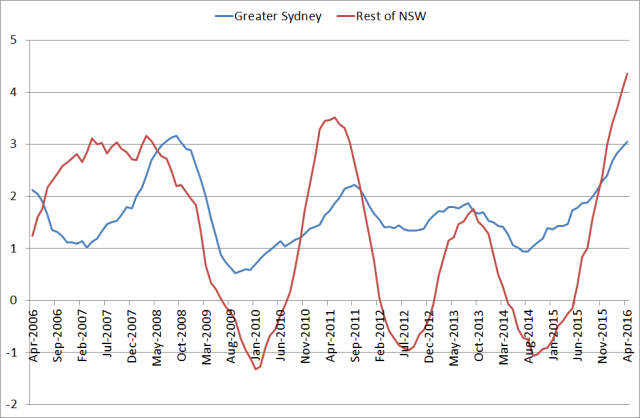
Source: ABS, 6291.0.55.001 Labour Force, Australia, Detailed – Electronic Delivery, Table 16. Labour force status by Labour market region (ASGS) and Sex. Original data have been adjusted to 12 month moving annual averages.
The last period employment in regional New South Wales significantly outperformed Greater Sydney was almost 5 years ago ending in November 2011.
The Richmond-Tweed region bordering South East Queensland performed the best with a stellar 15.0% employment growth rate, followed by the Southern Highlands and Shoalhaven region at 9.5% and the Hunter Valley (excluding Newcastle) at 9.0%.
Comparatively, regional Queensland employment (ex. Brisbane-Gold Coast-Sunshine Coast) has been falling for over 2 years. There is now a very large gap in regional employment growth between the two states.
Employment growth – Regional QLD (ex. Brisbane-Gold Coast-Sunshine Coast) and Regional NSW (ex. Sydney-Newcastle-Illawarra) — % over year
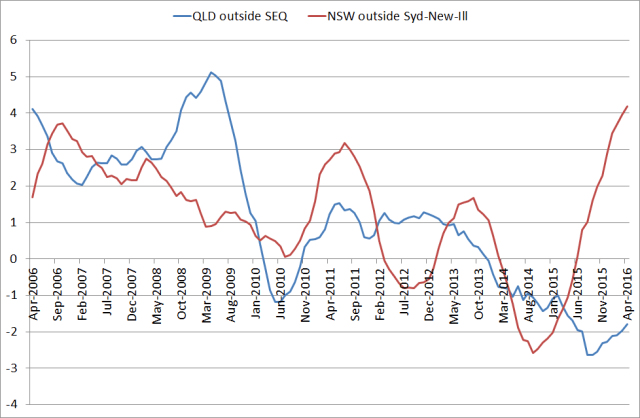
Source: ABS, 6291.0.55.001 Labour Force, Australia, Detailed – Electronic Delivery, Table 16. Labour force status by Labour market region (ASGS) and Sex. Original data have been adjusted to 12 month moving annual averages.
Considering the impact of lower coal prices on many Queensland regions it appears remarkable employment growth has been so high in the Hunter region. Proximity to Newcastle and Sydney may have helped the region’s labour market adjust, a benefit which Queensland regions such as Mackay do not have.
Despite strong regional employment growth some areas in NSW experienced falling employment, such as the Far West and Orana, the Murray and Riverina regions. The impact of the drought like conditions may have been detrimental to the labour market in those regions as they have in some regional Queensland regions.
Within the Greater Sydney area employment growth was greatest in the Central Coast region at 12.9% and the South West region of Sydney at 11.4%.
NSW Regional employment growth – % over year to April 2016
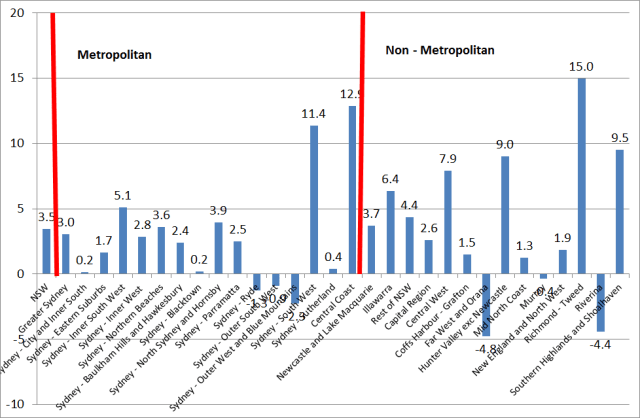
Source: ABS, 6291.0.55.001 Labour Force, Australia, Detailed – Electronic Delivery, Table 16. Labour force status by Labour market region (ASGS) and Sex. Original data have been adjusted to 12 month moving annual averages.
It is difficult to ascertain why employment growth was higher in regional NSW compared with Greater Sydney and regional Queensland. Perhaps the relative wage and land price gap between Greater Sydney and regional NSW overcame remoteness costs for businesses operating in regional NSW. Regional areas that have recorded the highest employment growth were close to major urban agglomerations, such as the Hunter Valley region and the Southern Highlands and Shoalhaven region to the Sydney-Newcastle-Wollongong urban agglomeration and Richmond-Tweed region to the Brisbane- Gold Coast-Sunshine Coast urban agglomeration.
As Greater Sydney business occupancy and labour costs continue to grow, the competitiveness of regional New South Wales businesses should increase, particularly for urban periphery regions.
Dr Alistair Robson is an independent economist based on the Central Coast of New South Wales. He holds a PhD in economics from the University of Queensland.


 Also see the latest
 Queensland Economy Watch