Protectionist Buy Queensland policy unlikely to survive in current form

Queensland’s new protectionist procurement policy, Buy Queensland, was the subject of discussions today between Australia’s and New Zealand’s Trade Ministers, Steve Ciobo and Todd McClay (see this AAP report). You may recall that late last month the Queensland Government announced the new Buy Queensland policy, whereby it will unashamedly favour local businesses in procurement, giving an excessive weighting (up to 30%) to the criterion of whether a supplier is Queensland based. The policy means that an interstate or foreign supplier could deliver a far superior bid on all the other criteria (e.g. proposed technique, value for money) but still lose the tender.

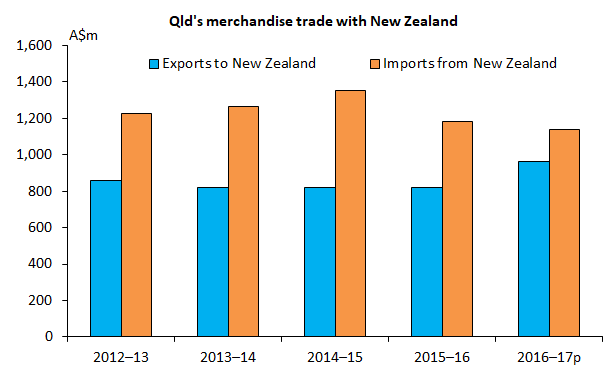
Superficially, Buy Queensland looks like it is doing Queenslanders a huge favour, but it isn’t. First, it is shielding Queensland businesses from the invigorating effects of competition which ultimately reduces prices for consumers and makes our economy more productive. Second, it risks retaliation from trading partners, including our trans-Tasman cousins in New Zealand, who buy around $1 billion of Queensland’s merchandise exports each year (see chart below). Regrettably, Buy Queensland violates economic and trade agreements Australia has had with New Zealand for at least two decades (see this Sky News report).

Sure, there may be examples of poor procurement decisions where an overseas supplier was chosen largely on the basis of price—reference has been made to the New Generation Rolling stock constructed in India—but price alone should never have been the sole criterion. The problem in such cases was a poor procurement process, not a lack of discrimination in favour of Queensland firms. The Buy Queensland policy means we could end up with perverse outcomes, where some local suppliers that are lower quality and more expensive than interstate or international suppliers are chosen due to the heavy weight given to being a local supplier.

The Buy Queensland policy will make Queensland taxpayers worse off, through higher prices for goods and services purchased by the government, and it risks turning Queensland into a national laughingstock. Under our federal system of government, and under our Constitution, the Commonwealth has the right to make trade agreements with our countries. State Governments cannot unilaterally decide to ignore those agreements.

The State Government will no doubt come under heavy pressure from the Commonwealth Government, which is currently being lobbied by the NZ Government, to amend the policy. Last Friday morning, there was an extraordinary interview on Steve Austin’s 612 ABC Brisbane program in which NZ Trade Minister McClay referred to the Queensland Government’s new policy as “crazy” (see this ABC News report). As an economist and a strong believer in free trade, it is hard to disagree with his assessment.

In 2015, the Queensland Competition Authority devoted a weighty chapter of its Industry Assistance Review Final Report to State Government procurement policy. Unfortunately, the QCA’s strong advice against preferential procurement policies such as Buy Queensland has been ignored by the Government. The QCA observed (on p. 309):

Preferential procurement policies can protect local businesses from international competition, increase procurement costs leading to higher taxation, and disadvantage businesses with higher productivity…

… Public sector procurement decisions should be guided by a single objective — achieving value for money in procurement. Broader economic, social and environmental objectives are best addressed through other policy instruments.

Nick Behrens of Queensland Economic Advocacy Solutions has pointed out substantial flaws with the Buy Queensland policy, and has offered some excellent suggestions regarding how it can be improved:

Queensland Procurement Strategy needs work

There are much better options than giving such a high weighting to being a local supplier. These include greater efforts to train small businesses in preparing tenders for government work, which a lot of small businesses find daunting. In its Industry Assistance Review Final Report, the QCA noted (on p. 309):

…where procurement policies focus on providing information and improving participation in public procurement it may heighten the competitiveness of tender processes and result in improved value for money for taxpayers.

Also, the Government could encourage it agencies to break up government projects being contracted out as much as feasible, so that Queensland small and medium-sized businesses have a greater chance of picking up at least some of the work. A good example of this approach is provided by the Townsville City Council’s new Haughton pipeline duplication project (see this Townsville Bulletin report).

The Government should revise its procurement policy along these lines. Alas, the current Buy Queensland policy is indefensible, and it needs to be reviewed and revised urgently. The Government should cooperate with the inevitable, because the policy cannot and ultimately will not survive in its current form.
Trade_with_NZ

Posted in Queensland Government, Uncategorized | Tagged , , , , , | 1 Comment

My thoughts on Deloitte’s Confidently Queensland Report

Deloitte, one of the big four professional services firms, has recently released a very interesting and informative report titled Confidently Queensland, which presents Deloitte’s goals for Queensland in 2027: liveable communities, a diversified economy, and inclusive growth. The report was co-authored by Deloitte Partner Dr Pradeep Philip, who has recently returned to Queensland. Pradeep’s career so far has included time as a departmental secretary in the Victorian public service and as an economic adviser to Prime Minister Kevin Rudd. Confidently Queensland was guided by a steering committee of Queensland business, public service and NGO luminaries, including John Wagner, Raynuha Sinnathamby and Michael Roche among others. Given these facts, it is certainly a report worthy of serious consideration.

Deloitte sees Queensland’s economy and society being transformed by five mega trends—emerging markets, digital disruption, increased urbanisation, environmental challenges and demographic change—and it sees four industries as supplementing the resources sector and being critical to our State’s economic prospects:

A diversified economy would mean that over the decade to 2027, industry growth in Queensland would not only be recorded in energy and natural resources, but also in tourism, international education, agribusiness and aged care. (from p. 46)

Deloitte has an aspiration for a bigger Queensland, stating an aspiration of boosting Queensland’s annual population growth by 30,000 people per annum and Queensland’s annual GSP by around $50 billion by 2027. It considers that this will require a broad range of policy measures, including investments in Queensland’s education system, improving the health system with a greater focus on prevention, and making Queensland communities more liveable, particularly in the regions, and facilitating the development of a more diverse economy. Deloitte appears to be suggesting that, during the mining investment boom, our State Government was too focused on that sector to the detriment of others.

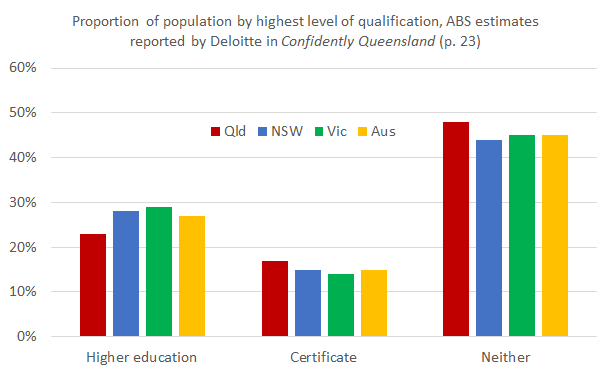
One of the reports clearest and most concerning messages is that Queensland receives particularly low marks in terms of educational attainment (see chart below). Deloitte notes (on p. 23):

…education has not been a strong point for Queensland in recent years. In fact, Tasmania is the only State with a lower proportion of the population attaining higher education qualifications than Queensland. In a knowledge economy, this just won’t cut it. There is much more work to be done here…

I completely agree. The report later contains some high-level policy prescriptions for improving education in Queensland, through improving funding certainty for State and Territory governments (but that is largely dependent on the federal government), encouraging value for money in delivery, improving workforce capabilities, and creating an integrated higher education system where VET is not seen as the inferior option to university, and one with more “short-cycle” qualifications. No doubt many readers will have heard these prescriptions before.

Deloitte_education_chart

Regarding liveability, Deloitte are correct to identify this as important for our own well being and for attracting people to Queensland, but I think Deloitte might be too focused on the regions and neglectful of SEQ (see p. 86). As I have commented before, State Government capital works spending appears skewed towards the regions already (see my post from last month and the Tropic Now report Economist says TNQ gets more state funding than South-East corner). There are some very substantial State Government investments planned for regional Queensland, including the Townsville Super Stadium and Cairns Convention Centre upgrade, for example.

One of the things I really like about Confidently Queensland is its analysis of Queensland’s economic challenges. For example, the report discusses how our rising energy costs are adversely affecting many industries, and are particularly bad for our minerals processing industry. The report notes (on p. 51):

Queensland’s competitive advantage in energy will never be like it was 30 years ago when governments specifically attracted resource processing to the State. Questions remain over the economic sustainability of minerals processing once legacy contracts cease in coming years.

The report is not specific about what minerals processing plants it has in mind, but I suspect they have in mind the Boyne aluminium smelter at Gladstone, which has recently trimmed its workforce (see this ABC News report), and the Mt Isa Mines Copper Smelter and Townsville Copper Refinery, which are at risk of shutting down (see this Townsville Bulletin report). The closure of these plants would be heavy blows to the Mt Isa and Townsville economies, bringing about the loss of many hundreds of jobs. Deloitte appears to be suggesting that the Queensland Government should plan ahead for these closures, which would involve investigating future training and worker relocation measures.

Deloitte’s three goals—liveable communities, a diversified economy, and inclusive growth—are all worthy goals, but achieving these goals is a great challenge. In this regard, I would have liked more from the report. The report was written at a very high-level and lacked the detail I would have liked to have seen in its policy recommendations. For example, Deloitte could have been harder hitting on retail trading hours’ restrictions, which are still excessive despite recent changes. It mentions the benefits that “expanded hours” could bring (on p. 64), but it does not directly criticise current restrictions. Also, Deloitte could have commented on whether payroll tax should be cut. At least it did recommend reducing stamp duty, which all economists know is a terrible way to raise revenue and should be abolished.

That said, I accept it is the nature of such a broad-ranging report as Confidently Queensland that issues often cannot be dealt with in the depth they deserve. Perhaps Deloitte could release a sequel to Confidently Queensland and have a closer look at those policy settings that are preventing our economy from reaching its full potential, providing more specific policy recommendations.

All things considered, Confidently Queensland is an excellent report and well worth reading. The reader is regularly rewarded with a variety of incredibly interesting facts, including that of the international travel habits of Chinese millennials (see p. 61).  And for those needing to get up to speed with current economic policy issues in Queensland, it is an excellent introduction.

Posted in Mining, queensland, Queensland Government, Uncategorized | Tagged , , , , , , , | 2 Comments

Quiggin calls for economically sensible road charges in outstanding Colin Clark Lecture

UQ’s Professor John Quiggin was only called upon Wednesday to fill in for an ill Richard Holden at the annual Colin Clark Lecture at Brisbane’s old Customs House yesterday morning, but nonetheless he managed to deliver an outstanding presentation titled:

Unscrambling the Toll Road Egg

Quiggin gave a very lucid explanation of what economics tells us about optimal road pricing. Unfortunately, what ends up happening in practice is completely at odds with sensible economics. Our current system of charging for roads is haphazard and not economically sensible. In Quiggin’s view, we could improve community welfare by applying a system of well-designed road charges based on the traffic congestion that motorists contribute to, and by cutting poorly-designed charges, such as motor vehicle registration, in a revenue-neutral fashion. Motor vehicle registration is particularly bad because it is unrelated to the extent of road usage.

Also subject to Quiggin’s disdain is the current unscientific way we toll roads. We have tolled some new roads and tunnels either because our politicians think tolls are necessary to pay for them, or because we have granted a private operator the right to toll them, through public-private partnership (PPP) arrangements. But if a new road delivers net benefits to the community, it can make sense to incur “good debt” to pay for it. Further, it may not have been necessary to have entered a PPP at all, and governments have often entered into PPPs for the wrong reason: to avoid debt showing up on the government’s balance sheet.

We know that charges on toll roads are unlikely to be set at the right level. A rational system of road charges would vary road charges according to the level of congestion on the road, which will vary according to the time of day. But this typically does not occur on toll roads. Toll roads are often severely under-utilised, suggesting the price of using toll roads (relative to the price of using free roads, which are competitors) is too high, and this is inefficient from the community’s point of view. The marginal cost of having another car travel on an under-utilised toll road can be very low, and much less than the cost of the toll. In contrast, on a busy non-tolled road, say Coronation Drive, the marginal cost of having another car on the road, creating congestion and slowing down other roads users, can be much higher. Ideally, motorists would take that marginal cost into account when making the choice of whether and what time to drive. But of course they do not, so there is socially inefficient congestion on our free roads.

To improve the efficiency of our road network, we need to adopt a system of road charges based on congestion, applying to the whole road network, and moving away from the current situation of highly-congested free roads  and under-utilised toll roads. Practically, we could follow the lead of London and Singapore, and start off by introducing a charge to enter the CBD, possibly limited to during the daytime. But eventually charges could be based on the usage of arterial road in peak periods.

Quiggin noted that he thinks the reason politicians oppose a CBD congestion charge is because all the decision makers work in the CBD and hence would be adversely affected, as would most of the people they work and socialise with. But he thinks it would be good policy and may be politically feasible. Quiggin argued that any revenue raised by congestion charges could be used to pay for a reduction in motor vehicle registration, which no doubt would be politically popular. He would also have the government buy privately-owned toll roads, with “good debt” if necessary, so they can be incorporated into a rational system of road pricing.

Road pricing was a fine topic for a Colin Clark Lecture, as Colin Clark himself had written on the topic and would have been in strong agreement with much of Quiggin’s lecture. In his 1982 book Regional and Urban Location, published by UQ Press, Clark observed (on p. 231):

The proposal to tax congestion as an adverse economic externality is not new—it was proposed by Pigou as long ago as 1920, when road congestion was a rarity.

So the concept of a traffic congestion charge is nearly one hundred years old. It is about time we apply the concept in Australia and move toward a more rational system of road pricing, using the money raised to fund a cut in highly-regressive motor vehicle registration charges.

My previous posts on road pricing include:

RACQ should push for demand management options such as congestion pricing

Govt should explore transport demand management options before committing to costly infrastructure

Old_Customs_House,_Brisbane

Brisbane’s old Customs House was the scene of the 2017 Colin Clark Lecture, hosted by the UQ School of Economics

Posted in Transport, Uncategorized | Tagged , , , , , , , , , | 2 Comments

Spit casino cancellation highlights dysfunctional system constraining development

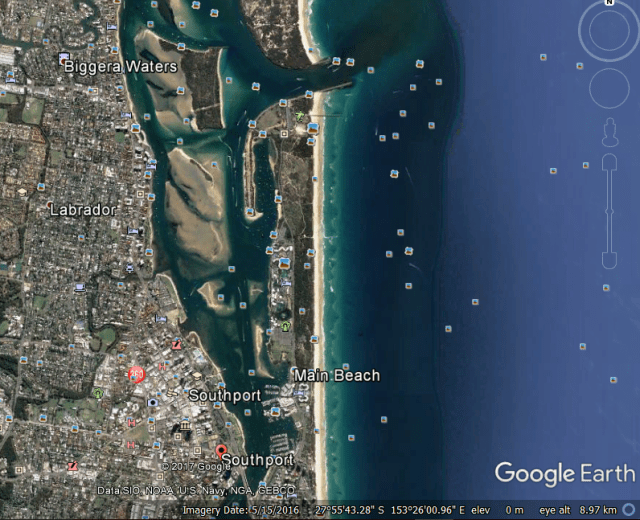
The Queensland Government’s politically expedient decision to cancel Chinese company ASF’s proposed casino-resort on the Spit at Southport completely stunned me yesterday. In its media release, the Government offered no good reason for why it was cancelling the project. If it had a new environmental impact study that showed the casino-resort would adversely affect some endangered fauna or flora in the region, perhaps I could understand the decision. But the media release offers no such convincing explanation.

The Government is now initiating a community-led master plan, which appears to necessarily include a huge public park, which will become the Gold Coast’s “Central Park”. This would no doubt be beneficial to locals, but has the Government produced a cost-benefit analysis showing that would be a better use of the area than an alternative development? Not that I can tell.

This is a highly political decision, which, as others have noted, sends a very bad signal to investors, domestic and foreign. You might be willing to spend billions of dollars, create thousands of jobs, and be willing to endure what is already a multi-year development approval process, but, in the end, our government can just say “whatever, we’ve changed our mind” and it’s game over. (And good luck getting compensation, because the government lawyers had included a clause saying the government reserves its right not to proceed.)

The Gold Coast Bulletin has prepared an excellent timeline of the sorry saga of planned developments on the Spit, starting in 2001 when the Southport Chamber of Commerce first proposed a cruise ship terminal in the Broadwater, a proposal which was accepted by the Beattie Government in 2004, but then rejected in 2006 prior to the election. Which is similar to what has happened to the current casino-resort proposal, which for the last two years appears to have had the support of the State Government. But no longer; there is an election looming.

Tourism has been one of the real bright spots for the Queensland economy, and it is very disappointing the State Government is no longer supportive of a major development in this vitally important sector for our State.

The_Spit

The Spit, Gold Coast, Queensland

Posted in Gold Coast, Tourism, Uncategorized | Tagged , , , , , , | 2 Comments

PC scathing of Qld sugar industry’s “dependency psyche” & “back to the future” re-regulation

One of the low points for the current Queensland Government occurred in late 2015, when it failed to stop the Real Choice in Marketing legislation advanced by Katter’s Australian Party with support from the Opposition and Billy Gordon. This provided cane growers the extraordinary power to force foreign owned milling company Wilmar and other millers to market their sugar through Queensland Sugar Ltd. Prior to this legislation, Wilmar and several other millers had indicated they wished to seek alternative marketing arrangements to QSL (see the QSL website for background).

The Productivity Commission has just published a scathing assessment of the “back to the future” re-regulation of the Queensland sugar industry in its latest Trade and Assistance Review (see section 3.4 from p. 60). The PC considers that “large parts” of the Queensland sugar industry have a “dependency psyche”, a legacy of historic regulation they have a yearning to bring back.

As the PC identifies, the Real Choice in Marketing legislation raises the issue of sovereign risk and may deter future foreign investment in Australian agriculture. So it is fortunate that, following an agreement between Wilmar and QSL in May, there is now an industry consensus supporting a repeal of the controversial legislation. The PC observes that (p. 61):

Reregulation of Queensland sugar was a backward step and the Queensland government should ensure that they do, as indicated in their media release announcing the settlement of the dispute with Wilmar (Byrne 2017), repeal the Real Choice Act.

It certainly was a backward step, and one that raised the prospect of a revival of agrarian socialism. Thankfully that threat now appears to have receded.

But as the PC notes, there remains a deeper problem, and one which is largely a Commonwealth rather than a Queensland Government responsibility, the granting of charity status to QSL in 2015. This charity status means that it would be difficult for a private sector operator to compete with QSL, entrenching QSL’s position in the market. The PC rightly observes:

Notionally, QSL’s not-for-profit status means that it will offer services at a lower cost to users, but in general not-for-profit status simply allows an organisation to be less efficient than its for-profit competitors.

As a charity, QSL is eligible for a payroll tax exemption from the Queensland Treasury, estimated to be worth around $1 million per annum. This is regrettable, given the PC analysis suggests there is no legitimate case for QSL being a charity, and its charity status confers it an unfair competitive advantage. Clearly, the Australian Government should undertake a review of QSL’s status as a charity.

TAR_2016_17

Another outstanding Trade & Assistance Review from the Productivity Commission

Posted in Agriculture, Uncategorized | Tagged , , , , , , , | 1 Comment

ACCC Chairman critical of market share of Qld State-owned power generators

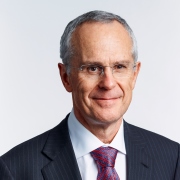
Yesterday morning, in one of the best interviews of a public official I have ever heard, ACCC Chairman Rod Sims gave frank and informative replies to ABC Brisbane’s Steve Austin on the state of the electricity sector and the inquiry into electricity prices the Commission is currently running. As Chairman Sims noted in his introduction to an inquiry forum held at Brisbane’s Hotel Urban on Wickham Terrace last night, broadly speaking, power prices have doubled in real terms over the last decade on Australia’s east coast. This is of great concern to households and a wide variety of businesses, some of which are experiencing power price increases that are making their businesses unviable or forcing them to curtail operations and shed staff. It was good to see that Queensland industry was represented at Hotel Urban last night. Notably, a representative from Bundaberg Rum attended and addressed the forum regarding his concerns.

On both the radio and at the forum, Chairman Sims made it clear that the Queensland power generation industry is too heavily concentrated: two State-owned generation companies, Stanwell and CS Energy, control two-thirds of the generation capacity. As the companies asserted their market power earlier this year, by bidding high prices to supply electricity at times of shortages in the national electricity market, wholesale power prices in Queensland soared. In June, former Energy Minister Mark Bailey had to direct Stanwell, obviously the main culprit, not to take advantage of its market power, and wholesale prices have since dropped (see this ABC News report).

Nonetheless, Chairman Sims appears concerned that the underlying problem of market concentration in Queensland power generation remains. After Chairman Sims’s comments, the State Government really has no choice but to break up Stanwell and CS Energy, which operate multiple coal, gas, hydro and diesel plants, into a number of smaller generators, and to ideally privatise them (although dealing with the market concentration issue is the major concern). As part of its recent Powering Queensland plan, the State Government has announced it is investigating “the restructure of Government owned generators and the establishment of a ‘CleanCo’”. After Chairman Sims unequivocal comments on market concentration, that restructure will need to feature a major break up of the generation companies.

Also, see Steven Wardill’s article in today’s Courier-Mail:

State Government policy ‘means prices are higher than they should be’

D16 133476 Rod Sims Corporate Photo (1) - September 2016

ACCC Chairman Rod Sims

Posted in Energy, Uncategorized | Tagged , , , , , , , , , , , , | 4 Comments

Greater use of Gold Coast beaches by restaurants & cafes would boost tourism

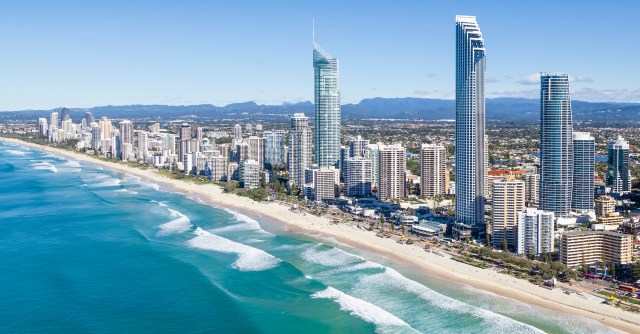
Gold Coast, Queensland, Australia

Aerial view of Gold Coast, Queensland, Australia

Mike Winlaw, CEO of the Surfers Paradise Alliance, a business chamber, has suggested the Gold Coast take inspiration from Bali and allow commercial operators greater access to the beachfront. The Gold Coast Bulletin reports that Mr Winlaw said:

“Many tourism destinations have successfully differentiated themselves by offering an exceptional beachside experience combining entertainment and dining, right by the water’s edge.

“With our spectacularly wide coastline, I believe this is an opportunity the Gold Coast needs to seize and one which, if done right, would add much value to the region’s tourism offering by activating that differentiating experience for our own beautiful beaches.

“We have already seen the emergence of a sophisticated dining culture on the Coast, but most of the popular cafes and restaurants have been established in villages set back from the water.

“While there has been some move towards the sustainable commercialisation of our beaches, so far nothing significant has eventuated and other than a limited number of locations across the Coast there is nowhere residents or visitors to the Gold Coast can enjoy the magic experience of dining or being entertained right on the sand as the they watch the waves lapping the shore or the moon rising over the ocean.

What a terrific idea from Mr Winlaw. It is consistent with the point that I and other economists have frequently made that our rules and regulations are significant and often inappropriate constraints on economic activity and employment opportunities. You may recall I discussed the role of policy settings in influencing unemployment in my last post on the upcoming Ted Evans lecture and recent Queensland employment trends.

I should also note that allowing commercial operators greater access to beaches was an idea advanced in the leaked 2015 draft Economic action plan from the Queensland Department of Premier and Cabinet, a plan which regrettably was quickly disowned by the risk averse State Government. Action item 3.42 was:

Allow business to operate on QLD beaches with special permits. Find a way to allow commercial activity on QLD beaches. While there is a need to control commercial activity on public land, like beaches, there are some activities that would be acceptable to the community. Increasing the commercial activity will increase economic activity, provide services to the public and create jobs.

Given the secrecy around government policy advice and decision making, and given the main author of the Economic Action Plan is no longer in the department, it is unclear whether the Premier’s department is still producing such provocative and economically sensible pieces of policy advice.

Posted in Gold Coast, Uncategorized | Tagged , , , , , , | Leave a comment

On the upcoming Ted Evans lecture & Qld’s recent employment trends

On 14 September, the Economic Society of Australia (Qld), of which I am the Secretary, is hosting the inaugural Ted Evans Public Policy Lecture at Customs House, Brisbane. The inaugural lecturer will be none other than former Treasury Secretary Ted Evans himself. Evans was the major advocate within the Treasury for floating the dollar in 1983, and led the Treasury during the GST implementation. But he may well be remembered by many for a profound observation he made on unemployment in the 1990s. At the time of Ted Evans’s retirement in 2001, the then Prime Minister John Howard observed:

Ted will be forever associated with that memorable phrase; in one sense, we can choose the level of unemployment which we are willing to bear; when discussing economic and social constraints on reducing unemployment.

While general economic conditions obviously play a large role in determining the level of unemployment at any time, Ted Evans’s famous phrase suggests we should review current policy settings (e.g. penalty rates, trading hours’ restrictions) with a view to changing those which are constraining employment. This is particularly the case for Queensland, where our unemployment rate remains stuck above 6 percent. In June, it was 6.3 percent (ABS trend estimate), significantly higher than the national average of 5.6 percent, not to mention the NSW unemployment rate of 4.8 percent, based on the June labour force data released by the ABS on Thursday.

While the volatile seasonally adjusted Queensland unemployment rate jumped 0.4 percentage points to 6.5 percent in June, this was likely a statistical aberration, as the labour market appears to have been improving over this year, vacancies are higher than they were 12 months ago, and nationally the labour market is performing reasonably well. My fellow Queensland economists Pete Faulkner and Nick Behrens are also positive about the Queensland labour market outlook:

Jobs report as expected, but it’s generally good news

Queensland employment growth stands out in June 2017

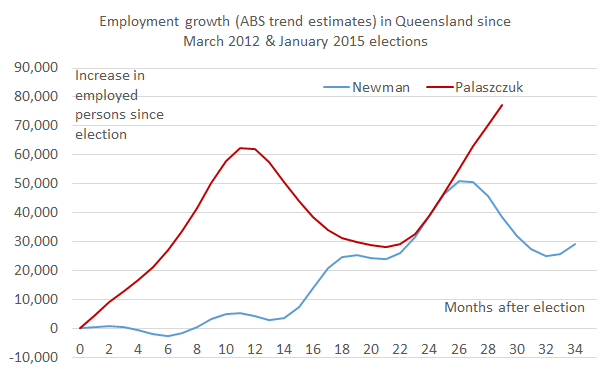
As I have noted previously, the positive trend in the labour market means the Palaszczuk Government will most likely be able to claim jobs growth was superior over its term than during the previous LNP Government’s term (see chart below).

Jobs_since_election_Jun17

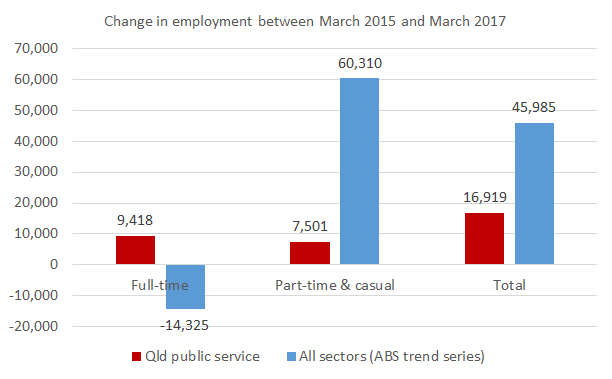
That said, the Government remains vulnerable to criticism, because the bulk of the jobs growth has been in part-time jobs, and public sector employment has surged. This has led property market experts, among others, to question the true strength of the Queensland labour market, as reported recently in the Courier-Mail:

Buyers agent firm Propertyology warned the state’s jobs growth was “being artificially inflated by one solitary sector” – the public service.

Property director and Real Estate Institute of Australia hall of famer Simon Pressley said “it’s clear that Queensland’s economy is weaker than how it appears on face value”.

Certainly, the Queensland public service has been a major contributor to recent jobs growth in Queensland (see chart below based on the most recent public service data for March 2017*).

Public_sector_jobs_March_17

Growing the public service is one way of increasing employment, but it is generally not an efficient or sustainable way of doing so. We should instead reflect on Ted Evans’s point that the level of unemployment we are willing to bear is a policy choice, and re-evaluate those policy settings that restrain economic activity and employment growth.

*Note that full-time employment in Queensland is now slightly above the level in March 2015 (1.6423M) with the ABS estimating full-time employment at 1.6435M (in trend terms) in June 2017. Over the term of the current Government, full-time employment is now up by 13,600 or 0.8 percent.

Posted in Labour market, Uncategorized | Tagged , , , , , , , , | Leave a comment

Queensland’s economic transition since the end of the mining investment boom

According to the Brisbane Times, at the LNP state conference on Sunday, Queensland Opposition Leader Tim Nicholls was highly critical of the Government’s economic management:

“…you certainly can’t create jobs or effectively manage our finances when the Queensland domestic economy is $6.5 billion smaller in 2017 than it was in 2015 when we were last in office.”

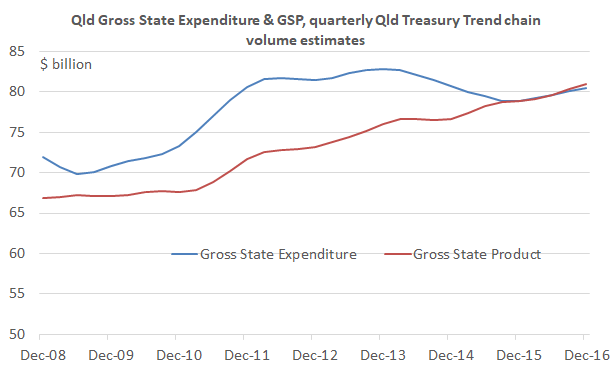
The Opposition Leader appears to be referring to Queensland’s level of State Final Demand or Gross State Expenditure. I am unsure of the exact data series he used, but I can get something close to his estimate using Queensland Treasury State Accounts data. That said, State Final Demand/Gross State Expenditure is not really the best economic measure to use, as it does not include exports and imports in its calculation. Rather gross state product (GSP), the comprehensive measure of economic activity, should be preferred.

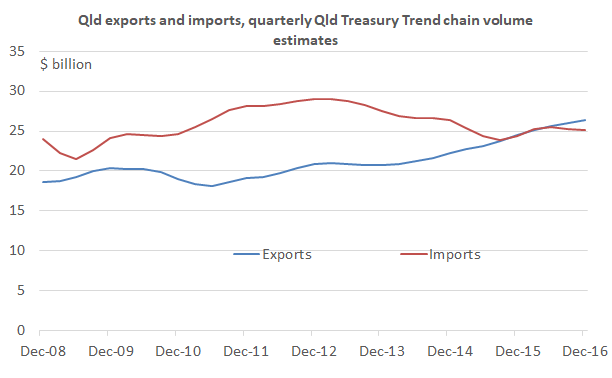
During the mining investment boom, State Final Demand/Gross State Expenditure was boosted by a temporary surge in capital expenditure, which was always expected to fall back, and to subsequently lead to higher exports. Indeed, a major feature of Queensland’s economic transition at the end of the mining investment boom has been a surge in exports, as new projects including LNG plants have come online, and a fall in imports, as the investment phase and its related imports of capital equipment and supplies have ended (see chart below).

Transition_chart1

This transition has meant that, although Gross State Expenditure/State Final Demand has fallen as temporarily high capital expenditure has declined, GSP has nonetheless increased (see chart below). Over 2015 and 2016, GSP grew at an annual average rate of 2.8 percent, compared with an historical average annual growth rate of over 4 percent.

Transition_chart2

The Opposition could argue that growth has not been as strong as it could have been with better economic policies, and point out the bulk of jobs created during the Government’s term have been part-time (see my last jobs data post), but the Opposition will find it hard to argue the economy is smaller than when it was last in office.

Posted in Macroeconomy, Uncategorized | Tagged , , , , , | 3 Comments

Is North Qld under-funded by the State Government relative to the South East?

In Saturday’s Courier-Mail, State Affairs Editor Steven Wardill reported on the unmovable perception among North Queenslanders that their region is under-funded by the State Government, despite official data showing otherwise. Wardill noted:

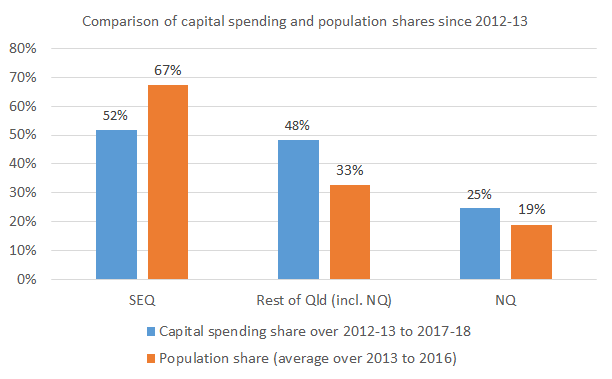
Facts and figures are dismissed out of hand. Northern Queensland may spend 31 per cent of the state’s revenue and produce only 21 per cent of it, but that kind of detail is cast aside as “bullshit, mate” by those who insist there’s an imbalance.

It’s accepted that the state’s capital commandeers all the cash, even though it’s not true. It’s what’s best described as a “vibe” and it’s venomous.

I am unsure of the source of the 31 versus 21 percent figures, but I am confident that North Queensland is not being under-funded by George St relative to other regions, based on official budget data from Queensland Treasury that I would consider reliable. Figures that I presented in my post-State Budget post show that NQ regions receive significantly more State Government capital works funding per capita than South-East Queensland. That chart was based on data presented in the 2017-18 Budget, and I have now analysed the data in previous Budget papers to determine that regional Queensland typically receives more than its fair share relative to SEQ (see chart below).*

Regional_shares_Chart1

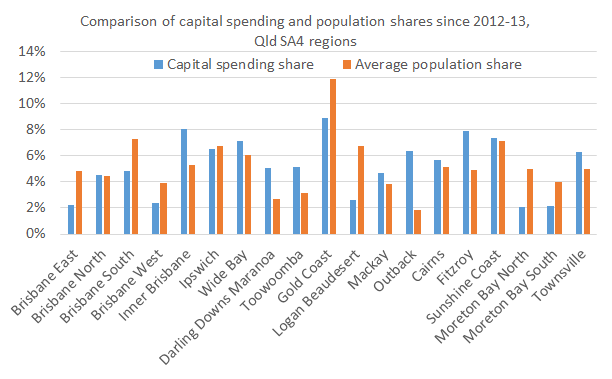
Indeed, if any region should be complaining, it is the Logan-Beaudesert region in SEQ which has been persistently under-funded relative to other regions (see chart below).

Regional_shares_Chart2

If there ever is a separate State of NQ, its residents may well end up wishing they had remained with the rest of Queensland, once they realise just how good a deal they actually had.

*NB. I have included the following regions in SEQ: Brisbane, Ipswich, Logan Beaudesert, Moreton Bay North and South, Gold Coast and Sunshine Coast. I have included the following regions in NQ: Cairns, Fitzroy, Mackay and Townsville. Part of the Outback region lies in NQ, but the part in NQ could not be split out.

Posted in Infrastructure, North Queensland, Uncategorized | Tagged , , , , , , , , , , | 15 Comments