Are we still turning Japanese? I don’t think so – guest post by Joe Branigan

I am delighted to publish the full version of Joe Branigan’s recent article on second languages offered in Queensland schools. An edited version was published in the Courier-Mail last week, but that version omitted one of Joe’s major points and did not include any charts. GT

Are we still turning Japanese? I don’t think so

by Joe Branigan

Ask any Queensland public school kid what second language has been foisted on them, and it is more likely than not the answer is Japanese. A lot has changed since Japanese was first introduced into Queensland schools decades ago, and it is time that the second languages on offer more closely reflect Queensland’s current and future trade, and international tourist and education services relationships. Mandarin Chinese needs to be the second language offered in most Queensland public schools.

In a crowded curriculum, with core English language and maths skills declining, every minute of a student’s day is valuable. An hour spent studying a second language, for example, means one hour less that’s available to study core subjects like English, Maths and Science. The decision to study a second language therefore has costs as well as potential benefits for students and the broader Queensland community.

Languages closely related to English, such as the Latin-based languages, may help students improve their understanding of English and lead to better communication skills, but so too can studying English more. Languages such as German, French and Italian are declining in global importance with each passing decade.

Asian languages can provide work opportunities and new cultural experiences for Queensland students in adult life, not to mention the chance to reflect on one’s culture and place in the world.

Surely the best approach, given a crowded curriculum, scarce teaching time and limited public resources, is to offer the most currently relevant languages to Queensland students.

In 2018, the main second language offered is Japanese, taught at 54% of Queensland public schools or 527 out of 974 schools (Figure 1). Next most popular are German (15%, 146 schools), Chinese Mandarin (14%, 135), French (9%, 90), Italian (7%, 64) and Indonesian (6%, 63).
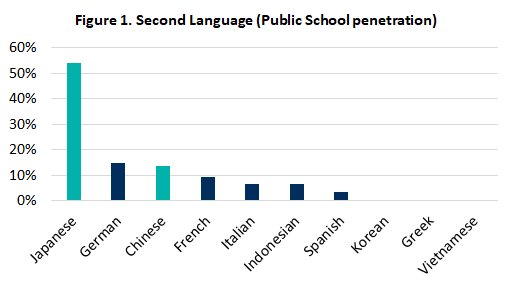
JB_chart1

Japanese is offered in almost four times as many public schools in Queensland compared with Chinese despite the fact that a truly seismic economic, geo-strategic and cultural disruption has occurred in North Asia over the past four decades.

Today, China is Australia’s and Queensland’s largest trading partner by a significant margin. Queensland merchandise trade with China is double that of Japan. The number of Chinese visitors to Australia is three times that of Japan and Chinese tourism is increasing while Japanese tourism is likely to fall over the long-term as the population and economy of Japan continues its structural decline (Figure 2).
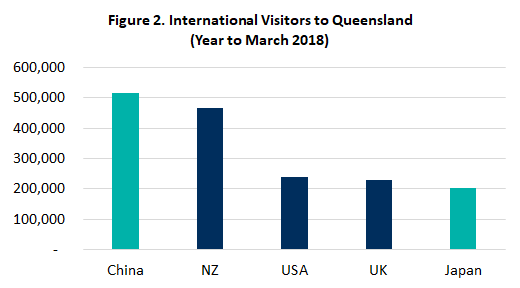
JB_chart2

The number of Chinese students coming to Australia to learn English or enrol in undergraduate and postgraduate studies is many times that of Japan (Figure 3).
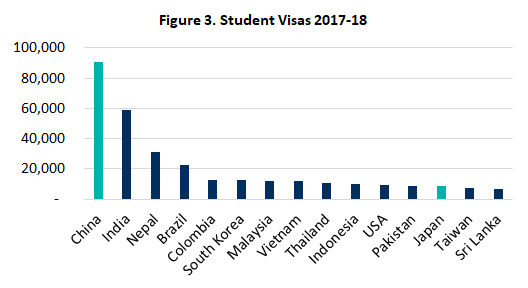
JB_chart3

Chinese, English and Spanish are the world’s most spoken native (or L1) languages. As a native language, Japanese ranks 13th globally, and as an L2 language (or second language) Japanese does not even rank in the top twenty because it is not widely spoken outside of Japan.

The significant lag in offering a Chinese language choice to the 86% of Queensland public schools currently missing out is, in my view, a result of professional capture and bureaucratic inertia. School Principals and P&C’s, who are given the responsibility to “make decisions about the choice of language and the year levels of provision”, are understandably reluctant to disrupt longstanding relationships with Japanese teachers, existing teaching resources and sister schools in Japan.

Further, Education Queensland guidelines seem to seek to embed the status quo by identifying a merit order of the most commonly taught languages now, warning that “the availability of teachers is critical to the success of the Languages program”, encouraging the matching of languages taught across neighbouring schools in order to share resources, and matching languages offered between primary and secondary schools to promote continuity of study.

These guidelines will not foster the disruption required to make Chinese the leading second language taught in Queensland public schools. The impetus for change, therefore, must come from the Education Minister Grace Grace and her Director-General Tony Cook.

The best performing Queensland private schools have been more responsive to Australia’s changing relationship with Asia and adjusted their language programs accordingly. But most families stuck with limited school choice in the public system are offered a 1980s suite of language choices by Education Queensland.

This change needs to happen now. Even if Education Queensland provided the resources to roll-out Chinese language study in 20 additional public schools per year, it would take a decade for Chinese to be available in half of Queensland public schools. By then, the Chinese economy and strategic influence will totally dominate Asia-Pacific affairs. Our relationship with China, whether ultimately a friend, foe or strategic competitor, is vital in any reasonably foreseeable future.

Mandarin, by most accounts, is not an easy language to learn. It is tonal and character-based, and less mature than English in terms of its development. But the level of difficulty of a language should not be confused with what is useful for Queensland students. That’s why Japanese was rolled out in the 1980s despite the apprehension around whether Queensland kids could handle it.

Are we still turning Japanese? I don’t think so.

Joe Branigan is Director of Tulipwood Economics.
Posted in Education, Uncategorized | Tagged , , , , , , , | Leave a comment

My comments on NQ exit in ABC online story

Thanks to ABC state political reporter Josh Bavas for asking my opinion on the new state of North Queensland that has been proposed from time-to-time, most recently by Katter’s Australian Party and Queensland Senator Matt Canavan, Minister for Resources and Northern Australia. You can read my comments in Josh’s story:

Queensland border debate: Could a ‘Nexit’ be on the cards?

As a North Queenslander by birth, I’m naturally favourably disposed toward the idea of a state of North Queensland, but I’ve always been skeptical regarding whether it would actually be as beneficial to people in the north as they believe. Successive state governments have been relatively generous to North Queensland, including through large expenditures on the road network and partly funding a new $250 million super stadium in Townsville. Of course, a high value could be placed on political autonomy and the ability to determine your own destiny.

My view is that proponents of a new NQ state need to crunch the numbers and produce a cost-benefit analysis showing the costs and benefits to both North Queenslanders and residents of the rest of Queensland and Australia. Among other things, we need to understand whether and to what extent a new NQ state would be dependent in the long-term on a favourable redistribution of GST revenue, and to what extent royalty revenue currently earned by the Queensland government would instead go to a new NQ government.

Also, it would be good to see some analysis of the set up costs of a new state, where the state should be divided, and how existing state government assets in NQ should be transferred. If a new NQ state capital were set up in my hometown of Townsville, or less likely in Cairns, the new administration would no doubt need to rapidly recruit public servants, many of which would need to come from outside of NQ, given the relatively small professional workforce currently there.

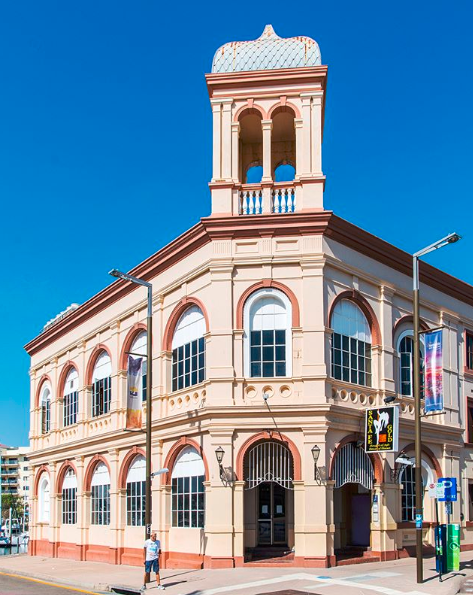
In Josh’s story, I was very pleased to see a photo of “bustling Flinders Street in Townsville 1888.” The photo is quite possibly of a procession to celebrate the 100th anniversary of the arrival of the First Fleet. While Flinders Street today is no longer as bustling as it has been in the past, we are reminded of the city’s previous boom times by several of the buildings lining Flinders Street, particularly its east end. The magnificent Burns Philp building, with its striking pavilion up top, is one such reminder. This was once the local office of the then powerful and prosperous trading company Burns Philp, which it must be acknowledged was shamefully involved in the trade of “blackbirding”.

BurnsPhilpTownsville

The Burns Philp Building on Flinders St East, Townsville,
photographed recently by Jennifer Tunny.

A new state of NQ would be a boon to the Townsville economy if the new administration were based there. Of course, the location of any capital would be vigorously debate, and Cairns’s civic leaders would no doubt make a strong case for their city. I don’t expect to see a new NQ state anytime soon, but, given the desire for political autonomy for distinct regions is growing worldwide, we may well see a new NQ state sometime this century.

Posted in Cairns, North Queensland, Townsville, Uncategorized | Tagged , , , , , , | 2 Comments

Qld regional unemployment rates facet wrap via R

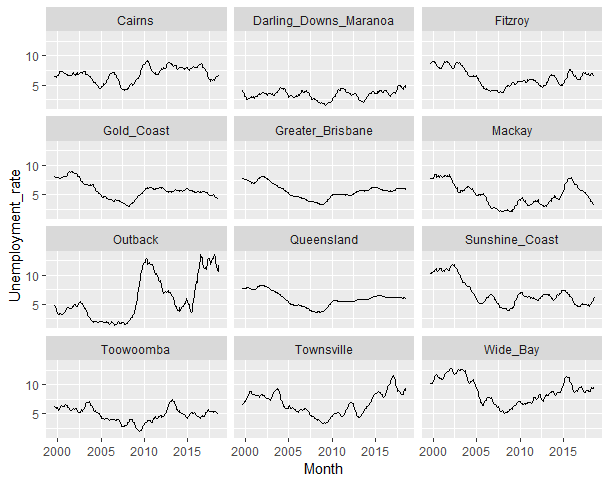
Queensland is such a large and diverse state, with regional economies having vastly different drivers of growth (e.g. tourism in Cairns, mining in Mackay), that it’s often hard to get a sense of how different parts of the state are performing. Following Thursday’s data dump from the ABS, which among other things showed a strong pick up in interstate migration (see Qld the most popular state for interstate movers), I thought a visualisation of regional unemployment rates faceted by region might be revealing (Figure 1).

Figure 1. Queensland regional unemployment rates, Sep-99 to Aug-18,
12-month moving averages of ABS monthly estimates

Reg_urates_Aug18

Unemployment remains very high in the usual places: the outback which has been suffering from the drought, my home town of Townsville which has shed a lot of manufacturing and heavy industry jobs in recent years (e.g. at Queensland Nickel), and Wide Bay, which has typically been short of economic opportunities and also seems to attract unemployed people due to its low cost of housing. The state’s lowest unemployment rate is in the Mackay region, which has been doing very nicely out of the recovery in coal prices and production that began in late 2016.

For additional information, see the Queensland Government Statistician’s Office’s regional labour force brief for August 2018.

For those interested, I produced Figure 1 using the ggplot2 package in R.

Posted in Cairns, Labour market, Mackay, Migration, Mining, Townsville, Uncategorized | Tagged , , , , , , | Leave a comment

Blunt message to states from Canberra on recreational cannabis – guest post from Stephen Thornton

I am delighted to publish this guest post from my good friend and colleague Dr Stephen Thornton. Views expressed in this guest post are Stephen’s, and should not necessarily be attributed to me as well. GT

Blunt message to states from Canberra on recreational cannabis

Last week an Australian Senate committee released its report on Senator David Leyonhjelm’s private members bill to allow any State or Territory Government to legalise and regulate cannabis. The committee, chaired by Queensland LNP Senator Ian Macdonald and including Queensland Labor Senator Murray Watt, was told that cannabis use is less harmful than alcohol use and tobacco use, and that otherwise law-abiding recreational cannabis users were cast as criminals, which increases pressure on the criminal justice system and supports organised and violent crime.

Although I did not make a submission to the inquiry, in 2016 I undertook a preliminary examination of the likely economic and social benefits of legalising recreational cannabis use in Queensland [see here], prompted by its legalisation in a number of US states, which as of January this year includes California, one of the world’s biggest economies. My report found similar benefits to that identified by Senator Leyonhjelm in terms of economic and social benefits to government and consumers, specifically:

  • The Queensland government could collect around $90 million/year in tax and fee revenue in the medium term with new jobs created and would realise significant savings in the budget in regard to decreased police, court and prison costs.
  • Consumers, once purchasing cannabis on the black market and at risk of being fined and imprisoned with the associated police record and social stigma limiting their future job prospects, would realise significant benefits by purchasing from licenced premises and also in terms of product safety. Importantly, they would also financially benefit from lower transaction costs and via a consumer surplus as the scheme matured and the price of cannabis decreased in a competitive environment.

Costly cannabis arrests in Queensland (offset to some extent by fines) are the highest in Australia and have been since 2001-02. Queensland police in 2015-16 arrested 25,307 persons of the nearly 80,000 arrests in Australia and nearly as many as NSW and Victoria in total despite having around one-third of their combined population.

Number of cannabis arrests 1997-98 to 2015-16 (NSW, Vic, Qld & national total)

cannabis_arrests

One aspect I didn’t cover off on in my report was the economic relationship between the now legalised medicinal cannabis market and a future recreational use market. This year, a medicinal cannabis farm was approved by Brisbane City Council (see article here) while Australia’s first licenced medicinal cannabis producer Medifarm with its grow facility located on the Sunshine Coast recently asked the Palaszczuk Government for funding to build a Centre of Excellence at the University of the Sunshine Coast, which reportedly could create 500 jobs, attract $500 million in capital investment over 15 years and generate $1 billion in exports over five years.

The Senate report, which recommends that the bill not be passed, picks up on this point. It notes that it would drastically alter the Commonwealth’s oversight of medicinal cannabis production, manufacture and distribution which may lead states and territories to consider separate moves in regard to authorising cannabis and cannabis-derived products for medical and scientific use. In other words, the feds would lose control of their newly minted medicinal cannabis scheme.

Interestingly, but quite coincidentally, a Forbes article was also published last week which briefly explores how the two cannabis markets are not necessarily mutually exclusive given that people may purchase cannabis products in the recreational market for medicinal purposes, especially when the price of medicinal cannabis is significantly higher and when access to the drug is limited to certain medical conditions only, as is currently the case in Queensland.

The latest revenue projections for the US cannabis industry quoted in the Forbes article (in $US) shows a revenue decrease for medicinal cannabis from $5.9 billion in 2017 to $4.3 billion in 2018 and an increase in recreational cannabis revenue from $2.6 billion to $6.7 billion. However, the estimate for 2022 for the medicinal cannabis market is $7.7 billion which indicates the trend will not necessarily be downward, while the recreational market is expected to continue to expand to be worth $15.7 billion.

This is especially interesting as in the US recreational cannabis use at the federal level is still not legal, which has now created an environment of uncertainty with the change of President and the negative views towards cannabis of Attorney-General Jeff Sessions who has reversed the previous Obama administration’s ‘go easy’ on states which had legalised it.

Further north though, and after much planning and consultation, Prime Minister Justin Trudeau from 17 October will have implemented Canada’s national regulated recreational cannabis scheme which was a key plank of his policy platform for election in 2015 which takes a more health-focused and less commercial approach than many US states on things like plain packaging and advertising.

Although I was quite bullish when quoted in the Courier Mail saying that at least one of our governments by 2020 will be seriously exploring the benefits of legalising recreational cannabis on the back of what is learnt in North America, I still maintain that the push in Australia will likely come from one of our state governments rather than at the federal level, especially given the policy paralysis on other contentious issues like climate change. Canada will be the country to watch both in terms of economic and social outcomes, as I expect any scheme introduced here to take a similar health-focused approach.

Dr. Stephen Thornton is a social economist and principal of BG Economics.

Posted in Social policy, Tax, Uncategorized | Tagged , , , , | 5 Comments

Low wages growth & the drop in household saving – 612 ABC Brisbane panel discussion

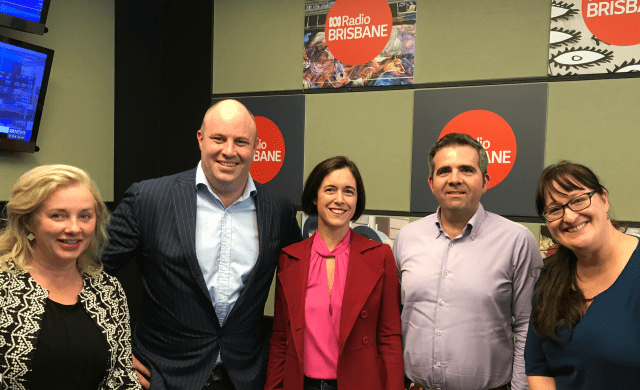
Low wages growth and the drop in household saving recorded in the June quarter National Accounts were considered in a panel discussion I participated in on Emma Griffiths’s 612 ABC Brisbane Focus program yesterday morning, which you can listen to here:

Focus: Are you spending your savings to fund your life?

Other panel members included Griffith University academic Di Johnson, Queensland Council of Unions General Secretary Ros McLennan, CCIQ spokesperson Dan Petrie, and former trade minister Craig Emerson, who joined us by phone. Many thanks to host Emma Griffiths and her producers Ria and Josh for having me on the show yesterday.

low_wages_panel_ABC.png

Left to right: Emma Griffiths (ABC), Dan Petrie (CCIQ), Ros McLennan (QCU), me, Di Johnson (Griffith).

Posted in IR, Labour market, Macroeconomy, Uncategorized | Tagged , , , , , , , , , , | Leave a comment

Has there been a “huge slump” in the Qld economy?

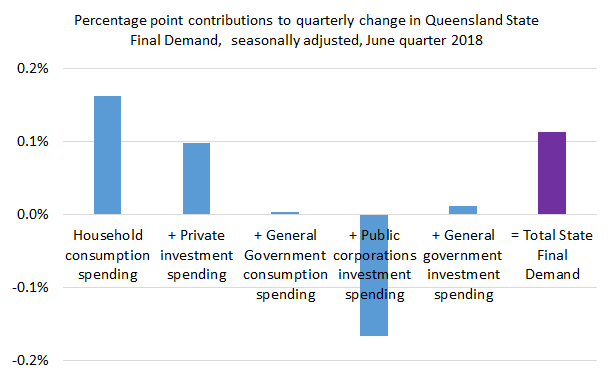
The Courier-Mail today is reporting a “huge slump” in the Queensland economy after yesterday’s ABS National Accounts figures revealed state final demand grew only 0.1 percent in the June quarter, the second lowest rate among states and territories. The paper notes:

“The slump in the data, which does not include the state’s booming export sector, was blamed on a virtual shutdown of government spending on infrastructure while the private sector has started to open its wallet.”

I’ve been concerned about Queensland’s economic performance for a long while now, but I think the commentary I’ve seen in response to the latest data is misguided and somewhat hysterical, especially since the national economy is performing reasonably well.

The disappointing state result is largely a reflection of the lumpy nature of capital investment spending, which means spending can vary substantially from quarter-to-quarter depending on whether major projects are commencing, ramping up, or finishing. As shown in the chart below, the “huge slump” is due largely to lower capital spending in June quarter than March quarter by public corporations (e.g. Energy Queensland, QR, the state-owned ports, Urban Utilities). There appears to have been a big rush of public corporations capital spending in March quarter, pumping up that quarter’s figure to $1.31 billion in total, which fell to $1.17 billion in June quarter. This was, nonetheless, slightly higher than the figure of $1.16 billion in December quarter last year.

sfd_Jun18

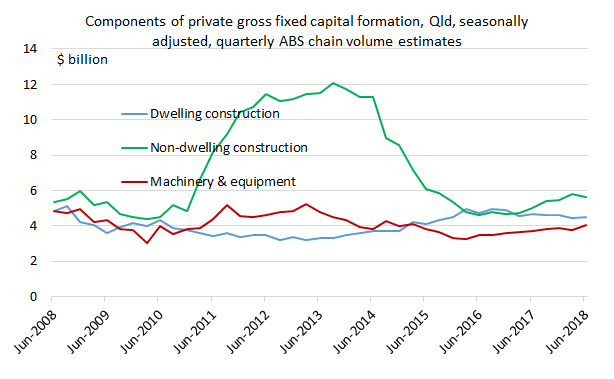
The Courier-Mail was right to point out that “the private sector has started to open its wallet” and it is encouraging that machinery and equipment investment is starting to pick up (chart below). That said, we’re still well below the total private capital investment levels we saw earlier this decade when the massive $70 billion Gladstone LNG terminals construction project was underway. That’s the huge bulge you can see in non-dwelling construction in the chart below.

private_capex_Jun18

Overall, the Queensland economy remains lukewarm, but it is hysterical to say it’s had a “huge slump.”

Posted in Macroeconomy, Uncategorized | Tagged , , , , , | Leave a comment

Economists and the media

This Thursday lunchtime, I’ll be chairing an ESA (Qld) seminar on economists and the media, featuring former ABC finance reporter Rebecca Archer, Director of Connect Media Training, and Griffith Economics Professor Fabrizio Carmignani, a frequent media commentator and contributor to The Conversation.* The media provides economists with opportunities to express their views and to be influential in the public debate, but it can also be daunting to many. I know many colleagues have been concerned their comments would be taken out of context by journalists seeking headlines. So I believe this seminar will be of value to many economists and finance professionals, as it is designed to answer the major questions economists have in dealing with the media.

Bec

Rebecca Archer, Director of Connect Media Training

Drawing on her extensive experience at the ABC and BBC, Rebecca will respond to the following questions, among others from myself and the audience:

1) Why does economics matter to journalists?

2) What can the finance industry and economists offer in terms of stories?

3) What’s in it for you to speak to a journalist?

Fabrizio will provide a different perspective, that of an economist who has been successful in engaging in the economic policy debate, particularly on state and federal budget policy issues. I have asked Fabrizio to comment on how economists can successfully engage with the media, particularly the importance of actually having something worthwhile to say, which can only come from doing the hard work and understanding an issue in depth.

This seminar should be of interest to a wide range of economics and finance professionals who are (or one day will be) either called on to speak to the media themselves or need to understand how the media works, so they can better forecast the public reception of policy initiatives or company reporting, for example. What is it exactly that gives an issue what journalists call news value?

So, if you’re in Brisbane this Thursday 6 September, please consider attending this seminar from 12.15pm at Morgans Financial Ltd, Level 29, Riverside Centre on Eagle St in Brisbane CBD:

Economists and the media

*I am a current Vice President of the Economic Society of Australia (Qld).

Posted in Uncategorized | Tagged , , , , , | Leave a comment

RBA Deputy Governor Guy Debelle’s Low Inflation address to ESA Qld at the Brisbane Hilton

Last Wednesday, RBA Deputy Governor Guy Debelle addressed the ESA (Qld) business lunch at the Brisbane Hilton on the topic of low inflation.* The Deputy Governor took the audience through the different components of the consumer price index (CPI) and showed the large contributions that increases in cigarette and energy prices have made to inflation in recent years, and also that these increases have been offset by declines in many retail prices due to greater competition and technological improvements, keeping inflation low overall.

While Debelle’s speech was highly informative, it was something he only briefly mentioned, and which was not actually in his official speech, that interested me the most: the debate about whether house prices should be included in the CPI. Debelle noted that housing costs are reflected in the CPI in two ways: new dwelling construction costs and rents. He said that house prices themselves are not included, but why that is so could form the topic of another speech. For economists already familiar with the CPI data, that may well have been a more interesting speech, as it would have prompted a discussion of the appropriateness of the RBA’s current methodology for setting monetary policy.

Recall that the RBA sets the overnight cash rate, which influences longer-term interest rates, with a view to targeting 2-3% CPI inflation over the business cycle. It is important, therefore, that measured CPI inflation provides as accurate a gauge of underlying inflation as possible, otherwise monetary policy could be too loose or too tight, destabilising the economy.

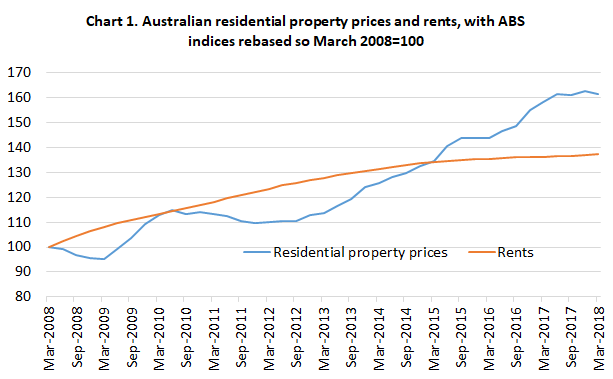
As house prices are not included in the CPI, the RBA may not adequately consider them in its formulation of monetary policy. The RBA could set monetary policy too loose, with a low cash rate, encouraging a housing boom with high house price inflation, even though rents may be increasing at a much lower rate. But, as it is rents that are included in the CPI not house prices, the RBA may miss the signal that its monetary policy is too loose. This is arguably what has happened in Australia since 2012-13 (see chart 1). In his latest column in the AFR Weekend, leading financial economist and investor Christopher Joye made the excellent observation:

…the RBA had recklessly underestimated the impact of its 2012 and 2013 rate cuts on house price growth and credit creation, which would precipitate a bubble and the need for unprecedented regulatory constraints on lending…

Those regulatory constraints by APRA have worked, and Sydney and Melbourne house prices are now falling, after having reached absurd levels. Hopefully the adjustment will be relatively smooth without an adverse impact on the broader economy. Of course, that is not guaranteed. Consider the related risk to the economy from the reset of a large number of interest-only loans for investment properties to traditional principal-and-interest loans over the coming years. This reset could lead to cash flow problems for many investors and forced sales of properties, putting further downward pressure on prices and possibly curtailing household consumption expenditure, with macroeconomic consequences (e.g. see this AFR article from April).

In my view, the RBA has patted itself on the back too much regarding the success of its inflation targeting regime, and it should consider alternative approaches, such as nominal GDP targeting or an approach which augments inflation targeting with a mandate to promote financial stability, as discussed by Warwick McKibbin and Augustus Panton in an RBA conference paper from April:

25 years of inflation targeting in Australia: Are there better alternatives for the next 25 years?

Finally, I should note it’s probably unnecessary to include house prices in the CPI, although the RBA should pay greater attention to house prices than it has historically. Statistical agencies such as the ABS arguably have valid grounds for excluding house prices from the CPI. For instance, houses are an investment, rather than a typical consumption good, and the CPI is intended to measure consumer prices. The larger issue is the appropriate monetary policy framework, particularly the extent to which central banks take into account credit conditions and asset prices in their monetary policy decisions. By focusing excessively on CPI inflation, which the CPI inflation target of 2-3% prompts the RBA to do, the RBA arguably failed to restrain the excessive growth in house prices we saw in recent years. Over the next few years, we will see whether that misjudgment will have adverse macroeconomic consequences.

propertyprices&rents

* I am a Vice President of ESA (Qld), but this post contains my personal views, which should not necessarily be attributed to the society.

Posted in Housing, Macroeconomy, Uncategorized | Tagged , , , , , , , , , | 5 Comments

Lack of clarity on due diligence for GBR Foundation grant is a major concern

Today’s Courier-Mail includes opposing opinion pieces on the Turnbull government’s controversial $444 million grant to the Great Barrier Reef Foundation, which according to the author of the first opinion piece, Foundation Managing Director Anna Marsden, is the “lead charity” for the reef. The opposing opinion piece by Simon Black of Greenpeace Australia summarises the legitimate concerns that have been expressed over the wisdom of granting so much money without a tender process to a small not-for-profit, one which at the time had around six full-time and five part-time employees. Black reminds us that Foundation MD Anna Marsden once compared the grant to winning lotto. While the government rightly observes that it isn’t the first government that has granted such a large amount of money without a competitive process, that of course doesn’t excuse it. It is akin to the young child’s defence that whatever he or she did is OK because Jack or Sally did it also.

Moreover, I am particularly concerned that the grant appears to have been inserted into the budget process late in the day, and was not subjected to several months of scrutiny from central agencies (Treasury, Finance, Prime Minister and Cabinet) and Expenditure Review Committee ministers. A strong giveaway of the lack of appropriate scrutiny given to the grant is the obfuscation in the answers provided in the Senate Budget Estimates hearings in May. NSW Senator Jenny McAllister asked very pertinent questions of Finance Minister Cormann at Estimates, which the minister had to take on notice (see Question on Notice 23 May 2018):

Senator McALLISTER: I might pick up on some of those issues around the payment to the Great Barrier Reef Foundation. When was Finance first consulted on the proposal?
Senator Cormann: This is a proposal that is part of the budget process. I’m quite happy to take on notice consideration of the date as to when this was first considered. But you would, of course, appreciate that, consistent with convention, I’m not going to be at liberty to reveal the content of cabinet deliberations or deliberations of cabinet subcommittees.
Senator McALLISTER: Would it first have been brought to the Department of Finance’s attention before Christmas, as part of the portfolio budget submission?

McAllister was rightly trying to determine whether the grant would have been subjected to several months of rigorous scrutiny, or due diligence you may say, that many other budget proposals would have been subjected to. The answer eventually provided to the question Minister Cormann took on notice wasn’t illuminating:

It is a longstanding practice not to disclose information about the operation and business of the Cabinet, including details of matters that may have been raised in meetings of the Cabinet, as to do so could potentially reveal the deliberations of the Cabinet, which are confidential.

This was a disappointing response, especially considering government ministers and staffers regularly brief journalists on matters considered by the Cabinet (e.g. see this AFR report). It is the positions taken by ministers on Cabinet matters that are rightly confidential, to ensure ministers can debate vigorously in the Cabinet. With the possible exception of some national security issues, there is a strong public interest in knowing what matters are considered by Cabinet and when they are considered.

Since that question-on-notice response was provided, some important information regarding the timing of the development of the $444 million grant has been provided by Minister Frydenberg, particularly that the grant was discussed with the Foundation over the period 9 April to 22 April, following agreement from ERC, which was first presented with the idea of a “partnership” with the Foundation in March  (see this Guardian Australia report). It certainly appears that the development of the grant was rushed. Further information on the process underlying the awarding of the grant would be highly desirable.

Posted in Budget, Uncategorized | Tagged , , , | Leave a comment

Is the Dutton Park high-rise high school really necessary?

David Gillespie, Brisbane State High School Council Chairman (and author of Free Schools and Sweet Poison) gave a terrific interview on the 612 ABC Brisbane Breakfast program (at 2:18:50) yesterday morning. He argued State High’s over-enrollment problem is due to the education department’s failure to ensure only students living in the school catchment (or who have obtained a place via selective entry) attend the school. There are many State High students who have at one time lived in the catchment—e.g. if their parents briefly rented a property in the catchment—but no longer do so. Because State High achieves such excellent academic results, largely because it offers many places to gifted students outside the catchment, many families move into the catchment area, often temporarily, so their children can enroll by right and avoid the competitive selection process. The result is a school that has reached its capacity, with a school population of over 3,000 students.

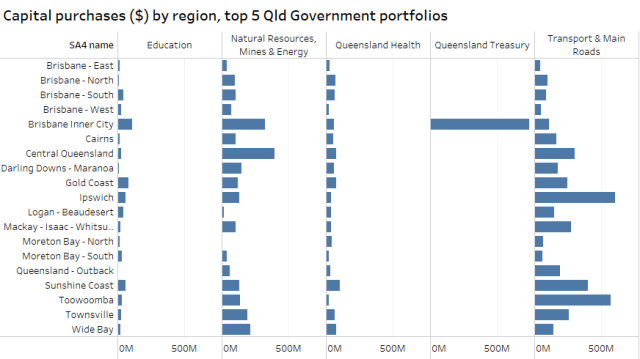
I agree with David Gillespie that the proposed new high school at Dutton Park, which is intended to take some of the load off State High, is probably unnecessary at present. It is not justified by population growth. It would be better to fix the policy failure underlying over-enrollment at State High than to build a new high school. Indeed, Gillespie questioned whether parents would actually send their children to the new Dutton Park high school, as they are already driving past reasonably good state high schools to take their children to State High. It could end up a white elephant. I was happy to hear Gillespie’s views as I have previously questioned why the Brisbane inner city area is receiving the largest amount of state education department CAPEX (see my state budget CAPEX post and chart below).

Capital spend by region for top 5 portfolios

Gillespie argues the solution is cracking down on enrollment rorting, so only children currently living in the catchment or who qualify for academic or sporting reasons can attend State High. I would suggest we instead apply economic principles. Having a large number of students wanting to attend State High shouldn’t be viewed as a problem, but as an opportunity. The state education department is missing out on an opportunity to raise revenue and to manage demand for places at the school at the same time. I expect it could raise parental contributions to State High to levels similar to private schools (e.g. $20K+ p.a. for Brisbane Grammar) for many families no longer living in the catchment. We know that parents value highly the ability to send their children to State High and this lifts house prices in the area (see my post Property market shows parents are willing to pay for high performing state schools).

Imposing additional fees on out-of-catchment students would help manage demand and could help finance the augmentation and refurbishment of infrastructure at the school. It would very likely be more efficient and cost-effective to manage the demand at State High through higher fees, possibly using some of the additional revenue to refurbish and expand some existing school facilities, than to build a new high school at Dutton Park.

To an economist, this seems like such an obvious solution, but there would no doubt be resistance to it on the grounds of fairness. I would respond that the current system is not necessarily fair. Those students lucky enough to secure a place at State High will receive a superior education to those at many other state high schools. If, as I expect, parents are willing to pay handsomely for the right to send their children to State High, why couldn’t they make an additional contribution to the cost of their children’s education, which could allow some funding to be re-directed to disadvantaged schools? Also, under the current system, taxpayers will have to fund the construction of a new high-rise high school at Dutton Park, at a likely cost of around $70-80 million (based on the budget estimate of the cost of the Fortitude Valley High School of $73 million). These funds may be better spent on poorly performing schools in outer metropolitan Brisbane or in regional Queensland.

On school funding issues, also see my posts:

Excellent proposal for school funding reform from ISQ head David Robertson

Qld private independent schools saving taxpayers $1 billion per annum

Posted in Education, Uncategorized | Tagged , , , , , , , , , | 6 Comments