New Townsville – guest post by Colin Dwyer

I am delighted to publish this guest post by Colin Dwyer of DS Economics on the Townsville economy’s improving prospects. The views expressed are Colin’s and should not necessarily be attributed to me. GT

New Townsville

In this essay Founder of ‘Our Fair Share’ Colin Dwyer identifies over 20 private and public sector Townsville projects, (some potential, many confirmed) worth over $9 billion that are helping Townsville forge a new reputation and a stronger more diversified economic future.

Townsville is Northern Australia’s largest city, has 300 days of sunshine each year, and has a reputation as a diversified economy.  The North Queensland city once enjoyed 8% GRP growth and 3.5% population increases. The economy is bolstered by the largest regional hospital in Queensland, the largest Army Barracks in Australia and is a major higher education, base metals exporter and transport hub. But in 2016-17, Townsville experienced a deep depression with significant declines in asset values, significant jobs and skills losses and suffered another year of negative net migration. A contributing factor to the length of Townsville’s downturn was minimal public and private investment.

Something has changed in Townsville. Asset prices have stabilised, jobs are being created, there are cranes on the horizon once again and, while the city is not firing on all economic cylinders, in 2019 a NEW Townsville is likely to build on this opportunity and create a new economic reputation.  Over 20 major projects are current, starting or planned for Townsville in 2019.  Their total cost is similar to Townsville’s current GRP, something that should be envied by other cities.

Although some sectors in Townsville are struggling, 2018 seems to be the start of economic recovery. There’s more potential in Townsville with multiple major projects costing over $9 billion, more jobs and improving economic activity in 2019 and beyond.  This is significant for a city with just over $10 billion in GRP.  Some of the projects are large with meaningful enduring operational job outcomes.  Sun Metals recently confirmed its expansion plans with a 350 jobs construction workforce requirement, and more than 150 above average income earning operational staff needed on completion.  In 2019 the federal government will drive the three year $512 million Haughton flood plains Bruce highway upgrade just south of Townsville and Adani will start on its $2 billion Carmichael Coal mine.  The $2 billion Singapore defence project recently announced it had acquired enough land to proceed to the next phase of the project.  In 2020 Townsville will open its new stadium, in time for the NRL season.  These diverse projects will create significant enduring jobs.

Several other organisations have similar reports including QMBA and Townsville Enterprise.  DS Economics has identified over 60% of current and future known major projects are private sector ventures.  In June 2018, BIS Oxford released their forecast for the next year and North Queensland, including Townsville, is highlighted as a key growth zone for major projects.  The report identified an expected 3 to 4 times increase in construction and mining activity over the preceding year.  It is worthwhile noting that the Townsville City Council capital investment budget is $430 million for 2018-19, similar to the combined capital expenditure budgets of Rockhampton, Mackay and Cairns (their collective population is approximately double Townsville’s population).

Townsville

Townsville’s economic future is looking much brighter than in the four years 2013 to 2016.  Townsville’s GRP is forecast to grow between 2-3% in 2019, boosted by major construction projects, improving health and social assistance jobs and mining and manufacturing activity. In 2019, Townsville is expected to be one of the fastest growing regions in Queensland (this could also reflect poor growth forecasts for other regions).  The challenge for North Australia’s largest city, Townsville, is to build momentum and consolidate sustainable consistent economic net gains and secure a fair share of public and private sector investment.

Major Mining and Construction projects

Townsville is experiencing growth in major construction projects, not seen since 2002. Twenty-three projects amount to over $9.6 billion. Positively, Townsville’s major projects portfolio is varied. They are both private and public projects, across manufacturing, mining, transport, tourism and defence industries.  Some projects are unfunded as yet and may not eventuate.  Of the 12 projects with confirmed funding commitments, half are private sector projects.

Townsville Major Construction Projects 2019 to 2012

Townsville Construction Projects            $ million
Public Funded Projects           1,322
Private Funded Projects           3,519
Other Unfunded Projects *           4,760
Totals           9,601

Source: DS Economics * includes Singapore defence project

There are multiple transformational projects on Townsville’s economic horizon such as the new JCU STEM education centre, new TAFE education centre, battery factory, nickel/cobalt sulphate refinery, renewable energy producers, retail space, a nickel mine, nickel sulphate refinery and a significant expansion at Sun Metals refinery.

All these projects are positive for Townsville’s economic future.  Some may not get funding, but having so many major projects is significantly different to 2016 and prepares a positive platform for Townsville’s recovery.

One key area of recovery is workforce improvements. Townsville job opportunities have improved significantly during 2018, driven by health and social assistance, major construction projects and mining jobs.  Officially 5,500 jobs have been created in Townsville region in the year to October 2018 and in the past two months the official monthly unemployment rate has improved to ‘full employment’ levels, although the ABS does note “the estimate is subject to sampling error too high for most practical purposes.”  But there’s rarely all positive news, the banking inquiry and local job security concerns have restricted credit, as have interest rate movements in the United States. Slow wages growth and job confidence has restricted local consumer spending.  Local and online retail and other business restructuring has reorganised local competitive advantage and influenced investors and consumers.  Townsville is emerging from recovery in a complex economic and political environment.

Conclusion

In 2018, Townsville emerged as a solid regional economic growth centre.  Population growth is expected to be above 2% in 2018 and 2019. Net migration is likely to be positive for the first time in years.  The DS Economics residential vacancy rate for Townsville halved in 2018 to below 3% in September 2018. In early 2019 the vacancy rate is more than likely to tighten below 3% again. Officially, thousands of jobs have been created in the year to October 2018 (their long term tenure and consistent benefit needs scrutiny).  Multiple major projects are driving a new reputation, local confidence is positive but fragile, bolstered by multiple private sector projects and thousands of direct, indirect and induced jobs and enduring operational jobs.

One future project, the $2 billion Singapore defence deal (it was recently announced it had acquired sufficient land at Greenvale northwest of Townsville to proceed) offers multiple industry supply chain opportunities to connect with Asia.  It also offers a chance for a regional location to not just adapt to new technology but to produce, supply and thrive in a complex globalised and digitised world.  Another proposed project, a battery factory, has supply chain support from a new Nickel sulphate refinery. If successful, it could be a catalyst in developing a complex value-added industrial park in the Townsville state development area; creating a unique North Queensland technology cluster with solid supply chain advantages.

In 2016 Townsville was in depression, had minimal public investment, was losing jobs and experienced negative net migration. In 2019, Townsville will build on recovery, set itself new goals and build new population and economic reputations.  NEW Townsville has many significant major projects across a variety of industries that are likely to create short term and longer term opportunities.  Australia needs its flagship regional cities, like Townsville, to perform independently (with private investment) and consistently, but also to gain its reliable fair share of federal and state public investment.

2016 and 2019 have one key element in common, they are both federal election years. Townsville’s main electorate of Herbert decided the federal election outcome in 2016 and gave the city much negotiating ammunition. Herbert was decided on just 37 votes and at least one major public project was negotiated during the 2016 election.  Next year will be different for Townsville.  Not all elections are determined by one electorate and the political strategy will need to change if Townsville is to leverage its marginal status at the next federal election.

Colin Dwyer, DS Economics

Posted in Townsville, Uncategorized | Tagged , , , | 4 Comments

Recommended reading: This is Marketing by Seth Godin

Last month, at the ESA-Griffith-QUT-UQ Economics Summer School held at O’Reilly’s Rainforest Retreat, Griffith University Senior Lecturer Andreas Chai gave a fascinating presentation on his research on consumption patterns. Here are the important points from Andreas’s report for UNIDO on Household Consumption Patterns:

While low- and middle-class households tend to spend in a relatively similar manner, spending patterns among affluent households differ considerably, likely due to the greater discretionary power these households enjoy in terms of spending…

…Differences in spending patterns between households tend to grow as household income rises, creating new opportunities for niche markets and higher quality goods.

So some rich households will divert large parts of their income to luxury travel, others to haute couture; while the obscenely rich will buy properties in central London or Manhattan, Lamborghinis, and super yachts. How are we to make sense of what is driving consumption patterns as households get richer? One answer could be found in one of the best books I’ve read recently: This is Marketing by Seth Godin, arguably the world’s number one marketing expert. Indeed, Seth Godin could help us understand consumption behaviour across most households, with the exception of those at subsistence levels. His mantra is simple but compelling: “People like us do things like this.” For example, people like us eat sushi and do Bikram yoga; or people like us send our children to private schools and holiday at Noosa.

This_is_marketing_cover

As the late Harvard economist John Kenneth Galbraith argued many years ago, our consumption preferences are not exogenous, but are subject to peer influences and can be manipulated by marketing. Once upon a time, during the age of the New Industrial State as Galbraith called it, when families sat down together to watch the Brady Bunch, Charlie’s Angels or Family Ties, advertisers could, in Seth’s words, “sell average stuff to average people” by buying enough TV ads. But that pre-internet world is long gone. We’re not willing to pay more than a commodity price for average stuff, and we’ll ignore all the spam and pop-up ads. We’re now more sophisticated and demand goods and services that can set us apart from the average person and can help us identify with our tribe; as Seth says, “people like us do things like this”.

Seth, therefore, sees a great mission for the marketer, catering to the smallest viable audience (p. 33):

…find a corner of the market that can’t wait for your attention. Go to their extremes. Find a position on the map where you, and you alone, are the perfect answer. Overwhelm this group’s wants and dreams and desires with your care, your attention, and your focus. Make change happen. Change that’s so profound, people can’t help but talk about it.

That Seth Godin can make marketing sound like a noble vocation shows he is indeed the world’s greatest marketer, but I do think there is a lot of truth in his book. And it’s likely to yield a high return on investment to anyone purchasing it, given the large number of marketing insights that can be readily applied, no matter what good or service you’re selling, even if it’s your own labour you’re selling to your current employer.

As QEW is an economics blog, I should note that in a section titled “The myth of rational choice” Seth writes on p. 23 “Microeconomics is based on a demonstrably false assertion” (i.e. rational choice). Of course, many economists now accept that the standard microeconomic model needs to be supplemented with an understanding of psychology, and that is where behavioural economics is making important contributions. I should also add that a model of rational economic agents does have substantial value as a guide to rational decision making when it comes to consumption, saving and investing. But economics probably went wrong in the 1940s and 1950s due to the incredibly influential contributions of Paul Samuelson and Milton Friedman.

Both Samuelson and Friedman made multiple important contributions to economics, and both deserved their Nobel Prizes, but they arguably set economics, particular in the US, heading in the wrong direction, so that many leading US economists, with notable exceptions such as Paul Krugman and Brad DeLong, were thoroughly unprepared for the 2008 financial crisis. Samuelson and Friedman, due to the power and elegance of their reasoning and expression, were too influential among their students, who should have been more skeptical.

Economists will recall that Samuelson showed them how to express consumption and production decisions as mathematical optimisation problems, using first-year college calculus; and Friedman persuaded economists they should model the actual behaviour of consumers and businesses as if they were solving those optimisation problems. But we’ve learned since then that, while our models are extremely useful as benchmarks for what the rational consumer or business person should do as market conditions change, we made a mistake by assuming the real world would work exactly as those models predict. As with artists, and to their detriment, economists fall in love with their models.

If this book from Seth Godin on marketing can make a mainstream economist like me question the progress of economics since the 1940s, it must be extremely good. And it is; it is highly thoughtful and practical, and I cannot recommend it highly enough.

Posted in Uncategorized | Tagged , , , | 2 Comments

Coal, climate change, solar & batteries – why Qld Treasury wanted to offload the state’s energy assets

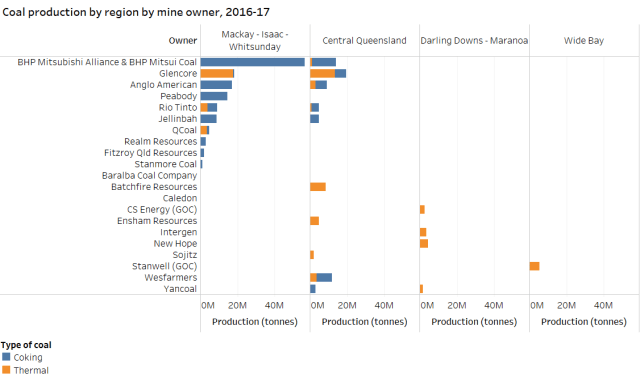
The recent Financial Times report Development bank halts coal financing to combat climate change, reprinted in this morning’s AFR, should prompt some serious long-term thinking from the Queensland government and local governments with regional economies heavily dependent on coal mining, particularly Mackay’s (also see this Reuters report which isn’t pay-walled). While two-thirds of coal production in Queensland is of coking coal (see chart below), there is no doubt there would be a large adverse shock to regional economies if there was a big shift worldwide away from thermal coal for energy generation.*

Coal production x owner x region

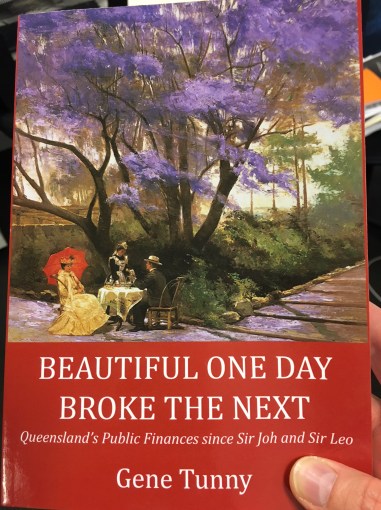
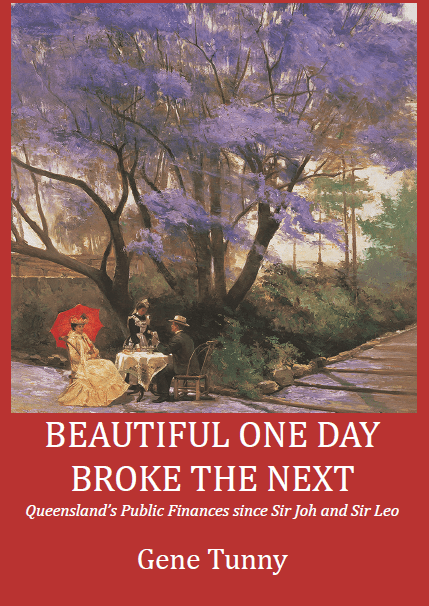
The FT report reminded me of the potentially major implications the worldwide shift against coal and related developments in solar PV and battery technologies could have for the Queensland state budget. Indeed, this issue is discussed in my new book Beautiful One Day, Broke the Next: Qld’s Public Finances since Sir Joh and Sir Leo. Comments regarding the government-owned corporations (GOCs) in energy generation and distribution from former Under Treasurer Mark Gray, reported on p. 167 of the book, are revealing as to why the Treasury was very supportive of the Newman government’s Strong Choices privatisation program:

According to former Under Treasurer Mark Gray, senior Treasury officials considered that the future income streams from GOCs were seriously at risk from technological change and possible policy responses to climate change. The energy assets were seen as particularly vulnerable, due largely to developments in solar and battery technologies which could reduce the reliance of households on electricity generated by the state-owned CS Energy and Stanwell and distributed by Energex and Ergon Energy, now Energy Queensland.

Furthermore, according to Mark Gray, in late 2014, at presentations on the Strong Choices privatisation program to potential investors, such as superannuation and sovereign wealth funds, Queensland Treasury officials were already being asked about the impact of technological change on the future profitability of GOCs and the risk of assets being stranded.

For more revelations and insights into Queensland’s recent state financial history, please consider reading my new book. The official book launch is next Wednesday evening at the Connor Court Book Room on Boundary St, West End, Brisbane:

Connor Court Christmas Party and launch of Gene Tunny’s Beautiful One Day, Broke the Next

cover

* I prepared this chart for a Lytton Advisory report on Extended Payment Terms for the Resource Industry Network that I co-authored wrote Craig Lawrence.

Posted in Budget, Mackay, Mining, Uncategorized | Tagged , , , , , , , , , , , , , | 4 Comments

ABC radio interviews on Beautiful One Day, Broke the Next & Qld Gov’t MYFER

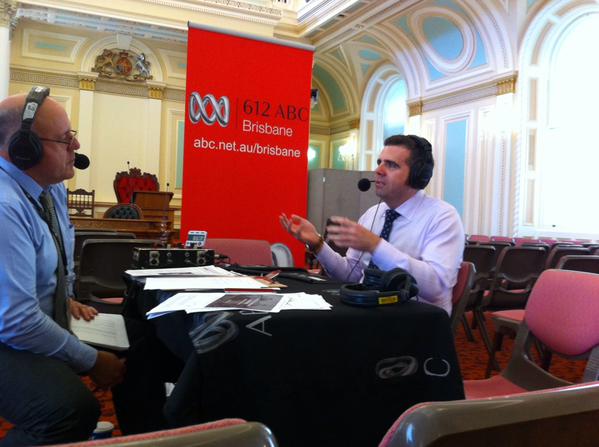
Earlier today I spoke with Steve Austin on his 612 ABC Brisbane Drive program about the Queensland Government’s Mid Year Fiscal and Economic Review and my recently published book Beautiful One Day, Broke the Next.

While the state government today reported a $677 million surge in royalty revenue this financial year owing to higher than expected coal prices, it still projected more-or-less the same trajectory of increasing state debt, which is on its way to over $83 billion in total by mid-2022. And the MYFER highlighted a substantial fiscal risk to future state budgets, the impending High Court decision in the Timber Creek case regarding native title compensation (see p. 16 of the MYFER).

You can listen to my views on MYFER as well as my responses to Steve’s questions regarding my new book from 2:02:10, but please note this audio will be taken down from the ABC site after it’s been up for a week:

Steve Austin’s 612 ABC Brisbane Drive program, Thursday 13 December 2018

Topics discussed included Sir Leo Hielscher’s fine fiscal legacy, how Queensland’s fiscal situation deteriorated after Terry Mackenroth left the Treasury portfolio in the mid-2000s, how Queensland lost its once much vaunted position as the low tax state, and why we shouldn’t be complacent about the debt. We discussed the fiscal trouble Queensland found itself in during the last financial crisis and how it would be a good insurance policy to pay down debt in case we face another one, with Steve noting predictions of a global recession and possible financial crisis in 2020.

This was the second ABC radio interview on the book I had this week. On Tuesday, I was lucky enough to speak with Pat Hession at ABC North Queensland, who broadcasts from the ABC’s well-positioned site on Wickham St, Townsville, just a short walk from both Flinders St and the Strand:

Is Qld’s government debt ever going to reduce in size

GT at PH

From the archives: Steve Austin and me chatting about the fiscal challenges facing the newly-elected Palaszczuk government on its first day of Parliament in 2015, from the stately chamber of the Legislative Council (i.e. Qld’s upper house which was abolished in the 1920s).

Posted in Budget, Uncategorized | Tagged , , , , , , , , , , | 2 Comments

Joe Branigan’s award winning paper on the correct use of CBA and economic impact analysis

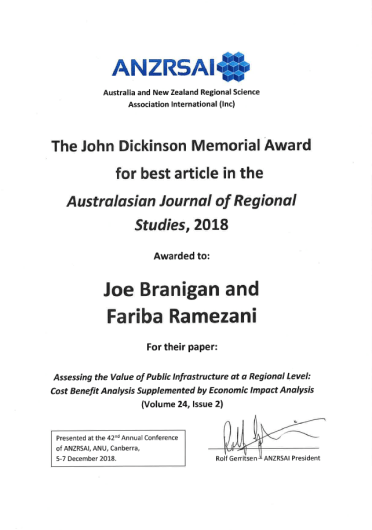
Congratulations to my old friend and fellow Queensland economist Joe Branigan of SMART Infrastructure Facility for his award-winning paper on assessing the value of regional public infrastructure (see photo below). In his paper, published in the Australasian Journal of Regional Studies, Joe and his co-author Fariba Ramezani nicely explain the distinction between a cost-benefit analysis (CBA) and an economic impact analysis (EIA).

JB_award

For instance, Joe’s paper has an excellent summary of the importance of CBA:

Importantly, CBA provides a solid, comparable framework for estimating the strengths and weaknesses of alternatives by comparing the potential changes in society’s wealth due to the project with that of the relevant alternatives (which may include doing nothing, deferring or otherwise varying the project, or proceeding with an alternative project).

For this reason, economists tend to see CBA as having primacy over EIA, but alas economists are not usually the ultimate decision makers, and EIA is typically given a large weight by decision makers who may have regional economic development objectives in mind.

Broadly speaking, an EIA tells us how much value added and employment a project creates, while a CBA tells us whether it’s worth investing in the project in the first place, recognising there are alternative uses of society’s resources.

That said, a well done EIA should report on the economy-wide impacts of a project (i.e. also modelling any offsetting reductions in activity in other regions or industries as a new project draws workers and capital away from them). But this is not always done, and we too often see incredible estimates of regional jobs being created by particular projects, both directly and indirectly.

Alas, the two distinct though complementary techniques of CBA and EIA are often badly applied by analysts or confused in the minds of decision makers. For an example, see Joe’s 2016 QEW guest post on the Townsville Super Stadium, in which he discussed how regional EIA and CBA were in conflict for that project.

Posted in Uncategorized | Tagged , , , , , , | 2 Comments

My book launch at Connor Court Christmas party, Wednesday 19 December at Boundary St, West End

My new book Beautiful One Day, Broke the Next covers Queensland’s state finances over the last thirty years, during which time Queensland went from being the exemplar of sound public finance in Australia to a cautionary tale of the dangers of fiscal extravagance. In the book I discuss what went wrong, how much we really should worry about the $80+ billion of debt we are tracking toward, and what the state government should do to correct the course. While already available for purchase, the book will be officially launched next week on Wednesday evening 19 December during the Connor Court Christmas party at the Connor Court book room, upstairs at 146 Boundary St, West End, Brisbane, across the street from the well-known Avid Reader bookstore. You can book to attend via this link:

Connor Court Christmas Party and launch of Beautiful One Day, Broke the Next

Come and celebrate Connor Court Publishing’s Christmas Party as well as the launch of Gene Tunny’s new book “Beautiful One Day, Broke the Next”.

The evening will include, wine and cheese, great speeches, a book launch, the big book raffle, as well as the opportunity to purchase last minute gifts from the book room.

BODBTN_cover

Posted in Budget, Uncategorized | Tagged , , , , , | Leave a comment

Qld economy continues to disappoint

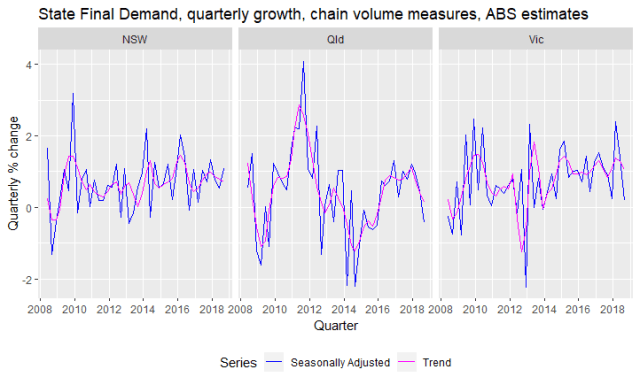
Queensland’s economic under-performance, which I’ve been commenting on regularly (e.g. see Deloitte’s weird definition of “strong employment growth”), is a major part of the reason why Australia’s GDP growth for September quarter came in lower than expected yesterday. The ABS has estimated national economic growth in September quarter at 0.3% and through-the-year growth at 2.8%, in seasonally adjusted terms. Queensland’s State Final Demand (SFD) fell by 0.4% in September quarter compared with growth of 0.3% across all states and territories (see the ABS summary). NSW’s SFD increased at the strong rate of 1.1% while Victoria registered only 0.2% growth (see chart below).

SFD_quarterly_growth_Sep18

My colleague Nick Behrens at his QEAS blog nicely summarised the disappointing September quarter National Accounts data for Queensland as follows:

Latest ABS data confirms Queensland’s domestic economic growth has now peaked and is falling away which has considerable implications for future employment growth in the Sunshine State…

…Quarterly domestic economic growth for Queensland peaked in the December quarter 2017 following a strong two year period that generated considerable employment growth. However our domestic economic growth has progressively eased across 2018 which is now actively influencing our State’s employment growth at present.

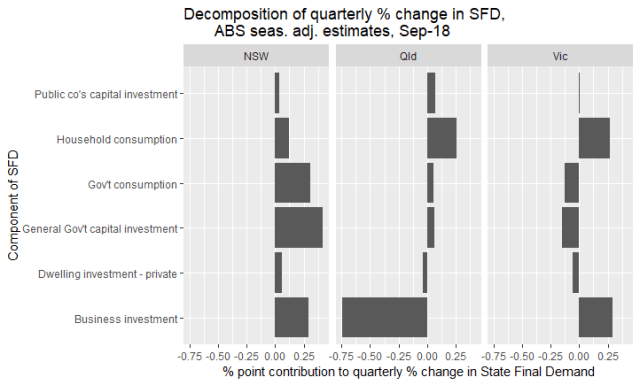
The decline in Queensland’s SFD is primarily related to declining capital investment, particularly in non-residential construction (and more precisely heavy/engineering construction), which forms a large part of business capital investment (see chart below and my post Industry groups right to say Qld economy failing to create the number of jobs needed). This of course is a volatile component of SFD and should rebound somewhat over the next few years as major projects (e.g. Queen’s Wharf, Brisbane Live, Adani Mega Mine, Cross River Rail PPP) ramp up. So I’m not panicking yet, but I would like to reiterate my suggestion that the state government urgently review the full range of regulations and legislation that could be impinging upon business activity and job creation.

SFD_decomposition_Sep18

Also on the disappointing September quarter National Accounts figures, see Mission Beach-based economist Pete Faulkner’s post GDP disappoints.

Posted in Labour market, Macroeconomy, Uncategorized | Tagged , , , , , , , , , , | 2 Comments

Deficient Qld state public administration is a major theme of my new book

Sadly, Queenslanders are getting accustomed to regular stories of failures of state public administration, with two major stories this week. We have learned about the $250 million digital hospitals program cost blow out and the results of the inquiry into the botched $4.4 billion procurement of the New Generation Rollingstock (NGR) trains. Yesterday the Courier-Mail reported:

AN INQUIRY into the State Government’s botched delivery of new trains worth $4.4 billion could end in a lawsuit.

Commissioner, retired judge Michael Forde said yesterday that his four-month inquiry into the project’s flaws found no evidence that successive ministers or top officials had been told the train design breached disability access legislation.

But he said the inquiry exposed a lack of consultation with the disability sector.

The design issues were not raised with Transport director-general Neil Scales until 2016 – three years after the contract for 75 new trains was signed with a consortium led by manufacturer Bombardier.

It’s pretty hopeless and rather incredible that senior public servants were unaware of the major issues involved in a multi-billion dollar procurement. They need to be accountable for either the lack of proper stakeholder consultation conducted by their department or for what may be a “she’ll be right” culture of dismissing and not conveying bad news up the chain of command. I’m surprised there aren’t loud calls for mass sackings of senior Transport and Main Roads bureaucrats.

Queensland’s sub-standard public administration is a major theme of my new book Beautiful One Day, Broke the Next, now available for pre-order from the Connor Court website. This is a state in which we’ve had a water crisis, health crisis, electricity crisis, health payroll debacle, fake Tahitian prince scandal, hospitals cost blow out, rail fail and the NGR procurement snafu, among other public administration stuff ups.

There is something deeply wrong with Queensland’s public administration. Partly this is due to the lack of an upper house, which was abolished in the 1920s, although I’m not necessarily advocating for one to be restored. We need to strengthen the role of parliamentary committees in overseeing government business and also we need to improve the quality of the state public service. It’s been widely observed that successive governments have politicised the public service and we now have very few long-term career public servants with the skills to administer high quality policy development and program delivery.

On Queensland’s recurrent failures in public administration, in addition to my book, I recommend Ken Wiltshire’s excellent 2016 Courier-Mail opinion piece Take the politics out of policy.

cover

Posted in Health, Transport, Uncategorized | Tagged , , , , , , , | 6 Comments

Industry groups right to say Qld economy failing to create the number of jobs needed

I am pleased to see that peak industry bodies (e.g. the Property Council of Australia and the Infrastructure Association of Qld) are saying the same thing I have been regarding Queensland’s lacklustre jobs growth, with the Sunday Mail* today reporting:

Queensland is attracting rising numbers of people to live in the state—but failing to create the jobs they need, says new analysis.

Peak industry groups for property, business and infrastructure are challenging the Palaszczuk Government to use next week’s mid-year fiscal and economic review (MYFER) to refocus policy direction and close a growing “performance gap” between Queensland and New South Wales.

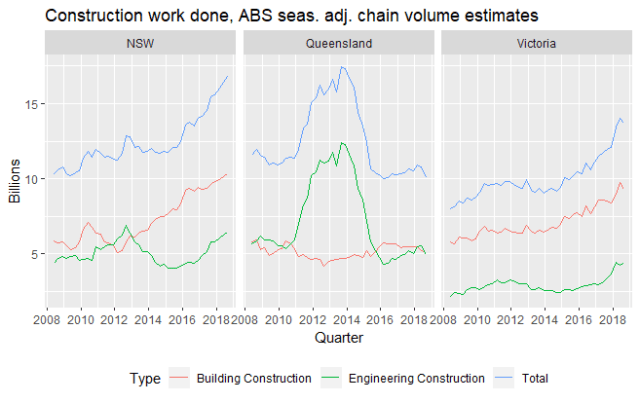
I have discussed this performance gap in previous posts (e.g. Deloitte’s weird definition of “strong employment growth” and Qld only state/territory with 6%+ unemployment rate). The September quarter construction activity and private capital expenditure data released by the ABS last week confirmed the diverging trends between Queensland and southern states. For instance, contrast the plateau in construction work done in Queensland over the last few years with the upward trends seen in southern states (see my facet plot below and this ABS summary of the new data).

cons_work_done_Sep18

While there are some major projects that are expected to boost activity in Queensland (e.g. Cross River Rail, Queen’s Wharf, Brisbane Live, Adani mega mine) over the next few years, I doubt these projects alone will be sufficient to close the performance gap we have seen. Indeed, NSW’s economy appears set to be injected with large additional amounts of public infrastructure investment, with the Sunday Mail reporting:

Analysis commissioned by the Property Council said that Queensland consistently spent a much greater proportion of Gross State Product on developing infrastructure than NSW did between 1999 and 2014. But forward budget outlooks showed that trend would be reversed for the first time between 2019 and 2022—a period during which NSW would invest $87.2 billion on infrastructure, almost double Queensland’s $45.8 billion spend.

Again, I am pleased the peak industry bodies have raised the performance gap as an issue with the state government. As I have previously argued, we need to review the full range of regulations, taxes and charges that impinge on business activity in Queensland.

*A hat tip to Nick Behrens who writes at the QEAS blog for alerting me to the Sunday Mail article. 

Posted in Labour market, Macroeconomy, Uncategorized | Tagged , , , , , , , , , , , , , | Leave a comment

Deloitte’s weird definition of “strong employment growth” for Qld

I was surprised when I read Deloitte’s latest commentary on the Queensland economy, as reported by the Courier-Mail on Thursday (Jobless rate hides Qld’s economic success story), because the commentary makes little sense:

QUEENSLAND’S economy is performing strongly despite the country’s highest unemployment rate, analysis released today reveals.

“Queenslanders are more positive about finding a job,” Deloitte Access Economics partner Natasha Doherty said in the latest quarterly outlook report on the state.

Although the 6 per cent ­jobless rate is 1 per cent above the national average, it has to be viewed in the context of more people seeking work, Ms Doherty said.

“This is against the backdrop of strong employment growth with 35,000 jobs added over the year to September.

The quoted 35,000 jobs growth over-the-year to September corresponds to a growth rate of only 1.4%, compared with 2.4% nationwide and state population growth of 1.8%. This cannot be considered strong employment growth and, indeed, I would call it moderate at best. Oddly, Deloitte hasn’t quoted the latest ABS Labour Force Survey data which show Queensland employment growth at the lower rate of 1.1% compared with 2.3% nationwide through-the-year to October (see my post on these figures and Queensland Treasury’s briefing). Deloitte emphasises that, according to the ABS data, much of recent jobs growth has been in full-time positions. But Queensland’s rate of full-time employment growth at 1.8% is lower than the national rate of 2.4% and is around the population growth rate, so it’s nothing extraordinary.

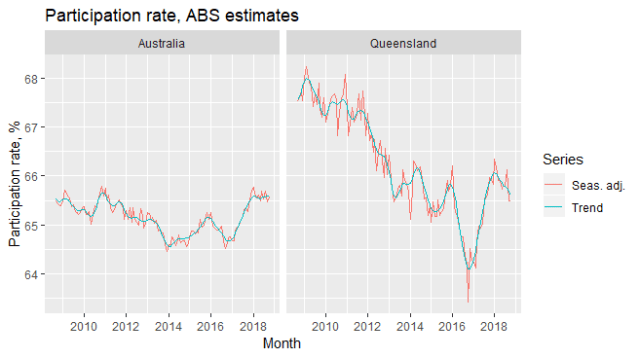
Deloitte is also wrong to point to more people seeking work as an explanation of the state unemployment rate staying at 6%+ while the national rate has declined to 5.1%. Deloitte would have been right to point to an increase in state labour force participation in 2017, but over the year to October 2018 Queensland’s participation rate has fallen from 65.9% to 65.6% (see chart below). Furthermore, in October, the participation rates for Queensland and Australia were equal at 65.6%. We can therefore reject Deloitte’s hypothesis that Queensland’s current 6%+ unemployment rate is due to more people than usual seeking work, which would require the labour force participation rate to have increased over the year, something which did not occur. Instead, Queensland’s current 6.2% unemployment rate is related to the state experiencing only modest employment growth, at a rate lower than the population growth rate.

Part_rate_to_Oct18

Deloitte’s commentary on the Queensland labour market is inconsistent with the latest data and makes little sense.

Posted in Labour market, Macroeconomy, Uncategorized | Tagged , , , , , , , , | 2 Comments