Let’s keep the “Renewable energy jobs surge” in perspective

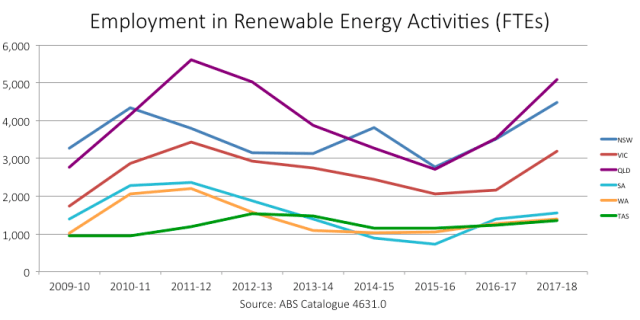
Yesterday the ABS released its latest renewable energy jobs estimates and its media release reported a Renewable energy jobs surge on the back of solar. My colleague Nick Behrens from QEAS tweeted about the new data and produced the chart below which I’ve borrowed for this post. Now I can understand the ABS’s need to write punchy headlines that capture the attention of journalists and pundits, but I’m concerned the ABS is not applying its usual level of rigour in defining jobs associated with particular sectors. The ABS is including in its broad definition of renewable jobs those jobs associated with the construction of renewable projects such as solar farms:

In this publication renewable energy employment is defined as employment in activities principally motivated by the production of renewable energy, and/or by the design, construction and/or operation and maintenance of renewable energy infrastructure.

This is an odd definition and one which, incorrectly in my view, conflates jobs in the construction and operational phases of renewable projects. It gives a potentially misleading impression of the relative ongoing contribution to employment of the renewable energy sector. Undoubtedly there is currently a large amount of construction of renewable energy projects and that will no doubt continue in the foreseeable future, but once these projects are up and running, their contribution to employment will be much, much lower.

For example, earlier this year Townsville City Councillor Margie Ryder made the following observations in a Townsville City Council post regarding a recently approved solar farm at Bluewater:

This development is expected to create 200 jobs during the construction stage and support 3 ongoing jobs when it is operational.

That is, the level of employment in the operational phase is 1.5% of the level in the construction phase for that particular solar farm.

Even if you include construction jobs, the aggregate level of renewable energy employment (around 5,000 full-time equivalent employees in Queensland) isn’t that large relative to other sectors. For example, Reuben Lawrence’s Economic Contribution report for the Queensland Resources Council notes there are over 35,000 FTEs directly associated with the resources sector.

In summary, I suspect renewable energy, despite whatever other merits it has, will not be a major employer of Queenslanders beyond the construction phases of renewables projects.

Renewables_chart

Posted in Energy, Uncategorized | Tagged , , , , , | 6 Comments

Digital Minimalism calls for cost-benefit analysis of social media apps & digital tools

On the 612 ABC Brisbane Drive program yesterday afternoon, host Steve Austin suggested to Education Minister Grace Grace that increasing use of laptops, tablets, and smartphones could be behind declining NAPLAN scores for writing over the last decade.  Steve noted correlation doesn’t imply causation, but his proposition struck me as credible. Certainly many of us now have the feeling that all the new digital tools which are facilitating constant connectivity and often shallow forms of communication via Facebook and Snapchat are having adverse consequences. We are less focused, less productive, and more anxious, as we are constantly bombarded with new requests or reminded about previous commitments.

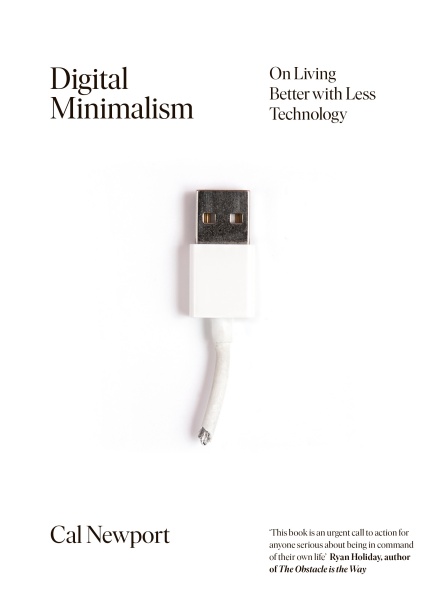
Since the publication of his 2016 book Deep Work, Georgetown Computer Science Professor Cal Newport has led the resistance against the onslaught of social media and constant connectivity that is distracting us from the focused deep work we ideally should be doing. His latest book Digital Minimalism: On Living Better with Less Technology, published in February by Penguin, may well be the most important business book of the year.

As an economist who frequently calls for greater use of cost-benefit analysis in decision making, I was very glad to see Newport’s definition of digital minimalism. Rephrasing it in economic terms, the philosophy is only to use digital tools which deliver net benefits, taking into account the full opportunity cost of your time and attention. Newport notes (on p. 29):

The so-called digital minimalists who follow this philosophy constantly perform implicit cost-benefit analyses. If a new technology offers little more than a minor diversion or trivial convenience, the minimalist will ignore it.

For many of us, it may well be optimal to abandon Facebook or Twitter, or at least to adopt strict standard operating procedures for social media use—e.g. I will only check Facebook for half an hour on a Saturday afternoon and then I will intentionally only check what family and close friends are up to. Newport argues you’re best off deleting social media apps from your phone, and he notes not even Steve Jobs realised how distracted we would become by our smart phones when he launched the iPhone in 2007. The value proposition Jobs emphasised was that the iPhone is an iPod that doubles as a phone, so you don’t have to carry two devices. But Facebook, Twitter, Snapchat, et cetera have changed everything, and now the few of us who are (largely) immune need to constantly watch out for all the “smombies”, the smart phone zombies, who are a danger to themselves and others on our city streets.

We can’t return to the pre-iPhone world, nor would it necessarily be desirable to do so, but we can certainly become smarter in how we use all the new technology. Cal Newport may have just solved this problem for us in Digital Minimalism. If widely adopted, I expect his advice would lead to significant improvements in productivity and well being.

Digital_minimalism

Posted in Productivity, Uncategorized | Tagged , , , , , , , , , , | 2 Comments

Cash is king – Seth Godin’s latest podcast episode “Money flows”

Seth Godin’s latest Akimbo podcast episode Money flows is a lucid introduction to the importance of cash flow for business health. Even businesses that appear to be thriving can get into trouble due to the gap between the commencement of projects and final payment, which can often be several months. Seth gives lots of excellent practical advice on how to avoid cash flow problems, and is an advocate of bootstrapping, whereby you develop a business model that enables you to receive a large share of payments up front from customers, to help you do the work and deliver.

I well understand the importance of cash flow, as a small business person, and also through my consulting and work experience. Last year, I worked with Craig Lawrence of Lytton Advisory on a project for the Resource Industry Network on the impact of extended payment terms (e.g. 60 days rather than 30 days after an invoice is approved for payment) on businesses in the supply chains of mining companies in Queensland. You can read about the implications of extended payment terms for business cash flow and sustainability in our report, which is available via a link in this RIN news article reporting that, pleasingly, BHP has announced a restoration of 30 day payment terms:

Resource Industry Network Welcomes BHP Announcement To Implement 30-Day Payment Terms For Its Supply Chain

Cash flow is also important to governments, a lesson that was drilled into me during those crazy months in late 2008 and early 2009, when policy makers around the world were dealing with the financial crisis. While the time itself was incredibly stressful, I later had an enjoyable conversation with 612 ABC Brisbane’s Steve Austin about some of my experiences during that time in 2017:

Interview with ABC Radio’s Steve Austin on “The time Australia’s Treasury almost ran out of money”

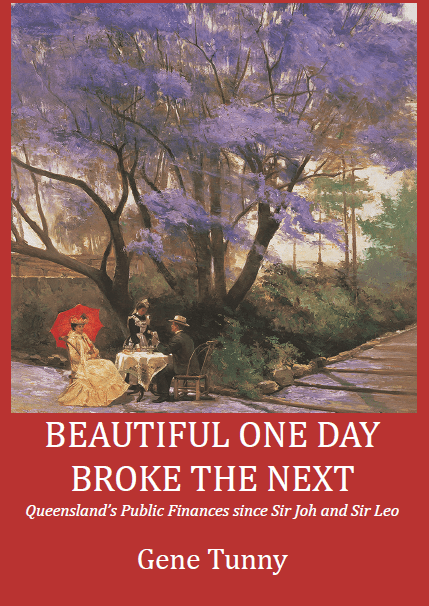
It was during those crazy months when I first learned about Queensland’s own fiscal crisis, from visiting Queensland Treasury officials who were pleading with the Commonwealth for assistance, as I discuss in my book Beautiful One Day, Broke the Next, which the State Library of Queensland will have available for sale prior to the upcoming Grattan Institute budget event I’m speaking at next Tuesday:

2019 Federal Budget: unpacking the economics and politics for Queensland and Australia

Cash

Posted in Budget, Mining, Uncategorized | Tagged , , , , , , , , | 4 Comments

ABC radio interview on 2019 Budget – why Laurie Oakes is to blame for tight security

I had an enjoyable chat with Craig Zonca and Loretta Ryan on 612 ABC Brisbane this morning regarding the upcoming federal budget, particularly regarding security around the budget. You can hear me from around 48 minutes, 28 seconds into the recording:

Breakfast, Tuesday 2 April 2019

Note this link will self-destruct after around one week.

The interview was prompted by a quirky Fairfax story from yesterday, a story which doesn’t appear to have been an April Fool’s day joke:

Budget paper one night stand ends for Treasury officials

I noted the intense security around the budget is partly a result of journalist Laurie Oakes having got his hands on the 1980 budget papers, days before the budget was to be brought down by then-Treasurer John Howard.

As a matter of clarification regarding my response to the final question in the interview, the federal government has already funded a feasibility study for high-speed rail. The expected rail announcement in the 2019 Budget relates to $700 million for the South Geelong to Waurn Ponds rail upgrade (see this ABC News report).

Finally, I am a panelist at a Grattan Institute event in Brisbane Tuesday night (9 April) next week at the State Library:

2019 Federal Budget: unpacking the economics and politics for Queensland and Australia

perspectives-treasury-building-post-486x324


Posted in Budget, Uncategorized | Tagged , , , , | Leave a comment

Qld’s 2nd Health Crisis in 15 years – read about the 1st in my book Beautiful One Day, Broke the Next

The more things change, the more they stay the same. Queensland’s health system is again in crisis, with Queenslanders told by our ministers only to use the public hospital system in an emergency. And, predictably, the Premier is blaming the federal government. As the Courier-Mail reports this morning:

THE Premier has again attempted to deflect blame to the Federal Government over Queensland’s health woes.

Annastacia Palaszczuk claims the Federal Government owes her government $300 million in health funding.

The involvement of both federal and state governments in the health system is one of the underlying causes of the current crisis, of course. The other underlying cause is that, as Queensland Health’s website notes:

If you are eligible for Medicare you can access: public hospital and community-based services for low or no cost…

We have made a value judgment as a society that public health is important and should be heavily subsidised. That is fine, but we need to understand the economic consequences of that choice. We are setting aside the price mechanism which we rely on in so many markets to balance supply and demand. In other markets we ration by price, but in health we need to ration by quantity, meaning that, in Queensland, we now have to tell people to stay away from public hospitals unless it’s a life-or-death emergency.

Sure, we have had population growth and a spike in summer flu cases, but if we have a purely demand-driven system we are always at risk of having insufficient capacity. As a caller asked Steve Austin on his 612 ABC Brisbane Drive show yesterday afternoon, how would our hospitals cope if there were a major incident (e.g. plane or bus crash, natural disaster, etc)?

I should say the Premier is partly right to blame the federal government, as both state and federal governments are responsible for the health system, but she needs to recognise her government’s own role in the mess. State and federal governments both need to work together to find a solution and, ideally, one level of government would eventually leave health solely to the other level of government, so there is clear accountability.

You can read about Queensland’s first health crisis, which began with the revelations about “Dr Death” at Bundaberg Hospital in 2005, and resulted in a panicked, costly response from the Beattie government, in my 2018 book Beautiful One Day, Broke the Next.

cover

Posted in Health, Uncategorized | Tagged , , , | 4 Comments

Bad economic news keeps coming – declining job vacancies & inverted US yield curve

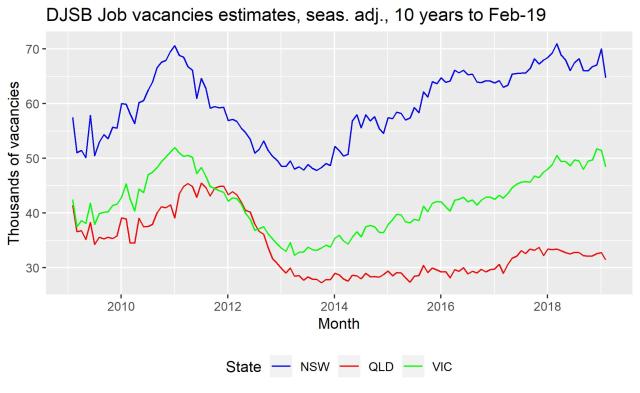
The federal Department of Jobs and Small Business published its February 2019 internet job vacancies data last week, and it revealed a continuation of the downward trend in job vacancies, which were 5.5% lower in Queensland and 4.0% lower nationally than the year before (see the chart below). This appears consistent with the downswing in the economy I suspect is now occurring.

vacancies_feb19

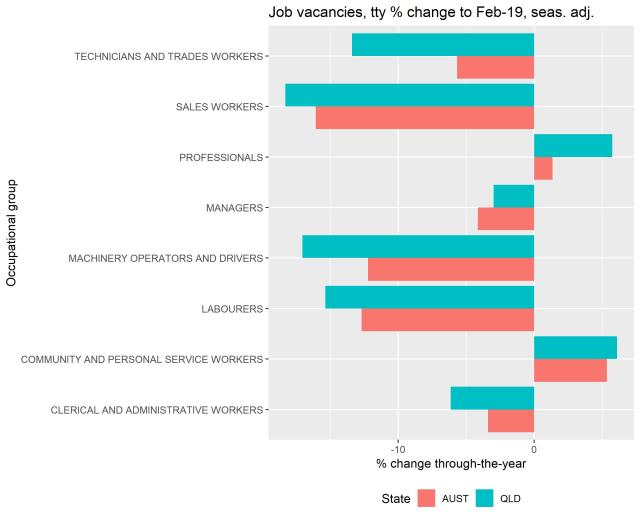
The fall in vacancies was experienced across most occupational groups, with the exception of professionals, largely in health and education, and community and personal service workers (e.g. carers and aides), most likely due to the NDIS.

ttygrowth_occ

Also, consistent with the story of an economic downswing, nationally and potentially internationally, too, are the reports that Hundreds of Queensland retailers are at risk of collapse and that the yield curve for US Treasury bills and bonds has inverted for the first time since 2007, which was the year of the sub-prime crisis and the start of the panic which culminated in the global financial crisis in late 2008. As the Financial Times reported last Friday:

…the difference between two- and 10-year yields dipped below 10 basis points for the first time this year. This is the primary indicator that investors watch because it has inverted — where short-dated yield rise above longer-dated yields — before every recession since the second world war.

As noted in the Financial Times article, an inverted yield curve is not a perfect predictor of a coming recession, but it certainly did spook financial markets when it occurred.

I should note Queensland did have a surprisingly good result in the ABS labour force figures for February, which were published last Thursday, with the seasonally adjusted rate falling to 5.4% and the trend rate to 5.7% (see the Qld Treasury briefing). This was due largely to a fall in labour force participation, however, so I’m not getting too excited about it. Given our relatively younger population, it seems very odd that Queensland’s participation rate is now at 65% compared with the national average of 65.6%. The peculiar data may be related to a change in the composition of the ABS’s sample of Queensland households. Indeed, we know the ABS had difficulty getting data from its Townsville households due to the floods, as noted on the ABS website and in Pete Faulkner’s post, raising questions about the reliability of the data. So we need to wait and see whether the Queensland unemployment rate stays at this lower level. As always, we need to be cautious in interpreting month-to-month changes in the labour force data.

Finally, as I’ve noted before, I undertake my data analysis and charting using R, the data science programming language, which I can’t recommend highly enough. I’m trying to convert others to using R and am running an upcoming course which I discuss in this new video:

Here is the link to the Eventbrite page for the course:

Data science with R: Introduction with a focus on ABS economic data

Posted in Labour market, Macroeconomy, Uncategorized | Tagged , , , , , , , , , , , , | 2 Comments

Luckily Qld property prices never reached crazy levels that NSW’s and Victoria’s did – now less room to fall

Michael Janda at ABC News has a good summary of the residential property price data for December quarter published yesterday by the ABS:

Australia’s $133 billion property price slide rapidly becoming the worst in modern history

This correction has been a long time coming. Then RBA Governor Glenn Stevens warned about Sydney’s “crazy” house prices in mid-2015. Incidentally, following the Governor’s comments which were made at an ESA Queensland business lunch,  I set a UQ ECON2040 Macroeconomic Policy assignment on the implications for monetary policy of the housing price bubble. And in early 2017 I posted:

Sydney & Melbourne house prices defy rational explanation

As I’ve noted in a previous post, Howard Marks’s 2018 book Mastering the Market Cycle is recommended reading on economic cycles and the implications for investing, and he is especially lucid on real estate (on p. 169):

Much of investing is subject to gross generalizations and sweeping statements—usually stressing the positives, because of humans’ tendency toward greed and wishful thinking—and for some reason this seems particularly true in real estate. Over the course of my career I’ve heard investment in real estate rationalized by easily digested statements like “they’re not making any more” (in connection with land), “you can always live in it” (in connection with houses), and “it’s a hedge against inflation”…What people eventually learn is that regardless of the merit behind the statements, they won’t protect an investment that was made at too high a price.

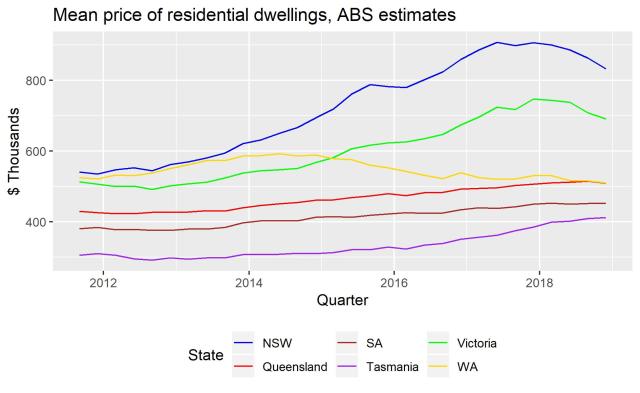
A lot of investors in the Sydney and Melbourne markets are learning that now, and we are now seeing an adverse wealth effect drag on consumption spending. Luckily Queensland property prices never reached the crazy levels they did in Sydney and Melbourne and falls in local property prices have been slight so far (see chart below), with the exception of inner-Brisbane city apartments. Partly, that would have been because we have had more mixed economic circumstances than other states in recent years.

meanprices

As I’ve noted before, I undertake my data analysis and charting using R, the data science programming language, which I can’t recommend highly enough. I’m trying to convert others to using R and am running an upcoming course:

Data science with R: Introduction with a focus on ABS economic data

If you regularly analyse and chart ABS data, I would recommend attending my training day and learning how you can save huge amounts of time in your data analysis and charting. The early bird registration fee expires this Friday.

Posted in Housing, Uncategorized | Tagged , , , , , , , , , , , , , , , , | 4 Comments

The 7 habits of highly effective economists Part 2 – Habits 4 to 7: Public victory & renewal habits

7habitsI have previously posted Part 1 of the 7 habits of highly effective economists in which I covered the first three habits. This post covers the remaining four. The 7 habits were first defined by the late Stephen R. Covey in his brilliant 1989 book The 7 Habits of Highly Effective People: Powerful Lessons in Personal Change.

Habit 4. Think Win/Win

The habit of thinking “win/win” should come naturally to economists, who regularly preach the gains from voluntary exchange between individuals and trade between nations. Earlier this week, former Trump economic adviser Gary Cohn made some newsworthy observations to Stephen Dubner on Freakonomics Radio about how the vast majority of economists support free trade, but alas one of the few who don’t, Peter Navarro, has the ear of President Trump. The interview is well worth listening to:

A free trade Democrat in the Trump White House

Regarding policy advice, thinking win/win, or recognising the gains from trade, economists should generally support policies that promote better economic performance, recognising that policies that enhance productivity can provide additional income that can partly be redistributed to compensate any losers from policy change. Literally, a rising tide lifts all boats, but that isn’t always the case when it comes to economic matters. Many policy changes will create losers as well as winners. But we can often find a set of policies that improve economic outcomes and compensates the losers so that most people are better off.

A good example of this is the introduction of the GST in 2000. Remembering that John Hewson lost the 1993 election campaigning for a GST, the Howard government was very careful in designing a tax reform package that would have wide appeal. John Kehoe wrote a good summary of the deliberations around the GST package in the AFR in 2010 in his article GST: the reform that divided a nation:

In the cabinet meetings, Treasury’s [Ken] Henry explained the distributional effects of the GST across all income groups, taking into account things like tax cuts and pension increases. The modelling was used to assure ministers that taxpayers would not be worse off.

Petrol prices were politically sensitive, so the excise rate was cut to offset the GST to ensure pump prices “need not rise”.

This is a good example of how economists should look for and can help design “win/win” policy solutions.

Habit 5. Seek first to understand, then to be understood

This habit is important for economists, because there is a risk we can become narrowly focussed on economic issues in a discussion, and not realise that the reason we have trouble communicating with some readers or listeners is because they are placing a much higher weight on social or environmental criteria.

There is also a risk economists can fall in love with their models, and not realise that one of our elegant abstract models is not always applicable. I don’t fully agree with him, but it’s worth reading former PIMCO CEO Mohamed El-Erian’s latest criticism of the economics profession, Why economics must get broader before it gets better, because it does highlight how economists usually need to think more laterally than their existing models to engage meaningfully in policy debates and influence decision makers. El-Erian is particularly critical of economists for their contributions to the recent US-China trade war debate:

So far, the vast majority of economists have trotted out the conventional argument that tariffs (real or threatened) are always bad for everyone. In doing so, they have ignored work from their own profession showing how the promised benefits of trade, while substantial, can be undermined by market and institutional imperfections. Those who wanted to make a productive contribution to the debate should have taken a more nuanced approach, applying tools from game theory to distinguish between the “what” and the “how” of trade warfare.

While I don’t support Trump’s trade war, I would concede there is a need for economists promoting free trade to try to understand why Trump started the trade war in the first place. Maybe he will secure some concessions from China on intellectual property protection and market access. That said, it seems like a costly and risky way to try to achieve that outcome to me.

Habit 6. Synergise

Habit 6 has become a cliché in business now, so I won’t write too much on it. I’d simply observe that economists have the greatest opportunities to synergise when they work with non-economists and where both understand each other’s perspectives and learn from each other. A good example is economists working with engineers.

Economists and engineers need each other, more than they often think. The late great UK economist Ralph Turvey instructs economists on the importance of working with engineers in a working paper from 2000 What are marginal costs and how to estimate them?  He notes that the economist’s concept of marginal cost, the additional cost associated with an incremental change in output, is not as easy to measure as textbooks suggest, and that where operations involve significant capital equipment:

…marginal cost is an engineering estimate of the effect upon the future time stream of outlays of a postulated change in the future time stream of output. There are as many marginal costs as there are conceivable postulated changes. Estimating any of them usually requires engineering and, often, operational research skills. It rarely requires accounting skills.

So economists involved in water regulation and pricing for example need to work with engineers who know what future augmentations (e.g. dam upgrades, desalination plants, etc) could meet future demand requirements.

The role of the economist is to work with the engineers and advise decision makers on the most cost-effective way of satisfying future demands. To give a Queensland example, I recall how my former Marsden Jacob colleague and good friend the late Dr Tony Hand worked extensively with engineers (and with Peter Jacob) to produce the cost-benefit analysis for the Traveston Crossing Dam, which was identified as “the most cost effective and beneficial water storage option for South East Queensland” (see this Bligh government media release) during SEQ’s water crisis in the 2000s. The dam never went ahead, however, as the federal Environment Minister Peter Garrett was concerned about the proposed dam’s impacts on turtles and lungfish.

Habit 7. Sharpen the saw

The previous habits I’ve covered in this post are referred to by Covey as the habits of public victory, as they help us succeed in the public domain. The final habit reinforces the habits for public victory, as well as the habits for private victory. It is the habit of renewal or self-improvement: sharpen the saw.

Economists can sharpen the saw in various ways. We can keep up with current economic and financial issues, by reading local newspapers but also the Financial Times and the Economist, for example. Several blogs are also well worth reading and you can find some links on my QEW blogroll. Increasingly, one of the best ways to keep up with economic news and views is through podcasts, and my favourites are EconTalk, Macro Musings, Freakonomics Radio, and the Bulletin with UBS. I also find it useful to scan recent issues of economic journals, particularly the more policy oriented ones, like the Oxford Review of Economic Policy and Journal of Economic Perspectives, as well as the latest think tank (e.g. CIS, Grattan) publications.

Finally, I think economists should learn other skills, such as public speaking and a data science programming language (e.g. see my post How you can automate ABS data analysis and charting using R). I think Dilbert creator Scott Adams was spot on when he noted to Tim Ferriss who interviewed him for Tools of Titans (pp. 269-270) that:

Capitalism rewards things that are both rare and valuable. You make yourself rare by combining two or more “pretty goods” until no one else has your mix…At least one of the skills in your mixture should involve communication, either written or verbal…It sounds like generic advice, but you’d be hard pressed to find any successful person who didn’t have about three skills in the top 25%.

That’s great advice for economists wishing to become highly effective.

Posted in Uncategorized | Tagged , , , , , , , , , , | 2 Comments

Credit cycle in downswing phase

credit_total

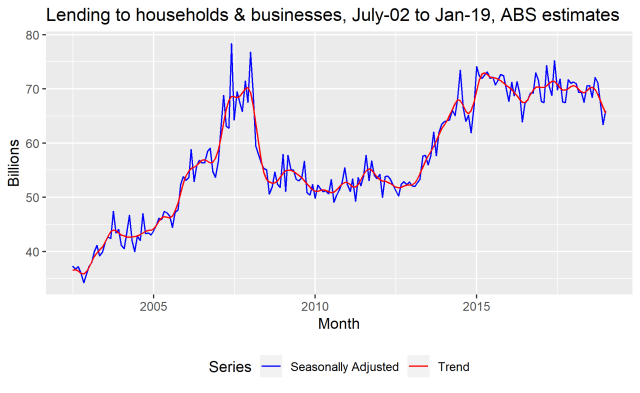
There is a lot of disappointing economic data coming out for Australia lately. Today the ABS released its January 2019 Lending to households and businesses estimates which  confirmed the credit cycle is in the downswing phase (see chart above). This is related to a range of factors, including a weaker property market and falling house prices in Sydney and Melbourne, tighter lending standards possibly related to the banking Royal Commission, and slowing economic activity nationwide, and it will likely reinforce the slowing down of the economy. As legendary US investment fund manager Howard Marks explains in his latest book Mastering the Market Cycle (on p. 137):

…the credit cycle…is both highly responsive to economic developments and highly influential. Lastly it is also extremely volatile. Thus its movements are powerful and extreme, and they greatly affect activity in many other areas. And all these things are exacerbated by the swings of psychology…

When credit was growing strongly it supported residential construction and flowed into rising house prices and capital gains which supported consumption spending. But now that wealth effect on consumption spending has reversed and residential construction activity is falling.

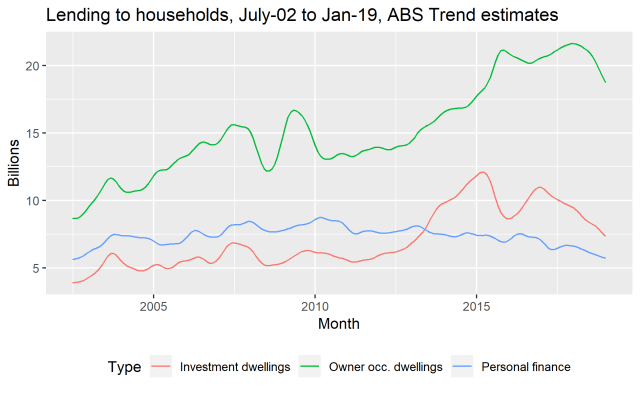
Lending to households for both owner occupied and investment properties has fallen massively (see chart below).

credit_households

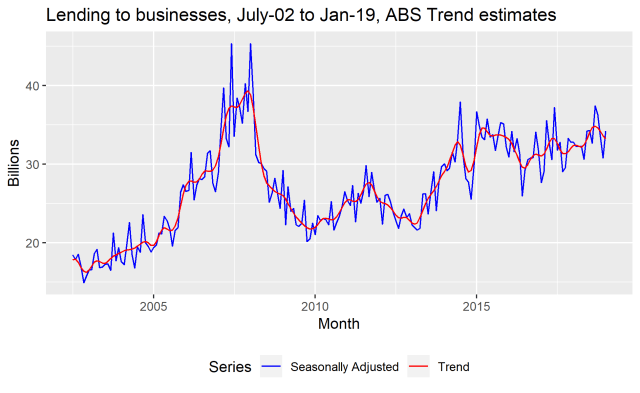
While business lending recorded strong growth of around 11% in seasonally adjusted terms in January, I don’t think that indicates any upswing in business lending as business lending is highly variable from month-to-month and the trend measure continued to decline in January (see chart below).

credit_businesses

Posted in Macroeconomy, Uncategorized | Tagged , , , , , , , , , | Leave a comment

The 7 habits of highly effective economists – Part 1: Habits 1 to 3 for private victory

I’ve recently become a huge fan of Tim Ferriss’s extraordinary podcast The Tim Ferriss Show. One of the questions Tim regularly asks his super-successful guests is:

What is the book (or books) you’ve given most as a gift, and why? Or what are the one to three books that have greatly influenced your life?

One book I have lent to people in the past, and which has certainly had a great influence on me, is Stephen R. Covey’s The 7 Habits of Highly Effective People published in 1989. It was popular among commerce and economics students when I started studying at UQ in the early nineties, and I have periodically returned to the book ever since. I thought of 7 Habits when I heard Tim ask the question noted above on one of his podcast episodes, and I started thinking about what the seven habits of highly effective economists would be.

In this post and a subsequent post, I will provide my views on what the 7 Habits mean for economists. This post covers the first three habits, the habits for what Covey calls “private victory”, and I’ll cover the remainder in a future post.
7habits

Habit 1. Be proactive

The principle behind this habit is that, to a large extent, you are master of your own destiny. You have more potential influence than you realise. Recognising this can be very useful for economists, who can often become frustrated when decision makers such as government ministers or regulators don’t follow their advice. Think for example of economists or so-called “econocrats” in the Canberra public service, who were incredibly influential in the periods of micro-economic reform in the 1980s and National Competition Policy and tax reform in the 1990s, but who have since found the era of structural reform, for lack of a better term, is over. Since then, multiple grand economic policy schemes, including the Carbon Pollution Reduction Scheme, the Resource Super Profits Tax, and, more recently, the National Energy Guarantee, have failed to secure the political support they needed.

It would be easy for economists to blame politicians, to blame them for being short-sighted and ignorant, but that would be (mostly) unfair, and it would also be unhelpful. If politicians or the community don’t accept your advice, as an economist you need to recognise that either:

  1. your facts and arguments were not strong enough and you need to do better next time, or
  2. the decision was influenced by important non-economic considerations (e.g. social or environmental) on which economists are not necessarily the right people to advise decision makers.

Once you recognise the reason why your advice was not followed, you may learn something that can help you influence decision makers in the future. Consider, for example, how many times the most famous economist of the 20th century, John Maynard Keynes, failed to convince decision makers on important economic issues. His advice not to punish Germany was rejected by Lloyd George at the Paris Peace Conference in 1919, and his advice against putting Britain back on the gold standard was rejected by Churchill, then Chancellor of the Exchequer, in 1925, with disastrous economic consequences. Keynes was right, but he failed to convince Churchill, who listened instead to the voices of conventional finance, particularly Montagu Norman of the Bank of England, who wanted Britain back on the gold standard.

After such huge failures, did Keynes give up? Of course not, he continued working and writing books and articles, for both his fellow academic economists and ordinary people, and eventually in 1936 he wrote the General Theory of Employment, Interest and Money, the book that changed everything. Keynes then won the most important debate of all, regarding how the government should manage the economy. The mixed economy we have today, with government accounting for one-third or more of GDP in advanced economies, was given intellectual justification by Keynes. He was the inspiration for what John Kenneth Galbraith called the “Mandarin Revolution” in Galbraith’s outstanding late 1970’s BBC television series The Age of Uncertainty.

For those who are averse to Keynes, you might like to think instead of Milton Friedman, who spent decades arguing for free market policies, and who saw the US federal government massively expand its influence in the sixties and seventies, before his ideas were adopted to varying degrees in the US, UK and many other economies. Of course, Friedman’s great contribution to macroeconomic policy, monetarism, was a complete failure, sending Thatcher’s Britain into deep recession in the early 1980s, although economists did learn a lot about how monetary policy actually works from the British monetarist experiment.

So, if you’re an economist and you feel you’re under-achieving, I would say that the habit of being proactive is a good place to start. Don’t wait for your employer, clients, politicians or journalists or whoever you want to influence to ask for your analysis and views. Do the work and publish it, in blogs or discussion papers, or record your thoughts in podcasts or videos. Seek out opportunities to assist people who need your help. So if you hear someone on the radio or see them on the TV, and you think they could benefit from some information or analysis you could provide, then get in touch with them and share your knowledge and wisdom.

Habit 2. Begin with the end in mind

This habit is equivalent to Simon Sinek’s instruction to Start with Why. (If you haven’t watched his amazing TED Talk yet I highly recommend it.) As an economist, you should recognise that you’re usually trying to either:

  1. write or say something useful and interesting about the economy or an aspect of the economy – e.g. whether Australia is on the brink of a recession or not, or
  2. assessing whether a project or policy measure is sensible from an economic perspective.

Generally, you’re trying to better understand economic issues and to communicate your understanding to an audience. While ongoing academic research in economics is important and essential, I believe that economists provide the most value by contributing to the public’s understanding of economic issues. As an economist you should aim to improve the community’s understanding of economic issues and to solve economic problems. To do this successfully, you will need to understand the relevant economic phenomena, project, or policy so well that you can clearly articulate your analysis and advice to any educated layperson, not just to your fellow economists. You may need to do much more research and data analysis than you expect, and you might like to discuss your findings and opinions with colleagues, to test your understanding, assumptions, and findings.

Regarding this habit, I would note that economists need to choose the tools that are best suited to the job in hand. Don’t use a theoretical or econometric model just because you think it’s elegant or clever, or because you want to show off. Use the most appropriate tool for the job. As Paul Krugman noted in his 2018 Oxford Review of Economic Policy article Good enough for government work?:

This paper argues that when the financial crisis came policy-makers relied on some version of the Hicksian sticky-price IS-LM as their default model; these models were ‘good enough for government work’. While there have been many incremental changes suggested to the DSGE model, there has been no single ‘big new idea’ because the even simpler IS-LM type models were what worked well. In particular, the policy responses based on IS-LM were appropriate.

The financial crisis was a huge blow to those technically brilliant economists who had spent many hours learning and building theoretically elegant but practically useless Dynamic Stochastic General Equilibrium (DSGE) models. I made a similar point in the discussion time after LSE Professor Mary Morgan’s public lecture on economic modelling at UQ in 2016. Similar to other professionals, economists need to focus on solving the problem in hand, as directly and efficiently as possible.

Habit 3. Put first things first

Some readers have probably been introduced to this habit in time management courses that have taught the time management matrix introduced in 7 Habits. You are implored to devote time to the non-urgent, important work that can really advance your career. You are to avoid any unimportant work.

In recent years, Georgetown computer science professor Cal Newport has shown us how to carve out big chunks of time to undertake the non-urgent, important work, such as research on important issues, writing a book, composing a symphony, or doing whatever is important to you. Newport talks about the importance of Deep Work and gives you tactics for doing it (e.g. avoiding the internet as much as possible, ignoring most emails which are usually inconsequential, or more radically giving up Facebook and other social media completely).

For economists, deep work involves such things as writing reports, articles and books, and doing the data analysis and thinking that support these outputs. Economics is a challenging discipline, and you need large amounts of uninterrupted time to do the work. That’s why I generally avoid meetings unless they are absolutely necessary for projects I’m working on, and I’ve tried to create as comfortable an office for myself as possible, so I’m happy to spend lots of time in it working on projects, articles and speeches (e.g. see photos below). If I didn’t have a quiet place where I can work without interruptions like my office, I doubt I ever would have finished my book Beautiful One Day, Broke the Next. Writing that book was a good example of how difficult it can be to complete big projects involving deep work. I originally thought I’d finish it in 3-4 months but it ended up taking me nearly two years, including lots of after-hours time in the office.

IMG_1431

A bit of greenery and natural light are essential in an office

The habit to put first things first also involves, according to Covey, such things as:

…building relationships, writing a personal mission statement, long-range planning, exercising, preventive maintenance, preparation—all those things we know we need to do, but somehow seldom get around to doing, because they aren’t urgent.

An example of how I’ve put this habit into practice in recent years is my development of a set of scripts, written in the freeware programming language R, to automate a lot of my data analysis. This has saved me many hours and avoided lots of frustration with notoriously unreliable and unstable Excel workbooks, as discussed in my recent post:

How you can automate ABS data analysis and charting using R – preview of my upcoming course

I’ve now discussed the first three of the seven habits. The remaining habits, which I’ll discuss in a future post are:

  1. Think win/win
  2. Seek first to understand, then to be understood
  3. Synergise
  4. Sharpen the saw

Office

A comfortable chair is a good place for long phone conversations, reading papers, and planning presentations and reports.

Posted in Uncategorized | Tagged , , , , , , , , , , , , , , , , , , | Leave a comment