Qld health reforms much needed – some regional health services look very costly

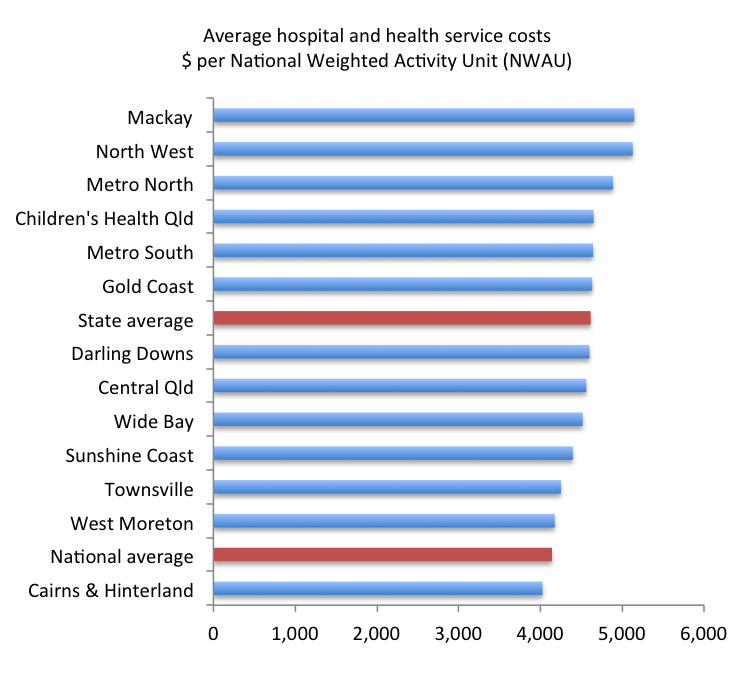
The Blueprint for Better Healthcare in Queensland contains some very interesting data toward the back that show we have substantial disparities in the average costs of delivery across the Queensland health system. Mackay and North West health services look particularly costly. To some extent, this may be explained by their regional nature and demographics of patients, but then why do Townsville and Cairns perform so well? These data require further analysis (i.e. to what extent are differences due to differences in services offered?), but for now here they are in a chart I’ve prepared:

healthchart

Posted in Health | Tagged , , , , , , , , | Leave a comment

SEQ’s extensive but costly public transport system requires thorough review

I’m pleased the State Government is reviewing public transport fares, as reported earlier today in Quest Newspapers:

The State Government has made a commitment to address public transport fares in order to establish a new fare structure for southeast Queensland.

Transport and Main Roads Minister Scott Emerson said the six-month action plan would help deliver “better cost of living for Queensland families and passengers.”

He said a new fare structure would be introduced.

The news comes after a Rail Back on Track petition closed last month.

More than 1,100 commuters signed the petition to lower public transport costs.

Unfortunately, lower fares aren’t feasible, as the public transport system is already heavily subsidised. I blogged last year about the wicked policy problem presented by SEQ’s extensive but costly public transport system (see Increased train frequency unviable), and I continue to believe we need a thorough review of our public transport system and its relationship with our road network. I’m unclear whether the proposed fare review will really analyse the issues to the depth required.

Ultimately we need to charge much more for the high-cost long-distance rail services, such as those between Brisbane and the Sunshine and Gold Coasts. We also need to encourage much higher population densities in areas well served by public transport (e.g. Indooroopilly, Toowong, Milton, West End, Fortitude Valley, New Farm) to limit the need to extend public transport to outer metro areas at high cost.

Posted in Brisbane, Gold Coast, Transport | Tagged , , , , , , , | Leave a comment

West End Aldi could be frontline in battle for retail trading hours deregulation

The push for trading hours deregulation will receive extra impetus from Aldi, which hopes to set up a 24/7 store at West End in Brisbane (see the Brisbane Times report from the other day, Aldi looks to expand into West End). Given current trading hours regulations, this will not be allowable, so Aldi will no doubt be supporting the push for deregulation that is likely to grow out of the Burden of Regulation Review. This review is currently being undertaken by the Queensland Government’s Office of Best Practice Regulation (OBPR), which is expected to publish its final report by the end of this month. The final report will no doubt reaffirm the OBPR’s view in its interim report that there should be a fast-tracked review of trading hours regulations. For links to OBPR’s interim report and some of my numerous posts arguing for trading hours deregulation, see my post from last November:

OBPR recommends fast-tracked review of trading hours restrictions

Posted in Retail trade | Tagged , , , , , , , , , | Leave a comment

RBA confirms QRC analysis – resources sector spends mega bucks domestically

The RBA has released an excellent though technically demanding research paper on Industry Dimensions of the Resources Boom, which has received coverage in today’s Australian (Mining spreads work to 500,000). The RBA analysis confirms the analysis conducted by Reuben Lawrence for the Queensland Resources Council showing the resources sector is a major purchaser of goods and services from other sectors, which I referred to in my post on the billion dollar jobs package last Sunday.  The RBA analysis is hence further evidence that the Commonwealth Government’s assumption that Australian businesses are missing out on work from the resources boom is incorrect.

That said, I suspect the RBA’s estimated flow-on impact of the resources boom to other industries is slightly over-estimated. We know that a large share of the capital goods being invested in the sector are imported from overseas. Indeed, this is a large part of the story behind why Queensland’s investment and state final demand numbers have looked so good in the recent past, but our overall economy and labour market have been sluggish.

Unfortunately, there doesn’t appear to be any data to pin down the import share of resources sector capital investment, so the RBA was forced to assume one-half was imported, which it argues in consistent with business liaison the Bank has conducted (see p. 21 of the paper). The RBA may well have made a fair assumption, but given it appears a very important assumption and one based on limited data, I would like to have seen the RBA test the sensitivity of their results to variations in this assumption – i.e. what if the import content was 75% or higher?

Posted in Mining | Tagged , , , , , , , , | Leave a comment

Price sensitivity of demand for fine dining in Brisbane CBD – ARIA case study

Matt Moran’s ARIA Restaurant at Brisbane’s Eagle St Pier is proving that you can sometimes increase revenue by cutting your prices – that is, if demand increases proportionately more than the price proportionately falls.

ARIA is simply outstanding. It’s one of the few restaurants I’ve felt like clapping after a meal, and upon entering the restaurant for lunch today I was very happy to learn about the lunchtime special, which for two courses meant a fall in price from around $55 to $40, a 27% price reduction. From a quick scan of the restaurant I concluded that there were twice as many people dining than during a typical lunchtime in the early part of the year – i.e. a 100% increase in customers. So ARIA’s strategy has potentially increased its lunchtime revenue by around 45%, assuming I’ve done the math correctly after a long day.

Technically speaking, ARIA was able to do this because the demand for fine dining is highly price sensitive. It’s a luxury that people can go without, but, if the price is right, they just might try it. On my calculations above, demand for fine dining in Brisbane CBD has a high price elasticity of demand, of around 3.7 in absolute terms.

My lunch companion was a bit skeptical about my cavalier econometric estimates and argued that I needed more than one data point to draw such a conclusion, so I guess I’ll have to head back to ARIA again soon. Next time I’ll try the salmon for the main.

Posted in Retail trade | Tagged , , , , , | 7 Comments

HIA still worried about Qld housing industry

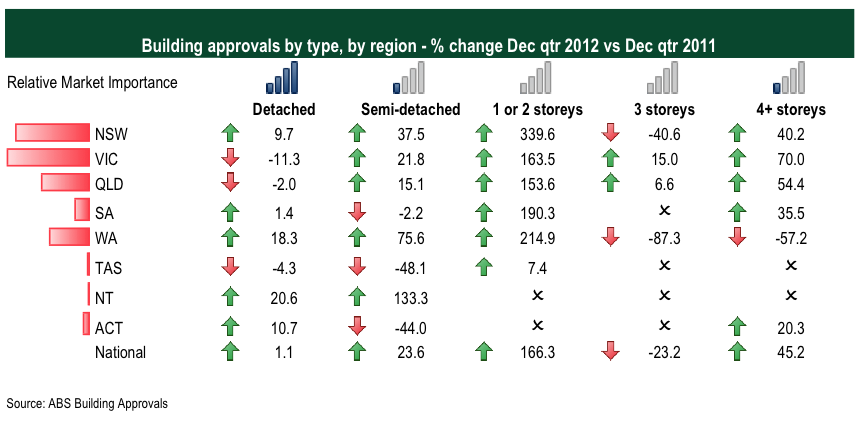
Building approvals are a reasonably good leading indicator of economic activity across the economy because the construction industry employs nearly 10% of the workforce (see this OESR table) and it buys a lot of products from other parts of the economy (e.g. timber, tiles). Hence it’s understandable the monthly building approvals data receive a lot of attention and I welcome the nice new note Residential building approvals – still a mixed bag that the HIA released yesterday. It contains a useful analysis of Queensland trends, identifying that, while Queensland is recovering in terms of approvals of apartment blocks and towers, it is doing poorly in the more important detached housing segment, as nicely illustrated in the HIA’s chart below.

HIAchart

The HIA concludes that Queensland and Victoria are detracting from the national outlook:

In conclusion, the evidence presented by approval data indicates that activity strengthened somewhat in the final quarter of 2012. This improvement has not been broadly based however, with contractions still being recorded in the vital detached house sectors of Queensland and Victoria. Encouragingly, detached house approvals in New South Wales showed brisk growth (from a recessionary base) and relatively strong figures were also recorded nationwide in the semi-detached and multi-unit sectors.

The next set of building approvals data will be released by the ABS on 4 March.

Posted in Housing | Tagged , , , , , , , | Leave a comment

Billion dollar Jobs Plan assumes local businesses aren’t getting fair share of work from big projects

The Commonwealth Government’s $1 billion Jobs Plan announced today (see media release) appears to be based on an assumption that Australian businesses aren’t getting a fair share of work out of major projects. I find this odd considering the massive amount of money the resources sector spends on goods and services across Queensland, for example, as documented in the Queensland Resources Council (QRC) publication Economic Impact of the Resources Sector on the Queensland Economy. (While I have previously criticised the economic multiplier figures presented by the QRC, I don’t dispute the direct spending estimates.) The publication notes:

Expenditure data provided by QRC full-member companies indicated that the resources sector contributed an estimated $36.0 billion in direct spending to the Queensland economy in 2011/12, comprised of….

…$27.9 billion in voluntary community contributions and purchases of goods and services from local businesses
(including contractors).

Australian businesses seem reasonably savvy in seizing opportunities to work in the resources sector and hence I don’t think the Government’s proposed new Australian Industry Participation Arrangements for big projects ($500M+) are justifiable.

Even if Australian businesses aren’t getting their fair share of work, which I doubt, it is dubious economic policy to prod companies into locally purchasing goods and services that could be purchased more cheaply from overseas. That would run counter to enhancing productivity and realising the benefits of free trade.

Posted in Industry policy | Tagged , , , , , , | 1 Comment

Government should resist subsidising Disney Nemo film – no long-term benefit to Qld

The Queensland Government should refuse to contribute money to attract the filming of Disney’s 20,000 Leagues Under the Sea to the Gold Coast (see the news report Angelina Jolie and Brad Pitt could film a movie in Australia). The previous attempt to establish Hollywood on the Gold Coast failed, and it won’t work again, especially given the Australian dollar is so much higher. The Government would be subsidising Disney’s production to create temporary jobs that will finish when the production packs up. There appears little justification for Governments to spend millions of dollars to create temporary employment opportunities in the film industry for people who probably already have jobs in other industries. The film industry requires special skills and experience and I don’t expect any hard-core unemployed people would get a job on the film. The jobs would instead go to people taking a break from, for example, their job in a cafe or their personal training business.

Posted in Arts, Gold Coast | Tagged , , , , , | 14 Comments

Where do Queensland’s super rich live?

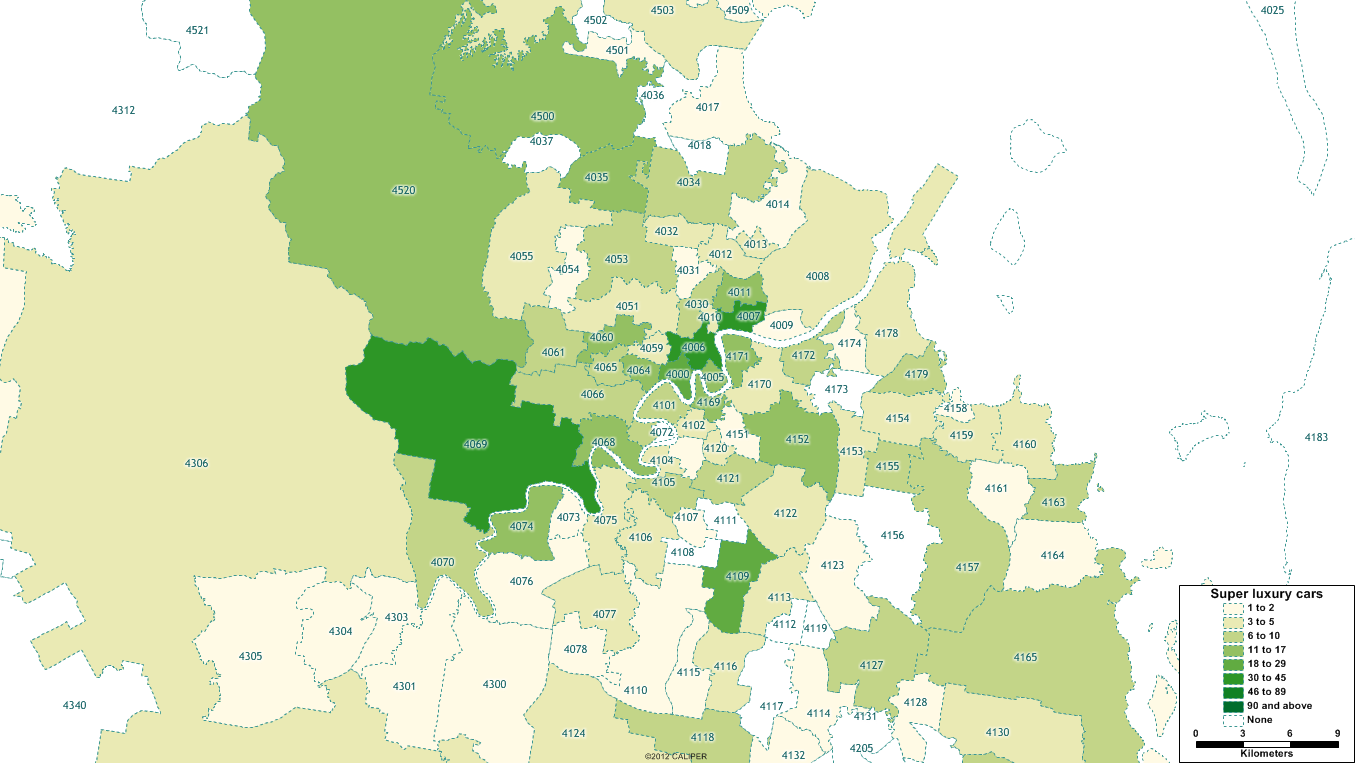
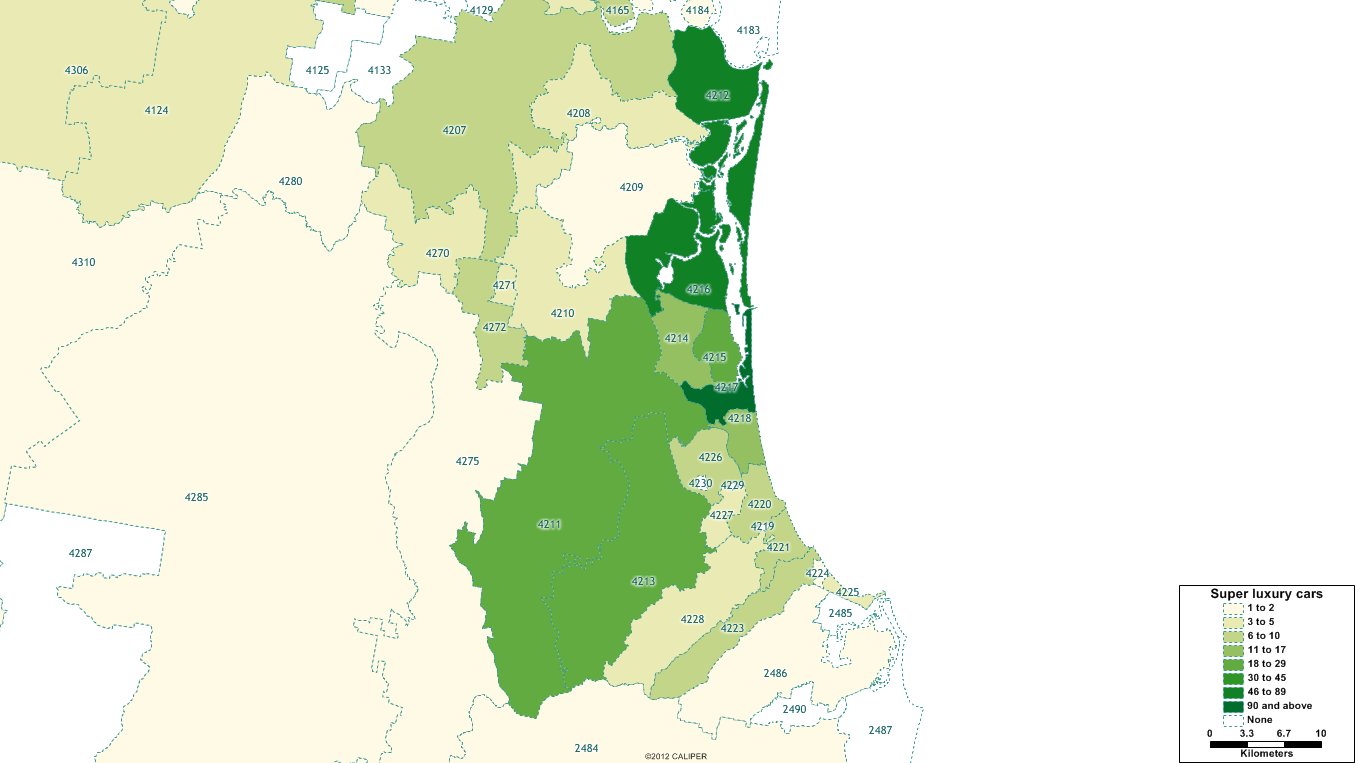
Queensland’s super rich are most prevalent in the Ascot-Hamilton and Kenmore-Brookfield areas in Brisbane and up and down the Gold Coast, if registration data by postcode for super luxury cars – Rolls Royce, Bentley, Ferrari and Lamborghini – are a reliable indicator (see maps below and my post from Sunday for details of the newly released car registration data). Not many super rich appear to live on the Sunshine Coast on in Cairns and Townsville, or if they do they don’t tend to flaunt their wealth (see maps below the fold). There is a lot of detail on the maps and, if you’d like a close look at them, please open them in another window so they fill the whole screen. On the maps, the darker the green shading, the more super luxury cars are in that postcode.
Here’s the Brisbane map:Brisbanes_super_luxury_carsGold Coast:GoldCoast_super_luxury_cars Continue reading

Posted in Brisbane, Cairns, Gold Coast, Townsville, Transport | Tagged , , , , , , , , , , , , | 2 Comments

Potentially large economic and environmental benefits from improving pedestrian safety

I’m pleased to see the Queensland Government will install flashing lights at schools with a view to improving pedestrian safety, as reported by the Sunshine Coast Daily earlier today:

WALKING to and from school will be safer for children and parents as the Newman Government announced the next 33 schools to benefit from flashing traffic lights.

It is possible there will be significant benefits to the community from a reduction in injuries caused by cars to school children or their parents. Also there will be additional economic and environmental benefits. This is because the safer we can make walking to school the more likely it is that children will walk to school, reducing kilometres travelled in cars.

A Department of Infrastructure and Transport Discussion Paper on Active Travel released toward the end of last year notes there is strong evidence to suggest there are substantial economic (e.g. avoided health costs, avoided road infrastructure costs) and environmental benefits (e.g. reduced greenhouse gas emissions) from reducing kilometres travelled in cars and shifting people to walking, riding or catching public transport instead. The Discussion paper summarises the significant economic benefits per kilometre travelled by active means (walking or cycling) as follows (p. 13):

Economic analysis suggests that the benefits of a typical walking or riding infrastructure project include decongestion (20.7 cents per kilometre), health (up to 168 cents per kilometre), vehicle operating costs (35.0 cents per kilometre), infrastructure savings (6.8 cents per kilometre) and environment (5.9 cents per kilometre).

Given these potential benefits, which are very large when one considers the potential reduction in vehicle kilometres travelled by greater walking or cycling, it may be sensible to consider wider investments in pedestrian (and cyclist) safety, as well as improving walking and cycling routes to make walking and cycling less of a hassle.

There are lots of places in Queensland cities, particularly in Brisbane’s inner western suburbs, that could be made much safer for pedestrians through greater use of traffic calming devices and building proper-sized roundabouts – ideally, roundabouts should deflect the path of vehicles enough to significantly slow them down. For any readers in Brisbane City Council, I’m thinking in particular about the roundabout at the intersection of Patrick Lane and Dixon Street at Toowong. It is very dangerous for pedestrians to cross near here, and I wonder if this discourages some residents of Land St and Sylvan Rd apartment towers from walking to and from Auchenflower train station?

Posted in Brisbane, Transport | Tagged , , , , , , , , , , , , , | Leave a comment