GFC-induced frugality hasn’t stopped drift to private schools

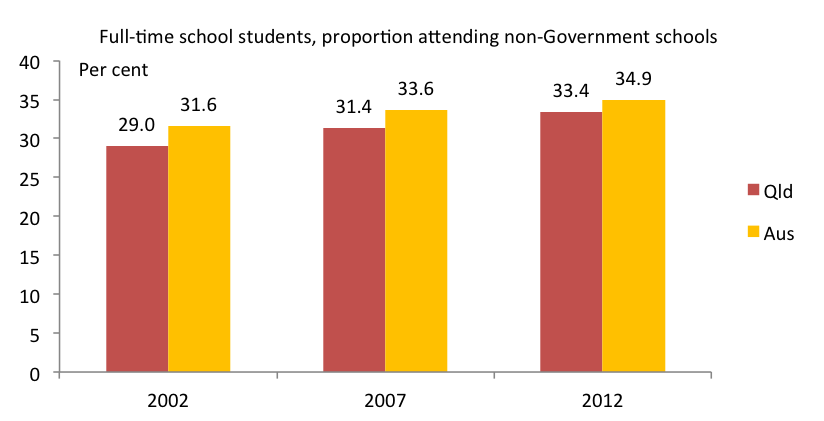
In the wake of the financial crisis, Australians started saving more (see my post Retail trade restrained by stubbornly high saving rate), but it appears they are still willing to spend money on a private school education for their children. Here’s a chart based on today’s new ABS schools data:

School chart

The ABS media release notes:

Since 2002, Queensland has grown the fastest with an increase of 39.1 per cent in the number of students attending Non-government schools.

As per capita income continues to rise, I expect the trend toward private schooling will continue as, rightly or wrongly, there is a perception private schools offer a superior and safer school environment.

Posted in Education | Tagged , , , , | 2 Comments

Pause in recovery in new motor vehicle sales in Qld

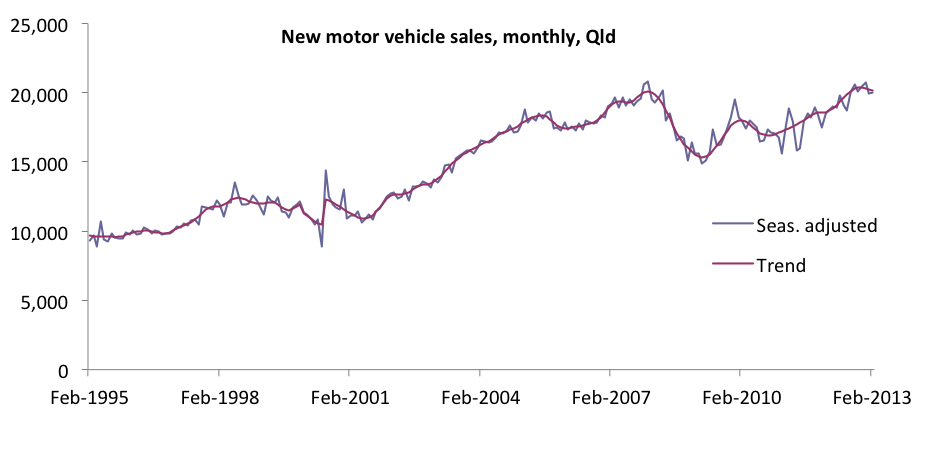
While Queensland had decent growth of 6.9% through-the-year to February 2013 in new motor vehicle sales, we actually had the lowest growth rate across all States and Territories in new sales (see today’s new ABS data). Eyeballing the data, I’m concerned the recovery in new motor vehicle sales since the financial crisis may have paused.mvsales

Posted in Retail trade, Transport | Tagged , , , | Leave a comment

RBA says SEQ builders see signs of improvement in sector

Christopher Kent of the RBA has given an informative speech on Recent Developments in the Housing Market, in which he noted there are signs of improvement in the SEQ building industry:

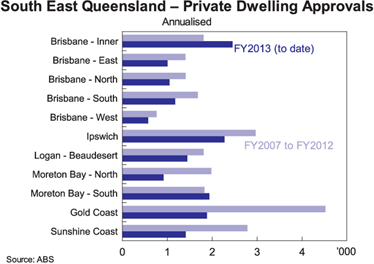
Approvals in Queensland have been subdued, particularly on the Gold Coast and in the south-east of the state more generally; however, even builders in that region have indicated to us that there are tentative signs of some improvement in demand more recently.

Mr Kent observes that approvals in detached houses have been very low and it’s only the apartments data that are encouraging. This explains why approvals in inner Brisbane are noteworthy relative to other SEQ regions, as shown in this chart I’ve pinched from the speech:

sp-ag-140313-graph8-4-small

Based on the promotions for new developments around town, the amount of apartment stock coming in the next few years in inner Brisbane is staggering, and it looks like it will be a good time to get into the market.

Regarding approvals data in North and Far North Queensland, Pete Faulkner’s post from earlier this week is informative:

Local Building Approvals less than inspiring

On today’s new ABS labour force data (see Queensland Treasury’s labour force brief), I’m unsurprised Queensland’s seasonally adjusted unemployment rate increased, because I always doubted the large fall last month and suspected it was noise in the data (Very surprising employment numbers for Qld – ABS needs to investigate volatility). I expect labour market conditions will remain tight for a few months more at least.

Posted in Housing, Labour market | Tagged , , , , , , , , , , | Leave a comment

High Australian dollar has wide-ranging impacts – e.g. on CSR & local production of foreign films

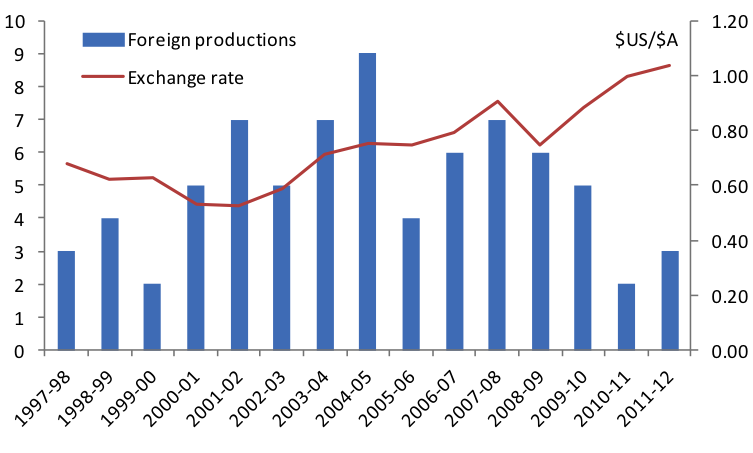
The high Australian dollar has been linked to job losses at CSR, according to an AAP report (CSR blames cuts and plant closure on currency). There is no doubt the high Australian dollar is having profound impacts on a number of sectors. Another example is the Australian film industry, which I’ve been researching recently for a paper I’m writing. After recently reading an excellent 2012 Drum piece by Greg Jericho (Wolverine and a blockbuster case of tax secrecy), I decided to investigate the relationship between the value of the Australian dollar and the number of foreign films (i.e. films under foreign creative control) made locally. Clearly foreign productions such as Scooby-Doo and House of Wax were attracted by our low dollar in the early 2000s and in recent years we have been a less attractive location, as shown in this chart based on Screen Australia data:

foreign

Posted in Arts, Macroeconomy | Tagged , , , , , | Leave a comment

4WD mums causing car-bike war theory sounds wacky, but motorists’ attitudes to cyclists do matter

It has been observed internationally that cyclists are safer in communities where more people ride bikes (e.g. Copenhagen), because motorists are used to seeing to cyclists and treat them as legitimate road users. So the attitudes of our motorists toward cyclists do have a real impact on the safety of our cyclists. Hence I wouldn’t be so quick to criticise the views expressed at a Gold Coast conference regarding the long-term impact on road safety of driving children to school in SUVs, as reported on www.news.com.au today:

A WORLD expert on transport has blamed four-wheel-drive mums for the war between cyclists and Gold Coast motorists.

Werner Broeg said if more parents allowed their children to ride bikes to school, instead of ferrying them around in cars, they would grow up to become drivers with a greater respect for cyclists, the Gold Coast Bulletin reports.

Mr Broeg, the keynote speaker at the Asia Pacific Cycle Congress being held at the Gold Coast Convention and Exhibition Centre, said only 2 per cent of Australians rode a bike daily.

He also said fewer women rode bikes, with too many opting for large 4WDs to do the school run, which contributed to congestion outside of peak-hour times.

“When you see women driving their SUVs during the school pick-up, it is little wonder they don’t want their children out on the road because they want to protect them from the type of driver they are.”

Of course, you can hardly blame mums and dads for wanting to see their children get to school safely. While, from the perspective of population health, it makes sense to get children riding or walking to school (because of the synergistic benefits of having more people out riding and improving the attitude of motorists), given current traffic conditions many children are much safer getting driven to school than they would be walking or riding. It is essential that we improve the quality and connectedness of bike paths so that riding to school is a genuine and safe alternative to being driven.

Posted in Transport | Tagged , , , | 2 Comments

ABARES forecasts large increases in seafood prices over coming decades

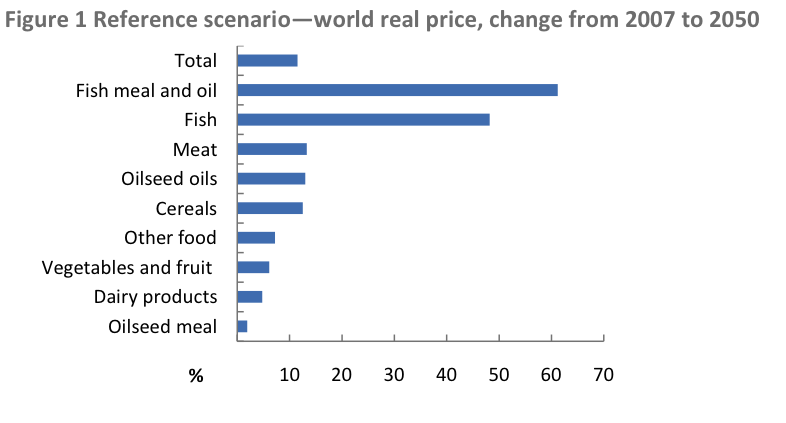
The traditional seafood feast at Christmas will become much more expensive in future decades as limitations on our seafood stocks mean that rising demand significantly increases prices. This forecast is contained in ABARES’s new publication Global food production and prices to 2050, which was released at the 2013 Outlook conference in Canberra earlier this week. Check out this interesting chart (p. 7 of the report):

ABARESchartFull credit to ABARES for the ongoing quality of their data collections and analysis, as well as for the hosting of such an interesting and well-organised conference earlier this week.


Posted in Agriculture, Uncategorized | Tagged , , , , , , | Leave a comment

Qld Treasury GRP figures show Far North really struggled post-financial crisis

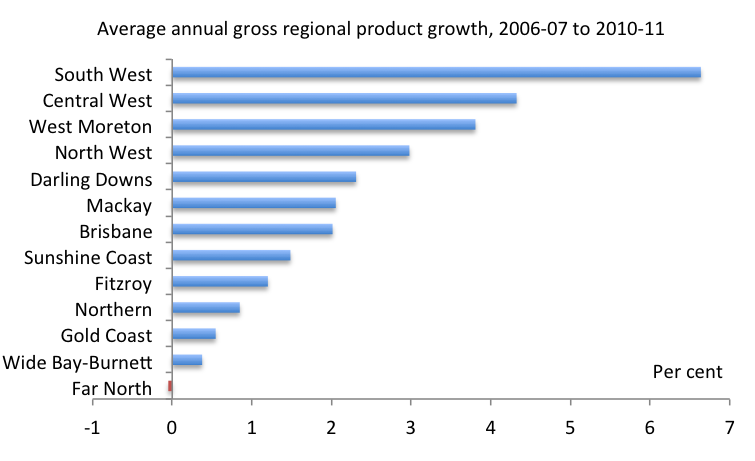
Queensland Treasury released its latest gross regional product (GRP) estimates yesterday, and they confirm that Far North Queensland really struggled in the post-financial crisis period, with the Far North’s GRP (in real terms) actually marginally contracting between 2006-07 and 2010-11 (see the chart below based on Table 2 in the publication).

GRPgrowthIn other news, today’s ABS National Accounts data confirmed what we already knew from labour force data, that the December quarter was very weak for Queensland (see Treasury’s information brief).

Posted in Cairns, Macroeconomy | Tagged , , , , , | Leave a comment

Coal Seam Guar – the most important agricultural product you may never have heard of

I’m currently in Canberra attending the ABARES 2013 Outlook Conference and I must say I’m very impressed by the organisation of the conference and the program. The highlight of the first day for me was the presentation by Tony Matchett of the Australian Guar Company on “Guar – a new industry for Australia’s arid North.” Guar apparently is an important ingredient in the fracking gel used in coal seam gas mining. Tony cited some incredible figures on the amount of guar Australia imported in 2012 – 6.5M kg compared with just over 5M kg in the seven years 2005-11, which goes to show just how massively the CSG industry has grown over the last year. Tony is trying to establish a domestic guar industry, with some help from some savvy agribusiness gents from Texas, and let’s hope he’s able to do so (with minimal assistance from the Government, of course). This is potentially a big deal for Central, North and Far North Queensland, which provide the best conditions for commercially growing guar in Australia. Good luck, Tony!

Posted in Mining | Tagged , , , | Leave a comment

Govt should embrace Costello Commission of Audit privatisation recommendations

Unsurprisingly, the Peter Costello-led Queensland Commission of Audit has recommended privatisation of a large number of Queensland Government assets, as reported in the Courier-Mail this morning:

SELL assets or spend the next half a century paying off debt.

That is the stark choice presented to the Newman Government by the final Commission of Audit report into the state’s finances.

The Courier-Mail can reveal the report by former federal treasurer Peter Costello, delivered yesterday, has recommended the state undertake a massive sale of assets to pay off burgeoning debt.

The report found there was no scope to increase taxes or cut expenditure, while the sale of electricity assets, including Energex and Ergon, would raise the $25 billion to $30 billion necessary to reclaim Queensland’s AAA credit rating.

The state should also consider selling some of its other seven government-owned corporations, which include Queensland Investment Corporation, and SunWater.

As the report makes clear, if it wants to restore our AAA credit rating in the next few years, the Government really doesn’t have much of an alternative to asset sales and should embrace the Commission’s recommendations. Without asset sales, it would take a long time to get back our AAA rating, as discussed in my previous post:

When will Queensland get its AAA credit rating back?

While some commentators will criticise the Government for selling income generating assets, they fail to see the short-term benefits in helping to regain our AAA credit rating (lowering our borrowing costs) and the fact many of these businesses would be much better run by the private sector (improving productivity). I hope the Government releases the report as soon as possible in the interests of a fully informed public debate.

My previous posts on privatisation of Queensland Government assets include:

Why is QIC government owned anyway?

Queensland Rail Privatisation Debate

Posted in Budget, Queensland Government, Queensland Rail | Tagged , , , , , , | Leave a comment

Did Qld’s sluggish economy force NZers and Brits back home?

The controversy over the ABS’s odd comments on female representation in leadership positions (Women don’t have what it takes to lead, finds ABS) led me to examine its latest Social Trends report, which contains this interesting set of facts on international migration:

…Queensland and Western Australia had the highest permanent departures relative to the number of people in those states, with 95 and 94 per 100,000 of their respective populations permanently departing in 2010. Tasmania (30 per 100,000) and South Australia and the Northern Territory (both 49 per 100,000) had the lowest number of permanent departures relative to their respective population sizes.

In 2004, the ACT had the highest rate of permanent departures for its population size, with 91 per 100,000 leaving permanently for overseas, closely followed by Western Australia (87 per 100,000).

The data showing Queensland has the highest rate of permanent departures are for 2010, and in the other year of data reported, 2004, Queensland wasn’t near the top, suggesting recent conditions must have played a role in Queensland’s elevation to the top. I notice that NZ and the UK are the largest destination countries for permanent departures, and I know that Queensland is home to large numbers of people from NZ and the UK.

I wonder if Queensland’s sluggish economic performance in recent years has forced many people from the NZ and UK to reconsider life in Queensland and to return to their home countries? Economic conditions are an important driver of migration, and they have certainly also negatively impacted on interstate migration to Queensland in recent years. The odd thing is, that economic conditions would hardly have been better in the UK and NZ, but many people may have come to Queensland for greater economic opportunities, and if they’re not available, then returning home would look much more attractive.

Posted in Migration | Tagged , , , , , , , , , | 1 Comment