Top power regulator skeptical about “gold plating” allegation

I attended an excellent function on electricity distribution pricing at Customs House, Brisbane last night which was organised by the UQ Energy Initiative. Panelists included John Pierce, Chair of the Australian Energy Market Commission (AEMC), Tony Bellas, who recently chaired the Queensland inquiry into network costs, and Tony Wood of the Grattan Institute. One of the issues discussed was “gold plating” of the network, i.e. over-investment in the network by electricity businesses, which Prime Minister Gillard identified last year as a major driver of electricity price rises.

AEMC Chair John Pierce appeared highly skeptical about the gold plating argument, noting that, from his experience sitting at the Cabinet table as NSW Treasury Secretary, Governments are keenly aware that capital invested in the electricity network is capital that can’t be invested in roads, hospitals or schools. Based on his comments last night, and this interview from last year (High power rates: it’s a poles and wires story), Pierce appears to believe that the real issue is the very generous rate of return allowed electricity businesses such as Energex and Ergon relative to the risks involved.

My previous posts on the electricity network include:

Maybe the electricity network hasn’t been gold plated

Recent studies show potentially large savings in power bills
Posted in Energy, Uncategorized | Tagged , , , , , , , , , | Leave a comment

Major projects construction activity still strong, but appears to be peaking

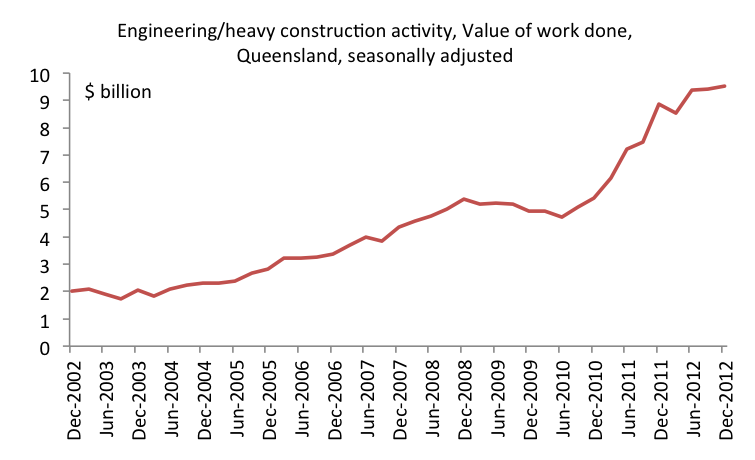
RBA Governor Glenn Stevens, who incidentally was re-appointed for another three years today, has recently observed that the mining construction boom would peak in the near future. The latest ABS data on engineering construction activity appear to confirm this view, with activity looking like it’s set to peak this year. Here’s the key chart for Queensland:

engcons

Posted in Mining | Tagged , , , , , , , , | Leave a comment

Is it worth paying $10K each for temporary film industry jobs?

So Captain Nemo is coming to Australia, possibly to the Gold Coast, and the Australian Government will provide a $21 million subsidy, as reported earlier today in the Gold Coast Bulletin (Govt commits $21m for sci-fi film):

THE Federal Government has earmarked $21.6 million for the science-fiction classic 20,000 Leagues Under the Sea to be remade in Australia.

Prime Minister Julia Gillard and Arts Minister Tony Burke said the one-off payment to producers Walt Disney Studios would support investment in the local industry and could create up to 2000 jobs.

“The securing of this film is a huge coup for the Australian film industry and for the near 1000 local businesses that will be providing goods and services for the film,” Ms Gillard and Mr Burke said in a joint statement today.

Paying over $10,000 each for temporary jobs on a film production doesn’t seem like a good use of public funds to me when there are so many better uses. Indeed, we’d probably be better off spending $10,000 on a training course for a long-term unemployed person. And if we’re going to subsidise the film industry, we should at least spend the money on films that actually contribute to Australian culture. The value of Captain Nemo to Australian culture is zero. I’ve previously criticised film industry subsidies here:

Government should resist subsidising Disney Nemo film – no long-term benefit to Qld

Posted in Industry policy | Tagged , , , , , | 2 Comments

How were job losses shared across Qld Government agencies?

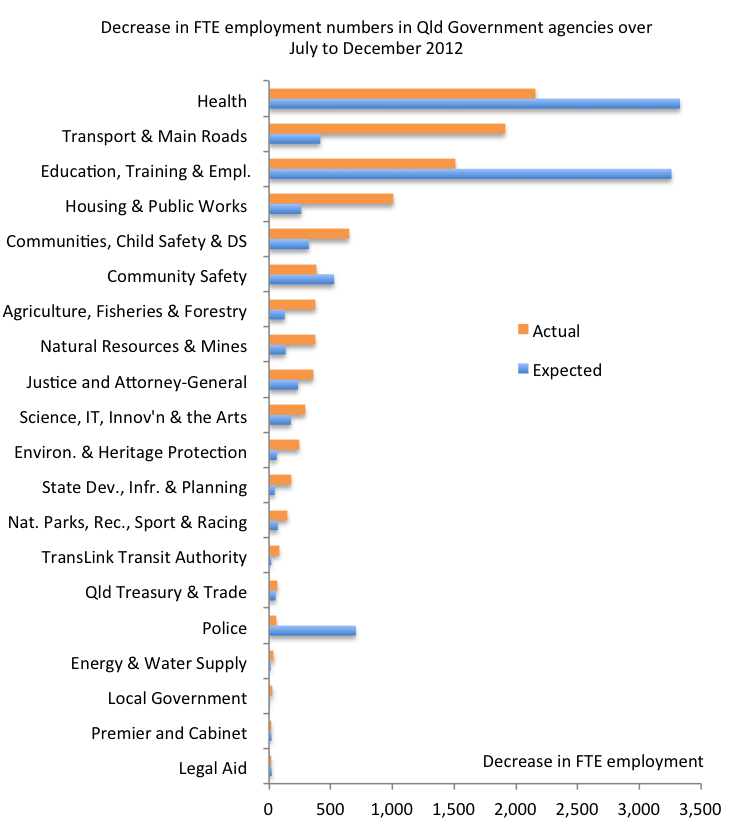
An article in the Financial Review this morning (Government jobs growth masks softer employment market) prompted me to examine the Queensland public service data more closely. Given the significant Queensland public service (QPS) job cuts over the last nine months, I doubt Queensland is contributing to the growth in public administration, education and health jobs observed across the country as a whole. That said, fewer QPS jobs were lost in health and education than might have been expected, if total job losses between 30 June and 31 December 2012, some 9,900 full-time equivalent (FTE) jobs, were pro-rated across agencies according to their employment levels (see chart below covering top 20 agencies by job losses). The difference between actual and “expected” job losses for health and education is no doubt due to the desire to protect front-line jobs. This would also explain the protection of jobs in the Police Service.

FTEs

Transport and Main Roads, by contrast, experienced many more job losses than would have been expected based on their size. I expect this was due to lingering inefficiencies that existed in the organisation following the merger of Transport and Main Roads into the one agency a few years ago.

Posted in Education, Health, Queensland Government | Tagged , , , , , , , , , , | 2 Comments

Public sector hiring freeze continues

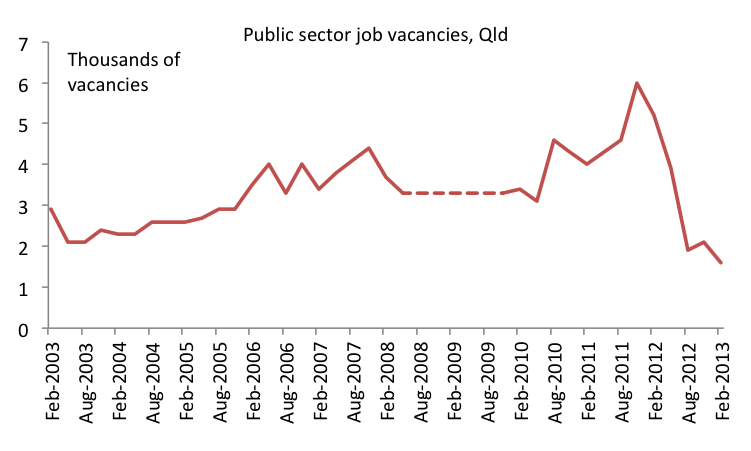
Job vacancies data released by the ABS yesterday point to continuing weakness in the labour market, with job vacancies of 26,000 in February 2013 compared with 36,100 in February 2012. Around one-third of the decline in job vacancies through the year was attributable to the public sector, with public sector vacancies plunging after the 2012 Queensland election, as shown in the chart below (N.B. dotted line is an interpolation for those quarters in which the ABS temporarily ceased collecting vacancies data).

vacancies

Posted in Labour market | Tagged , , , , | Leave a comment

Tourism had reasonable December quarter, but room for improvement

The ABS released its December quarter 2012 Tourist Accommodation data today and they confirmed tourism has recovered significantly since the financial crisis but not to previous highs (see charts below).

Decqtrs


Comparison

Posted in Tourism | Tagged , , , , | Leave a comment

Deputy Premier the most hospitable Minister

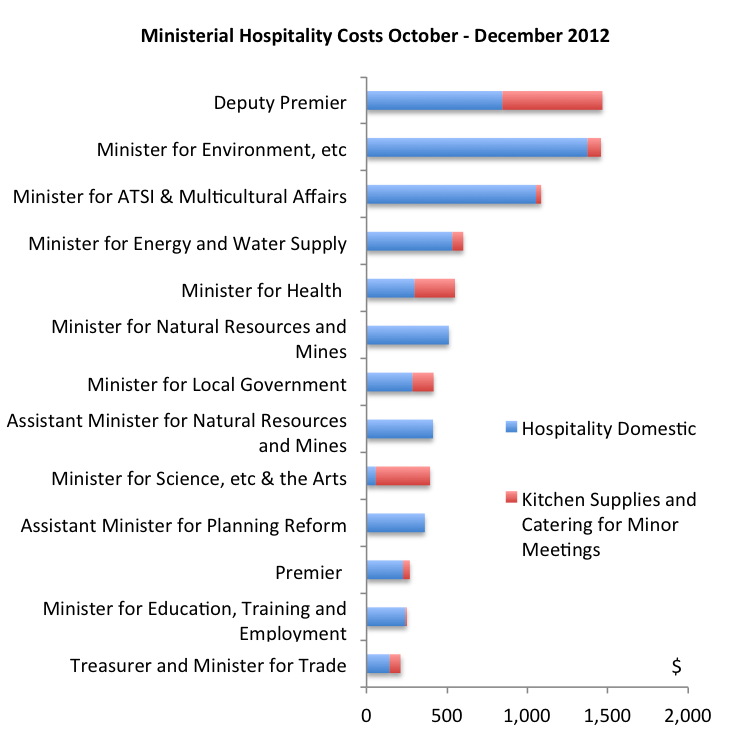
It’s well known that Deputy Premier Jeff Seeney is a major force in the current Queensland Government, and he’s obviously taking on a big share of stakeholder management, based on Ministerial hospitality costs data released today (see chart below). The Premier and Treasurer, however, appear to be leading the austerity drive by example, so don’t expect any cream biscuits if you’re lucky enough to get a meeting with either of them.

hospitality

The other 10 Ministers spent less than $200 each over October to December 2012.

Posted in Queensland Government | Tagged , , , , , , | 1 Comment

Buy locally campaign unnecessary, but harmless

Buy locally

It seems obvious to me that buying from local businesses is good for the local economy and I suspect it’s obvious to most Queenslanders, too, but for some reason we need a Government information campaign to tell us this (Think Queensland, Buy locally). At least it’s just a promotional campaign and doesn’t distort the market in favour of local suppliers or impose a burden on businesses. Hence it’s nowhere near as bad as the Federal Government’s campaign to encourage local purchases, as discussed in my previous post:

Billion dollar Jobs Plan assumes local businesses aren’t getting fair share of work from big projects

I hope the Queensland Government didn’t pay an advertising firm too much to design this unnecessary campaign.

Posted in Industry policy | Tagged , , | Leave a comment

New Ipswich Coles shows regulation banning supermarket liquor sales is pointless

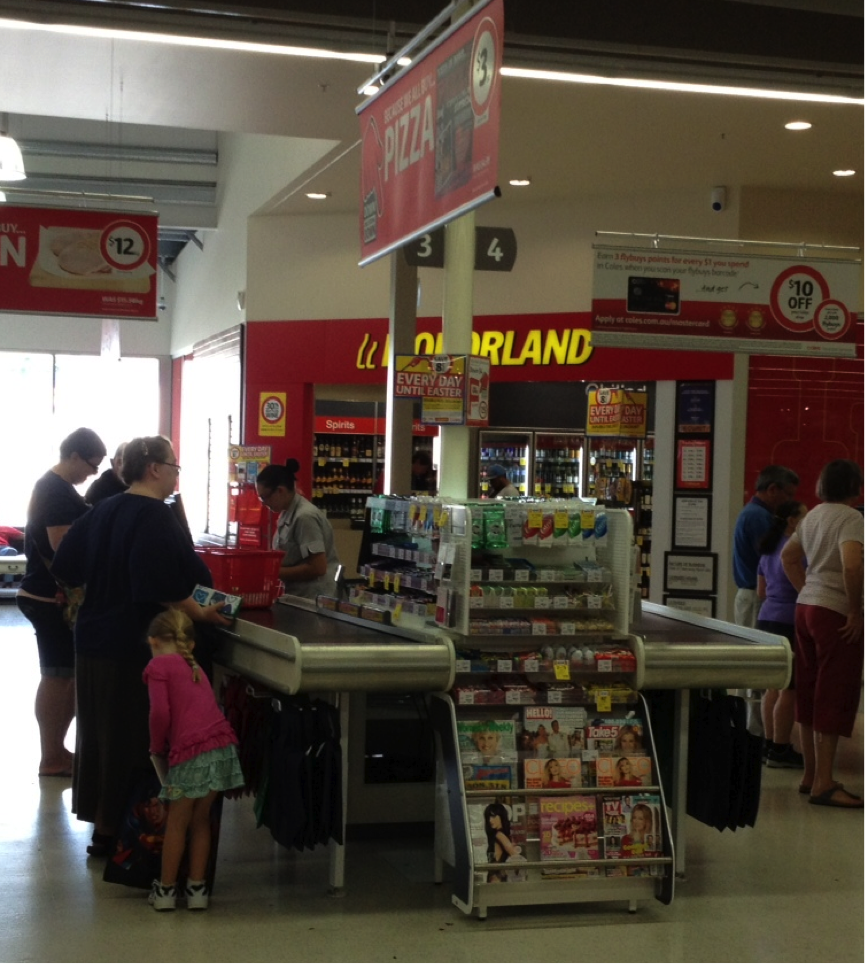
The Queensland Government may as well remove the regulation banning supermarkets from selling liquor, as called for by Master Grocers Australia (see this AAP story) because with co-located bottle shops they are effectively already selling liquor. This was apparent when I visited Coles’s new flagship Ipswich store today and noticed the Liquorland has very little physical separation from the supermarket, although there’s probably just enough so Coles hasn’t breached the regulation:

colesipswich

Posted in Ipswich, Retail trade | Tagged , , , , , , , | 2 Comments

Qld struck by Dutch Disease – manufacturing employment has plunged in last few years

The so-called Dutch Disease of a booming resources sector and a contracting manufacturing sector has been very evident in Queensland over the last few years, as seen in the chart below based on the latest vintage of ABS quarterly labour force data released today. The Dutch Disease is caused by a resources boom boosting the exchange rate and hence reducing the international competitiveness of our manufacturing sector.

dutchdisease

Pete Faulkner has posted on today’s ABS regional labour force data:

FNQ unemployment rate up but the trend is down

Trend is your friend, as they say.

Posted in Macroeconomy, Mining | Tagged , , , , , | Leave a comment