Big box stores like Costco essential if we’re to close retail productivity gap with US

I was pleased to see the Deputy Premier used his special powers to approve the big box Costco store at North Lakes in Brisbane, avoiding a potential legal dispute that could delay the development (see the AAP report Costco is coming to Queensland). Big box stores like Costco are highly efficient and we need more of them if we are to close the large gap in retail sector productivity we have with the US, as observed by my former Treasury colleague Jyoti Rahman in a thought-provoking Economic Roundup paper in 2005:

Comparing Australian and United States productivity

Jyoti observed:

The US retail trade sector has experienced rapid productivity improvement since the mid-1990s. This productivity surge can be attributed almost entirely to the entry of more productive firms that displaced much less productive existing retailers…The entering firms were usually large discount operations — the ‘big-boxes’ like Wal-Mart. These stores are more productive because of their size, which allows them to exploit economies of scale, efficiently use warehousing, better manage inventories and implement other innovative operation practices…

Jyoti wondered whether our low population density might limit the proliferation of big box stores in Australia, but thankfully recent developments suggest it might not, which is very good news for Australian consumers.
Posted in Retail trade | Tagged , , , , , , , | Leave a comment

Commission of Audit report an impressive guide to reform of Qld Government

The three volumes of the Commission of Audit report released today form an impressive guide to the reform of the Queensland Government over the rest of the decade. With solid analysis of policy issues across the wide range of public services in Queensland, and strong arguments in support of greater outsourcing and privatisation, the report will have a long shelf life. I have no doubt the report will one day be cited as instrumental in the inevitable privatisation of Energex and Ergon, which unfortunately the Government in its response today has rejected for now, even though sales proceeds would pay off a big chunk of State debt, as Commission head Peter Costello pointed out on tonight’s 7.30 Report.

Although some of the Commission’s recommendations were rejected, the Government has committed to implementing a large number of them and there is doubt the implementation of many of the Commission’s recommendations (e.g. contestability of public transport services, commercialisation of TAFE, among others) will have profound consequences for public service delivery and will drive efficiency and productivity improvements.

While on the theme of public sector efficiency, I should note the Centre for Independent Studies’s recently set up website Waste Watch, which is dedicated to identifying what it considers wasteful uses of public funds, such as $10k for yoga at Parliament House in Canberra.

Posted in Budget, Queensland Government | Tagged , , , , , , , , | 5 Comments

Forward estimates budgeting needs rethinking in more volatile economic times

Today’s speech by Prime Minister Gillard is a good attempt at explaining the Government’s budgetary challenges, but I was unconvinced by this line in the speech:

The Budget will outline the fiscal path for the coming four years, one designed both to take account of the nation’s current circumstances and to shape the nation’s future.

The PM effectively acknowledged in her speech that the Treasury cannot reliably forecast Government revenue several months in advance, let alone four years, so any fiscal path set out in the Budget will lack credibility. Governments need to recognise that, with the heightened economic volatility that will be with us for much of this current decade, the budgetary forward estimates are unreliable and Governments should be very reluctant to commit to expenditures in years beyond the upcoming financial year.

That is, the Government should avoid expenditure measures such as the $1.1 billion over 2012-13 to 2015-16 it provided to boost income support payments in the 2012-13 Budget. While forward estimates budgeting is usually useful, because it forces Governments to think about the ongoing impact of budget measures, it can be problematic if Governments make decisions based on revenue forecasts that are unreliable. Given the undeniable volatility in revenue, Governments should be more careful in what they commit to, in case the funds are not available.

For more on Australia’s budgetary challenges, I recommend the nice piece at the Conversation by one of Australia’s leading economists, John Freebairn:

Federal Budget 2013: Why our unsustainable structural deficit must be tackled

Regarding Queensland’s budgetary challenges, I’m looking forward to seeing the full Commission of Audit report and the Government’s response tomorrow.

Posted in Budget | Tagged , , , , , , , , | 4 Comments

Government should fully repeal compulsory bike helmet law

I’m a great believer in bicycle helmets and I’d never ride my bike on the road without one. Indeed, a nice red Giro helmet I owned undoubtedly saved me from a nasty head injury when I decked it after hitting a branch on Settlement Road at the Gap one Sunday morning in 2004. Wearing a helmet makes sense for anyone riding a bike and you’re taking a risk if you don’t wear one. That said, making helmets compulsory is bad from a public health perspective, because it discourages people from riding bikes, as I discussed in a post back in 2010:

Should we repeal the compulsory bike helmet law?

Also worth a read is Cameron Murray’s 2010 post Helmet law rebound effects and the success of terrorism.

Given that the compulsory helmet law is bad policy, I’m pleased that the Government is allowing an exemption for Sikhs, as reported by the Brisbane Times, and I hope it eventually considers getting rid of the compulsory helmet law entirely.

Posted in Health, Transport | Tagged , , , , | 4 Comments

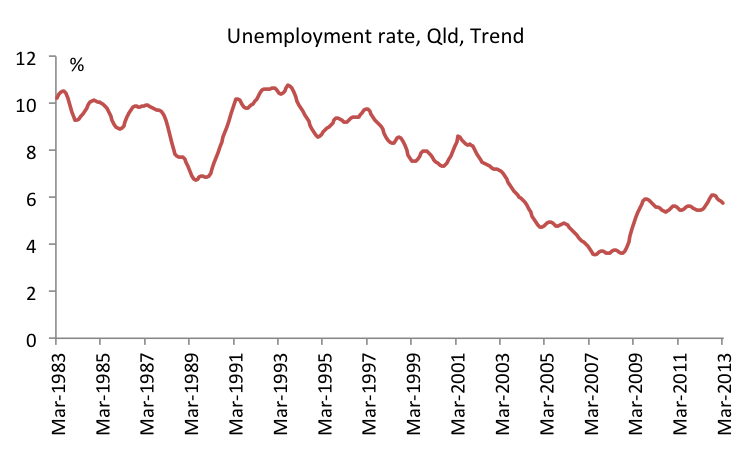
Qld jobless rate not “historically high”

I agree with CommSec that Queensland is in the middle of the pack in terms of economic performance among the States, but I disagree with their observation in the State of the States report that “the jobless rate remains historically high.” While there has clearly been a slowdown in the labour market, the unemployment rate is nowhere near historical highs, as a quick check of historical ABS data shows:

unemploymentMy recent posts on the state of the Queensland labour market include:

Public sector hiring freeze continues

Disappointing vacancies data support Treasury’s very low employment growth forecast for 2012-13


Posted in Labour market | Tagged , , , , | 2 Comments

ABS should review administration of Labour Force Survey in North Qld

I remember one of the old hands in the Queensland Government Statistician’s Office telling me back around 2000 that they once queried the ABS about the reliability of labour force data for Queensland, and were told the main point of the Labour Force Survey is to produce a reliable national unemployment rate estimate, which is essential for the RBA in setting monetary policy. In other words, you should be grateful you’re getting any State data at all. So there have always been doubts about the reliability of labour force data at the State level, and this appears to be the reason Queensland Treasury has consistently used trend estimates in its briefings, even though the seasonally adjusted data are much more likely to identify turning points in the labour market.

Given the concerns about the State-level labour force data, I’ve always been super skeptical about the reliability of data at the regional level, and recent batches of regional data have confirmed that skepticism. Loose Change in a post earlier today (Employment breakdowns) points out the wacky labour force data for North Queensland we’ve seen recently. These numbers are so wacky that I’m starting to worry about the quality of the administration of the Labour Force Survey in North Queensland. I would encourage the ABS to undertake an urgent review of these data to establish whether the extreme volatility is due to (a) sampling error associated with the small sample size in the region or (b) failure to consistently obtain representative samples of households in this region.

Posted in Cairns, North Queensland, Townsville | Tagged , , , , , , , , , , | 10 Comments

Qld Government should sell assets – further spending cuts would weaken economy further

Given the weakness in the Queensland economy in recent months, it’s unsurprising Government revenues have fallen short of forecast levels, and the Government is considering  asset sales recommended by Peter Costello’s Commission of Audit, as reported by the Courier-Mail this morning:

A MASSIVE decline in revenues could force the Newman Government to adopt many of the Costello Review’s most controversial recommendations, including asset sales.

The Courier-Mail can reveal the Government’s Budget in June will predict a fiscal deficit for 2013/14 of more than $8 billion, compared to the $4.6 billion estimated in November.

Combined with this year’s deficit of $10 billion, the total red ink racked up by the Government could exceed $18 billion by the middle of next year if no action is taken.

Huge writedowns on stamp duty, royalties and payroll revenue predictions are responsible for the bulk of the state’s fading fiscal fortunes.

The deficit figure comes despite the Government reining in spending by more than $5.5 billion last year by cutting thousands of public servant jobs and cancelling funding for programs.

The Government should sell assets, particularly electricity businesses Energex and Ergon, so it can pay down debt and reduce its interest bill as soon as possible. Trying to repair the budget through further spending cuts, which the Courier-Mail reports is a possibility being explored, would be counter-productive. The State Government exerts a major influence on the Queensland economy, particularly on the construction sector, and further spending cuts would mean the recent economic weakness would continue for many more months, and would actually risk additional declines in revenue if the economy worsens as a result.

Posted in Budget | Tagged , , , , , , | 5 Comments

Cap on Government size desirable, but probably unachievable

The great British-Australian economist Colin Clark, who Keynes regarded as “first class” and who served in top Queensland public service roles in the 1940s, famously speculated that Governments couldn’t grow beyond 25% of GDP without causing major economic problems. Given that relatively low spending Government sectors such as Australia’s now spend 35-40% of GDP, Clark’s prediction was probably a little bit alarmist, with the benefit of hindsight. That said, it appears clear there is a large amount of wasteful government spending, particularly on corporate welfare/industry assistance, and Australia needs a debate on whether we can feasibly shrink our public sector, or at least limit its growth over time.

Hence it’s good to see the Business Council of Australia President Tony Shepherd calling for “a hard cap on the size of government” in an excellent speech today. Unfortunately it will never work, because politicians wouldn’t want to tie their hands in this way, but it’s a great idea. The Centre for Independent Studies has also recently launched the Target 30 campaign to cut Government down to 30% of GDP (see this Australian report, Wasteful public spending targeted).

Posted in Budget | Tagged , , , , | 4 Comments

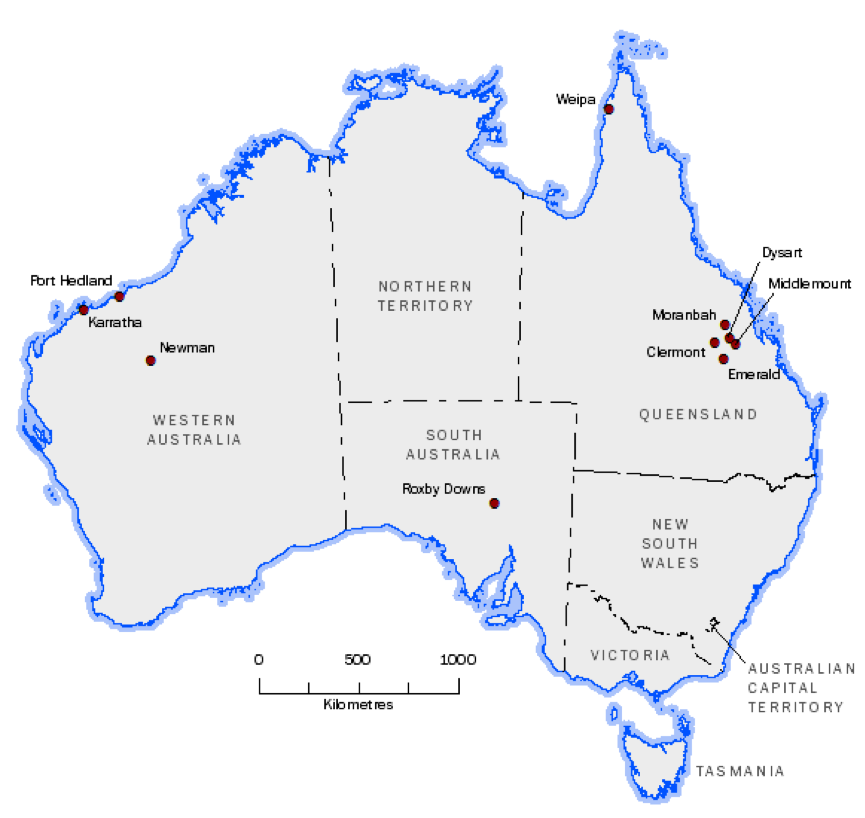
Six of the ten high growth mining towns in Queensland

The ABS published an excellent Australian Social Trends piece on Towns of the Mining Boom yesterday, noting the impact of fly-in, fly-out (FIFO) workers. Six of the ten high growth mining towns reported by the ABS are in Queensland (see ABS map below), but the fastest growing and the largest of the high growth mining towns is Karratha in WA. Also check out the coverage at MacroBusiness (Mining employment booms in Perth).

miningtowns

Posted in Mining | Tagged , , , , , , , , | Leave a comment

More evidence of modest recovery in Far North

A new Chamber of Commerce and Industry Queensland (CCIQ) survey reported on by the Cairns Post today provides further evidence a recovery is underway in Far North Queensland:

CCIQ Far North Queensland policy chairman Brett Moller said the region had “in general performed admirably over the past decade largely due to the efforts of the businesses and communities across the region”.

“Despite facing some significant challenges over its more recent history, the economic fundamentals for the Far North Queensland region are potentially quite strong and indicators point to there being a modest economic recovery under way,” he said.

I posted on the recovery in FNQ a couple of months ago, although I was probably a bit too confident about the strength of it:

Compelling evidence of robust recovery in Far North Qld

It’s probably more accurate to say the recovery is modest. Building approvals, an important leading indicator, still appear weak. Mark Beath at Loose Change has covered the disappointing building approvals figures for Cairns, linking them to both the over-hang from the pre-financial crisis building boom and massive increases in strata insurance premiums in recent years:

Dead in the water

Posted in Cairns | Tagged , , , | 2 Comments