Which Qld regions are the most productive per capita?

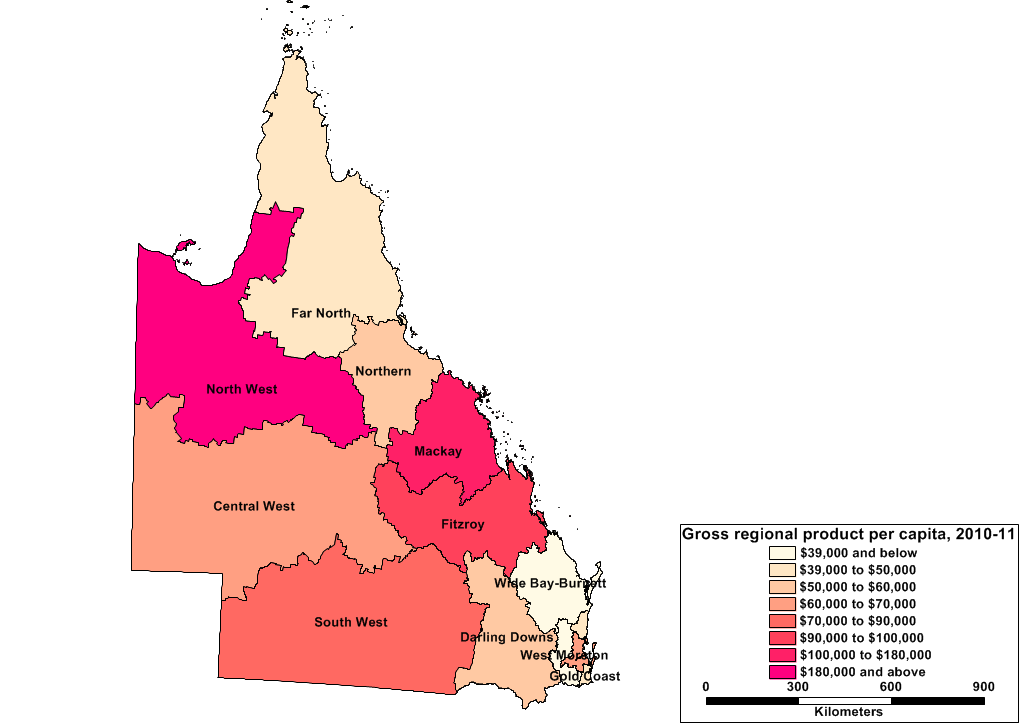
Based on Queensland Treasury figures published earlier this year (Experimental Estimates of Gross Regional Product), the North West and Mackay regions of Queensland have the highest levels of gross regional product (GRP) per capita, largely due to mining in each region (see map below). Mining is very capital-intensive and the sector produces a much higher level of output per worker than other industries. (Also, the use of FIFO workers from outside each region would mean GRP per capita would be higher than otherwise, because the FIFO workers wouldn’t count in the resident population that is the denominator in the GRP per capita calculation.)

GRP per capita_Qld


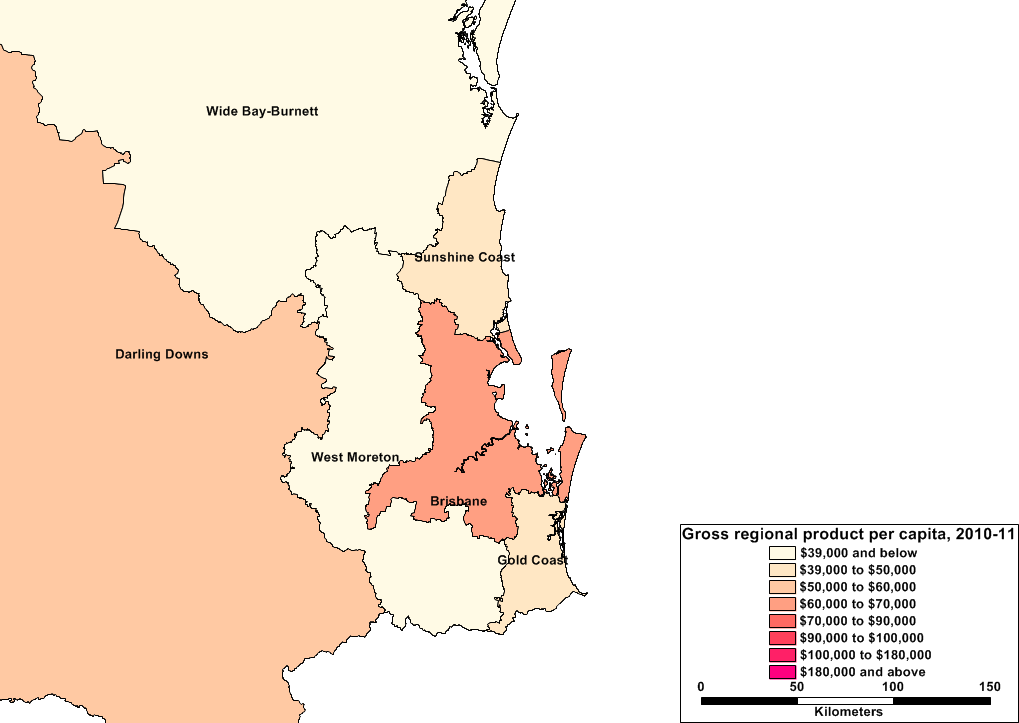
Within South East Queensland (SEQ), Brisbane has the highest level of GRP per capita and West Moreton the lowest (see map below). Obviously, Brisbane is the hub of economic activity in SEQ, with many head offices and large employers attracting workers from across SEQ, so this is unexpected.


SEQ GRP

Posted in Brisbane, Gold Coast, North Queensland | Tagged , , , , , , , , , | Leave a comment

Greater uncertainty over 2013-14 economic outlook

The last 24 hours have seen the release of a sobering NAB report on its monthly business survey (Business conditions collapse in June, retail worst hit, says NAB) and the latest IMF World Economic Outlook, which has slightly downgraded China’s growth forecast but boosted Japan’s (Emerging Market Slowdown Adds to Global Economy Pains). With Japan being a major trading partner of Queensland’s, I’m hoping the better outlook for Japan largely offsets the slightly worse outlook for China.

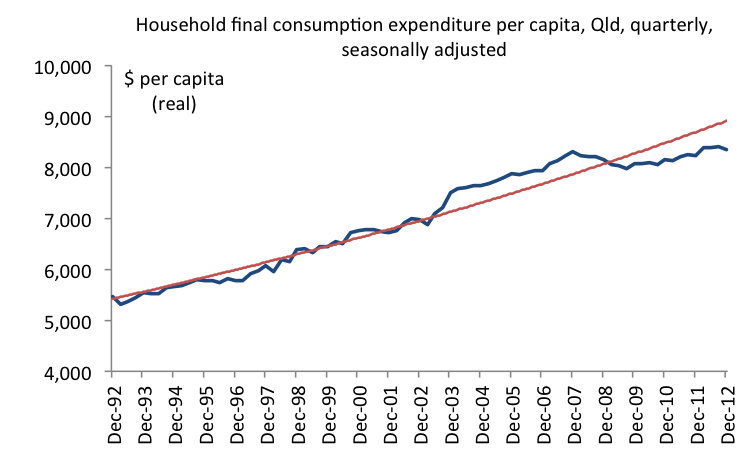
Overall, in Australia, it’s starting to appear that there won’t be a smooth transition from the peak of the resources boom – i.e. other sources of activity won’t immediately substitute for mining investment which is starting to come off its highs. Part of the problem is the cautious consumer, as evidenced by a high household savings ratio (discussed in a previous post) and below trend household consumption expenditure (see chart below, based on the most recent Queensland State Accounts data, with my trend line in red).

ConsWhile I was less concerned than many commentators about last week’s retail trade data, it is undeniable that consumer spending has been lower than might be expected based on an extrapolation of the historical trend. It’s hard to see what could boost consumer spending and thus inspire business confidence over the current financial year, so I expect 2013-14 will be another financial year of sluggish economic conditions.

Posted in Macroeconomy, Uncategorized | Tagged , , , , , , , , , , , | 4 Comments

Scope to raise more revenue from gambling and cut bad taxes

In making his case for getting Brisbane’s second casino licence, James Packer observed last week (according to the Courier-Mail):

“Brisbane and Queensland have been badly let down by Echo – they have under-invested and underperformed. Queensland taxpayers are missing out on taxes, and the people of Brisbane deserve a much better resort offering.”

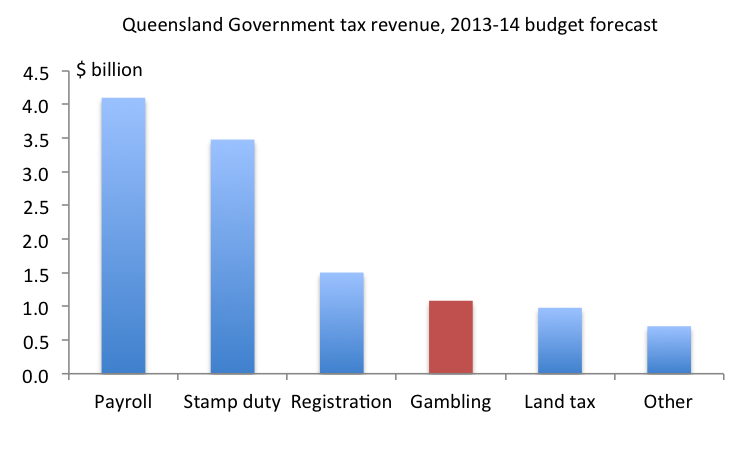
While Mr Packer is obviously motivated by more than his concern for Queensland’s public finances, he makes a very good point about us missing out on tax revenue. Currently, Queensland raises much more revenue from taxes that are worse than gambling taxes and levies from an economic perspective, namely payroll tax and stamp duties (see figure below).

taxI’ve previously discussed the State Government’s reliance on inefficient taxes in a number of posts, including:

Government has to rely on inefficient taxes to fix budget – GST reform needed

Inefficient State taxes

Hence I see an opportunity to raise more revenue from gambling, which can be used to cut payroll tax and stamp duties to some extent. I wouldn’t expect gambling taxes and levies to replace these taxes fully, so broader tax reform is still needed.

Posted in Budget, Tax | Tagged , , , , , , , , | 2 Comments

Toowoomba very reliant on education sector – risk from higher ed reform

An article in the Toowoomba Chronicle has reminded me just how significant the University of Southern Queensland has been to Toowoomba’s economic development and prosperity, and the USQ Vice-Chancellor is certainly right to be concerned about potential higher education policy changes (USQ boss claims regulations will hit regions the hardest):

THE University of Southern Queensland warned that any move to regulate university enrolments for students would have serious consequences for regional and rural Australia.

USQ vice-chancellor Professor Jan Thomas said that any proposal to limit the places available, or to move away from participation targets, should be carefully considered.

As I posted on earlier this week (Commonwealth should give up student target – big savings possible from higher ed reform), I’m a supporter of the proposed changes, but I would acknowledge there are risks involved. Unfortunately, we’ve used universities as a regional economic development tool, but this has meant some regional economies may have become too reliant on their universities.

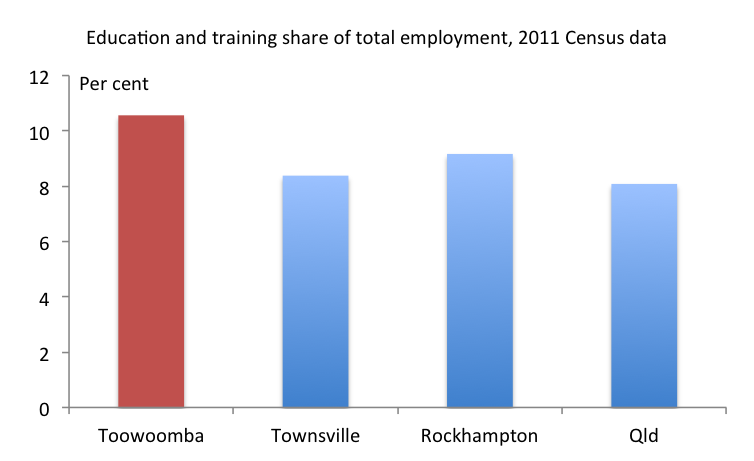
I’m reluctant to suggest this is the case for Toowoomba, given it is a relatively large city by Queensland regional standards, but Census data do indicate education and training sector employment is proportionately much higher in Toowoomba than in the rest of Queensland (see chart below in which I compare Toowoomba with some other regional centres with universities and the State average). To an extent, this may be to do with Toowoomba being an important centre of secondary education for the Darling Downs, but I expect USQ is an important contributor. Hence there is undoubtedly a risk to Toowoomba from higher education funding changes.

education

Posted in Education, Toowoomba, Uncategorized | Tagged , , , , , , | Leave a comment

Queenslanders spending, but not building

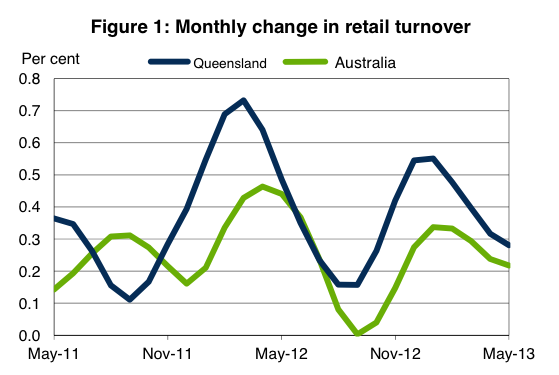
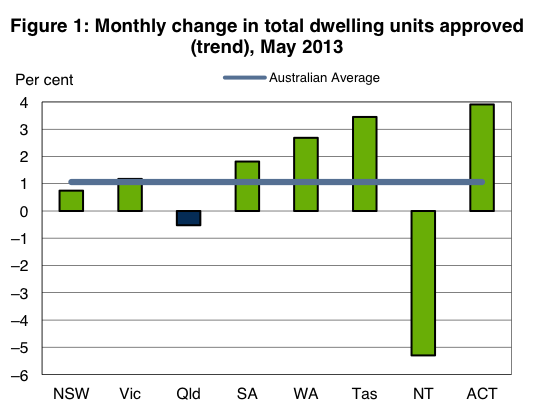
It was a week of mixed economic news for Queensland, with the latest ABS data showing retail spending is growing reasonably well in Queensland, while building approvals continue at low levels. Queensland is out-performing the rest of Australia on retail trade (first chart below, borrowed from Qld Treasury), but is not experiencing the recovery in building approvals that appears to be occurring elsewhere in Australia (second chart below, also borrowed from Treasury).

retailbaThe combination of reasonable retail trade numbers and poor building approvals suggests the problem the building industry in Queensland is facing is a relative oversupply of dwellings, because of strong building industry activity in the lead up to the financial crisis and also because Queensland’s population growth has been lower than expected in recent years.


Posted in Housing, Macroeconomy, Retail trade | Tagged , , , , , | Leave a comment

Further decline in exchange rate would be good news for Qld tourism

The HIA released an interesting note today forecasting the Australian dollar will continue to decline, possibly down to the US$0.70 to US$0.80 range (see Decline of the Aussie dollar: Where to from here?). I agree with the HIA there are good reasons to expect the dollar to depreciate further. Also, the RBA thinks further declines are not unlikely, with the Governor’s media release today noting:

The Australian dollar has depreciated by around 10 per cent since early April, although it remains at a high level. It is possible that the exchange rate will depreciate further over time, which would help to foster a rebalancing of growth in the economy.

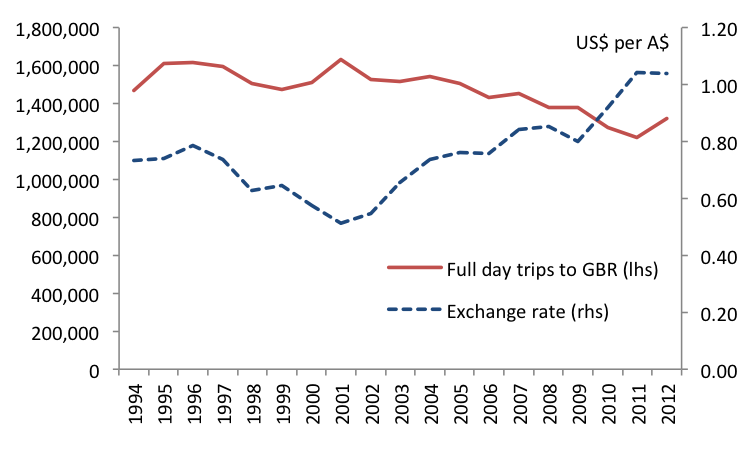
A further decline in the exchange rate would be welcome news for our tourism industry, which has struggled under the high exchange rate. As an example, see my chart below comparing day trips to the Great Barrier Reef (GBR) (sourced from the GBR Marine Park Authority) and the exchange rate, which shows how visitor numbers dropped significantly as the Australian dollar appreciated.

GBR tourismThe declining exchange rate would certainly be viewed as good news in Cairns, which is highly dependent on tourism. Mark Beath at Loose Change is keeping a close eye on Cairns airport passenger numbers, which were soft in May but had experienced strong growth in previous months, thanks in large part to Chinese visitors:

Airport Data: What happened in May?

My recent posts on Queensland tourism, which have been keeping track of its slow recovery, include:

International tourism continues to recover, particularly in TNQ, thanks largely to Chinese visitors

Tourism had reasonable December quarter, but room for improvement

Posted in Tourism | Tagged , , , , , , , , , , , , | Leave a comment

Commonwealth should give up student target – big savings possible from higher ed reform

highered

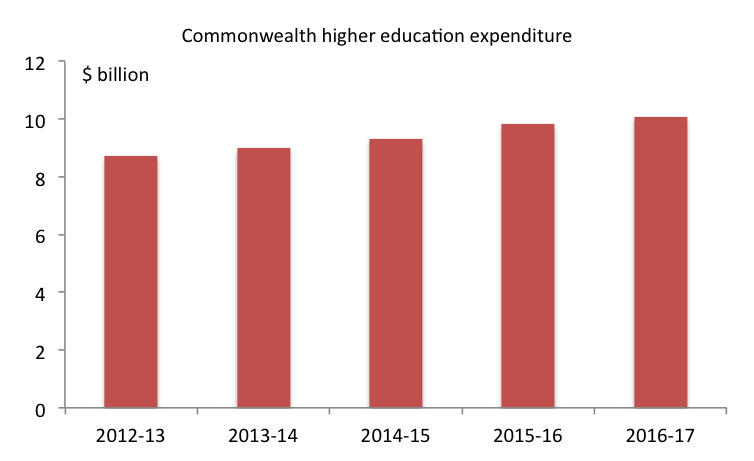
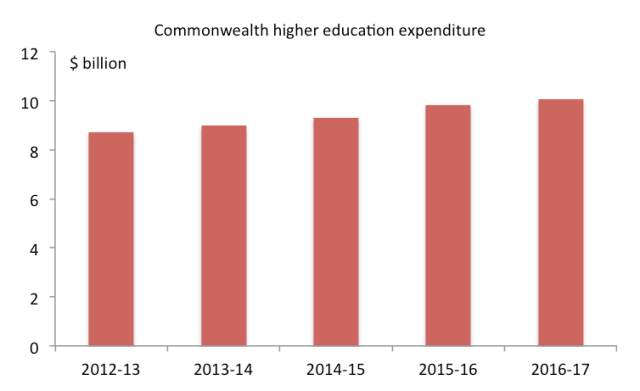
The Commonwealth is projected to spend over $10 billion on higher education by 2016-17 according to the 2013-14 Budget papers (see chart above). Hence it’s unsurprising the Government is looking at savings in this area, as reported in the Australian today:

THE Rudd government could walk away from a key education target to increase university participation, with Higher Education Minister Kim Carr saying rapid growth in enrolments over the past three years had potentially compromised the quality of degrees on offer.

Senator Carr, who was yesterday returned to the federal ministry, indicated the government was prepared to dump its quest to have 40 per cent of young people with at least a bachelor’s degree by 2025. While a reversal in policy, the move would stem budgetary pressures to fund hundreds of thousands of new places by putting caps back on how many students universities could enrol.

This would be a good idea, at least as an interim measure before wide-ranging reform of higher education funding. Un-capping student enrolments at universities was always highly risky for the Commonwealth, given it picks up a high proportion of the costs of higher education, with students paying only part of the costs through the HECS-HELP loans scheme (see Andrew Norton’s excellent Graduate Winners publication, particularly p. 16, for an overview of higher education funding). Hence, to limit the Commonwealth’s exposure, it makes sense to cap the number of places the Commonwealth subsidises.

But this would only be an interim measure, as the higher education system requires signficant reform to wean it off Commonwealth support over the longer-term.

As Andrew Norton observed in his Graduate Winners report for the Grattan Institute, many graduates do very well out of their university studies, and a case can be made for reducing Commonwealth subsidies and having students contribute a larger amount through HECS-HELP. Further, in my opinion, the Commonwealth should consider re-introducing full-fee undergraduate places for domestic students.

I don’t expect the current Government will go this far, but I hope future Governments will consider these measures. Potentially billions of dollars can be saved from the higher education budget, and there is no shortage of worthwhile projects in other areas.

As an example, consider the much needed second range crossing to Toowoomba, which would cost up to $2 billion. With an accident occurring on the existing range crossing nearly every week, and one just on the weekend  (Truck crash shuts down the Toowoomba Range), it may be time to invest in this important project.

Posted in Education, Toowoomba, Transport | Tagged , , , , , , , , | Leave a comment

Productivity Commission says no rationale for State ownership of Energex and Ergon

Paul Syvret in the Courier-Mail today has a nice summary of the Productivity Commission’s latest report on Electricity Network Regulation. The Commission suggests there would be cost savings and lower power bills flowing from privatisation of electricity network businesses such as Energex and Ergon, noting on pages 24-25:

While governments have a legitimate role in owning and operating many services in Australia, the rationale for state-ownership of electricity network businesses no longer holds. This reflects the development of sophisticated incentive regulations that function best when the regulated businesses have strong cost-minimising and profit motives.

State governments often impose multiple constraints on state-owned corporations that are incompatible with maximising returns to their shareholders…

…There are strong arguments for privatisation of these businesses. There is no evidence that the productivity, reliability, quality or cost performance of private sector electricity network businesses is worse than their public sector equivalents. To the contrary, the evidence in Australia and internationally suggests that such private sector enterprises are more efficient.  [emphasis added]

The Productivity Commission makes the important point that consumer welfare is best protected by having good regulation in place, rather than State ownership. Indeed, State ownership can be bad for consumers because Energex and Ergon might be too worried about the political consequences of blackouts or brownouts that they over-invest in infrastructure to minimise the risk of power failures at an unacceptable cost to the community.

My previous posts on the electricity sector, particularly the desirability of selling Energex and Ergon (which are now to be merged but remain in State ownership), include:

Qld budget surplus delay not a big deal, but reinforces need to consider Energex & Ergon sell off

Qld Government should sell assets – further spending cuts would weaken economy further

Posted in Energy | Tagged , , , , , , , , | 5 Comments

State against State – Qld caught up to NSW in per capita output over 2000s

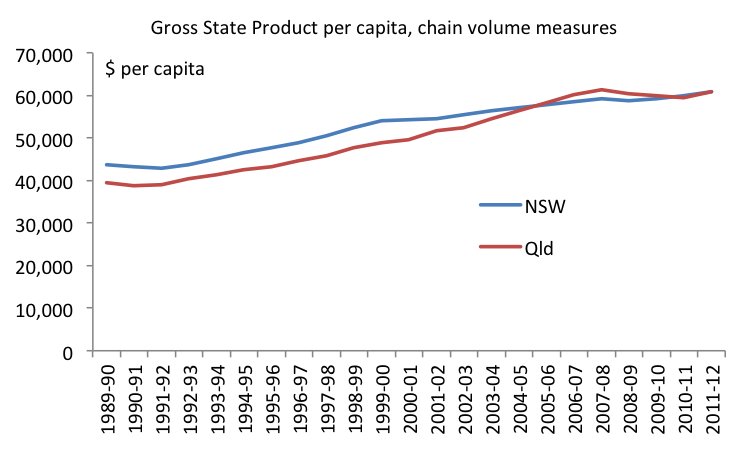
NSW was traditionally a more productive State than Queensland per head of population, as expressed in economic measures such as gross state product (GSP) per capita produced by the ABS. But Queensland’s economy caught up in per capita terms over the 2000s, due in large part I expect to the strength of the resources sector.

GSPpercapita


So on State of Origin day it’s good to know Queensland is making as large a contribution per capita to the Australia economy as NSW. Of course, average incomes would still be higher in NSW because a large share of the profits from the resources sector flow out of Queensland, but I’ll have to cover that in another post.

Posted in Macroeconomy | Tagged , , , , , , , , , | Leave a comment

Townsville beats Brisbane on economic fundamentals, says new RAI Insight database

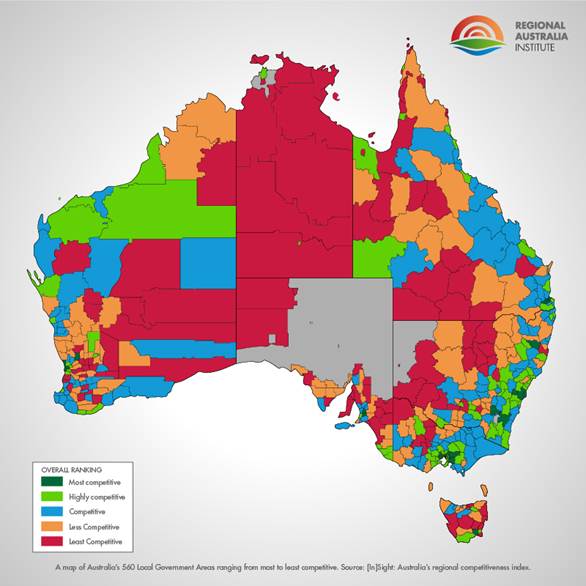
Townsville Mayor Jenny Hill will be pleased the Regional Australia Institute has ranked Townsville very highly on economic fundamentals in its new Insight database, as it supports the Council’s case for investing in the region that will be expressed in its Economic Development Plan 2013-17, also to be released today (see Townsville Bulletin coverage). An Insight database query shows Townsville is ranked 28th out of 560 local government areas across Australia on economic fundamentals (one of nine themes of regional competitiveness in the database), compared with Brisbane at 56th – also a good result, really. In large part, Townsville’s superior performance appears due to the value of building approvals per capita, which is certainly a reasonable indication of a region’s prospects, though it would be good to see a wider set of factors determining the economic fundamentals ranking in the future than the current set.

From a quick glance at RAI’s heat map of Australia, it appears Queensland has a relatively low share of highly competitive and most competitive regions, adding further urgency to the State Government’s economic reform agenda.

RAI-INsight-Heatmap-National

Posted in Brisbane, Townsville | Tagged , , , , , | Leave a comment