Unemployment in outer Brisbane

Katherine Feeney has a great article on the Brisbane Times website this morning: Unemployment hitting Brisbane’s outer suburbs hardest. It contains some commentary from me on Brisbane’s labour market that I gave to Katherine when she interviewed me yesterday, in response to some recent blog posts:

Which suburbs of Brisbane had the largest increases in unemployment?

Largest unemployment rate increases over 2012-13 in metro Brisbane and Central Qld

I’m rather impressed by the Datawrapper tool used to generate the chart in Katherine’s article and might add it to my toolbox.


Posted in Brisbane, Labour market | Tagged , , , , , , , | 2 Comments

Tourism recovering nicely on Gold Coast, not so elsewhere

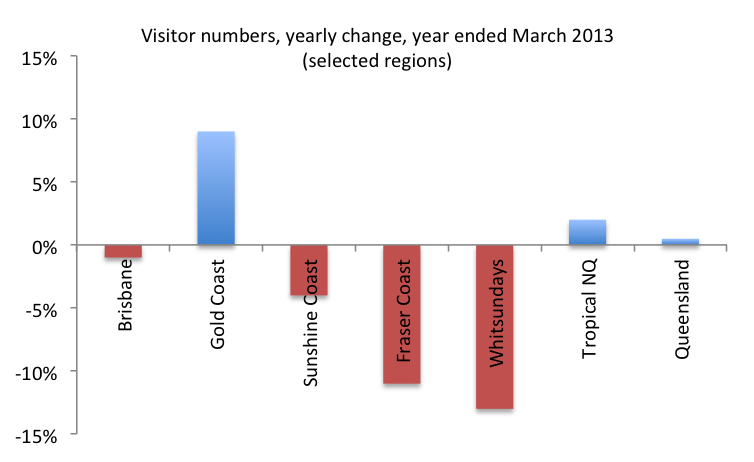
Tourism and Events Queensland (TEQ) released some Regional Snapshots for the year ended 2013 yesterday, and they show a good result for the Gold Coast (see Gold Coast Regional Snapshot), with total visitors up 9%, but less inspiring and somewhat distressing results for other regions (see chart below). The chart presents the percentage change in visitor numbers between the year ended March 2012 and the year ended March 2013, where visitors include domestic overnight and international visitors. The strong Gold Coast result appears to be due to a strong increase in domestic overnight visitors, while the less strong but still positive Tropical North Queensland result is related to an increase in international visitors, particularly from China.

visitorgrowthchartFor related coverage, see:

TEQ TNQ regional snapshot

Airport update for June (which notes visitor numbers for Cairns, in Tropical NQ, last year were influenced by eclipse tourism).


Posted in Gold Coast, Tourism | Tagged , , , , , , | Leave a comment

Which suburbs of Brisbane had the largest increases in unemployment?

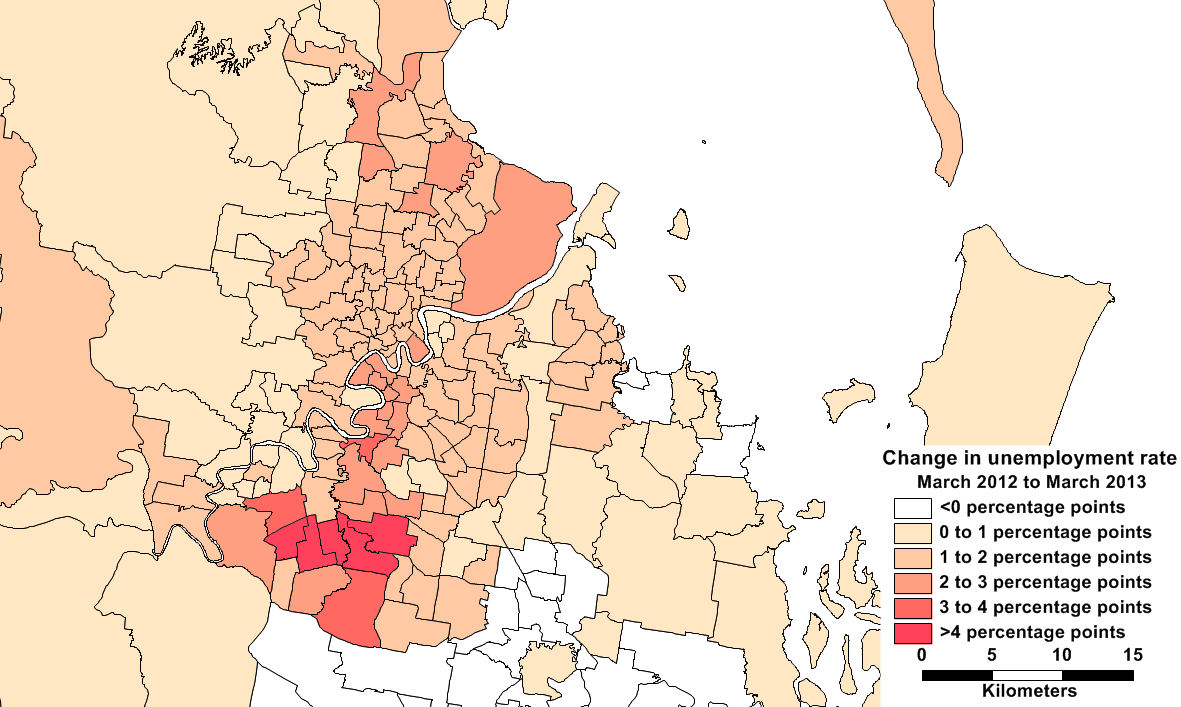
After looking at the new regional unemployment data for June 2013 last week, I wondered about the distribution of job losses across the Brisbane metropolitan area (see my previous post Largest unemployment rate increases over 2012-13 in metro Brisbane and Central Qld). Hence I had a look at the small area labour markets data produced by the Commonwealth Department of Education, Employment and Workplace Relations, the last vintage of which, for March quarter 2013, was released earlier this month. These data are produced by combining ABS labour force data with Centrelink data on Newstart and Youth Allowance recipients. While we’ve had three months of data since March 2013, I think the DEEWR data remain informative. So here is a map of the Brisbane metropolitan area showing hot spot suburbs with large increases in unemployment rates in the 12 months to March quarter 2013:

metroarea

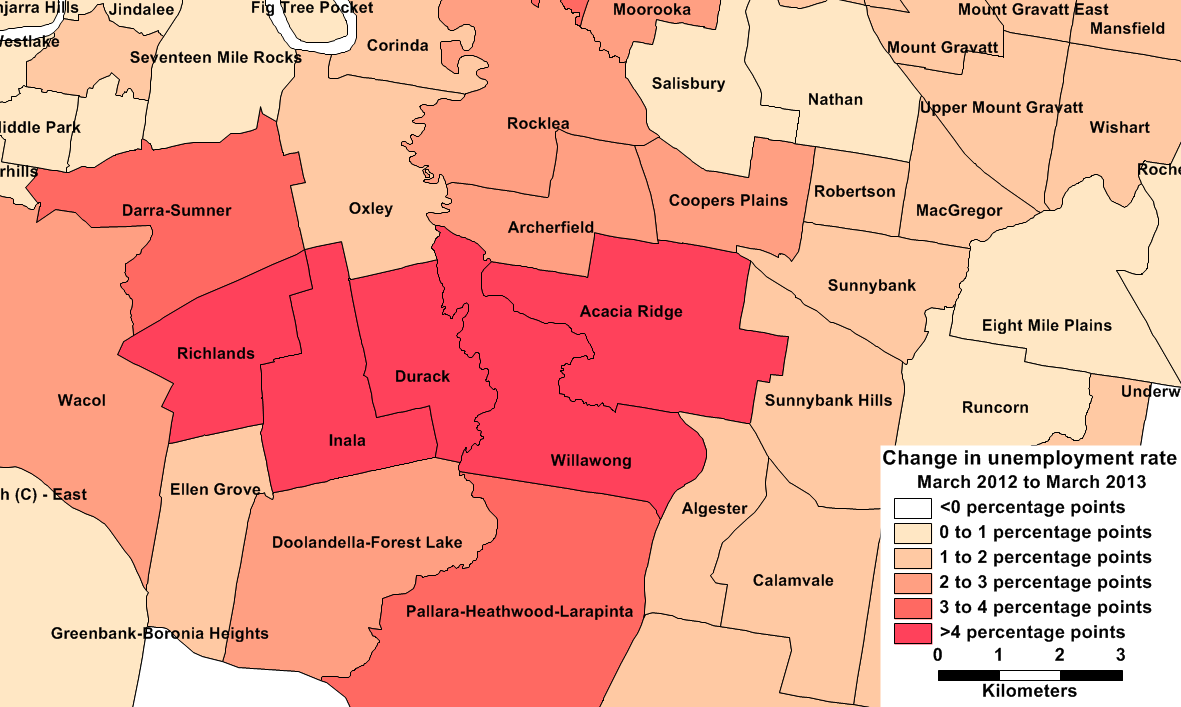
And here’s a close up to show the suburbs with the largest unemployment rate increases:

closeupInala, Richlands and Durack now have unemployment rates of around 25 per cent, while Willawong and Acacia Ridge have unemployment rates of around 19 per cent. In part, the large increases in unemployment rates in these suburbs may be related to newly unemployed people moving to the suburbs for cheap accommodation. But I suspect there are many existing residents in these suburbs, particularly young people, who have become unemployed as a result of Brisbane’s sluggish labour market.

Posted in Brisbane, Labour market | Tagged , , , , | 4 Comments

Largest unemployment rate increases over 2012-13 in metro Brisbane and Central Qld

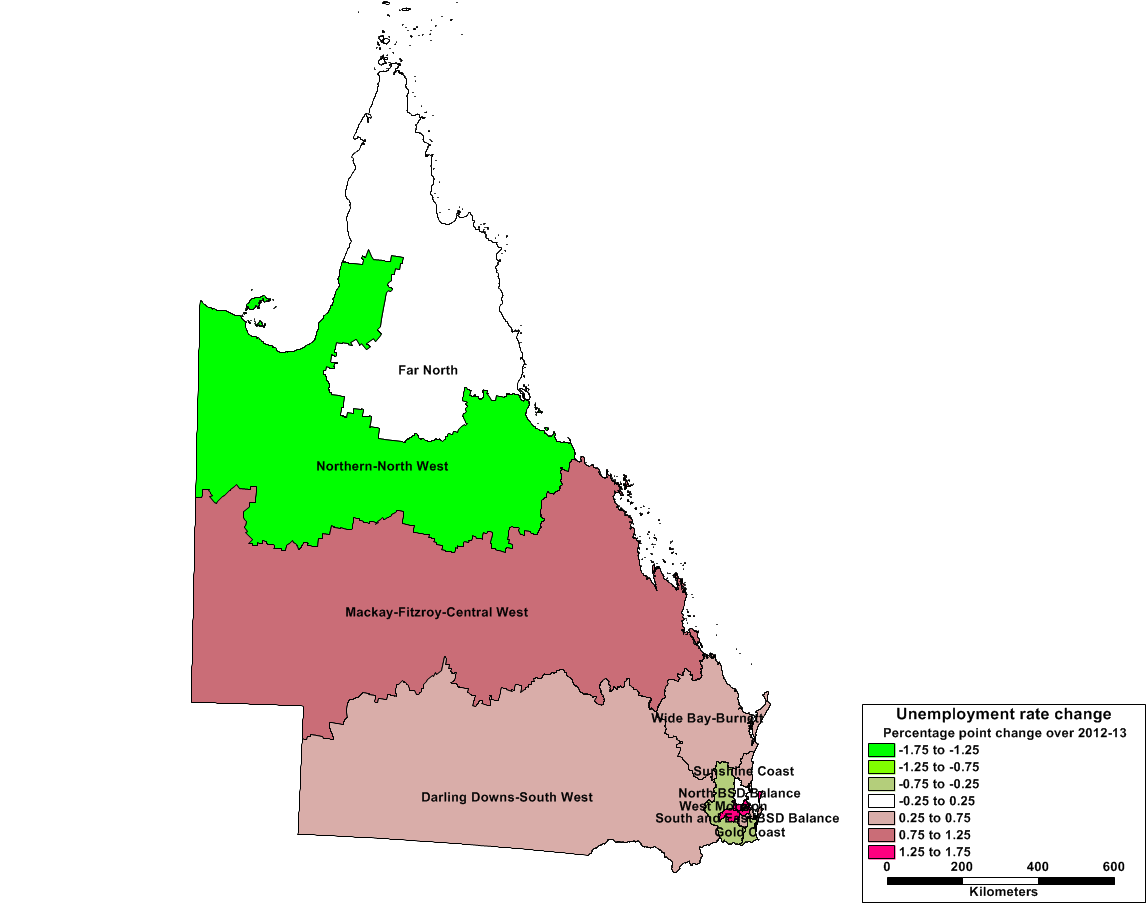
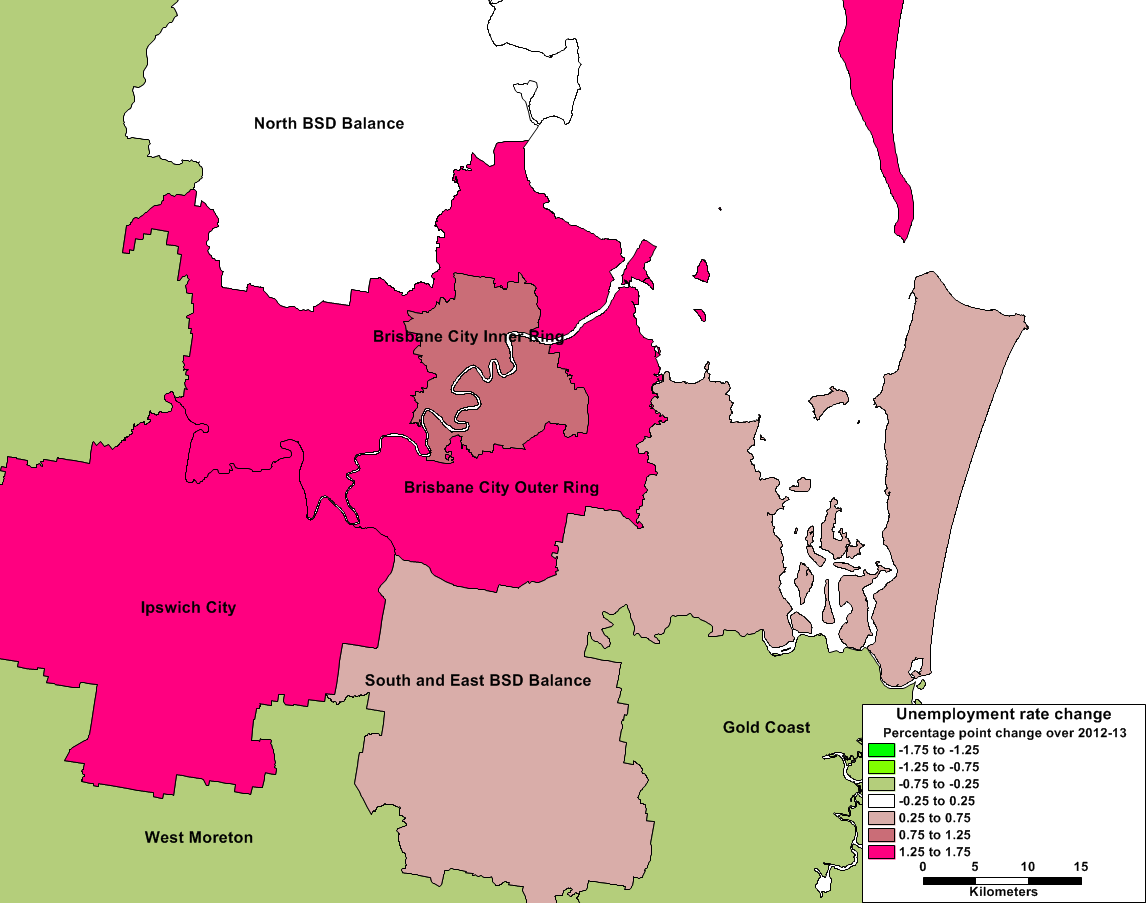
I’ve mapped the changes in regional unemployment rates over 2012-13 (based on Queensland Treasury’s briefing on yesterday’s ABS data) in the maps below. The largest increases in the unemployment rate are in metropolitan Brisbane, related in part to public service cuts I expect, and Central Queensland, possibly associated with a slowing resources sector. Note that the change over 2012-13 refers to the change in the unemployment rate between June 2012 and June 2013.

Here’s the Queensland map:

Qld_change_mapAnd here’s a closer look at the Brisbane metro area:

SEQ_change_map

Posted in Brisbane, Labour market, Mackay, Mining | Tagged , , , , , , , , | 2 Comments

Solar subsidy creates suburban “eyesore” on Gold Coast

In describing how government policies can have strange effects, economic textbooks often refer to the window tax that applied in Britain in France in the 18th and 19th centuries. This tax resulted in a number of households bricking up windows so they could reduce their window tax bills.

I expect the solar feed-in tariff will eventually join the window tax as an example of policies with strange effects in economic textbooks, at least in Australian textbooks. This occurred to me this morning when I read this Gold Coast Bulletin story (Solar panel feud flares):

IT’S the residential “solar farm” fracturing friendships in a quiet Gold Coast street – and the council can’t stop one popping up in your suburb.

Despite having 23 solar panels on his roof, Hope Island retiree Graham Drew has caused a furore by erecting a frame along his property to hold a 40 more panels.

At least five neighbouring households have repeatedly raised safety and aesthetic concerns with the council, including Mayor Tom Tate, but it says it is powerless to act as the structure was approved by an independent certifier and the city’s planning scheme does not regulate the installation of solar panels.

Property owner Kate Lockyer, whose home overlooks the panels, said the “eyesore” would have an enormous impact on the resale value of her house.

It’s worth clicking through to the article linked to above just to see the huge array of panels, which I think the property owner’s neighbour has rightly described as a “solar monstrosity”.

Posted in Energy, Environment, Gold Coast | Tagged , , , , , , | 2 Comments

OECD forecasts Australian unemployment rate to remain relatively low

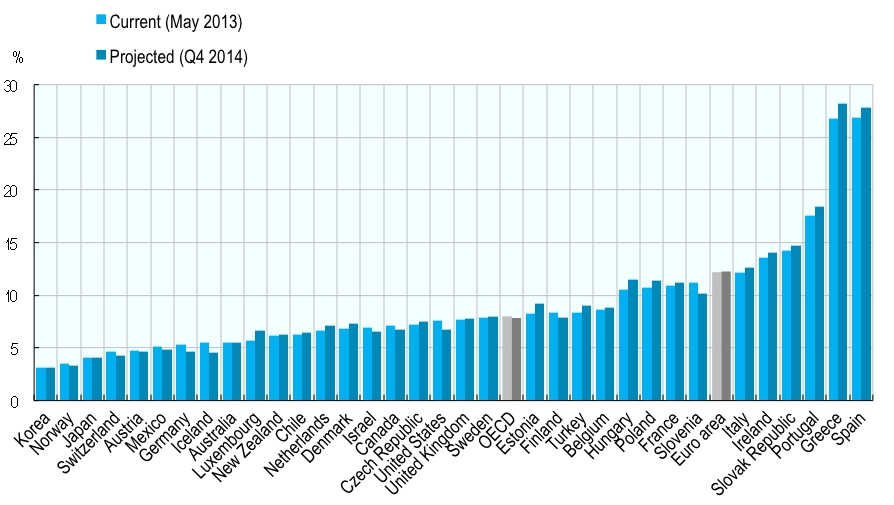
The OECD has released its Employment Outlook 2013, which contains a forecast of a stable, relatively low unemployment rate for Australia at 5.5 per cent and a grim forecast of persistent, high unemployment in the Euro area of over 12 per cent, as shown in this OECD chart of current and projected unemployment rates:

unemploymentRegarding the big economic news in Australia today, the early transition from a fixed carbon price to an emissions trading scheme linked with the European market (with a much lower carbon price), I think the Government has made the right decision, and it’s good news particularly for the Queensland economy. As I’ve discussed previously, Queensland is more vulnerable to a high carbon price than other States:

UQ study confirms carbon tax will hit Qld the hardest

Queensland has to make the biggest adjustment to carbon price

Posted in Labour market | Tagged , , , , , , , , | Leave a comment

Ipswich will play important role in eventual recovery of Qld building industry

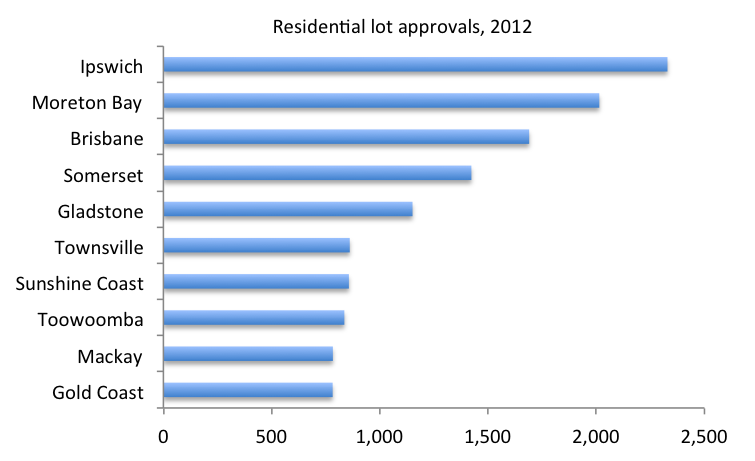
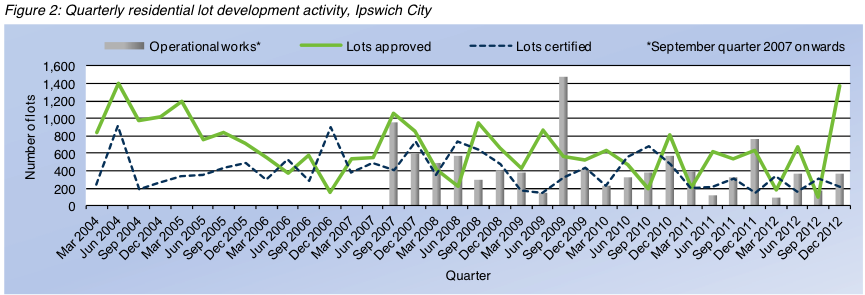
With Springfield continuing to grow and a new master-planned community being developed at Ripley Valley, Ipswich will play an important role in the eventual recovery of Queensland’s building industry from its current weak condition. Indeed, residential land data published today by Queensland Treasury show the Ipswich local government area leads Queensland in residential lot approvals (first chart below), and that there was a surge in lot approvals in Ipswich in the December quarter of 2012 (second chart below).

Reslotstimeseries

Posted in Housing, Ipswich | Tagged , , , , , , , , , , | Leave a comment

Tourism sector needs IR reform

You may have noticed how difficult it has become to get a single night’s accommodation during weekends in Australia, particularly via Wotif. And in yesterday’s Sunday Mail I noticed a large advertisement for two night weekend packages by Rydges, and it appears hotels are pushing us into staying two nights or not at all. While partly this may be good marketing, it may also reflect the impacts of the Fair Work Act, according to Queensland Tourism Industry Council chief Daniel Gschwind

Mr Gschwind gave an excellent presentation to the NCVER national research conference I attended last week in Mooloolaba on Queensland’s Sunshine Coast. While he talked a lot about China, and the prospect of 100 million Chinese travelling internationally in a few years time, he also noted that an important issue for the tourism sector is workforce flexibility, which made me wonder how the sector was faring under the new IR laws that replaced WorkChoices. Hence I asked Mr Gschwind a question regarding the impact of the Fair Work Act, and he noted it is a major constraint on the industry. With the sector unable to avoid paying penalty rates, as it could under WorkChoices, its labour costs have risen significantly on weekends. This has had a number of effects, including:

  • many hotels are refusing to book people in for a single night over the weekend, as they want to avoid the extra labour costs of refreshing rooms for new guests where they can; and
  • many restaurants are not opening during weekend times they traditionally opened (e.g. some may have previously opened Sunday night), not because of a lack of demand, but because labour costs are so high that it wouldn’t be economically viable to open.

These impacts are readily verifiable and add support to the need for a new review of the operation of our IR laws.

Posted in IR, Tourism | Tagged , , , , , , | 6 Comments

Productivity Commission study will highlight stamp duty impact on labour market

The Productivity Commission yesterday released the issues paper for its Geographic Labour Mobility study, a study which I expect will highlight the adverse impact of stamp duty on the labour market. Stamp duty on property transactions, which significantly increases the cost of re-locating in Australia, means our labour market might not function as efficiently as it could. It means fewer people may move between regions or States to take up new employment opportunities. The Commission notes in its issues paper:

Some policies may indirectly impede geographic labour mobility. Examples include policies that prevent the recognition of differential occupational licensing schemes across regions, stamp duty on house purchases, differences in tax treatment of owner-occupied housing and private rentals, and policies related to affordable housing, including the location of public housing and price and assistance for private rental accommodation. [emphasis added]

The Productivity Commission study will add further pressure to State Governments to reduce stamp duties, which I’ve previously noted are bad taxes (see links below). Unfortunately, given Governments raise a lot of money through stamp duties ($3.5 billion in Queensland in 2013-14), I expect reform won’t occur in the short-term.

Scope to raise more revenue from gambling and cut bad taxes

Government has to rely on inefficient taxes to fix budget – GST reform needed

Inefficient State taxes

Posted in Labour market, Migration | Tagged , , , , , | Leave a comment

Don’t read too much into one month’s unemployment figures – Qld data pretty volatile

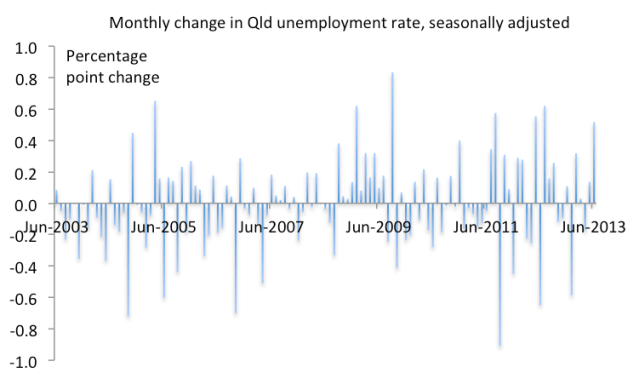
Today’s unemployment figures from the ABS confirm a lacklustre economic outlook for Queensland over 2013-14 as the resources sector slows down, but I think it’s too early to conclude we’re heading for anything worse than expected. That is, based on today’s data, I wouldn’t yet revise Treasury’s Queensland Budget forecast of average unemployment over 2013-14 of 6 per cent. While the seasonally adjusted unemployment rate increased to 6.4 per cent in June from 5.9 per cent in May, it needs to be kept in mind that the seasonally adjusted rate is pretty volatile from month-to-month (see charts below).

Unemplrate

pptchangeQueensland Treasury isn’t over-reacting to today’s figures either, with its information brief noting:

Despite an increase in the number of unemployed and a fall in employment in June 2013, Queensland’s trend unemployment rate remained at 6.0% in the month (see Chart 1), with the trend unemployment rate for May 2013 upwardly revised 0.3 percentage point to 6.0%.

Let’s wait a few more months and see if the trend unemployment rate gets much worse before worrying much more about the state of the economy. As I’ve noted previously, the unemployment rate is still really not that high from an historical perspective:

Qld jobless rate not “historically high”

By the way, on the resources sector slowdown, Mark Beath of Loose Change made some nice observations today in his post:

Last call for FIFO to the coalfields


Posted in Cairns, Labour market, Macroeconomy, Mining | Tagged , , , , , , , , | Leave a comment