Slowdown in Qld mining sector jobs growth, but no slump like in WA yet

MacroBusiness had a good post the other day (Where are the job gains and losses?) based on the detailed quarterly ABS labour force data released on Thursday. MacroBusiness’s charts show very slow growth in mining employment in Queensland and a big drop in mining employment in WA over the year to May 2013. Here’s a chart based on the raw data:

miningjobsGiven the bad news we’ve been hearing out of the mining industry recently I wouldn’t be surprised if Queensland mining industry employment starts to decline over the remainder of the year.  


Posted in Mining | Tagged , , , , , , | Leave a comment

Queensland regional unemployment maps, May 2013

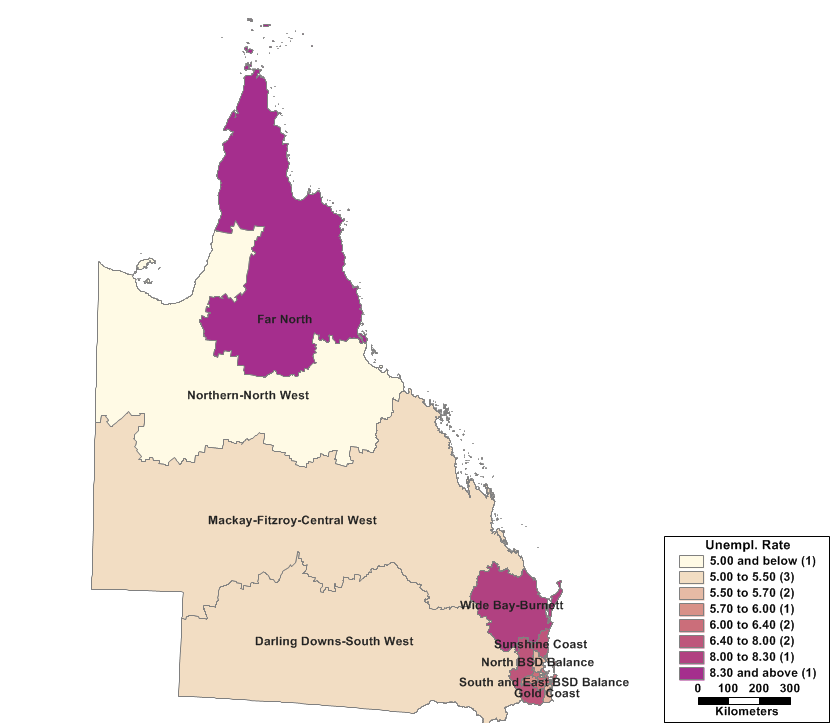
I’ve prepared some maps based on the ABS regional unemployment rate data released yesterday. I’ve taken the numbers from Queensland Treasury’s briefing on the data, which presents 12-month moving averages of the ABS data to smooth out the high degree of volatility in the data. Far North Queensland (FNQ) and Wide Bay-Burnett continue to have high unemployment rates relative to the State average. Here’s a map of the whole State:

Qld May 2013 unemployment rates

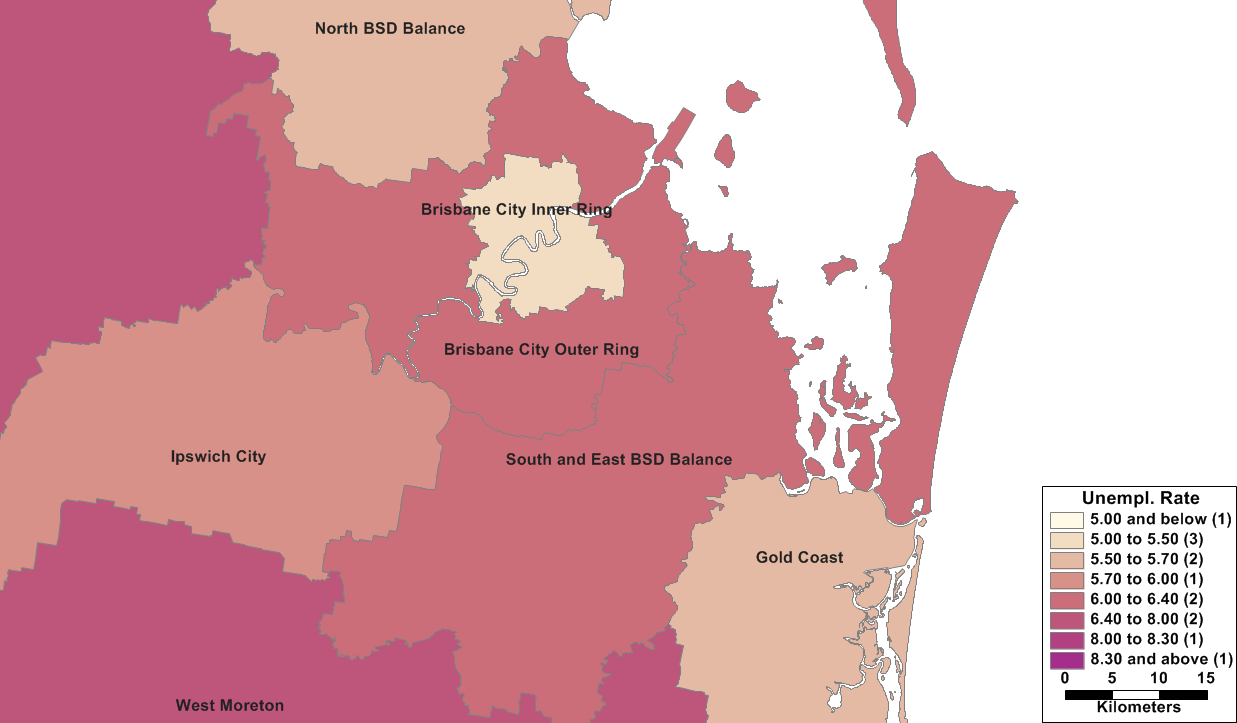
And here’s a close up of the Brisbane metro area:

Brisbane May 2013 unemployment rates

FNQ bloggers Mark Beath and Pete Faulkner have been doing a great job trying to figure out what’s been going on with the extremely volatile FNQ data:

Men on strike?

FNQ employment charts

Pete’s analysis suggests the FNQ labour market has really improved a lot in recent months, and we should start to see this improvement in Treasury’s smoothed unemployment rate measure in the coming months.

Posted in Brisbane, Cairns, Labour market, Wide Bay-Burnett | Tagged , , , , , , , | Leave a comment

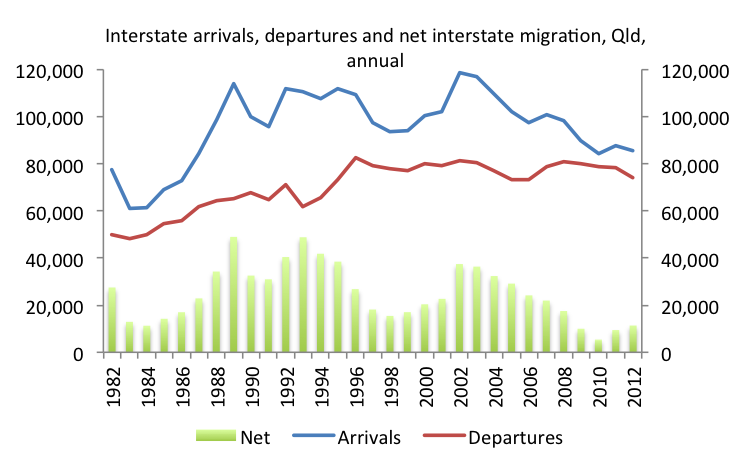
Qld records respectable population growth in 2012 – still waiting for interstate migration rebound

In 2012, Queensland’s population grew 2.0% to 4.61 million people, a respectable growth rate but only slightly above the Australian population growth rate of 1.8% and much lower than WA’s growth rate of 3.5% (see Queensland Treasury’s nice briefing on the new ABS data).  I’ve previously asked when will interstate migration to Queensland recover? It still hasn’t, as this chart based on today’s new data shows:

Interstatemigration

Posted in Migration, Population | Tagged , , , , , , , | Leave a comment

Drum opinion piece – Taxpayer money wasted chasing film productions

The ABC’s The Drum has published an opinion piece of mine:

Taxpayer money wasted chasing film productions

I see very little merit in Government assistance to the film industry, apart from supporting the creation of genuine Australian content that helps tell the Australian story – i.e. movies like Picnic at Hanging Rock or Sunday Too Far Away. Movies like The Sea Hawk or Captain Nemo do not deserve assistance and money should be re-directed to more worthwhile purposes such as education and health. If job creation is the objective of such assistance, why not direct the money to schools, hospitals or cash-starved NGOs which I’m sure could use it to hire support staff?

Posted in Industry policy | Tagged , , , , , , , | 2 Comments

Traditional small business lobby much smaller than it once was – should make trading hours deregulation easier

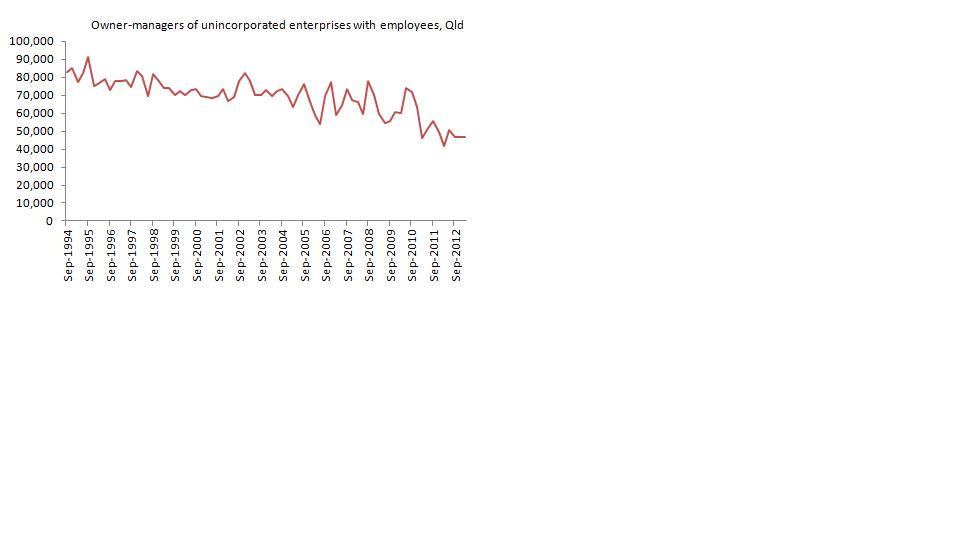
While thinking about retail trading hours the other day, it occurred to me again that the relative decline in traditional corner stores means that arguments in favour of maintaining trading hours restrictions are much less compelling. Across Australia there has been a general trend towards incorporated enterprises and there are fewer unincorporated small businesses with employees, such as the traditional mum-and-dad corner store (see chart for Queensland below). It’s much harder to be sympathetic towards the IGA chain than it would be to be sympathetic to a traditional corner store.

Employers

Posted in Retail trade | Tagged , , , , | Leave a comment

Odd that Treasury is proposing barrier to entry for financial advisers

My former colleagues at the Commonwealth Treasury can generally be relied upon to defend the free market, but occasionally they fail to do so, as appears to be the case with new legislation relating to financial planners reported on by the Financial Review earlier today:

Financial planners have lambasted Treasury proposals that would force advisers to obtain tax and commercial law qualifications, arguing the rules would force many professionals out of the industry.

On Friday, Treasury released a discussion paper detailing the qualifications financial advisers will need to obtain as part of the proposed legislation to bring planners under the Tax Services Agent Act (TASA).

Treasury recommends that financial advisers be required to take courses in commercial and tax law, which it estimates would amount to between 200 and 260 hours of study. In addition, planners would need to have at least 18 months of experience and be a member of a professional organisation.

This seems like an unnecessary barrier to entry that may ultimately constrain competition in the sector and result in higher costs to people seeking financial advice. If Treasury officers are struggling to figure out logical arguments against silly ideas like this one, they should read Milton Friedman’s classic, elegant defence of the free market in either Capitalism and Freedom or Free to Choose. A good place to start would be Chapter IX of Capitalism and Freedom on Occupational Licensure, in which Professor Friedman observed:

 …the great argument for the market is its tolerance of diversity; its ability to utilize a wide range of special knowledge and capacity. It renders special groups impotent to prevent experimentation and permits the customers and not the producers to decide what will serve the customers best.

Treasury should trust the market and not force people to obtain qualifications that may be unnecessary for them to do their jobs and meet the needs of their clients.

Posted in Uncategorized | Tagged , , , , , | 4 Comments

Queensland Plan survey – a mix of interesting philosophical and misguided questions

I found time today to fill out the Queensland Plan survey, which is meant to inform the Government’s development of a 30-year vision for Queensland. I did my best to answer the somewhat vague questions, a couple of which are misguided, being based on a faulty presumption of the Government’s role in the economy and society more broadly. The questions (in bold) and my responses are included below. As a great believer in debating fundamental issues of economic and political philosophy, I’d encourage you to undertake the survey if you haven’t already done so.

In the context of living in the community, how do we move our focus from me to we?

This isn’t a policy relevant question. It’s not the role of Government to offer moral or spiritual instruction.

How do we create and foster an education culture that teaches skills and values to meet global challenges and optimise regional strengths?

We need to improve the quality of teachers at our schools by paying better teachers more and worse teachers less (to give them the incentive to do better or leave), and by investing in ongoing professional development.

How do we empower and educate individuals, communities and institutions to embrace responsibility for an active and healthy lifestyle?

There should be a strong public health campaign against sugar, the over-consumption of which is largely responsible for the high percentage of our population that is overweight or obese. It is unnecessary to consume sugar in the large quantities we do (and coffee tastes much better without it). Obviously we should also encourage people to have active lifestyles and walk, ride or take public transport instead of driving.

How do we structure our economy to ensure our children inherit a resilient future?

Governments should provide essential public services as efficiently as possible and shouldn’t try to determine the structure of the economy. Ultimately, the economy’s structure is not something that can be set, but is rather the outcome of businesses supplying goods and services to consumers as cheaply as they can.

Governments shouldn’t try to pick winners. Broadly speaking, governments should treat industry sectors equally, because a subsidy for one industry (e.g. the film industry) is at a cost to other industries. A subsidy for a favoured industry means there is a higher tax bill that is borne in part by other industries.

How do we strengthen our economic future and achieve sustainable landscapes?

Government policies and regulations should be designed to encourage economic activity and the creation of wealth to pass on to future generations (while ensuring appropriate protection for our natural environment, of course). Currently there exists scope to improve policy settings with a view to enhancing economic outcomes – e.g. by restraining spending, outsourcing more public services, and getting rid of some inefficient taxes such as payroll tax and stamp duty.

How do we attract and retain the brightest minds and ideas where they are most needed and capitalise on global opportunities?

If we get the basic economic policy settings right, the brightest minds and ideas will come naturally. One policy we really need to reform is the set of restrictions on retail trading hours. Our trading hours restrictions are archaic and embarrassing and must annoy many bright minds who visit our cities and towns.

Posted in Queensland Government | Tagged , , | 2 Comments

24-hour retail trading inevitable and desirable

I was very pleased to read in today’s Sunday Mail that Woolworths will open a 24/7 store on Federal Government land at Brisbane airport, avoiding Queensland’s archaic trading hours restrictions. While the Attorney-General has suggested there needs to be a thorough consultation process, I expect this would simply yield predictable responses from affected parties. Economic logic and consumer demand are clearly on the side of deregulating trading hours.

Also, I wonder why there is a presumption that retailers have to prove there is a demand for longer trading hours? Perhaps full 24/7 trading is uneconomic in many locations, but let retailers work that out for themselves as they respond to consumer demand. I expect there is a huge demand for longer trading hours, judging by the number of people who pack into our supermarkets on Saturday and Sunday afternoons just before closing time.

I’ve previously commented on retail trading hours in a number of posts:

West End Aldi could be frontline in battle for retail trading hours deregulation

OBPR recommends fast-tracked review of trading hours restrictions

Setback for Qld consumers as extended Saturday trading hours bid is dropped

Easy way to make Brisbane more liveable

Retail trading hours restrictions holding back retailers

Posted in Retail trade | Tagged , , , , , | 2 Comments

Public service cuts had only temporary impact on unemployment rate

It’s now clear that Queensland public service cuts have had only a temporary impact on the unemployment rate, as I expected and have previously posted on (see Temporary surge in unemployment due to public service cuts and spending restraint). While the unemployment rate increased to around 6.2 per cent in the second half of 2012, it has fallen significantly since then and is now at 5.8 per cent and much closer to the rate in the rest of Australia, based on the latest ABS data:

UnemploymentGood summaries of today’s ABS Labour Force data are provided by Pete Faulkner (Unemployment rate refuses to rise) and Queensland Treasury (Information brief).


Posted in Labour market, Macroeconomy | Tagged , , , , , , | 9 Comments

Is it the right time for a $5M Milton CityCat stop?

La Dolce Vita cafe on Park Rd, Milton is almost a second home to me and, given I live close to the Toowong CityCat stop, I’d benefit a great deal from the Brisbane City Council’s planned Milton CityCat stop (see the 2013-14 Budget, p. 58). Previously I’ve posted on how a Milton stop would be a good way to improve access to the river (Park Rd CityCat stop and pedestrian subways are best ideas for River’s Edge Strategy).

But, given the growing challenge of funding public transport across Brisbane, I’m wondering whether the public benefits of the stop justify its cost. Undoubtedly a Milton CityCat stop would boost trade on Park Rd and stimulate the growth of new cafes, bars and restaurants, which are very much needed, given the precinct now looks a bit dated compared with, say, James St in the Valley. But this may simply be a diversion of economic activity away from another part of Brisbane, so it shouldn’t really be considered a public benefit. In terms of improving population mobility, the Milton CityCat terminal may not be a great investment, given Milton is already well-served by trains and buses, and is indeed only a short walk from the CBD. Further, it strikes me as a bit odd the Council would spend $5M on a Milton CityCat terminal that isn’t really essential at the same time it is having to cut back on public transport services more broadly, as reported by Felicity Caldwell in mX this afternoon:

Fewer new buses will hit the road and CityCat services will be reviewed as City Hall battles to fill a $16 million hole in the public transport budget.

It seems like a funny time to be building a new CityCat terminal.

Previous posts of mine on public transport include:

SEQ’s extensive but costly public transport system requires thorough review

Increased train frequency unviable

Posted in Transport | Tagged , , , , , | 3 Comments