Interstate migration to Qld remains low, probably reflecting sluggish labour market

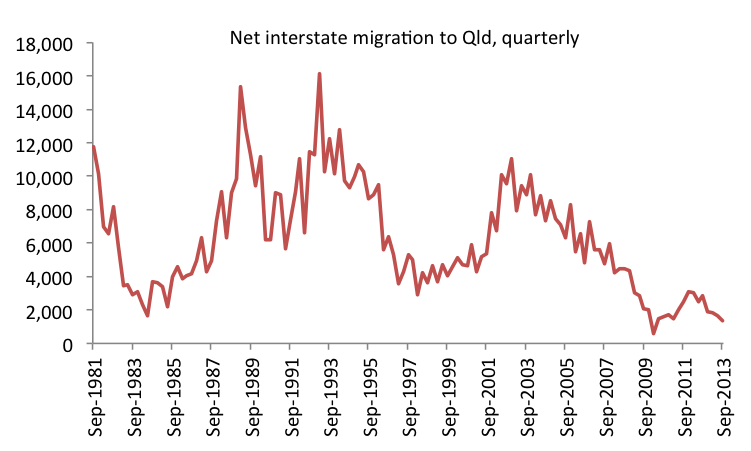
I remember it was once common in Australian TV shows to have characters move to Queensland when the actors wanted to leave the series or a character was no longer popular. The TV shows had obviously noticed the popularity of Queensland to people in southern states. Back in the eighties and nineties, Queensland was attracting many more interstate migrants than it is currently (see chart below).

interstatemigration


As I’ve discussed before (When will interstate migration to Qld recover?), Queensland has had low levels of interstate migration in recent years, due no doubt in part to our relatively lacklustre economic performance. Victoria and WA have just overtaken Queensland in net interstate migration, based on new demographic data released by the ABS today. In the 12 months to September 2013, net interstate migration was around 6,700 in Queensland, 6,800 in WA and 6,900 in Victoria. The Courier-Mail has a nice summary of the data, with some interesting observations by Bernard Salt:

Australian Bureau of Statistics data shows Victoria has overtaken Queensland as most attractive place for Australians to move to

Posted in Migration, Population | Tagged , , , , , , , , | 4 Comments

Trends in private school enrolments – big change in primary school enrolments

A significant trend in education in recent decades has been the strong growth in private school enrolments as many parents have become convinced private schools offer a better and safer school environment. Queensland Treasury’s information brief on the new ABS Schools data for 2013 last week noted:

The proportion of full-time students attending non-government schools has increased significantly in recent years, up by 4.1 percentage points since 2003. [GT: from 29.3% to 33.4%]

A large part of the increase in private school enrolments has been due to a strong increase in the primary school years (see chart below). In the last couple of years, however, enrolments appear to have plateaued across all grades, possibly because of recent cost increases or because all the households which can afford to pay private school fees (and aren’t philosophically opposed to private schools) are now sending their children to private schools. That said, it’s possible that if the economy does perform strongly over the next few years the trend towards greater private school enrolments could resume.

privateschools

Posted in Education | Tagged , , , | 5 Comments

Lower taxes across Australia preferable to special treatment for NQ

The Townsville Chamber of Commerce has called for a revamp of current tax arrangements for North Queensland. The Chamber is concerned the existing Zone Tax Offset has been eroded in value by inflation and is being claimed by fly-in, fly-out (FIFO) workers who don’t reside in NQ. As reported in the Townsville Bulletin yesterday:

The Townsville submission includes a number of recommendations for tax reform.

It calls for tax incentives for critical infrastructure, and tax deductions for residents who invest in “community infrastructure” such as solar panels.

The submission also raises one of the long-held criticisms made by North Queensland leaders – that the north’s contribution to Australia’s revenue from tax and royalties is not reflected in what the Government spends here.

I’ve previously criticised a proposal for special tax treatment for NQ and I maintain the same position that we should improve tax and regulatory policy settings across the whole country rather than favouring one region over others:

Government right in rejecting northern economic zone

We want businesses to invest and workers to live where they are most productive, and these decisions shouldn’t be distorted by tax concessions.

The Chamber is correct that the North makes a disproportionate contribution to the economy and Government revenue – well at least North West Queensland and the Mackay region do due to mining (see my post from last year: Which Qld regions are the most productive per capita?). However, a lot of the infrastructure that has been built to develop the North has been paid for by taxpayers and shareholders across Australia, so I can’t see much logic in the case that tax revenue generated in NQ should be returned to NQ, particularly when there might be more beneficial uses of tax revenue elsewhere in Queensland or Australia.

I doubt the Chamber will be successful in securing significant tax concessions for NQ, as I expect the Treasury will fight very hard against this proposal. In my view, the Chamber should instead focus its efforts on pushing for industrial relations reform in the interests of NQ’s tourism sector (see my post Tourism sector needs IR reform).

Posted in North Queensland | Tagged , , , , , , , | 4 Comments

Qld unemployment hot spots – Ipswich, Cairns and Wide Bay

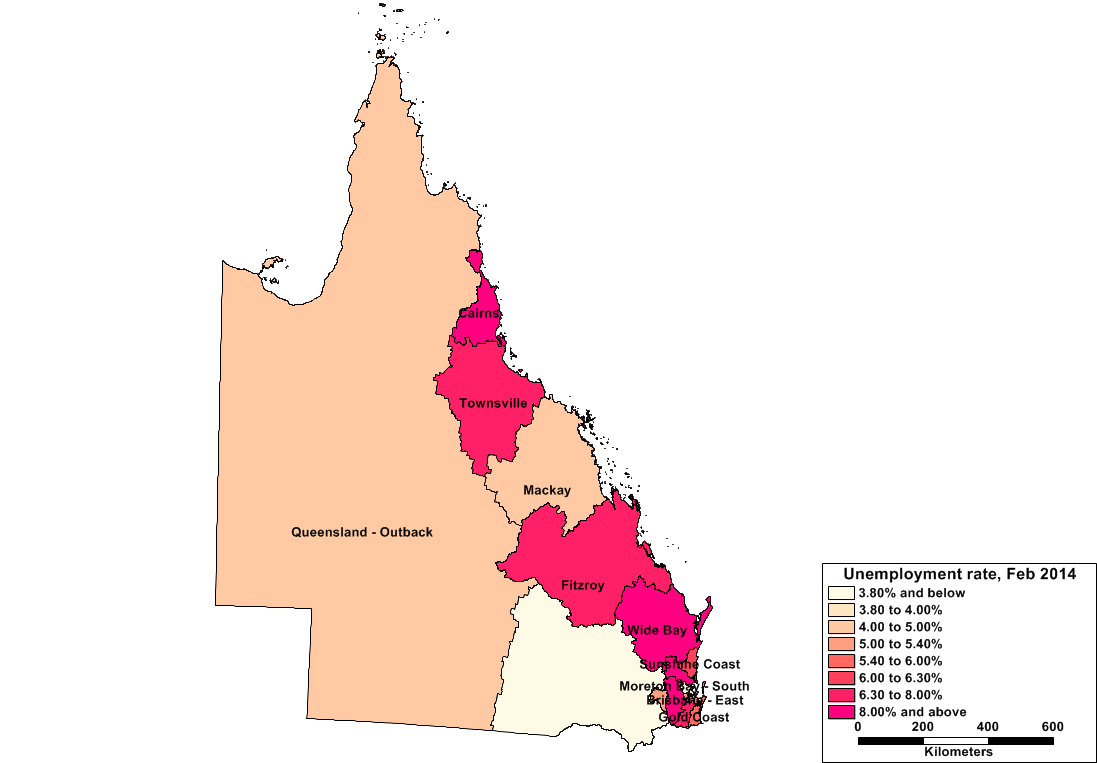
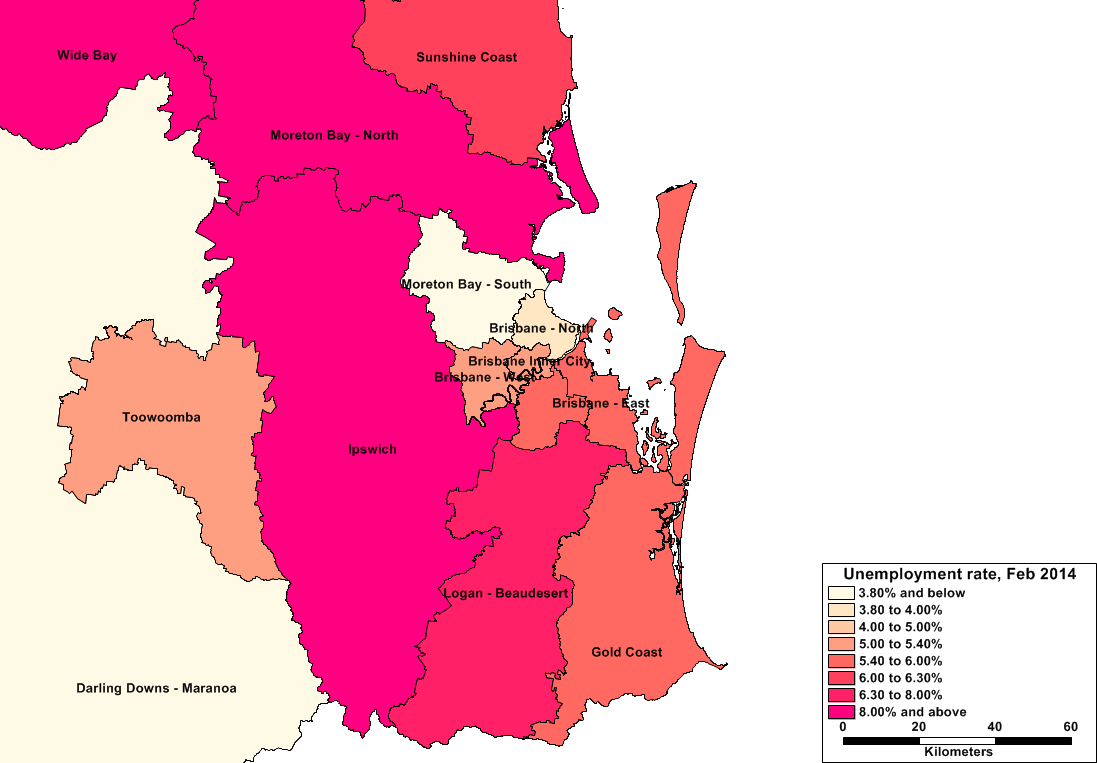
I’ve prepared some maps of regional unemployment rates based on last week’s new regional labour force data from the ABS for February 2014 (see below). The figures I’ve used are taken from Queensland Treasury’s information brief, which presents 12-month moving averages to smooth out the volatility in the data. The Ipswich region has the highest unemployment rate at 8.5% (with the comparable State average at 5.9%). Here’s the Queensland map:

Qld_urate_map_Feb14

And here’s the SEQ closeup map:

Urate_map_SEQ_Feb14

Pete Faulkner and Mark Beath provide good coverage of regional unemployment in FNQ and NQ:

Poor jobs data throughout North QLD

Employment blues continue to play

Posted in Labour market | Tagged , , , , , , , , , | 2 Comments

Qld Treasury right that paying down State debt is a huge challenge

debtprojection

Queensland Treasury’s new Economic and Fiscal Challenges report reiterates the huge challenge ahead in paying down debt and restoring Queensland’s AAA credit rating, which isn’t a likely prospect this decade. The projection that debt levels will stabilise at around $80 billion in a few years’ time and then increase to $120 billion in the 2020s is plausible given trends in government spending, particularly on health services (see chart above from the report).

That said, I doubt we’ll ever see State debt at $120 billion, given it assumes current expenditure and revenue trends, and the Government at the time will have the opportunity to prevent debt from blowing out further. The Treasury projection is a bit like assuming a ship’s captain sees an iceberg ahead and simply lets the ship run into the iceberg without attempting to steer it away. Either the Government will cut expenditure, raise taxes, or sell assets to reduce debt, as flagged by the Treasurer (Queensland Treasurer flags increased taxes and fewer services, as well as asset sales). I’ve previously commented on how asset sales are necessary and desirable:

Qld Government should sell assets – further spending cuts would weaken economy further

Link to my interview on Commission of Audit on ABC Brisbane radio this morning

Qld budget surplus delay not a big deal, but reinforces need to consider Energex & Ergon sell off

Posted in Budget | Tagged , , , , , , , | 5 Comments

Multiple exemptions to evidence-based policy

In recent years we’ve seen a number of colossal Government policy failures, including the National Broadband Network and the home insulation scheme, which is now being investigated by a Royal Commission. These failures have resulted from poor policy development processes at the centre of Government, representing a failure to fully adopt the push toward evidence-based policy in the 2000s. Given the risks that bad policies can pose to the economy, we need to reconsider at least two rules that operate in both Commonwealth and State Governments. These rules are:

  • Cabinet documents are not released to the public for 20-30 years, and
  • Election commitments are not to be subjected to the same level of scrutiny as other policies, as confirmed in a recent guide prepared for Commonwealth Public Servants (see Abbott’s push to reduce red tape by $1 billion per year, and note that this rule has also been applied by previous Governments).

The first rule protecting Cabinet documents means that Governments have got away with some pretty bad policy because the policy development process hasn’t been transparent to the public. The policy development processes around the NBN and home insulation scheme were apparently weak, and this would probably be obvious if the Cabinet documents were accessible to journalists and the public. In this case, knowing that they might be exposed if the evidence for policies was weak and the public would find this out, Governments might push for better policy development and implementation plans. The protection of Cabinet documents only serves the public interest in the case of national security matters or where documents would truly reveal Cabinet deliberations – i.e. in the case of minutes of the meetings recording which Minister said what (if not protected, Ministers might be less than fully frank). Otherwise, there should be a presumption that documents should be released to the public in the interests of transparency and promoting evidence-based policy.

Regarding election commitments, it seems silly to me to suppose that just because a Government has been elected a majority of the people approve of every single one of its policies. Governments have substantially greater resources to research and develop policies than Oppositions, and hence it should naturally be expected that election commitments should be subject to fresh scrutiny after an election. The Commonwealth Government should certainly review its Paid Parental Leave policy, to investigate whether it could be delivered in a lower cost and, arguably, more equitable fashion.

Posted in Budget | Tagged , , , , , | 8 Comments

Weekend reading – 15-16 March

The Productivity Commission’s monster of a report on Public Infrastructure, which (rightly) recommends congestion pricing on roads, is worth reading, particularly because of the excellent Chapter 14 in Volume 2 on Social and Economic Regulation.

On the costs to business of excessive regulation, Nick Behrens from CCIQ made some nice comments earlier this week in his media release Queensland Plan must build from economic platform. Regarding the Queensland Plan, Nick notes:

The draft plan recognises the need for a minimalist approach to governance, which is in keeping with business’s calls to cut red tape and streamline compliance.

Yesterday Queensland Treasury released Population growth highlights and trends, Queensland, which examines population growth in Queensland over the last ten years, which, as I’ve discussed on this blog, has been characterised by a large decline in interstate migration (e.g. see my post When will interstate migration to Qld recover?)

Ben Jensen from the Grattan Institute has written a new report, Making time for great teaching, which makes a good case for the importance of continuing professional development of teachers. I’ve previously commented on the need for raising the quality of teachers: Improving teacher quality key to lifting student performance.

Posted in Uncategorized | Tagged , , , , , , , , , , , , , | Leave a comment

Something for the optimists in today’s labour force data

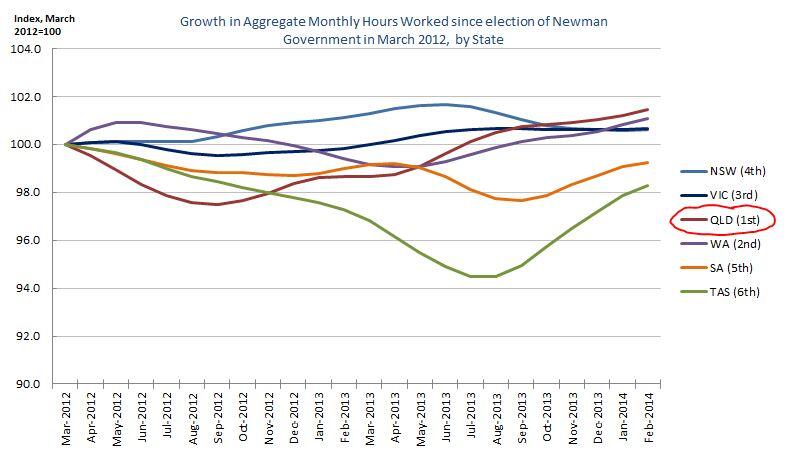
My friend and former Treasury colleague Joe Branigan has found some good news for Queensland in today’s new labour force data. Earlier today, Joe tweeted an interesting chart (see below), showing Queensland has led Australia in the growth of hours worked (in trend terms) since March 2012, when the new Queensland Government was elected. You can check out Joe’s twitter feed at https://twitter.com/JoeBranigan71.

BilSeN4CAAIghms.jpg largeIt’s good Joe is being optimistic, because today’s labour force data for Queensland weren’t really that great at first glance, with the unemployment rate increasing from 6.1% to 6.2% (seasonally adjusted). However, employment growth was strong, and unemployment increased because of rising labour force participation. It could be the economy is recovering, as other data such as those on building approvals and retail trade suggest, and the slight increase in the unemployment rate simply reflects more people entering the labour market and looking for work, because conditions appear to be better. As such, I’m somewhat less worried about Queensland’s rising unemployment rate than I was last month.

For other coverage of today’s labour force data, see the Treasury information brief and Pete Faulkner’s post, Jobs surge. National coverage can be found at MacroBusiness: Boom goes labour market!

Posted in Labour market | Tagged , , , , , , | 10 Comments

Treasury projections suggest Qld Plan regional population target unachievable

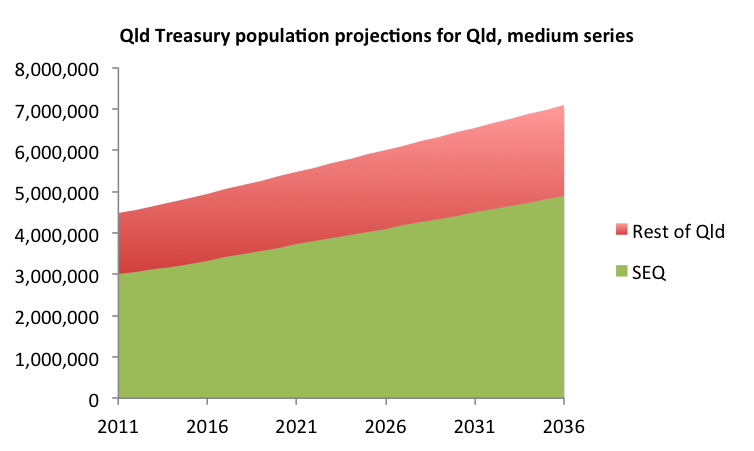
Projections

I’ve previously questioned whether the target in the draft Queensland Plan to have half the population living outside South East Queensland is achievable (see Regional infrastructure plan should be based on updated population projections). The latest official State population projections from Queensland Treasury, which appear to have been released today, show just how difficult that target will be to achieve given that Treasury is currently projecting an increase in SEQ’s share of Queensland’s population over the coming decades. The relevant figures, based on the medium-series projections,  are:

  • in 2014, an estimated 3.18 million people live in SEQ (Greater Brisbane, Gold Coast and Sunshine Coast), which is 67.1% of Queensland’s estimated population of 4.74 million.
  • in 2036, a projected 4.90 million people will live in SEQ, which will be 69.0% of the Queensland population of 7.10 million.

Treasury, of course, will argue that its projections are based on current policy settings and that they don’t take account of any policy measures that may be aimed at reaching the Queensland Plan target, which is true. However, given the existing trend is toward greater concentration in SEQ, it’s hard to see how Government policies could shift nearly 20% of the State’s population from SEQ to the regions. The Queensland Plan target would imply that some 1.3 million people would choose to settle in or re-locate to regional Queensland instead of SEQ, as a result of Queensland Government policies to promote the regions. This sounds highly implausible. The regional population target in the draft Queensland Plan is unachievable and should be scrapped.

Posted in Population, Queensland Government | Tagged , , , , , , | 4 Comments

Large fare savings possible from taxi industry deregulation

My friend and colleague Brad Rogers has a great post at his blog on Queensland Taxi Licenses and Drunken Violence. Brad argues:

Queensland’s taxi regulations are costing the Brisbane public over $80 million per year and may be contributing to drunken violence.  Queensland’s Department of Transport constrains the number of taxi licenses which increases the prices of taxi fares and long periods of waiting at peak periods.  The long lines of drunk people in the early morning on the weekend waiting for a taxi are one of the sources of drunken violence.  Deregulation of the taxi industry will reduce the cost of taxis by an estimated half the current fare and reduce waiting time for customers.  Getting party goer’s people off the street quickly and cheaply will assist in reducing drunken violence. [emphasis added]

While taxi industry deregulation wouldn’t be a complete solution to alcohol-related violence, it would certainly help reduce it to some extent. Regardless, the potential gains to consumers from deregulation are so large we really need to consider it.

Posted in Industry policy | Tagged , , , , , | 7 Comments