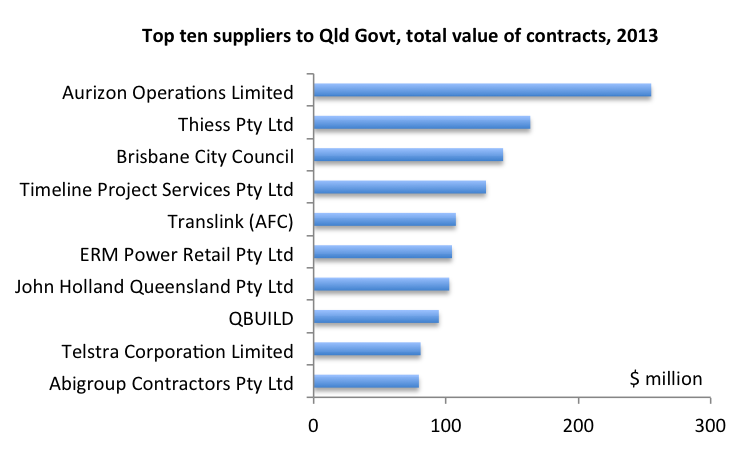
Top ten contractors supplying to Qld Government

Business people and professionals across Queensland will be interested in data recently uploaded to the Queensland Government’s www.data.qld.gov.au website, particularly because it will allow them to check how much Government work their competitors have obtained (Queensland contract disclosure—$10,000 and above). For example, the data set reveals around $6 million worth of Government contracts were awarded to Deloitte in 2013. Based on this data, I’ve prepared the chart below showing the top ten contractors to the Queensland Government. Although the description of the data on the website notes the data are for contracts awarded by the Queensland Government over the last six months, the data appear to relate to the whole of 2013 from an examination of the data set.

Suppliers

Posted in Budget, Queensland Government | Tagged , , , , , , | 2 Comments

Growing Chinese visitor numbers great news for Qld tourism

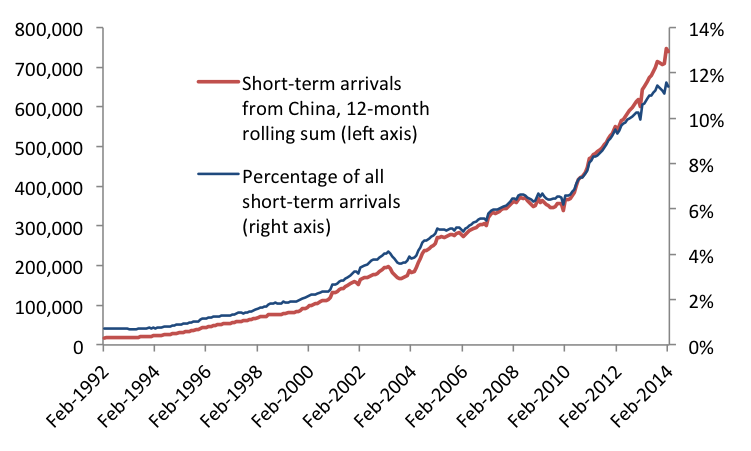
Mission Beach blogger Pete Faulkner has been closely following Chinese visitor numbers, given that many tourism operators, especially in the Far North, are hopeful that Chinese tourism will revive their industry. Regarding yesterday’s new overseas arrivals and departures data from the ABS, Pete notes (Chinese arrivals trend continues to grow):

Chinese arrivals into Australia over the past 12 months are now approaching 3/4 million and, with over 20% of these coming into Cairns, the positive impacts on the FNQ tourism sector continue to be significant.

You can see the strong trend over the last couple of decades in the chart below of Chinese short-term arrivals to Australia:

China

Other potentially good news for Queensland tourism was the Foreign Investment Review Board’s approval last month of the purchase of land for the Aquis mega-resort at Yorkeys Knob, just north of Cairns (Chinese developers get OK for $4.2 billion mega-resort near Cairns). While this is likely a positive development for the regional economy, some community members are concerned about possible environmental and social impacts. Cairns blogger Mark Beath has been providing ongoing critical analysis of this proposal, including this recent post:

Why no circus in Aquis Casino proposal?

Posted in Cairns, North Queensland, Tourism | Tagged , , , , , , , , , , , | 4 Comments

QCA review of Qld Govt industry assistance is great news

The Queensland Competition Authority has announced that the Government has commissioned it to review State Government industry assistance (see Review of Queensland Government Industry Assistance), which the Productivity Commission has previously estimated at over $800 million per annum (See Scope to cut Qld Government industry assistance). It’s a wide-ranging review which I expect will cover all forms of industry assistance, including grants to businesses, subsidies to industry through lower electricity and water prices (e.g. for sugar cane farmers and irrigators more broadly), concessional finance (e.g. through Screen Queensland), and tourism promotion expenditure.

I expect the QCA will identify large potential savings for the Queensland Government, given a lot of industry assistance cannot be justified from an economic perspective. While there is a case for some Government assistance to promote innovation, there are Commonwealth programs that do this (such as the R&D tax incentive), and a lot of what State Governments do is to give money to industry for things that it should be paying for itself.

Among others, important issues for the QCA to consider will include:

I wish my friends at QCA well for this review, as I expect it will make a signficant contribution to improving the State’s budget balance over the next few years.

Posted in Industry policy | Tagged , , , , , , , , , | 3 Comments

Dr Parkinson right that the GST should be broadened

I was pleased to see the Treasury Secretary, Dr Martin Parkinson, suggest today that the GST should be broadened to cover currently excluded items – i.e. health, education and fresh food (see Fiscal sustainability and living standards – the decade ahead). Broadening the GST could boost GST revenue by up to 20% or around $10 billion. This would mean an extra $2 billion to Queensland, assuming it flows to the States as per current practice and the Commonwealth doesn’t cut other payments to the States (so that it would effectively secure the increase in GST revenue). I’ve previously commented on the need to broaden the GST:

Government has to rely on inefficient taxes to fix budget – GST reform needed

GST changes should be considered as part of wide-ranging tax and expenditure review

I’ve also previously spoken about what I learned from Dr Parkinson when he was my Executive Director in Treasury’s Macroeconomic Group in the mid-2000s:

Speech to UQ Economics School Scholarships and Awards night

Dr Parkinson has been a big influence on many people who have walked the halls of the Treasury building, and I’m sure many of my former Treasury colleagues will be pleased that the PM has asked him to stay a bit longer (see Treasury chief Martin Parkinson earns temporary reprieve from axing).

Posted in Tax | Tagged , , , , | 8 Comments

Challenging labour market conditions for young Australians

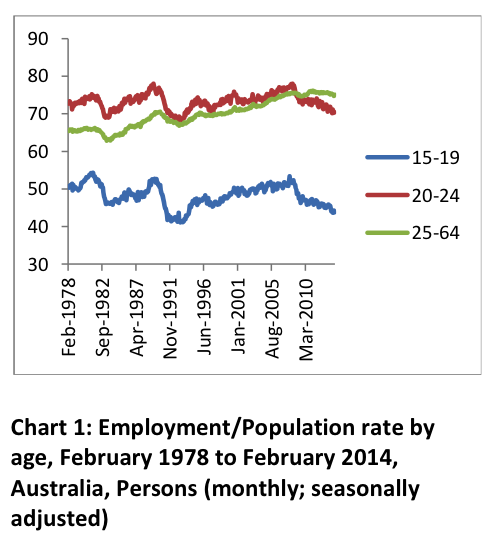
Professor Jeff Borland has recently published an informative labour market snapshot on What is happening to jobs for the young? As Professor Borland notes, employment opportunities for young people have declined significantly over the last few years as employers have become more reluctant to take on new people, particularly inexperienced young people. As a result, the percentage of young people in employment (the employment-to-population ratio) has fallen significantly (see the chart below I’ve copied and pasted from Borland’s snapshot, which is based on national data).

Borlandchart

As I’ve posted on before, we don’t make it easy for young people to find work, as we have a number of regulations that inadvertently restrict employment opportunities for young people:

Reduce youth unemployment through improved regulation – e.g. of penalty rates, taxis

Given the growing concern over youth unemployment, there is an extra urgency for the reform of regulations that make it harder for young people to find work.

Posted in IR, Labour market | Tagged , , , , , | Leave a comment

Catholic schools still benefiting from very favourable funding deal from Howard Govt days

I’ve received several interesting comments on my post Large savings for Qld Govt from shift to private schooling, including the comment below from a representative of independent schools (i.e. non-Catholic private schools such as BBC, Somerville House and the grammar schools):

…the main issue I wanted to alert you to was in relation to your suspicion/assumption about the difference in funding between the two private schools you used as examples, Brigidine and BBC.

It is true that a portion of the difference in federal funding relates to the differences in socio-economic status (SES) of the schools. The SES data, not ICSEA, is used for this funding formula.

BBC has a SES of 122, I think, and Brigidine has 115. On that basis, there would be some differential, but far smaller that the actual difference that you portrayed in your graph.

The major cause of the difference is that the Catholic schools system negotiated a special deal with the Howard government, which has been perpetuated by the Gillard government’s Gonski response. That means that all Catholic schools, regardless of their SES (and parental capacity to pay) are funded at the minimum SES level of 101 (in Qld). So Brigidine’s fairly wealthy parents get a massive federal subsidy, while BBC’s slightly more wealthy parents get a minimal subsidy. While the converse is true (that poorer catholic schools get the same level) there is an overwhelming benefit to catholic schools, most of which are above the 101 SES level.

This can be seen in the table referred to in the attached website… http://docs.education.gov.au/node/35461

The last column in the table reflects their funding, while the prior column reflects the true SES.

You will see that BBC’s SES is their actual funding level, while Brigidine’s is at the standard catholic level of 101 – a much higher level of subsidy. If you want a more extreme example, search for St Joseph’s school, Bardon, which at 125 has the highest SES in Qld (from memory), but still gets funding at the SES level of 101.

Based on the above, the current funding model appears to give highly favourable treatment to the Catholic school system compared with independent schools. Arguably, it is inequitable and confers an unfair competitive advantage to Catholic schools, and it should be reviewed.

Posted in Education | Tagged , , , , , , , | 2 Comments

CairnsWatch remains optimistic despite very weak Cairns labour market

Rick Carr of Herron Todd White Cairns has released the March edition of his excellent CairnsWatch report, and it contains this disturbing chart of employment in the Cairns region, which suggest a very weak economy:

Cairns_employedLet’s hope employment in Cairns begins to stabilise and trend upwards soon, so a nasty dynamic doesn’t arise whereby people leave Cairns because of a lack of job opportunities which further adversely affects the economy. Thankfully, at least some indicators for Cairns are good, as CairnsWatch notes:

Cairns continues to experience a mixed economic recovery, with strong forward tourism and construction indicators but a relatively weak labour market.

You can check out those other indicators in the CairnsWatch report linked to above. Other recent commentary on the Cairns economy includes:

Poor jobs data throughout North QLD

Employment blues continue to play


Posted in Cairns | Tagged , , , , | 3 Comments

Qld taxi queues compared to bread lines in Soviet Russia

On 612 ABC Brisbane radio this morning, Steve Austin interviewed my friend and colleague Brad Rogers on Queensland’s highly regulated taxi industry. In the interview, Brad discussed the large cost that the restricted supply of taxi licences imposes on consumers and the possible contribution the restricted supply makes to drunken violence:

Economist says taxi regulation could be contributing to drunken violence

Memorably, Brad compared late night queues for taxis to bread lines in Soviet Russia. Just as Soviet planners couldn’t ensure sufficient bread for Russian citizens, Queensland Transport bureaucrats can’t ensure sufficient taxis for Queenslanders. You need to let the market work and trust that supply will meet demand. Great interview, Brad!

Brad has posted on the regulation of Queensland’s taxi industry on his own blog BJREconomics:

Queensland Taxi Licenses and Drunken Violence

Posted in Transport | Tagged , , | 5 Comments

Large savings for Qld Govt from shift to private schooling

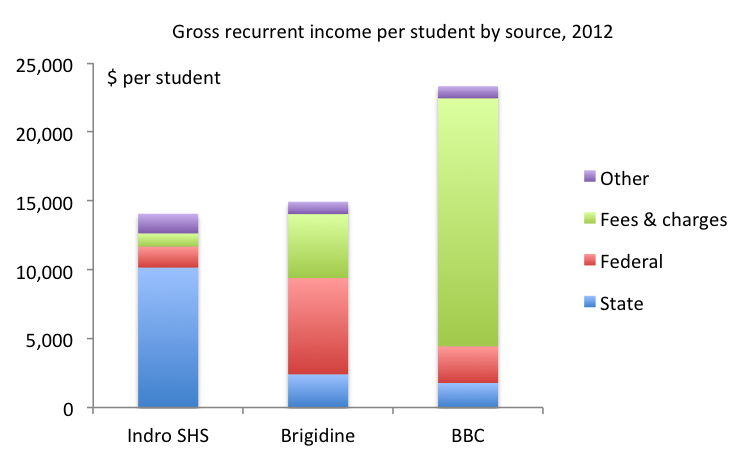
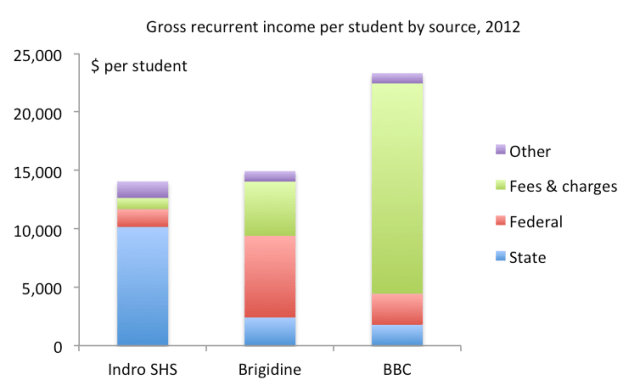
Last week I posted on trends in private school enrolments, and my colleague and friend Brad Rogers commented to me that the shift to private schooling is bringing significant savings to the State Government. While State Schools receive the bulk of their funding from the State Government, private schools receive large amounts of funding from parents and the Federal Government, and the State Government contributes much less. A simple comparison of some schools in my local area shows the thousands of dollars of savings that accrue to the State Government per student, if a student is shifted from a State High School such as Indooroopilly (Indro) SHS to a private school such as Brigidine or Brisbane Boys College (BBC) (see chart below based on My School data).
schoolfunding


While the State Government saves a large amount of money when a student shifts from a State School to a private school, a fraction of this saving ends up being replaced by the Federal Government, which provides significant funding to private schools – although the level of this funding varies greatly across schools. I suspect the differences in Federal funding between Brigidine and BBC reflect the socio-economic mix of students. BBC’s ICSEA (Index of Community Socio-economic Advantage) score is 1,168 compared with Brigidine’s score of 1,103 (N.B. average is 1,000), which would mean BBC receives less Federal funding than Brigidine on equity grounds.

Overall, for every private school student, the State Government appears to be saving around $8,000 per student per annum. A back-of-the-envelope calculation tells me that, if private schools had remained at the 29% share of Queensland students they had in 2000 rather than increasing to a 33% share by 2013, the State Government would have to spend up to an additional $300 million per annum on the State’s education system.

N.B. for simplicity, in making the above calculation, I have ignored capital funding for schools and have ignored any average cost differences that may exist between primary and secondary students.

Update. See my more recent post Catholic schools still benefiting from very favourable funding deal from Howard Govt days, which corrects my misunderstanding of the reason for the difference in Commonwealth funding between BBC and Brigidine.

Posted in Education | Tagged , , , , , , , , | 13 Comments

Queenslanders moving to Victoria

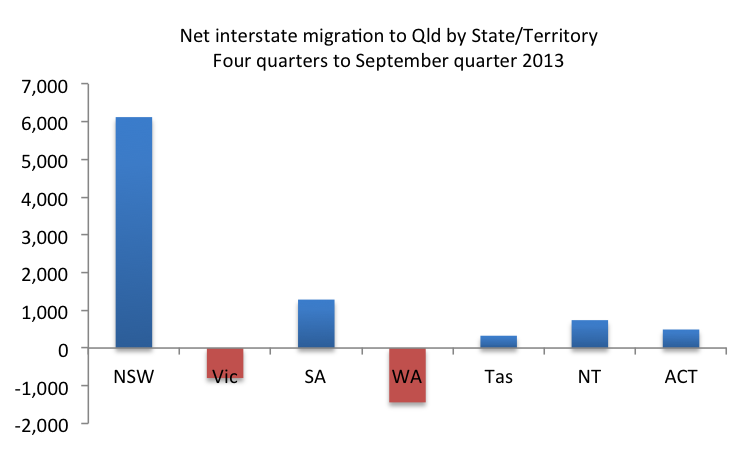
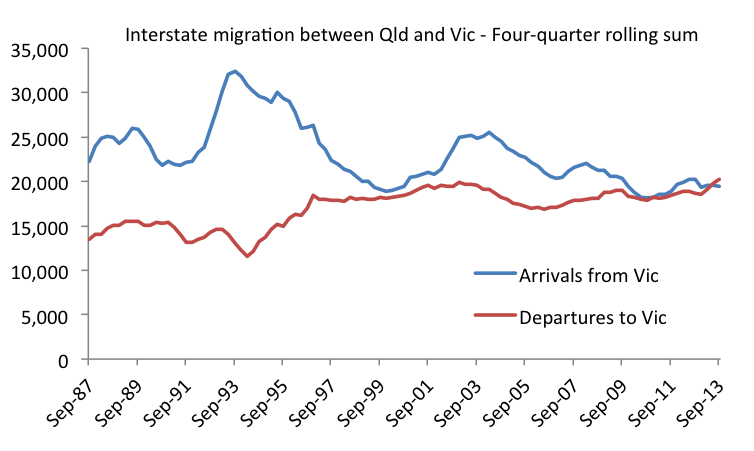
A closer look at the new population data from the ABS shows just how attractive Victoria has become to interstate migrants, including interstate migrants from Queensland. While Queensland is still attracting interstate migrants, as I’ve discussed in earlier posts (Interstate migration to Qld remains low), we aren’t attracting as many as in previous years and we’re no longer gaining interstate migrants from Victoria. Indeed, we’re now actually losing people to Victoria (see chart below on net interstate migration – i.e. arrivals to Qld from a particular State less departures from Qld to that State).

Net_by_State


Arrivals to Queensland from Victoria have dropped over time, but departures to Victoria from Queensland have increased over time, and now slightly exceed arrivals (see chart below).

Vic

I’ve written before about how Victoria is marketing itself much better than Queensland (Qld should look to Victoria for tips on tourism promotion). It appears many Queenslanders agree.  Clearly career opportunities in Melbourne are an important reason to relocate for many people, but no doubt Melbourne’s reputation as a cosmopolitan city with great restaurants, cafes and bars is also important.

Posted in Migration, Population | Tagged , , , , , | 4 Comments