Government should throw out Queensland Plan – it was a poor guide to future policy

site-name-v2I noticed that Mike Kaiser, labelled by the Courier-Mail as a “Queensland Labor stalwart,” has urged the new Queensland Government to retain the Queensland Plan that was developed by the previous Government. I disagree with Mr Kaiser that the Queensland Plan was a sound approach, and I would be very happy to see it go. The Queensland Plan contains a lot of high-level, motherhood statements and provides a very poor guide to future policy.

The development of Government policies requires detailed analysis on an issue-by-issue or project-by-project basis, and a glossy, high-level plan such as the Queensland Plan can’t do this. The lack of detailed analysis is apparent in one of the major policy targets set in the Queensland Plan: to double the regional population outside South-East Queensland. There is no real analysis in the Plan of what this would cost and what it would mean for State economic performance. Targets shouldn’t be set without undertaking detailed analysis of whether achieving the specified target is feasible and would yield net benefits to the community.

The Queensland Plan was a waste of taxpayers’ money and took valuable time away from the former Government – time that it should have spent on detailed policy analysis and development. I would be very pleased if the new Government threw out the Plan. Indeed, I was a critic of the Queensland Plan even when it was in its developmental stage:

Qld Plan survey – a mix of interesting philosophical and misguided questions
Posted in Population | Tagged , , , , | 2 Comments

PwC Budget breakfast tickets on sale – business sees need for budget repair, even if politicians don’t

Howard2003

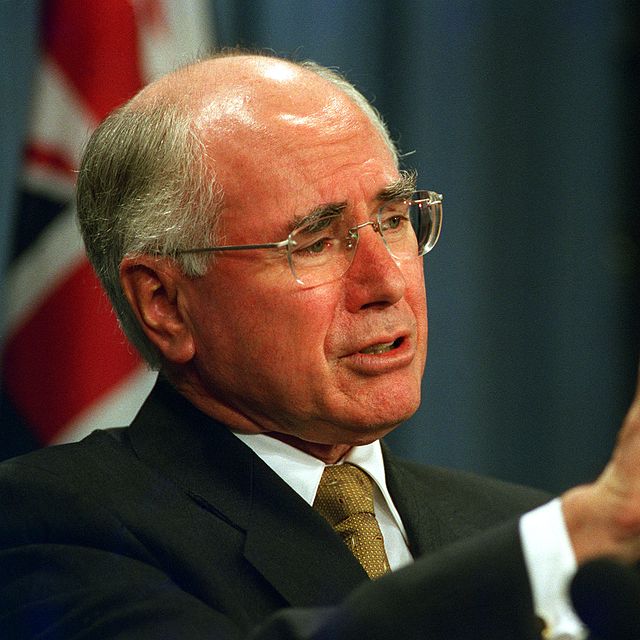
Former PM John Howard, who will speak at PwC’s Federal Budget Breakfast in Brisbane on 13 May

On the morning after the night the Federal Budget is delivered, the most desirable tickets in Brisbane are to PwC’s Budget Breakfast, which this year will again feature former PM John Howard, the Queensland Treasurer (although a new one this time, Curtis Pitt), Peter Switzer, and a few PwC senior executives. If you’d like to attend, I’d recommend buying a ticket as soon as you can off the PwC website.

I’ve noticed that PwC has labelled this year’s Budget breakfast “Prepare for repair”, which appears a bit optimistic, given the PM’s recent worrying comment that, more-or-less, our debt really isn’t so bad after all. Although the business community and the majority of economists see a clear need for budget repair, sadly the Government appears to have given up. After the political debacle of last year’s Budget, it’s pretty clear that the Federal Government won’t be proposing any major budget repair measures this time, which is a real shame—given the recent Intergenerational Report basically confirmed Australia has a large structural budget deficit, and we’ll have to get used to permanent deficits and growing debt.

I expect this year’s Budget will be very poorly received by the various speakers at the Budget breakfast. Indeed, Peter Switzer in particular will be very disappointed with the Government. To those who were in the audience last year, he will need to explain why his prediction that last year’s budget was a “Blackadder Budget”, with a cunning plan afoot, turned out to be so wrong (see my post on last year’s PwC Budget breakfast).

Posted in Budget | Tagged , , , , , , | Leave a comment

Addressing youth unemployment requires reform of workplace relations policies

teenage_unemployment_Feb15

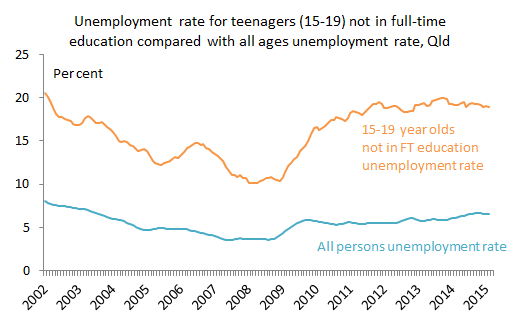
Youth unemployment has re-emerged as a significant problem in recent years (see chart above), partly as a result of the general economic sluggishness since the financial crisis. Also, Australia’s inflexible workplace relations regulations are likely playing a role, and youth unemployment would be lower with a more flexible regime. Workplace relations is a big issue for Queensland businesses. Regarding a joint submission with other industry bodies to the Productivity Commission’s workplace relations inquiry, Nick Behrens from CCIQ commented (see Qld industry bodies join to call for IR overhaul):

“This will be the biggest issue for businesses for 2015…We have to move away from a regime that seeks to protect employees against the worst case of the employer – to the detriment of the vast majority who do the right thing by their workers.”

I’ve previously commented on the youth employment boost that could come from deregulation in a number of areas:

Reduce youth unemployment through improved regulation – e.g. of penalty rates, taxis

Posted in Labour market | Tagged , , , , , , , , | Leave a comment

Cafe culture prevents employment slump

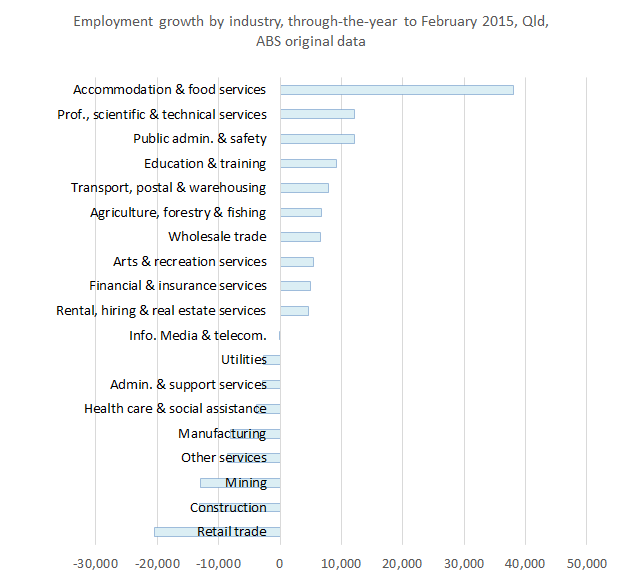
I recall Alan Kohler observing a while ago that everyone is eating out for breakfast on the weekends nowadays. It’s a good thing that people are, from an employment perspective, given that employment growth in cafes, restaurants and hotels has basically prevented the labour market from completely stalling in Queensland, which it may have done, due to the contraction in mining and mining-related construction (see chart below, particularly the bar for accommodation and food services, which includes cafes). I expect the recovery in tourism due to the lower exchange rate has had something to do with employment growth in the accommodation and food services sector, too.

employmentgrowthxindustry

Posted in Labour market | Tagged , , , , , , , , , | Leave a comment

Qld Government will find it a big challenge to achieve its fiscal strategy

Queensland Treasurer Curtis Pitt has rightly labelled the upcoming 2015-16 Budget as “no frills” (see ABC news report). The Government cannot afford any frivolous expenses, because the budget challenge it faces is massive. The major problems the Government has are:

  • limited funding for new infrastructure – the previous Government had relatively low capital expenditures budgeted for in the forward estimates, because it was expecting to use money from leasing out assets, which hadn’t been accounted for in the budget yet, to pay for a lot of new spending (see New Government faces big fiscal challenges); and
  • the Government has committed to paying down around $1.7 billion of debt per annum from 2018-19 onwards, which will require it to maintain the previous Government’s expenditure restraint and assumes no write downs in revenues over the forward estimates.

The 2015-16 Budget will include estimates for 2018-19 in its projections, and the Government will need to show how it will achieve the $1.7 billion surplus it will need in 2018-19 (see my comments on why a surplus is required and the debt reduction trust is a gimmick in my Black hole election presentation). This was always going to be a challenge. Recall the previous Government was only projecting a surplus in 2017-18 of $634 million, so the commitment in the Government’s fiscal strategy assumes favourable trends continue into 2018-19 and the surplus grows even larger.

Now, achieving the Government’s fiscal strategy appears to be an even bigger challenge, given the Treasurer’s speech yesterday can be interpreted as expectations management, preparing us for a Budget in which there is even less money to spend in the future due to revenue write downs, particularly of royalties.

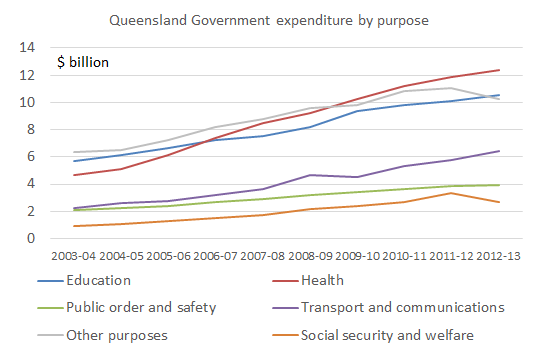
The Treasurer is in an unenviable position. Revenue may not live up to expectations, but expenses, particularly in health, will rise inexorably. Health accounts for nearly 28% of the budget and the share is ever-increasing, as health expenditure typically rises much faster than other expenditure items (see chart below). Indeed, health wasn’t always the function the Government spent the most money on; once that was education. The Government will need to take a hard look at health spending and see if further savings are possible, if it is to give itself a good chance of achieving its fiscal strategy.

Spending

Posted in Budget | Tagged , , , , , , , , , | 2 Comments

Queensland Treasury’s forecasting record on royalties

I’ve written before about the big fiscal challenges facing the Queensland Government, and about how concerning it is that the Queensland Treasury is now as reliant as it is on volatile revenues such as royalties (see Qld Govt increasingly dependent on volatile royalties revenue).  The volatility of royalties adds additional difficultly to developing the State Budget, because the Government can’t be confident future royalties estimates will be realised. Forecasting royalties can be challenging because the Treasury needs to make assumptions about variables that are difficult to forecast such as coal production, international coal prices and the exchange rate. So, I don’t intend to criticise Treasury, but rather would like to point out that the Government needs to consider that some of the money it thinks it has to spend might not actually turn up.

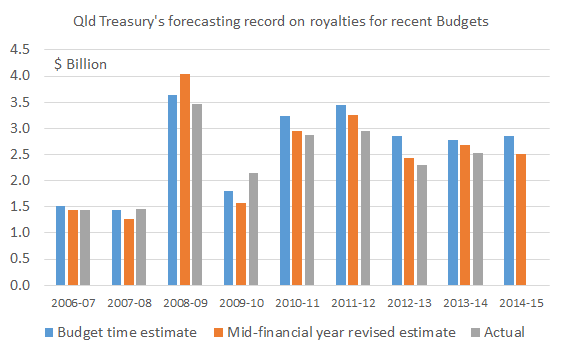
Consider the revisions in royalties estimates that occur within just one Budget year. The chart below compares Queensland Treasury’s forecast of royalties at the time of each Budget (typically held in June) with the revised estimate for that Budget year roughly six months later, and then with the actual royalties figure that eventuated. Unfortunately, at Budget time, typically, the Treasury appears to have been significantly over-estimating the royalties that would be available for governments to spend.

Treasury_royalties_forecasts

The chart shows that, even over six months, Treasury’s estimates of royalties can change by hundreds of millions of dollars. Indeed, between June and December last year, the previous Government revised the royalties estimate for 2014-15 from $2.85 billion to $2.51 billion, a downward revision of $340 million. Given the downturn in the resources sector, it is possible the 2014-15 estimate could be revised down further at Budget time later this year. And the Treasury must certainly be starting to worry about how robust those forecasts of $3-4 billion per annum in royalties from 2015-16 onward are now.

Posted in Budget | Tagged , , , , | 2 Comments

New SUV sales surge – pent-up demand possibly playing a role in pick up in new motor vehicles sales

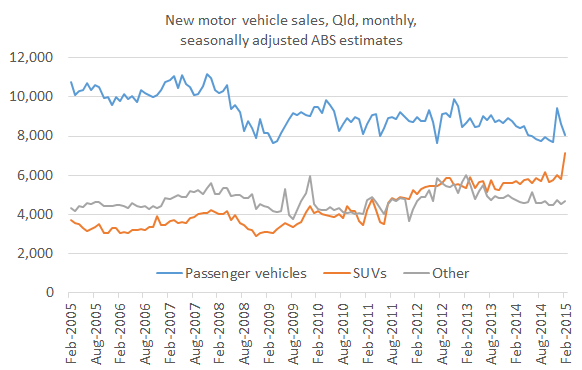
New motor vehicle sales in Queensland were 4.7% higher in February than in January in seasonally adjusted terms, driven by a surge in SUV sales, which could eventually overtake sales of passenger vehicles (see chart below based on ABS data released yesterday).

New_vehicles_Feb15

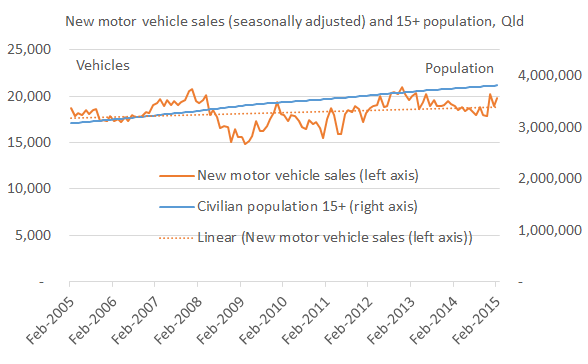
It’s likely there is an element of pent-up demand in the recent pick up in sales. Over the last ten years, while the population aged 15 and over has increased by 24%, new vehicle sales have increased by less than 6% (see chart below). Consumers may have been holding off on buying a new car due to the economic uncertainty since the financial crisis, but the need for a new car might be becoming overwhelming for many. We’ll need to wait and see if the current pick up continues before drawing any firm conclusions. A sustained pick up in new vehicle sales really doesn’t seem consistent with the short-term economic outlook.

vehicles_vs_pop_v2

Posted in Macroeconomy | Tagged , , , , , , | 4 Comments

Upcoming event on drivers of Qld economy – presentation by James Keating from QCA

The French-Australian Chamber of Commerce has organised an interesting event for Wednesday evening, 1 April in Brisbane CBD, featuring a presentation by James Keating from the Queensland Competition Authority:

Which industries are currently driving the Queensland economy?

I’m very interested in hearing James’s views on what industries might make a greater contribution to the economy now that mining is in decline. Based on recent building approvals data, it appears residential construction will make a much greater contribution (see Apartment and townhouse approvals double in January). Also, aged care, health and education will surely continue to grow in economic importance over the next few years.

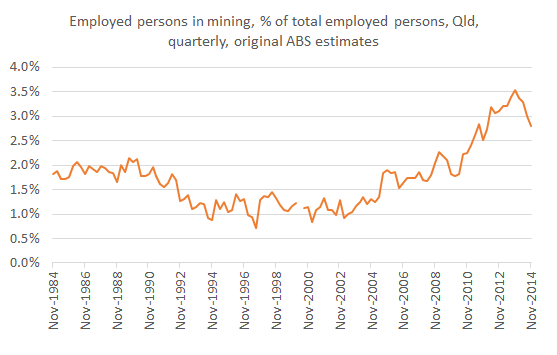
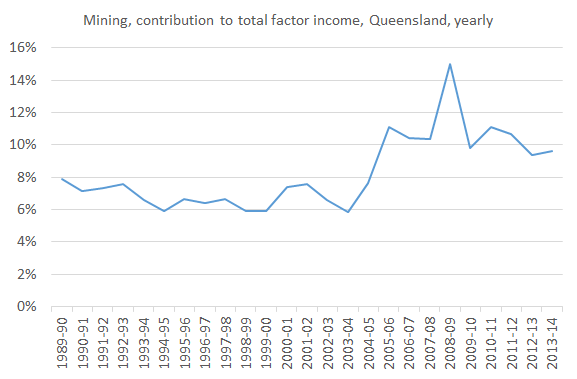
Given the large economic shock coming from the mining downturn (e.g. see Qld receiving huge economic shock from resources sector capital spending decline), let’s hope these other industries perform strongly over the coming years. While the importance of mining to Queensland has waxed and waned over the decades (see charts below), and the Queensland economy is much more than any one sector, there is no doubt the mining downturn will create hardship for many workers and businesses, and will cost the Treasury a large amount in lost royalties.

mining_employment_percentage

economic_contribution

Posted in Housing, Mining | Tagged , , , , , | Leave a comment

Urban sprawl filling in the 200km City

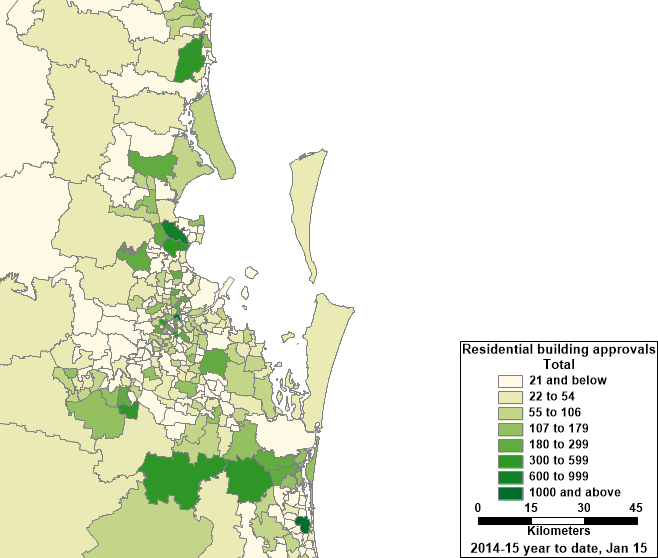
In the first seven months of financial year 2014-15, the top five suburban areas in Queensland for residential building approvals were: Newstead-Bowen Hills (1,358 approvals), Southport (1,305), North Lakes-Mango Hill (612), Caloundra-West (406), and Jimboomba (401) (see map below based on ABS data). The developments in North Lakes-Mango Hill and Jimboomba, along with developments in other areas such as Springfield and Ripley in Ipswich, mean that urban sprawl is progressively filling in undeveloped areas of South-East Queensland, which is undoubtedly becoming a 200km City (see my post Perth might grow larger than Brisbane, but it won’t beat SEQ 200km City). As I noted in my post last Friday, the pattern of development we’re seeing partly reflects development restrictions in Brisbane, and hence may be undesirable from economic and social perspectives.

200km_city_approvals_Jan15

Posted in Housing | Tagged , , , , , , , , , , | 6 Comments

State & local govts need to allow development to boost housing supply – Gap mega-suburb would be a good start

Now that likely future PM Malcolm Turnbull has highlighted the “big supply side issue” in Australia’s housing market (see yesterday’s Australian), it would be timely for State and local governments around Australia to review their regulations and charges, which many commentators consider are holding back development. A good start in our State would be for the Queensland Government to forget about its objections to the so-called mega suburb near the Gap in Brisbane, which it has decided to review (see Govt may step in over Upper Kedron mega suburb).

Last month, in a media release Land supply pressures mount the Housing Industry Association’s Shane Garrett was critical of the lack of land supply across Australia, noting “Policymakers have to intervene in order to allow for Australia’s long-term housing needs to be met.” The issue extends beyond the debate over developer charges and their impact on new land supply, and includes consideration of the grey tape of heritage protection that restricts development in our inner cities. My friend and fellow ESA Qld committee member Brad Rogers was highly critical of the protection of old Queenslanders in Brisbane in a great article first published on this blog in 2013:

Old Queenslanders in a new city

Brad was also interviewed by Steve Austin of 612 ABC Brisbane on the issue:

Death to the Queenslander

Having a more reasonable attitude to development in the inner city would allow for a boost to supply and a better matching of the supply that is provided to demand. While there is currently an apartment building boom in Brisbane, this appears to be occurring mainly in old commercial and industrial areas such as those in Milton and Newstead. This will provide much needed housing to young people (and baby boomer empty nesters) who want to live close to the city, but the apartment developments aren’t really suitable for families who need to look further away, to places such as Springfield and North Lakes. A relaxation of planning regulations in Brisbane’s inner city could allow for the development of more medium-density, family friendly developments, such as townhouses with communal gardens.

As noted by Tony Hall in his chapter in the book A Climate for Growth (pp. 168-169):

…current British practice shows how it is possible to achieve house-and-garden form at densities two to three times those in SEQ. Such types of higher density housing could facilitate both sustainable building techniques and an architectural style appropriate to the subtropical climate and cultural traditions of Queensland.

In summary, current government policies mean that not enough housing is being provided in aggregate, and, in those pockets where supply is booming, the type of housing – i.e. apartments in high-density developments – isn’t suitable or desirable for many families. Hence there is an urgent need to reconsider current policies.

Posted in Housing | Tagged , , , , , , , , , , , | 2 Comments