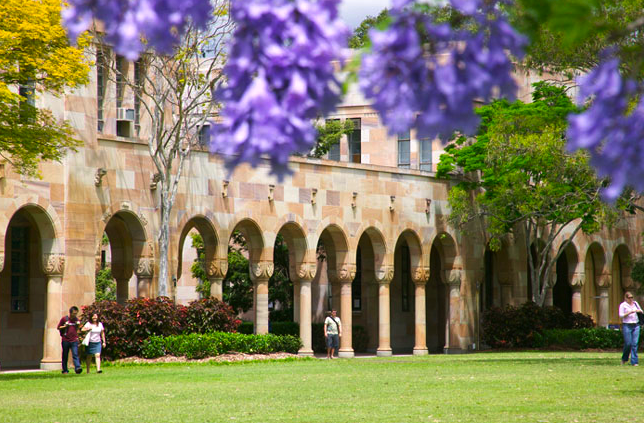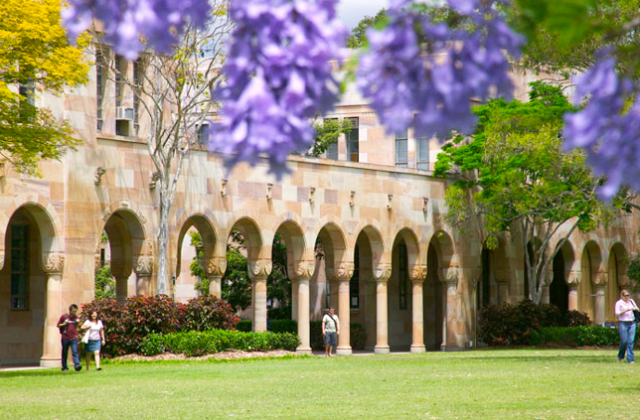
Our very own University of Queensland is a world leader in MOOCs. (Image attribution: By James Dover (Own work) [CC BY-SA 3.0 (http://creativecommons.org/licenses/by-sa/3.0)%5D, via Wikimedia Commons)
Last Thursday night, at the University of Queensland’s Customs House in Brisbane, Emeritus Professor Roly Sussex OAM gave a terrific lecture on a recent “game changer” for universities: the rise of Massive Open Online Courses, abbreviated to MOOCs. What makes MOOCs special is that anyone around the world can enroll in a MOOC – so long as they can access the internet and download the lectures and course materials – and they are free. The promotional webpage for the lecture provides a nice summary of the importance of MOOCs:
In 2013 the University of Queensland joined edX, the international consortium led by Harvard and MIT whose goal is to create and deliver learning through MOOCs, or Massive Open Online Courses. UQx, the University of Queensland’s title for its MOOCs, was born. By the end of 2014 there were nearly a quarter of a million enrolments from more than 250 countries and regions in UQx courses. That is nearly five times the University’s current regular enrolment.
I was very impressed by the innovation and quality displayed in UQ’s MOOCs, particularly a recent MOOC that UQ has developed called Denial101x: Making Sense of Climate Science Denial. The video promoting the course is brilliantly produced and gives you a sense of the quality of course content for UQ MOOCs, which typically cost an estimated $50,000 to $100,000 to produce.
The economics of MOOCs are fascinating. The delivery of MOOCs appears to be coming at a significant cost to UQ, and it isn’t recovering the costs of delivery via course fees. So is the university just engaging in a philanthropic endeavour, spreading knowledge to people who previously wouldn’t have been able to access it around the world? In part, the university’s motivations may be philanthropic, but the business case for MOOCs depends on MOOCs exposing the university to potential international students, and those students eventually enrolling in real degrees on campus and paying tens of thousands of dollars in course fees. Time will tell whether this strategy is successful.
MOOCs may also contribute to more efficient and effective teaching at universities. Emeritus Professor Sussex suggested MOOCs may redefine the role of the campus. MOOCs reinforce the trend towards students watching lectures online. This provides flexibility and saves transport costs for students. It also means contact time with teachers can be spent on interpreting and exploring course content, as is done in tutorials, which will increasingly become more important than lectures. With students increasingly being responsible for reviewing course content prior to class (e.g. by course reading or watching a recorded lecture), students may no longer have to attend lectures on campus in the future. This would be consistent with the so-called flipped classroom model. This trend would reduce the need for large lecture theatres, and would free up space at our universities – space that comes at a high opportunity cost, given the prime real estate that, for example, both UQ and QUT occupy.