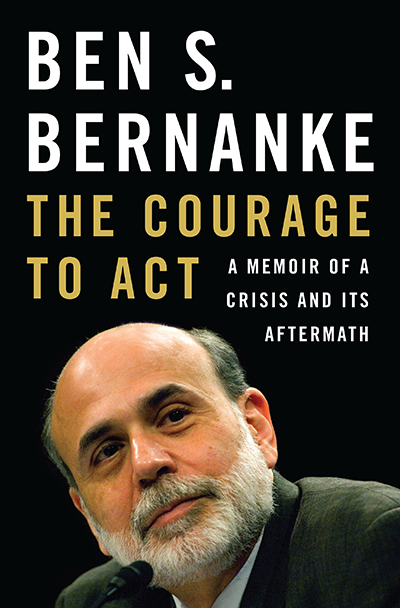
What I’m reading – Bernanke’s Courage to Act

courage_to_act_cover

One of my favourite passages in Ben Bernanke’s memoir of the financial crisis and its aftermath, The Courage to Act, describes how, on the way to the Federal Reserve building to deal with the imploding Bear Stearns, Bernanke takes the time to email his assistant Rita Proctor: “Pls order a couple of muffins and oj for me. I’ll be in in 10 minutes.” Now that shows a cool head in a crisis. Bernanke was certainly the right person for arguably the most important job for an economist in the world during the time of the crisis, Chair of the US Federal Reserve. He had the sangfroid, the character and the intellect to co-lead (with Treasury Secretaries Paulson and then Geithner) the US response to the financial crisis. Indeed, as an academic economist, he had established his reputation and earned a Princeton chair through his research into the causes of the Great Depression, which emphasised the need to prevent a banking panic and widespread bank failures, something which the Fed failed to do in the early thirties.

Bernanke’s memoir is excellent in its description of the relevant economic theories which guided his policy making during the crisis. He is particularly lucid in his description of the Fed’s lender-of-last-resort role, through the so-called discount window. He rightly gives credit to Walter Bagehot, whose 1873 classic Lombard Street implored central banks to lend liberally during panics, and is compulsory reading for all central bankers. Also, I liked Bernanke’s discussion of how he attempted to get the Greenspan Fed to be clearer in its signalling to the market regarding the future direction of monetary policy, and to adopt an explicit inflation target—which was not adopted by the Fed until 2012 (at rate of 2 per cent).

For his role in helping the global economy avert a re-run of the Great Depression—not an exaggeration—Bernanke may go down as history’s greatest central banker so far. Certainly Alan Greenspan’s star has faded as the loose monetary policy under his reign arguably contributed to the US housing bubble and the subsequent financial crisis after the bubble burst. Bernanke, however, has been followed by another outstanding economist, Janet Yellen, who may well distinguish herself in the role. She definitely faces large challenges, including the difficult decision regarding whether to raise the Federal Funds Rate from near zero later this year (see Janet Yellen just got some pretty bad news). This is a difficult decision because there is uncertainty about the strength of the US recovery and there are ominous signs from China. For example, you may have seen the worrying article about China’s debt binge in last week’s Economist (see Deleveraging Delayed). We live in interesting times.

You can pick up a copy of Bernanke’s Courage to Act at Dymocks on Albert St, Brisbane, which has dozens of copies. Dymocks incidentally now has an outstanding collection of economics books, which I understand is due in large part to the efforts of one staff member who is currently an economics student at the University of Queensland.
Posted in Macroeconomy | Tagged , , , , , , , , , , , , , | 2 Comments

Transparency needed around luring film productions such as Thor: Ragnarok to Qld

In its final report on government industry assistance (i.e. corporate welfare) released in August, the Queensland Competition Authority recommended an end to the lack of transparency that still, alas, characterises Queensland Government industry attraction measures. This lack of transparency was obvious on Friday when the Government announced the attraction of the Thor: Ragnarok film production to Queensland. As reported in the Gold Coast Bulletin:

The Premier declined to reveal whether the State Government had provided any financial incentives to secure the Marvel production, to be filmed exclusively in Queensland.

The State Government is rumoured to be contributing $3 million to the production while the Federal Government will reportedly kick in a total of $47.25 million towards Thor and Ridley Scott’s untitled Alien film, to be shot in Sydney.

This is regrettable, because it means the public is not given the opportunity to make a fully informed judgment about whether the assistance provided is in the best interests of the State. And it goes against clear recommendations made by the QCA that the Government should:

(a) cease providing attraction incentives for major film productions that deliver benefits largely appropriated by international production companies

(b) focus assistance for film and television production on activities that deliver net cultural benefits to the state

(c) ensure that any incentives, where government chooses to provide them, are provided transparently. (Recommendation 10.4, p. x of the report, which is available on the QCA website)

I have previously been highly critical of government assistance to the film industry, including in my 2013 article in the CIS’s Policy magazine Moochers making movies: Government assistance to the film industry. And, on ABC News in August, I expressed my disappointment that the Queensland Government had so quickly dismissed the QCA report’s recommendation (see my post ABC News interview on industry assistance).

Posted in Industry policy | Tagged , , , , , | 13 Comments

Qld regions have been struggling and not just the mining ones

TvlleWBurates

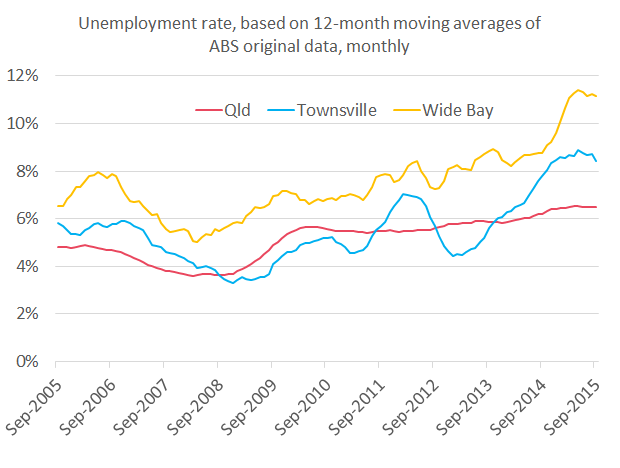
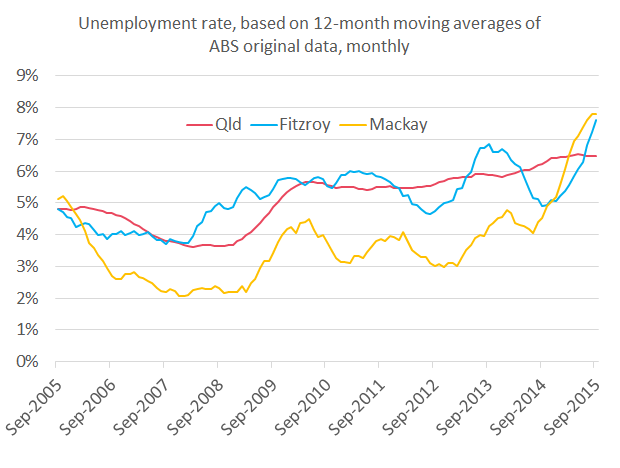
Townsville Mayor Jenny Hill’s alleged lack of success in bringing new infrastructure projects to the city may become a major issue in the mayoral election in March next year, based on a report in today’s Townsville Bulletin. The Mayor may be vulnerable on this issue, given how long it has taken so far to progress the Super Stadium, which still has not obtained the Commonwealth funding commitment it needs. She will also be vulnerable because of the relatively weak Townsville economy recently, although it appears the unemployment rate is thankfully coming down a bit. The Townsville region, like other Queensland regions, such as Wide Bay (see chart above), has struggled in recent years, and as I’ve noted before, net employment growth in Queensland is confined to the South-East, and the regions as a whole have been losing jobs. It is no surprise the mining regions are struggling (chart below), but it is not only them, as I have noted above. To give another example, Cairns is also a worry (see Pete Faulkner’s post Regional labour market data shows Cairns sliding badly).

Regionalurates_Sep15

Today’s updated regional labour force data from the ABS have not changed my general concern over the economic outlook. The Queensland Treasurer Curtis Pitt, however, has found some good economic news to be excited about recently. He is excited about the solid June quarter Queensland State Accounts figures produced by Queensland Treasury and by new survey data from NAB, regarding which the Treasurer is quoted in his media release as saying:

“According to the survey, business confidence in Queensland was the equal highest in the nation, along with New South Wales.

“The NAB Business Confidence index for Queensland is at +4, with all other mainland States outside New South Wales in negative territory.”

Let us hope the Treasurer’s optimism is justified. I remain concerned about the outlook for the national and State economies given the risk of weak business investment over the coming twelve months and the risk of a severe downturn in China.

For further information on the regional labour force data, see the Queensland Treasury’s latest regional labour force brief.

Posted in Labour market, Macroeconomy | Tagged , , , , , , , , , , | 2 Comments

Australia’s boldest experiment and the first age of the econocrat

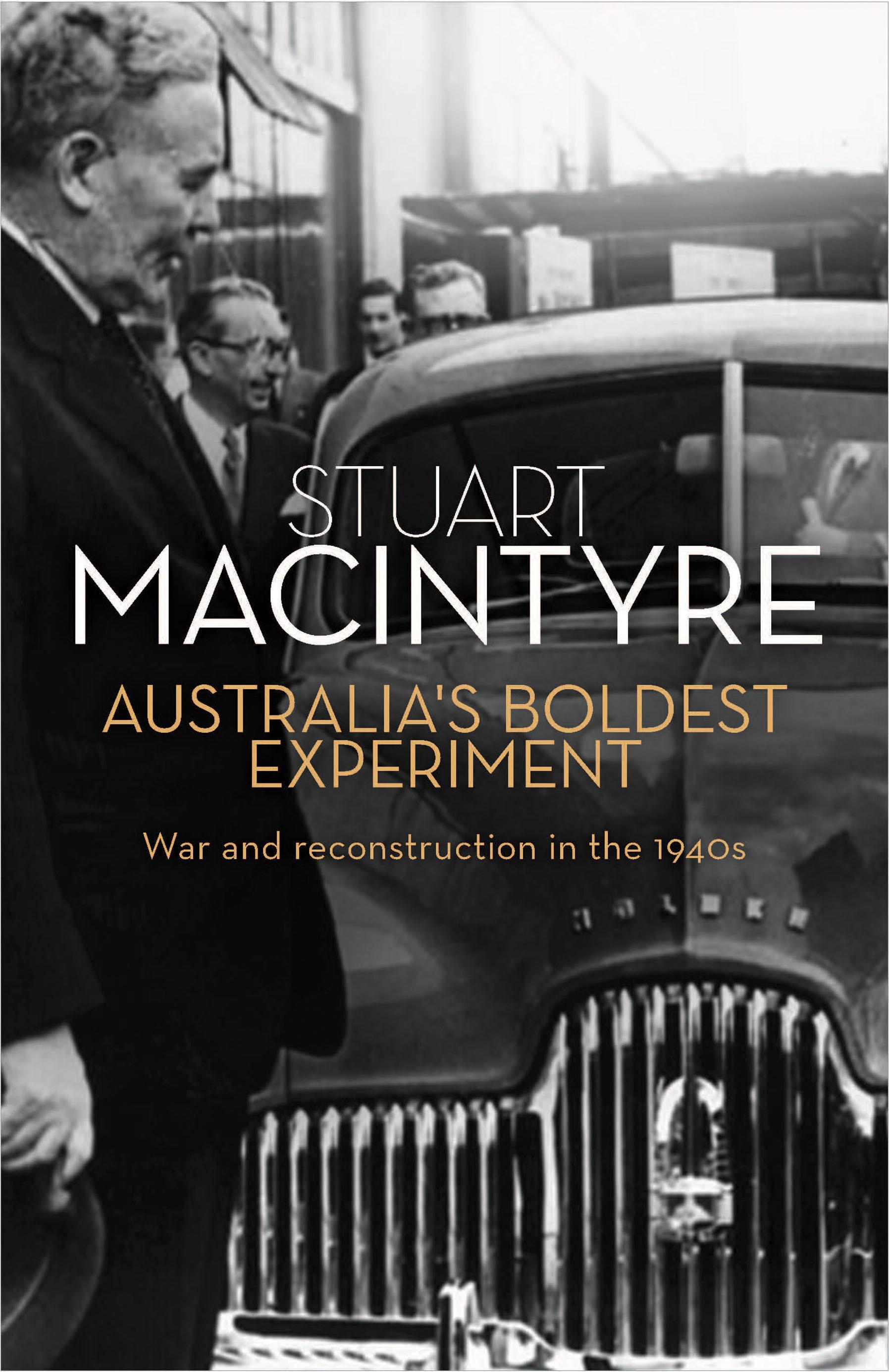
Boldest_experiment_bookIn the early 1990s, there was an article in the Weekend Australian on “The age of the econocrat,” which described the huge influence that economists in Canberra had on policy making at the time. It was an article which partly inspired my eventual career path. This of course was in those heady days of micro-economic reform. But there was an earlier age of the econocrat (i.e. the economic bureaucrat) in Australia, in the years of war and post-war reconstruction, in which one of the leading roles was played by the Director of Post-War Reconstruction, arguably the greatest of all econocrats, HC “Nugget” Coombs. Stuart Macintyre’s brilliant history of this period, Australia’s Boldest Experiment, published earlier this year, takes us back to those extraordinary times.

The book illuminates the important roles played by economists such as Coombs and Trevor Swan in post-war reconstruction, particularly in the largely successful demobilisation of troops after the war and the transition out of the war-time economy. But the book is no hagiography, and it draws attention to Coombs’s failure to repurpose his Department of Post-War Reconstruction into a ministry of economic planning that would provide a counterbalance to the laissez-faire prescriptions of the Treasury. As a former Treasury man, I am thankful that Coombs lost that battle.

It was also fascinating to read in the book about the extraordinary influence on decision makers, including on then PM Ben Chifley, that one of the all-time great Canberra mandarins, Treasury’s Frederick Wheeler, had from such a young age. Wheeler would later head the Treasury in the 1970s and would become well known for his opposition to the Whitlam Government’s unorthodox financing methods.

Something else I really liked about the book was its critical analysis of the merits of the Snowy Mountains hydroelectric scheme, that grand post-war nation building scheme which certainly helped transform the country, but which most likely did not stack up economically. As Macintyre notes (p. 423):

…even before the scheme was completed, there were claims that it did not add to the nation’s wealth but detracted from it. A critic argued in 1963 that thermal stations were a cheaper source of electricity and six years later the agricultural economist Bruce Davidson calculated that the private returns from additional farm production did not cover the public cost of providing the water.

So the Snowy Mountains scheme should provide a warning to anyone with grand schemes in their mind.

Macintyre’s book is highly recommended to anyone with an interest in Australian history or economy policy. I expect it would be of great interest to many of my former Canberra colleagues, who may marvel at the influence and achievements of the econocrats of the forties.

Posted in Uncategorized | Tagged , , , , , , , | 5 Comments

Australian Perspective: 2016 and beyond – keynote presentation to CPA Congress, Brisbane

I was delighted to give the opening keynote presentation at the Brisbane CPA Congress at the Brisbane Convention & Exhibition Centre this morning. My presentation slides (which I’ve slightly modified with additional headings and source information) are available to download:

Australian Perspective: 2016 and beyond

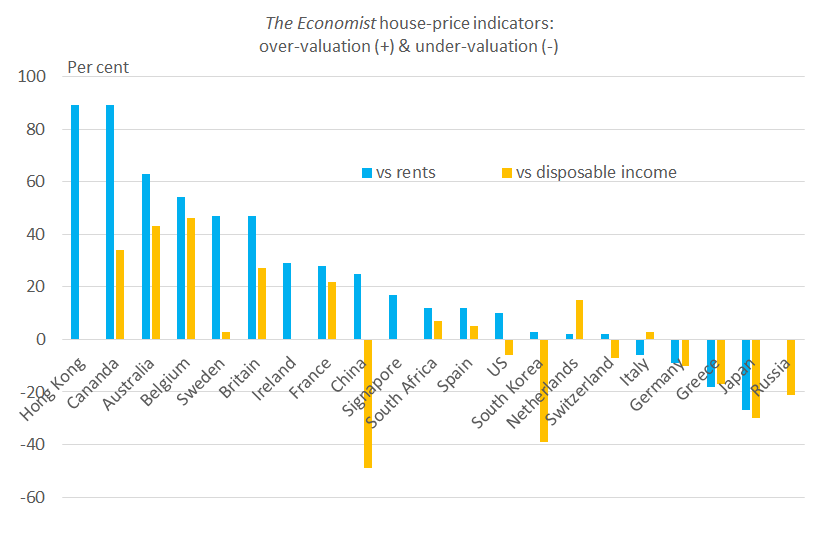
In the presentation, I emphasised the Australian economy is facing some strong headwinds. The outlook for business investment is discouraging, and there are real concerns about the Chinese economy and a risk it could experience a major downturn, which would obviously have ramifications for our economy. I discussed how I am also concerned about the housing market, given it is pretty clear the Sydney market at least has over-heated. So the recent Macquarie Bank report predicting a 7.5 per cent slump in house prices should not be quickly dismissed. Certainly, The Economist  magazine has argued Australian house prices are over-valued for what must be more than a decade now, and I was glad a recent issue contained its latest estimates of the extent of over-valuation, estimates which I used in the presentation this morning (see chart below).

Economist_housing_market

I also discussed the urgency of the budget repair and economic reform tasks for Australia, given the risk we will enter our next downturn still with a large fiscal deficit, reducing our fiscal room to manoeuvre, and also due to the challenges posed by population ageing and our ever-growing social security and welfare expenditures. I suggested the Government might consider changes to current superannuation tax concessions, so they are less generous to high income earners, and that changes to these concessions would be much less politically toxic than, say, changes to the aged pension (e.g. including the family home in the assets test) or negative gearing rules. The Government would be mindful of how many negatively-gearing landlords there are in Australia who would be adversely affected by any changes in the short-term. I also discussed how Australia would get major efficiency gains from raising more revenue via GST and cutting less efficient taxes, particularly stamp duties and payroll taxes.

Posted in China, Housing, Macroeconomy | Tagged , , , , , , , , , , , , | 2 Comments

Residential property a “bright spot” in Qld economy

commfinance_Qld_Aug15

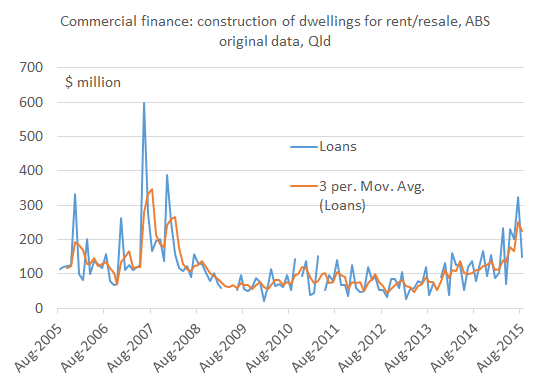
The Queensland Treasurer Curtis Pitt correctly noted yesterday that “The property sector is a real bright spot in the Queensland economy and it’s making a positive contribution to jobs and growth.” This is confirmed by data and casual observation. Regarding the data, for example, the Treasurer pointed to the high level of loans to investors for the construction of new dwellings, at least compared with the last few years (see chart above).  Regarding casual observation, wherever you walk in inner city Brisbane you are likely to spot cranes, as I did while walking along the Bicentennial Bikeway on Sunday afternoon (see image below of cranes over West End).

cranes This is all very well and good, but, as I’ve noted previously, there are real concerns about the impact all the new supply will have on the market over the next year or so:

As many units as houses approved in Queensland in last 12 months – is a unit price crash coming?

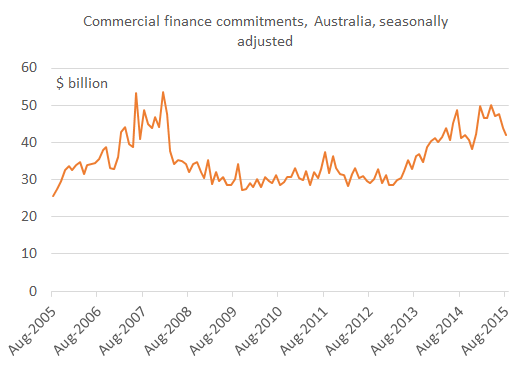
I also remain concerned about the broad economic outlook for the Australian and Queensland economies, particularly given potentially weak levels of business investment over the next twelve months. The drop in commercial finance commitments across Australia reported by the ABS yesterday (see chart below) has reinforced this concern of mine.

commfinance_Aus_Aug15

Posted in Housing, Macroeconomy | Tagged , , , , , | 8 Comments

Upcoming presentation by HSBC’s Paul Bloxham on Australia’s next growth driver, the services sector

With such significant uncertainty regarding the economic outlook, as the Australian economy is re-balancing at the end of the mining boom, there is much speculation regarding the future drivers of economic growth and jobs. Hence I am delighted that HSBC’s Chief Economist (for Australia & NZ) Paul Bloxham will present on the topic of Australia’s next growth driver: The role of the services sector at a lunchtime Economic Society of Australia (Qld) event on Wednesday 11 November, at Morgans, Level 29, Riverside Centre, 123 Eagle St, Brisbane. There is a small charge ($15 for members and $25 for non-members) to help ESA Qld (of which I am the Secretary) cover costs, but I am sure it will be well worth attending if you are interested in the economic outlook and where future jobs might come from. Registration details can be found on the ESA Qld website:

Paul Bloxham – ‘Australia’s next growth driver: The rise of the services sector’

Paul Bloxham photo4

Paul Bloxham, HSBC

Posted in Labour market, Macroeconomy | Tagged , , , , , , , , , , , | Leave a comment

Energy GOCs equity raid a good example of problem with public ownership

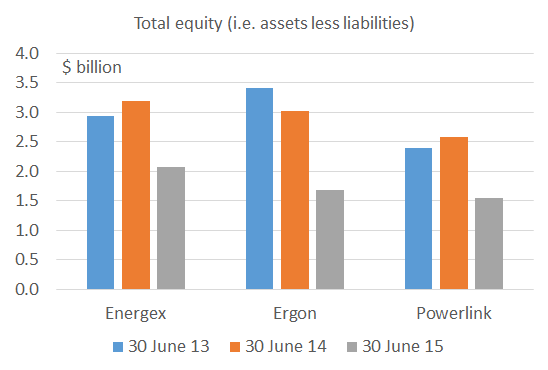
equity

I was quoted in the Courier-Mail this morning regarding the $3.5 billion the Queensland Government has withdrawn from equity in its power businesses (see chart above) for the purposes of paying down debt (see Earnings grab quick debt fix, Pitt says):

Former Federal Treasury economist Gene Tunny warned the dividend raid would affect the value of the government-owned corporations, which could be an issue if a future government was one day given a mandate to sell assets.

The Government is withdrawing cash and loading up the energy businesses with debt. It is reducing the financial flexibility of the companies and is interfering with the business finance decisions that the companies should be making themselves. Would the companies have paid a huge special dividend to the Government if not instructed by the Government? I doubt it.

The equity raid is motivated by the Government’s political need to appear to be improving the State’s financial position through its Debt Action Plan. But, as I noted at Budget time in July, the Government is not really improving the State’s financial position at all (see my Budget day post). It is simply shifting money around on its balance sheet. To really improve the State’s financial position, it needs to start running surpluses (on its fiscal balance). The accounting tricks are not fooling anyone.

Posted in Budget, Energy | Tagged , , , , , , , , , , | Leave a comment

Courier-Mail opinion piece on daylight saving

I have an opinion piece on daylight saving published in today’s Courier-Mail, arguing it is time for a new trial of summer time in Queensland, at least for South-East Queensland, as the economic costs (including the opportunity cost of lost recreational opportunities) are becoming too large to ignore:

It is time to give summer time another try

Queensland has changed a lot since the early 1990s when we last had summer time, as I note in the conclusion of the article:

…I suspect the benefits of daylight saving would be more obvious this time, particularly taking into account the greater emphasis on an outdoors lifestyle and al fresco dining in Queensland today, than in the early 1990s. It is time to give summertime another try.

Posted in Brisbane, North Queensland, Queensland Government | Tagged , , | 12 Comments

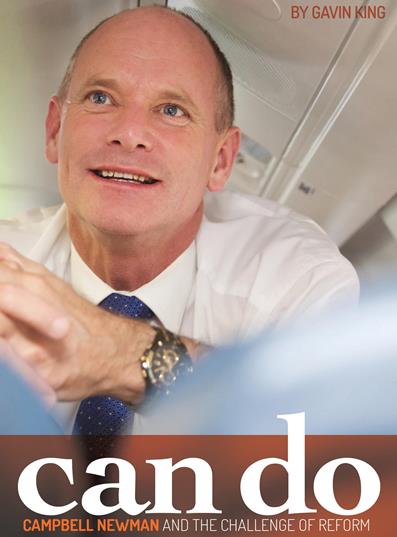
Can Do, the Campbell Newman biography by Gavin King

Former Cairns MP Gavin King’s just published Campbell Newman biography Can Do (which includes two quotes from me on p. 220 and 267) makes an important contribution to the economic reform debate in Australia. After telling the story of Campbell Newman’s life and political career, Gavin considers the implications of the Newman Government’s election loss for the future of economic reform.

I particularly liked Gavin’s reference to the concept of the “tyranny of the status quo”, identified by Milton and Rose Friedman a few decades ago and which now appears even more powerful. Any reform proposal, such as the leasing of government assets, now provokes a noisy and aggressive response from affected interests, making policy change extremely difficult, particularly given the benefits of reform tend to be diffused across the wider community, who are not motivated to demonstrate in support of change.

The book includes some heavy criticism of the media’s role in the political process, particularly from the former Premier. This is balanced by the inclusion of some other perspectives. Gavin notes that the right personality and political skills are essential to selling reform, and Mike Baird in NSW shows it can be done (although Gavin notes Baird had a better starting position than Newman because he had not suffered politically from having had to make previous tough decisions).

Marketing expert and Gruen Transfer regular guest Toby Ralph is quoted in the book as noting that “The trick of leadership is not to develop great strategy or cunning tactics; it is to get people to understand what must be done and why, then walk in lockstep toward that reform.” This is consistent with what I was trying to say in one of the quotes from me in the book, regarding the Government’s Strong Choices campaign on privatisation:

…Strong Choices was a missed opportunity for the Government…to really sell the privatisation agenda. I think the Government was poorly advised on how to go about it. I would have liked to have seen a green paper and a white paper, a more traditional public service process whereby it’s communicated to the public what the issues are and the likely impacts and having that conversation. I was a bit concerned that Strong Choices didn’t communicate at the right level. It was just a bit too slick and it didn’t allay the public concerns. (from p. 267)

So reform is possible, but it is obviously very challenging, as the Can Do biography makes very clear. Hence we perhaps should not get our hopes up that there will be significant progress on the major reform issue identified in the book: federal-state financial relations.

I would recommend this book to readers interested in Queensland politics and to those interested in economic policy issues in Australia. While the author’s political views come through in the book, so critics may argue it is not completely objective, Gavin has nonetheless reflected critically on the successes and failures of Campbell Newman, and hence he has made a valuable contribution.

Can Do book cover

Posted in Queensland Government | Tagged , , , , , , | 4 Comments