QIRC hearing important case on retail trading hours

The Queensland Industrial Relations Commission is currently considering an application from the National Retail Association, which represents big retailers such as Coles and Woolworths, for standardised trading hours across South East Queensland, which would extend opening hours, e.g. up to 9pm on Saturdays, in many locations (see this ABC news report). The first day of the hearing considered a report into the economic benefits of retail trading hours deregulation. The report was prepared in early 2014 by Professor Henry Ergas, Dr Alex Robson (now PM Turnbull’s senior economic adviser) and Joe Branigan, a former Treasury colleague and old friend of mine, who had to appear before the QIRC and defend the report yesterday. The report includes an estimate that up to 2,000 extra jobs could be created if there were full deregulation of retail trading hours across the State.

The methodology and data sources supporting the economic report were subject to an intense line of questioning from the counsel representing the independent grocers (e.g. IGAs) who are opposing the NRA’s applications. Despite the intense pressure, Joe was able to offer some moments of brilliance, such as when he referred to former Treasury Secretary Ted Evans’s observation that “in one sense, we can choose the level of unemployment which we are willing to bear” (see my 2014 post Unemployment rate is partly a policy choice). That is, the choices we make regarding economic and social regulations, such as on retail trading hours, can affect the level of unemployment. I have previously argued that removing restrictive regulations such as those on retail trading hours would boost employment, particularly among young people.

It would be good for the Queensland economy if the NRA case were successful. Unfortunately, in the hour-and-a-half I attended the hearing yesterday, I received the impression that the NRA team was a little under-prepared for the case. It became apparent that the NRA had not fully briefed Joe on the exact nature of its application, and this meant Joe had to concede to the counsel for independent grocers that he was unaware the definition of SEQ relevant to retail trading hours is significantly different from the definition of SEQ used by the Queensland Government and the ABS for economic statistics. This seems like a pretty important fact that the NRA should have picked up and briefed Joe on, given the NRA is relying on Joe to provide credible expert evidence to advance its case. Let us hope the NRA improves its game over the remaining days of the hearing.

Posted in Retail trade, Uncategorized | Tagged , , , , , , , , , , , , | 8 Comments

Qld employment growth is great news, but it is still not strong from historical perspective

LF_Oct15

Wisely, Queensland Treasurer Curtis Pitt did not get too excited over yesterday’s employment numbers, which were surprisingly strong at a national level, with the Treasurer noting, regarding the State unemployment rate, “While it’s welcome news that the seasonally adjusted unemployment rate fell 0.1 per cent to 6.2 per cent in October the ABS’s recent caution about the volatility of seasonally adjusted figures should be noted.”

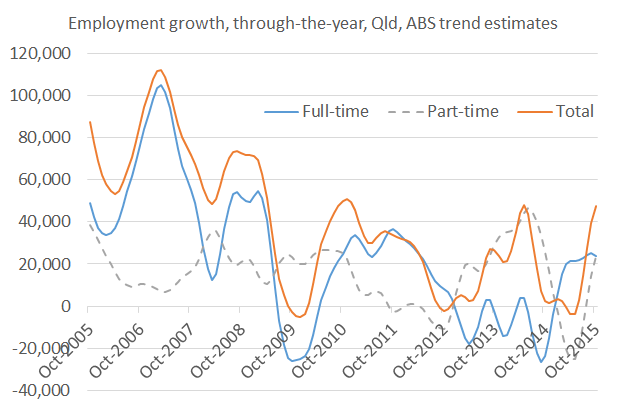
The Treasurer was right to point out the good news of very respectable employment growth in Queensland in recent months (see chart above). Many of the new jobs were likely in the building industry and hospitality, particularly as the lower dollar boosts tourism and as households are starting to shake off the frugality induced by the financial crisis.

The jobs growth we are seeing is welcome, but could be much higher. As Pete Faulkner has noted in an excellent dissection of yesterday’s ABS labour force data (see Strong jobs growth sees unemployment rate in surprise drop):

Trend jobs growth in QLD has been running at a pace greater than the expansion of the working population. The labour market has seen some credible improvements in recent months and a continuation at this pace should see the unemployment rate steadily drifting lower.

In other words, jobs growth is good, but not great, particularly from a historical perspective. The unemployment rate will only steadily drift lower, rather than experiencing large rapid falls. And there is, of course, the possibility that recent gains could be reversed, if some of the risks to the economy that have been highlighted in recent months (e.g. declining business investment and a China crash) are realised. So, it is not yet time to get excited about the economy.

Posted in Labour market | Tagged , , , , , , , , , , , , | Leave a comment

Australia Awards program with Indonesian Finance Ministry officials on strengthening the public policy process

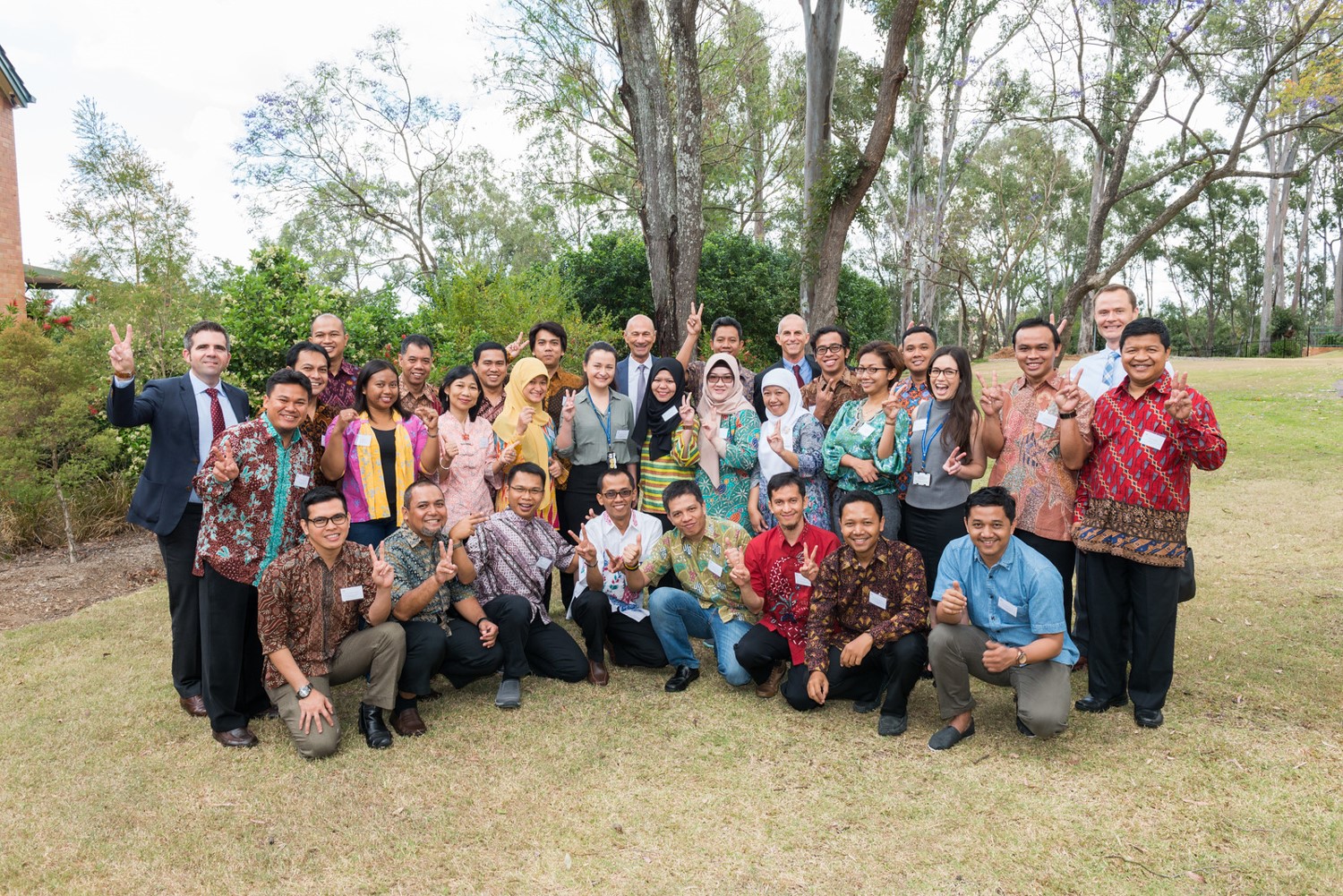
In late October, I felt honoured to deliver workshops on economic forecasting and industry policy to officials from the Indonesian Ministry of Finance. The officials were recipients of Australia Awards from the Australian Government and were visiting Brisbane to attend a two-week short course on Strengthening the Public Policy Process, which was held at the University of Queensland (UQ). The short course, which was organised by UQ International Development, also featured institutional visits to the Queensland Treasury in Brisbane and the Australian Treasury and Productivity Commission in Canberra. The Australia Awards program is a terrific way for our country to be a good international citizen, and for Australia and other countries to learn from each others’ experiences, and to enhance international cooperation and mutual understanding.

Morningtea

At morning tea on the first day at St John’s College, UQ

Groupphoto

Group photo in the grounds of St John’s College, UQ

Posted in Industry policy, Macroeconomy | Tagged , , , , , , , , , | Leave a comment

Great presentation by HSBC’s Paul Bloxham on the economic outlook to ESA Qld

In Brisbane today, HSBC’s Chief Economist (Australia & NZ) Paul Bloxham gave a terrific presentation on the economic outlook to the Queensland branch of the Economic Society of Australia, of which I am the Secretary. You can download his slides, which HSBC has graciously allowed ESA Qld to share, at this link:

Australia’s next growth driver: The role of the services sectors

Be sure to check out slides 10 and 11, which were popular with presentation guests, showing that “Despite slowing down, China is still contributing a lot to global GDP” and that “China is still contributing the most to global GDP growth”.  Paul appeared unconcerned about the risks of a China crash and the adverse flow-on impacts that would bring, and he is very optimistic about the US and Australian economies. He noted that low interest rates and the exchange rate are helping the Australian economy rebalance at the end of the mining boom, by boosting residential construction, international tourism and education activity, and consumption spending by Australian households.

Paul noted there is scope for a further interest rate cut in Australia, which may occur if the economy does not appear to be rebalancing as readily as the RBA would like. On US monetary policy, he noted that it is very likely the federal funds rate will be lifted from its near zero rate in December, beginning a long drawn out process in which the Fed will gradually seek to withdraw its monetary stimulus.

Posted in Macroeconomy | Tagged , , , , , , , , , , , , , , | 2 Comments

Brisbane ABC radio interview on raising the GST

I had a good chat this morning with Terri Begley on 612 ABC Brisbane regarding proposals to raise more revenue from the GST:

What raising the GST actually means

I noted that raising the GST and cutting more inefficient taxes (e.g. income tax, payroll tax or stamp duty) would be good from an economic perspective, but may have adverse equity implications, because the GST is regressive in its impact (see Townsville ABC radio interview on GST). Hence the total tax reform and compensation package would need to be carefully designed so poorer households are not adversely affected to a large extent. Abolishing the unpopular fuel excise and motor vehicle registration fees, options apparently being considered by the Government, may go someway toward lessening the pain of a GST increase.

Terri and I also discussed whether it would be desirable to raise more revenue by broadening the coverage of the GST to currently excluded items such as fresh food, health and education (rather than increasing the GST rate on the current base). I noted that, while it would be preferable to have as broad a base as possible, it may not be politically feasible, and that there may be some significant adverse impacts which would partly offset the benefits of having a broader base. For example, applying the GST to fresh food may lead to some switching in consumption to less healthy food choices. Also, applying the GST to school fees may lead to some parents taking their children out of private schools and sending them to State schools, costing State Governments more in education spending. This is a point that was previously made on this blog in a guest post from Michael Willis:

Time for a sensible debate on broadening the GST net

Posted in Tax | Tagged , , , , , , , , , , , , , | 6 Comments

Economics and environmental law seminar timely given debate over CSG & Galilee

One of the new words we have heard in recent years is “lawfare”, the use of the law as a weapon of war. In Australia, it has been alleged that environmental groups such as the Australian Conservation Foundation and the Environmental Defenders Office have been engaged in lawfare against mining projects, particularly regarding CSG and Galilee basin coal projects. Clearly environmental law has risen to great prominence in the public debate. As an economist, it is of great interest to me how economic factors are taken into account in environmental litigation and ultimately in judgments.

Hence I have great interest in an upcoming seminar on Economics in Environmental Law in Brisbane this Thursday (12 November) evening at 6.30pm, which is being hosted by the Environmental Defenders Office (Qld) at the College of Law, 140 Ann Street. Much attention will be given to the use of economic modelling in the assessment of projects, and whether improvements can be made to policies regarding the economic assessment of major projects. Speakers will include Rod Campbell from the Australia Institute, Cameron Murray (photo below) from the University of Queensland’s School of Economics and Sean Ryan from EDO Qld. And, with my Economic Society of Australia (Qld) Secretary’s hat on, I will chair the seminar. If you are interested, please consider registering via the website linked to above. I am looking forward to a lively discussion and debate!

cameron-3.131857Cameron Murray, UQ Economics

Posted in Agriculture, Environment, Mining | Tagged , , , , , , , , , , | Leave a comment

Queensland businesses remain pessimistic on average

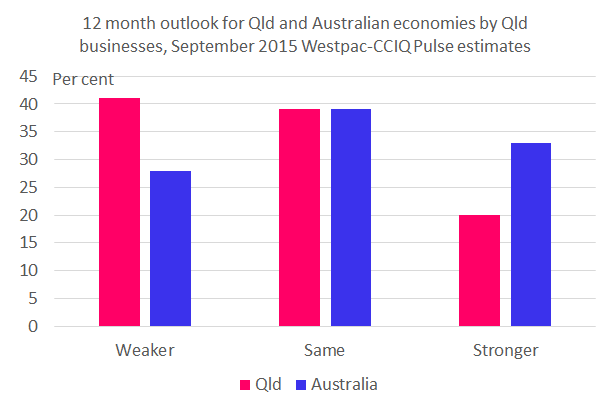
Queensland businesses remain a relatively pessimistic bunch, based on the latest data from the Westpac-CCIQ Pulse Survey, which I have previously argued is the most reliable data on business confidence in Queensland (see my post from June). CCIQ’s media release from last Friday emphasised the boost that the ascension of Malcolm Turnbull appears to have provided to confidence in the national economy, and certainly Queensland businesses are more optimistic about the national economy than the Queensland economy (see chart below showing the percentages of Queensland businesses which expect the State and national economies to be weaker, the same or stronger).

Pulse_Sep15

The Pulse survey data highlight the ongoing poor 12-month outlook for the Queensland economy, with confidence at an index level of 42.1 compared with a neutral level of 50. CCIQ remains optimistic, however, and is perhaps trying to talk up the economy, noting in the survey report that “Queensland businesses are expressing optimism about the State’s economic growth prospects, with business confidence remaining steady…” Also, CCIQ is encouraged by a pick up in expected business conditions in December quarter 2015 to an index value of 47.7 from 45.0 in September quarter, which is a welcome sign although it would still be below a neutral level of 50.

Posted in Macroeconomy | Tagged , , , , , , | Leave a comment

Townsville ABC radio interview on GST

The GST debate continues, with much attention focused on the regressive nature of the GST. That is, because poorer households typically consume higher fractions of their incomes than richer households, they pay proportionally more of their incomes in GST. Hence there would be a need to compensate low-income earners, particularly pensioners, who would be adversely affected by any GST increase. Of course, this would reduce the amount of money available for other purposes, such as providing greater funding certainty to State governments, and cutting income tax and highly inefficient state taxes such as stamp duty. Last week, I discussed the difficult choices to be made with Pat Hession from 630 ABC North Queensland:

What a GST increase might mean for NQ

While the Queensland Government appears opposed to a GST increase, at least one courageous policy officer in the Department of Premier and Cabinet supports a GST increase to replace payroll tax and stamp duty, based on recommendation 11.02 in the leaked Economic Action Plan that created so many headlines last month. It was correctly noted in the document that:

GST is a tried and well understood tax with lower negative effects than the current payroll tax and stamp duty.

I hope that the Queensland Government would reconsider its position if the Federal Government is able to develop a well-crafted tax reform package that improves the tax system while providing sufficient compensation for those adversely affected.

Posted in Tax | Tagged , , , , , , , , | 1 Comment

HSBC’s Paul Bloxham to discuss services sector in time of no ordinary disruption

I am very much looking forward to the presentation in Brisbane next Wednesday by HSBC’s Paul Bloxham, on Australia’s next growth driver: The rise of the services sector, to the Queensland branch of the Economic Society of Australia, of which I am the Secretary. Clearly most of the new jobs which will be created in the future will not be in manufacturing, agriculture or mining, but will be in the services sector. These jobs will typically revolve around human interaction and the application of high levels of professional and social skills, as routine less-skilled jobs are increasingly being automated. This trend is well discussed in a new book, No Ordinary Disruption, by three directors of the McKinsey Global Institute, and is nicely illustrated with data on jobs growth in the US in the 2000s (see chart below).

If you would like to attend the presentation by Paul Bloxham next Wednesday (11 November) lunchtime, please see the ESA Qld website for registration details.

newjobs_US

Posted in Labour market | Tagged , , , , , | 2 Comments

Tax mix switch to GST desirable and inevitable

I’m very pleased the Turnbull Government is pushing to raise more money from the GST, as this would allow cuts to more inefficient taxes such as income tax and stamp duty, and would be good for productivity and economic growth. The OECD (in a 2008 working paper Tax and Economic Growth) has noted:

“A revenue neutral growth-oriented tax reform…would be to shift part of the revenue base from income taxes to less distortive taxes such as recurrent taxes on immovable property or consumption.”

A GST increase would also provide greater funding certainty for state governments, which is why NSW Premier Mike Baird supports such a move, and why the Queensland Government should, too. My previous comments on the GST include:

GST much more efficient way to raise revenue than income tax

Stamp duty has to go – time to consider greater reliance on land tax and GST

4BC interview on KPMG’s analysis of GST increase for CPA Australia

Posted in Tax | Tagged , , , , , , , | 4 Comments