Low wages growth adds to concerns over strength of economy

Wages_Dec15

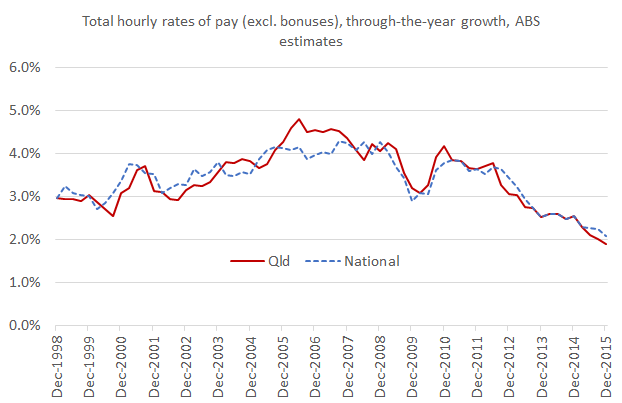
The ABS was right to identify the extraordinary nature of the December quarter wages data in the title of its media release, “2015 ends with lowest wage growth on record.” This applies at both the national level and in Queensland (see chart above). Wages growth at around 2% per annum is broadly in line with CPI inflation, so wage and salary earners have not really made any gains over the last year. The weak wages growth raises further doubt about the State Government’s misplaced optimism in the strength of the State economy based on the ABS jobs growth estimates. I agree with CommSec economist Savanth Sebastian, who is quoted in the Courier-Mail this morning as saying:

…poor economic indicators in the Sunshine State were caused by the collapse in infrastructure development.

Indeed, I said much the same thing last week in comments that were quoted in last Friday’s Courier-Mail:

Recent quotes from QEW in Qld Parliament and the Courier-Mail

Posted in Infrastructure, Labour market, Uncategorized | 2 Comments

Upcoming FACCI seminar on planning and operating Qld’s infrastructure

The French-Australian Chamber of Commerce and Industry (FACCI) is holding a very interesting breakfast event in Brisbane on Thursday 17 March on the topic of planning and operating Queensland’s infrastructure. The seminar will feature David Quinn, Building Queensland CEO, and Campbell Mason, interim CEO of Keolis Downer Gold Coast, which operates the Gold Coast Light Rail.

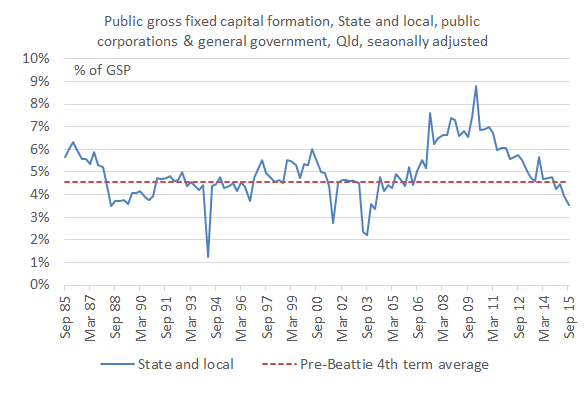
As FACCI notes, infrastructure is a topical issue, as the State Infrastructure Plan is currently being finalised. Given a drop off in major infrastructure projects, the Queensland business community is very interested in what the final State Infrastructure Plan will propose. Queensland engineering and construction businesses have come to expect high levels of infrastructure investment from the State Government, but the peak levels that we saw around 2010 (see chart below) probably will not be seen again for a long time, given the lack of money in the forward estimates for infrastructure. Hence there will likely be much interest in reviving the public-private partnership (PPP) model (e.g. Gold Coast Light Rail), which I expect will be one of the topics for discussion at the FACCI event.

capex_Qld_S&L

Update: I have amended my original post so that the event is correctly identified as a breakfast seminar.

Posted in Uncategorized | Leave a comment

On-street parking charges a better solution than Harding plan

One important lesson from economics is that problems are most efficiently solved by setting prices right rather than by regulations mandating particular actions. So it is with the problem identified by Brisbane residents of being parked out of suburban streets by residents and visitors of new apartment blocks. Labor’s lord mayoral candidate Rod Harding has proposed that developers should be required to include more car parks in their apartment developments, but this has been strongly and rightly criticised by both the Property Council of Australia, for the increase in property development costs that would result, and by Rail Back on Track, for not addressing the underlying problems leading to the shortage of parking. I was very happy that Robert Dow from Rail Back on Track referred to the issue of pricing in his comments on the Harding proposal reported in the Brisbane Times:

“If people are having issues with cars parking in their street, there are obvious solutions: fix the bus network, issue residential parking permits or charge cars for the privilege to park on the street.”

Robert Dow has economists on his side regarding the charging of cars for parking on the street. Appropriate pricing of on-street parking would recognise on-street parking spots are not free. They are Council assets with an opportunity cost and should generate a rate of return. Appropriate pricing would help resolve the shortage of spots by sending the right signals to residents, visitors and developers. Parking charges would naturally regulate the demand for parking spots in several ways, such as by discouraging some people from traveling to busy precincts in cars and encouraging them to take public transport instead, and by discouraging visitors from staying for too long. Also, by demonstrating a clear revenue stream from parking in an area, on-street parking charges may encourage private sector car parks to be developed.

The high cost of free parking was nicely articulated in an excellent 1997 article by UCLA’s Donald Shoup, which should be required reading for anyone involved in the car parking policy debate:

The high cost of free parking

Posted in Brisbane, Uncategorized | Tagged , , , , , , , | 8 Comments

Recent quotes from QEW in Qld Parliament and the Courier-Mail

I was very pleased to see that Rod Bogaards’s guest post last week on the lockout laws was quoted in the parliamentary debate on the laws (see p. 216 of Hansard for Wednesday, 17 February):

Mr MANDER: No, it is not rubbish. The crackdown in the CBD has totally done that. I also quote Rod Bogaards, a former Productivity Commission director, who said—

The NSW reforms appear effective in reducing alcohol-fuelled violence, but they appear to do so by lowering patronage rather than improving individuals’ drinking behaviour.

This legislation does not go to the core issue of why people are doing this in the first place. You cannot legislate against stupidity, which is how these people who go out and cause these problems behave. We have to address the core issue.

As you would be aware, the Government was successful in passing the lockout laws, at a substantial cost including a commitment to Katter’s Australian Party to invest in regional Queensland, potentially in some dubious projects. At least there will be an independent review of the laws in July 2018, but it would be good to have an interim review much earlier than that.

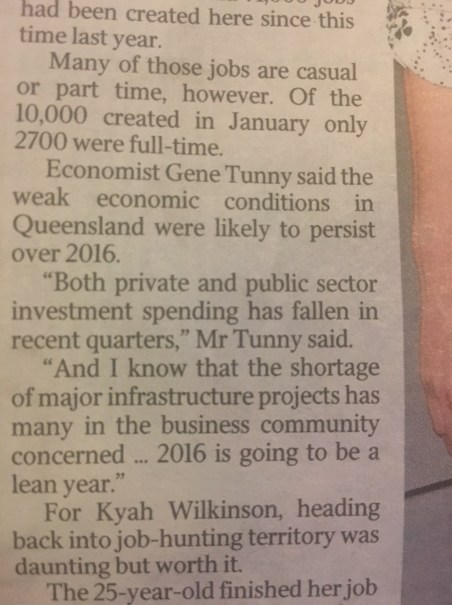
A QEW post was also quoted in the Courier-Mail (p. 9) on Friday— this time, my post on the January ABS labour force data (see image below).

IMG_0149

Posted in Infrastructure, Social policy | Tagged , , , , , , , , , | 2 Comments

Upcoming CPA Australia NFP conference

Nonprofit_image

The discouraging January labour force data released by the ABS yesterday make the economic outlook even more interesting, and Adam Creighton from The Australian is certainly correct that the weak labour market, which saw an increase in the national unemployment rate to 6% in January from 5.8% in December, increases the likelihood of a future interest rate cut from the RBA. I will be covering the economic outlook in an upcoming presentation at the CPA Australia Not-for-Profit Conference 2016, which is being held in Sydney, Melbourne and Brisbane over March. My presentation is titled Australia’s economic outlook, disruption and the collaborative economy: what it all means for NFPs.  You can read more about it on the web page showing the agenda for day one.

The conference will cover other very important issues to NFPs, including shared services, social benefit bonds and impact investing, so, if you have any connection with the NFP sector, I would encourage you to attend.

Posted in nfps, Uncategorized | Tagged , , , , , , , , , , , | Leave a comment

Unemployment data confirm Qld economy still in soft patch

Regular readers will know that I have been a bit skeptical about the State Government’s overly optimistic statements regarding the Queensland economy (e.g. see yesterday’s post). The economy has certainly been resilient at the end of the mining boom, but it is still relatively weak. This was confirmed today by the new ABS Labour Force Survey data for January, which show an increase in the seasonally adjusted Queensland unemployment rate from 5.9 per cent in December to 6.4 per cent in January (see chart below). Nationally, the unemployment rate increased from 5.8 per cent to 6.0 per cent.

Qld_unemploymentrate_Jan16

Alas, the weak economic conditions in Queensland are likely to persist over 2016. As I noted yesterday, both private and public sector investment spending have fallen in recent quarters. And I know that the shortage of major infrastructure projects has many in the business community concerned. 2016 is going to be a lean year.

Posted in Labour market, Macroeconomy, Uncategorized | Tagged , , , | 5 Comments

Trend is the Treasurer’s friend

The Queensland Treasurer Curtis Pitt issued an upbeat media release on the Queensland economy yesterday, but I am unsure the Queensland Treasury gross state product (GSP) data he quotes should be interpreted as optimistically as he interprets them. The media release begins:

“Key statistics released today show Queensland’s Gross State Product — a key measure of economic growth — accelerated to 2.6% for the year to the September Quarter 2015.”

That is correct based on the so-called trend estimates, which are derived by applying a statistical filter to the seasonally adjusted GSP series to smooth it out. An important consideration is that smoothing procedures are much less accurate for the most recent values of time series, because the future data points that would help determine the direction of the trend have not yet been observed. Hence trend estimates can mask turning points in time series (e.g. when an economy enters a downturn) because they give too much weight to past observations.

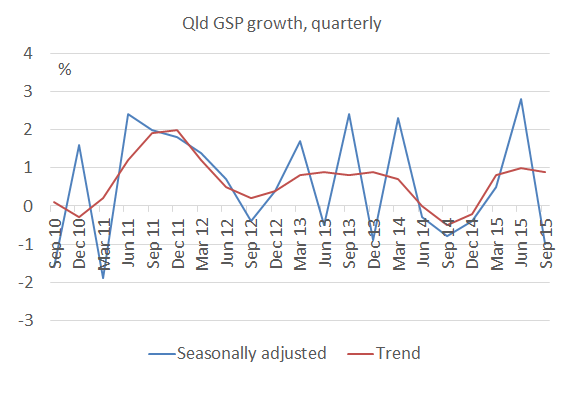
So economy watchers should examine the seasonally adjusted data as well as the trend data. Alas, the seasonally adjusted data are not so rosy for Queensland. The seasonally adjusted data show a lower through-the-year growth rate of 1.9%, rather than the 2.6% in the trend data, and, more worryingly, a fall in GSP in September quarter of 1%, compared with growth of 0.9% according to the trend data (chart below).

Qld_GSP_growth_Sep15

To some extent, this GSP decline in September quarter could reflect statistical noise, but the decline should caution anyone against placing too optimistic an interpretation on the recent GSP data from Queensland Treasury. The seasonally adjusted data suggest the Queensland economy is being adversely impacted by declines in both private and public sector investment spending.

Posted in Macroeconomy, Uncategorized | Tagged , , , , , , | Leave a comment

Negative gearing fine in principle, but capital gains tax discount creates major distortion

The Australian Government is right to be looking at reforming the rules around negative gearing, as the current rules appear to be distorting the market and encouraging excessive borrowing for investment properties (as well as denying the Government significant amounts of tax revenue). Negative gearing as a principle is fine, and is essential for the consistent treatment of debt and equity finance, but the highly concessional treatment of capital gains means that negative gearing strategies are very attractive to property investors. In its Re:think tax discussion paper from last year, the Treasury gives an excellent summary of the issues (Box 4.2):

“A property is said to be negatively geared when the mortgage interest repayments exceed the net income from the property (rental income minus other deductible expenses such as property agent fees, insurance, gardening, land tax and depreciation). In these circumstances the taxpayer can apply this ‘loss’ against their other income, such as salary and wages. This strategy is only financially effective where the taxpayer expects a future capital gain more than offsetting this ‘loss’. Generally only 50 per cent of that capital gain is subject to tax upon realisation, which the Financial System Inquiry’s final report noted could encourage ‘leveraged and speculative investment’ in housing.

So, ideally, the capital gains tax discount of 50%—which is arguably too concessional in Australia’s low inflationary economy—should be lowered, as it is distorting the market.  There is certainly a distortion to correct, a distortion which is demonstrated by two odd facts.

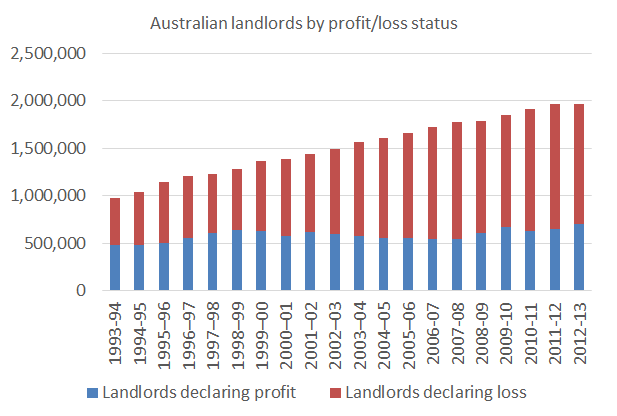
First, the majority of investors in rental properties are declaring net losses on their properties to the ATO (see chart below based on ATO tax data).

NG_chart1

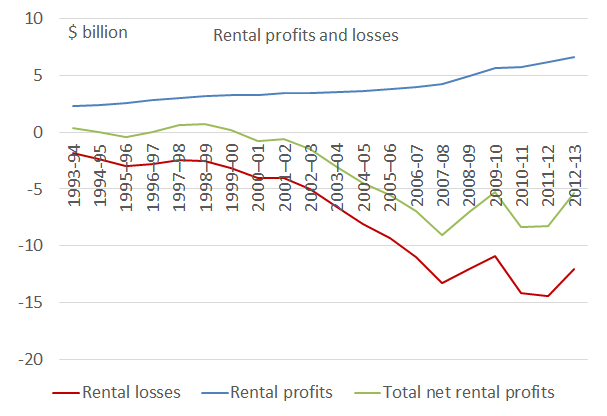
Second, as noted in Treasury’s tax discussion paper (p.64), “deductions claimed for investment properties as a proportion of gross rental income have increased over the last 15 years and are now greater than gross rental income.” So Australian households, in aggregate, are declaring a net loss on their rental properties, excluding capital gains (see chart below). That is, they are relying solely on capital gains to make money on their investment properties. This seems like a very odd situation, driven by the highly concessional tax treatment of capital gains that was introduced in 1999, and arguably should be addressed by the Government in its upcoming tax reforms.

NG_chart2

Posted in Housing, Tax, Uncategorized | Tagged , | 12 Comments

Update on lockout law debate

Rod Bogaards’ recent guest post on the proposed lockout law was quoted by Paul Syvret in the Courier-Mail yesterday in his opinion piece Lockout laws’ knock-on effects need to be weighed. Regarding the proposed law, Syvret noted:

The problem is there has been no qualitative evaluation of the socio-economic impact of such heavy-handed, nanny-state regulation.

As economist and former Productivity Commission director Rod Bogaards argues in an analysis of the NSW experiment, when you are deploying a very blunt regulatory club, there is a big difference between effectiveness and efficiency…

…the laws have taken a shotgun approach to dealing with a rat problem, with scant regard to the collateral socio-economic damage…

…If you are going to design effective and equitable regulation, then, as Bogaards says, “you actually have to do the work first to assess unintended consequences, and that hasn’t been considered in this instance”.

Well done to Rod for injecting himself into this important debate. Rod is certainly right regarding the need for closer analysis of the proposed law, comparing the expected benefits and costs of the proposal. Such analysis would include consideration of other options to reduce alcohol-related violence, which is undeniably a major problem. Other options to consider in a cost-benefit analysis could include greater police numbers in known trouble spots or an increase in the “sin tax” on alcohol (with compensating reductions in other taxes). Of course, any taxation changes would need to be enacted by the Commonwealth, but they should still be considered in a comprehensive analysis of options to reduce alcohol-related violence.

In 2012, John Marsden, a founding director of my previous employer Marsden Jacob Associates, led some very interesting work on the costs and benefits of increasing alcohol excise that is still relevant to the current policy debate. The study argued that an increase in alcohol excise (and fixing up the current anomalous taxation treatment of wine) would yield net benefits to the community through reducing binge drinking and harms to others. The report, which was commissioned by the Foundation for Alcohol Research and Education (FARE), can be downloaded via the following link:

Marsden Jacob report on alcohol taxation

Posted in Social policy, Uncategorized | Tagged , , , , , , , | Leave a comment

Will the lockouts and last drinks regulation work?

Guest post by Rod Bogaards

The Queensland Parliament is soon to debate lockout and last drinks legislation. To achieve the objective of reducing alcohol-fueled violence the proposed Queensland legislation needs to pass two tests:

  1. Will it be effective in addressing the violence in entertainment precincts?
  2. Will it be efficient in addressing the violence in entertainment precincts?

Based on the Sydney experience, the answer to the first question is ‘probably’ and the answer to the second is ‘possibly not’.

In Sydney in January 2014, the NSW Government introduced a package of regulatory changes, including a 1:30am lockout and a 3:00am last drinks for entertainment venues in Kings Cross and the CBD.

Evidence by the NSW Bureau of Crime Statistics and Research shows a significant reduction in assaults in Kings Cross (down 32%) and the Sydney CBD (down 26%) following the changes. Interestingly, there was little evidence that assaults were displaced to other entertainment areas or neighbouring precincts. The only exception was the Star Casino, where the number of assaults increased. However, the increase in assaults around the casino was much smaller in absolute terms than the fall in assaults in Kings Cross and the Sydney CBD.

The NSW study authors concluded:

“…the January 2014 reforms appear to have reduced the incidence of assault in the Kings Cross and CBD Entertainment Precincts. The extent to which this is due to a change in alcohol consumption or a decrease in the number of people visiting these precincts remains unknown.”

Recent research undertaken on behalf of the City of Sydney confirms that visitor numbers to the Sydney Entertainment Precincts have dropped markedly since the reforms and that more people have been going home rather than staying in entertainment venues until closing times. For example, in Kings Cross there were 58 per cent fewer pedestrians in the precinct at 11pm and by 4am numbers were down 84 per cent compared to before the legislation was implemented. This “chilling effect” on Sydney nightlife has been described in a recent opinion piece by Matt Barrie in the Courier-Mail.

The NSW reforms appear effective in reducing alcohol-fueled violence, but they appear to do so by lowering patronage rather than improving individuals’ drinking behaviour. As noted by Professor Gordian Fulde, an advocate for the lockout laws from the St Vincent’s Hospital Emergency Department:

“It’s a completely different place. The shops are empty, people have lost their jobs, there’s no denying that. For every action there’s a consequence.”

There is limited evidence on whether the reduction in alcohol-fueled violence outweighs the costs of the “chilling effect” on Sydney night life (reduction in consumer choice/enjoyment and reduced business activity).

Ideally, a consideration of the similar legislation for Queensland would involve a rigorous assessment of the expected benefits and costs of the proposed lockout and last drinks legislation.

The recently released Legal Affairs and Community Safety Committee report on the proposed legislation discusses some of the positive and negative impacts on various sections of the community, but does not attempt to compare these impacts and explicitly conclude whether there is a ‘net cost’ or a ‘net benefit’ from the legislation overall.

The difficulties of using blunt regulatory solutions to address what are essentially cultural and social problems are numerous. If robust policy analysis is not done before ‘doing something’ it increases the risk of poor policy decisions and unintended consequences.

The Legal Affairs and Community Safety Committee recommends conducting an evaluation of the legislation after it has been in place for 18 months to assess the impacts on the community. Recent history indicates that the quality of such evaluation needs to improve if it is to yield useful evidence for policy makers. According to the Queensland Auditor General the last evaluation of Drink Safe Precincts was not well planned or implemented, and did not provide reliable conclusions on the effectiveness of the trialed measures.

Rod Bogaards is an economic consultant and former Director of the Productivity Commission.

Posted in Social policy, Uncategorized | Tagged , , , , , | 10 Comments