QRC right about problem with royalties – does it now support a resource rent tax?

The new State of the Sector report from the Queensland Resources Council confirms the struggling position of the mining sector, and it must have the Queensland Treasury considering further royalties revenue write downs. It also makes me wonder whether the QRC might now prefer a resource rent tax (i.e. a mining super profits tax) to the current royalties regime. QRC CEO Michael Roche noted in the report that:

“…we need to be having a conversation about the fact that the state government is collecting royalties from resource operations which aren’t even covering their cash costs.”

I agree this is a conversation that needs to be had, because the QRC CEO has correctly pointed out the problem with royalties, that they are not related to profitability and can discourage efficient extraction of a resource. Royalties typically appear at the top of the list of bad taxes (see my 2011 post Inefficient State taxes). So it would be desirable, for the economy and arguably the mining sector, too, to cut royalties and make up the revenue with a resource rent tax, which would tax the super profits of mining companies (i.e. meaning they would pay much less tax in difficult times such as these, and more in the good times). However, the sector has previously opposed such a tax, and the limited resource rent tax that was implemented by the Gillard Government was ultimately repealed by the Abbott Government. The sector may now be regretting it was not more open to a resource rent tax.

Posted in Mining, Uncategorized | Tagged , , , , , | 6 Comments

Australia Awards workshop on policy making in Bandung

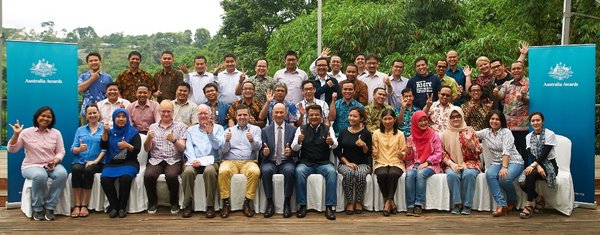
I returned to Brisbane this morning after a week in Indonesia, which I was visiting to help facilitate the post-course workshop for the Australia Awards short course Strengthening Public Policy Development Processes for Emerging Leaders from Indonesia’s Ministry of Finance. The Australian Ambassador to Indonesia Paul Grigson has tweeted a couple of photos from the workshop, one of which includes me (see embedded tweet above and the higher resolution image below which I extracted from the tweet; I’m in the front row, sixth from the left). The workshop was held in the beautiful capital of West Java, Bandung, which is famous for hosting the historic Asian-African Conference of 1955. I was very pleased to be part of the team assembled by UQ International Development to facilitate the short course.

Bandung_workshop_photo

Posted in Uncategorized | Tagged , , , , , | 2 Comments

Should Qld taxi plate owners be compensated for the recent disruption to the taxi industry?

Guest post by Rod Bogaards*

Recent announcements by the NSW and WA Governments to legalise ride sharing service UberX have also included proposals for ‘adjustment assistance’ for taxi plate owners.

Taxi plate owners are understandably concerned over the loss of value in their taxi plates caused by the erosion of the taxi monopoly. Taxi associations have been lobbying state governments for compensation if Uber is legalised.

The NSW Government announced a $250 million industry adjustment assistance package to taxi plate owners. This assistance will be funded by a levy on all point-to-point transport providers, equivalent to $1 per trip for five years. Similarly, the WA Government announced the establishment of a transition assistance package and hardship fund (although the details are still to be finalised).

The Queensland Government has commissioned its own independent review of the taxi industry and will have to decide whether any assistance is justified.

According to the Sydney Morning Herald, some lukewarm support for taxi compensation has come from the architect of the Commonwealth Government’s recent Competition Policy Review, Professor Ian Harper. Conversely, the Economic Regulation Authority in WA says there are three reasons why there is no justification for state government compensation for taxi owners.

  1. Loss of taxi plate value is due to technological change not a change in government policy

    The value of taxi plates has already shrunk irrespective of whether governments legalise Uber. This reduction in value has come about by technological innovation, not a change in government policy. The demise of state taxi monopolies has been brought about by the entry of ride sharing services rather than any government action. Governments are therefore under no obligation to pay compensation.

    But, even if it were due to a government policy change, the case for compensation is not clear cut. It is generally accepted that governments should compensate where they reduce or remove physical property rights. However, property rights that are generated solely by government regulation (such as taxi licences) are generally assessed on a case-by-case basis.

  2. Governments should not compensate taxi owners for poor investment decisions

    The purchase of a taxi plate is an investment like any other financial investment. Investors in taxi plates should have been aware of the risks associated with the relatively large investment they made. Similar to other investments, due diligence was required to assess whether the risk-return trade-off of owning a taxi plate was a sound investment. Taxi plate ownership was never a risk-free investment since there was always a risk that technological change or regulatory reform would reshape the taxi industry.

    If compensation is paid in such circumstances it would set a very expensive precedent. There are many industries experiencing rapid technological change and many investors in these industries will not recoup their investments.

  3. It is unfair for consumers/taxpayers to compensate taxi owners

    Asking consumers to pay more to taxi plate owners is very difficult to justify on fairness grounds, given they have borne the costs of the taxi monopoly for decades in the form of higher taxi fares and longer waiting times than would have existed in a market without supply restrictions. It would be inequitable for consumers to pay for the privilege of removing the taxi monopoly — they have borne such high costs already. A 2012 study by CIE estimates around $24–40 million is transferred from consumers to the 2,881 taxi licence owners in Queensland each year due to the limit on the number of taxi licences.

    It would also be unfair on taxpayers to pay compensation. Transferring money from taxpayers to taxi plate owners would have to be justified on the basis that taxi owners are somehow more deserving than those taxpayers funding the compensation.

According to the OECD, the New Zealand and Irish Governments deregulated the taxi industry without compensating taxi owners.

The Queensland Government’s approach will have important implications for consumers and taxpayers and set a precedent for other regulated industries that are being challenged by technological change.

*Rod Bogaards is an economic consultant and former Director of the Productivity Commission.

Posted in Transport, Uncategorized | Tagged , , , , , , , , | 8 Comments

Qld Renewable Energy Taskforce asked to achieve impossible 50% target

Queensland’s Energy Minister Mark Bailey yesterday announced in a media release that “A formidable team of business, energy, and environmental experts will lead the public inquiry into establishing Queensland’s 50% renewable energy target by 2030.” Being led by a former Macquarie investment banker, the team certainly has some claim to being labelled formidable, but it will struggle with the task set for it by the Government, to “investigate and identify the pathway to adopting the target.” The problem the Taskforce faces is that there is no credible path for Queensland achieving this target by 2030. My strong feeling is that this is not enough time for the more than 5X increase in renewable energy generation required, even if one makes optimistic assumptions about the uptake of battery technology to store solar energy captured from rooftops.

Of course, the Government probably does not even care its target is unachievable, as there is only the remotest possibility it will still be in power in 2030. It appears to have set an unachievable feel good target for political purposes, knowing it will not be held accountable for missing the target in 2030. I actually hope the Government is this cynical, because it means they are less likely to enact costly policies (e.g. solar power subsidies) in pursuit of the ridiculous 50% target.

Finally, another major problem is that the Government is assuming its 50% renewable energy target is desirable in the first place, that it helps us meet our energy needs in the most cost-effective way (accounting for externalities such as any greenhouse gas-induced climate change, of course). I cannot find any research produced by or commissioned by the Government that proves this is the case. The Government needs to make a much stronger case for its renewable energy target, particularly given it goes far beyond the 20% target (for 2020) that was once set at the national level.

Posted in Energy, Uncategorized | Tagged , , , , , , | 7 Comments

Challenging conditions outside SEQ

In his recent commentary regarding strong growth in the retail sector, National Retail Association CEO Trevor Evans noted:

“South East Queensland is performing strongly but performance in Queensland is being held back by issues in some areas…Some areas are living through the ripple effects of the downturn of mining, some areas are still suffering from the drought.” (quoted in this Brisbane Times report)

There is certainly a stark difference in economic conditions between SEQ (i.e. the Brisbane metro area, the Gold and Sunshine Coasts and hinterlands) and the rest of Queensland, as can be seen in the charts for employed persons in SEQ (on the left) and the rest of Queensland (on the right) below.

SEQ vs non-SEQ

Extremely weak conditions in regional areas such as Mackay have prompted the Government to consider accelerated works programs in other regions, not just Townsville, according to a Courier-Mail report this morning: “Ms Palaszczuk has pledged to fast track projects in other regional areas like Mackay and elsewhere affected by widespread resource industry job cuts.” The obvious point to make about fast tracking is that it is just shifting the largely temporary employment benefits of particular projects forward in time. If the Government spends the funds on particular projects today, it can no longer spend those funds tomorrow when it was going to originally. No doubt the Government will face calls for additional future funding for infrastructure to make up for the funds that are spent earlier than originally anticipated.

However, as I have noted since the last election, given it has denied itself proceeds from privatisation, the current Queensland Government faces an extremely difficult challenge in funding the future infrastructure expenditure that is likely required and is currently not fully budgeted for. See my post:

How the Qld economy performed over 2015

Posted in Brisbane, Gold Coast, Infrastructure, Labour market, Mackay, Macroeconomy, Mining, North Queensland, Queensland Government, Townsville, Uncategorized | Tagged , , , , , , , , , | 11 Comments

Mackay asks why is Townsville getting special treatment?

Yesterday afternoon I spoke with Elly Bradfield on ABC Radio’s Statewide Drive program about Queensland Nickel entering administration and the likely economic fallout. I reiterated the points I made in this blog yesterday that this could be a big economic shock for Townsville, particularly if administration takes the natural course to liquidation, and that the Government’s efforts to stimulate the region, via accelerated infrastructure works, will provide some short-term temporary jobs but will not address the long-term lack of economic opportunities.

Also, I noted that the State and Federal Governments have done the right thing in resisting calls for a bailout or bridging finance, as providing such assistance would open the floodgates and get the government in the business of propping up struggling businesses across the country. I hope the State Government maintains its economic rigour and does not rashly commit to new possibly dubious infrastructure investments with the aim of stimulating the Townsville economy. (While the Super Stadium is almost inevitable, I mentioned to Elly Bradfield there are likely much better ways to spend the money in the region, including possibly on a co-located high school at James Cook University I undertook a feasibility study for a few years ago.)

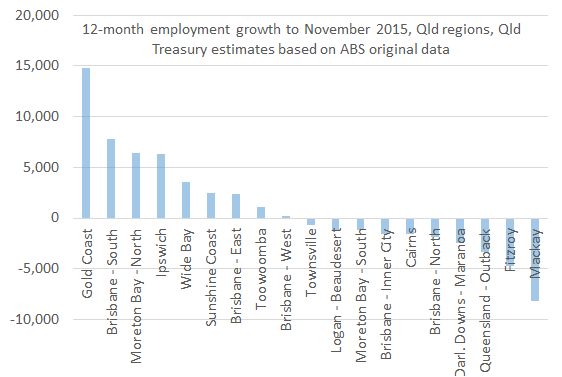
Finally I have to note that I was impressed by the Mackay Mayor Deirdre Comerford more-or-less asking on ABC radio why Townsville was getting special treatment from the Government when the Mackay region has also experienced job losses, indeed many more than the Townsville region in the 12 months to November 2015 according to Queensland Treasury estimates (see chart below)? That is a very good question. Due to the mining downturn and the drought, there are many regions in Queensland doing it tough. We should not be giving any region special treatment and generally should let the market determine the flow of resources and economic activity. As I noted yesterday, it may be that Townsville has to undergo a period of structural adjustment and that government efforts to stimulate its economy will ultimately be futile.

Emplgrowthbyregion_Nov15

I will post a link to the audio recording of the interview once it is available on the ABC website.

Posted in Mackay, Queensland Government, Townsville, Uncategorized | Tagged , , , , , , , , | 6 Comments

Economic pain continues for Townsville

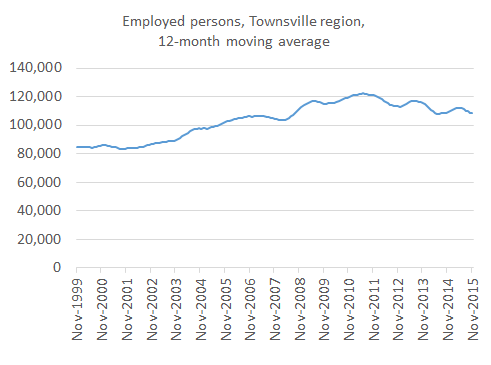
With the nickel refinery at Yabulu outside Townsville now in administration, following the sacking of hundreds of workers last week, Townsville residents are right to be very concerned about the economic impact of a possible refinery shutdown, and the loss of another 550 jobs, which would be a significant economic shock to the region. It would be a significant adverse shock to a region that is already struggling. The Townsville region has had a weak economy in recent years, and, as mining-related jobs have gone away, total employment in the region has fallen (see chart below) and the unemployment rate is now at around 8 per cent.

Townsville_employment

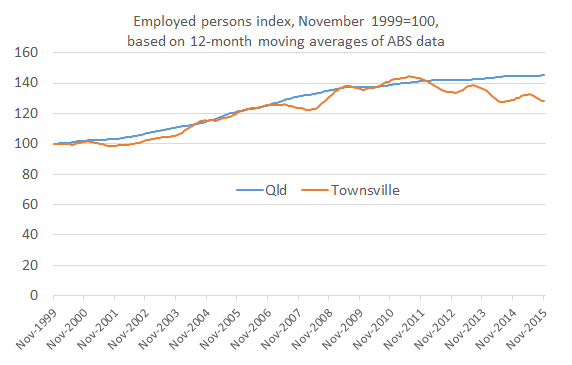
At the same time, employment in the rest of Queensland has increased and Townsville appears to have had four lost years (chart below).

Townsville_v_Qld

The State Government’s jobs plan for North Queensland, which involves the bringing forward of public works programs, might provide a temporary employment boost of 200 or more jobs (see this Townsville Bulletin report), but will not do much to counteract the long-term decline in jobs. The region will certainly get more of a long-term boost from the Energex-Ergon merger, which should see the gradual relocation of hundreds of professional jobs to the region, but the region will continue to suffer from a profound lack of economic opportunities, particularly considering Cairns has a much superior tourism offering.

The Government may need to accept that the Townsville economy needs to undergo some restructuring, and that employment growth may remain non-existent or very low in the region for some time. It needs to resist calls for dubious public investment projects, such as the Townsville Super Stadium, to which regrettably it has already committed its support. Instead, the Government needs to get the economic basics right, minimising regulatory restrictions on economic development and cutting inefficient taxes such as payroll tax.

Posted in Labour market, Townsville, Uncategorized | Tagged , , , , , | 5 Comments

Penalty rates reform should be considered as way to reduce youth unemployment

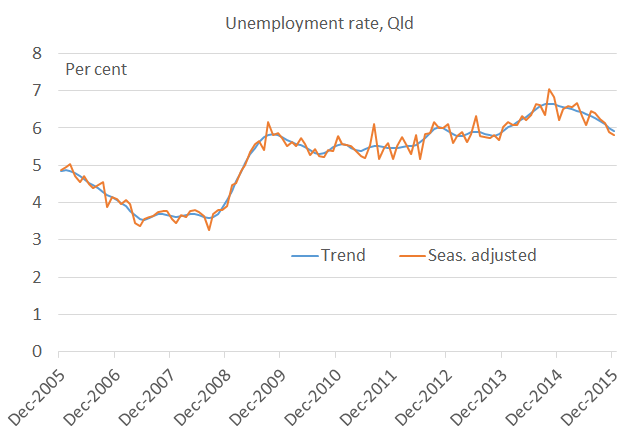
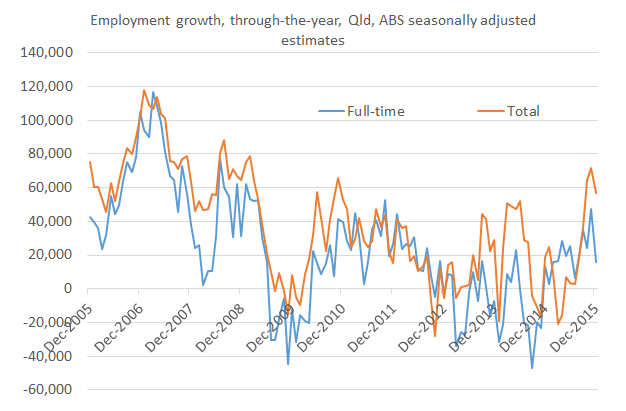
New labour force data from the ABS yesterday showed that Queensland ended 2015 with solid employment growth, and with the unemployment rate falling slightly further to 5.8 per cent, as the Queensland economy remains resilient at the end of the mining boom (see charts below). However, as the Courier-Mail has pointed out this morning, the good news at the macro level should not distract us from high rates of youth unemployment, particularly in regional areas such as Cairns and Townsville.

While youth unemployment is expected to be higher than prime-age unemployment, due to the lower skill levels and years of experience of young people, I suspect that a significant part of youth unemployment is due to policy settings that mean that many young people are priced out of the labour market. I am referring, of course, to minimum wage and penalty rates. At a minimum, the Productivity Commission’s recommendations regarding the alignment of Saturday and Sunday penalty rates should be adopted, which would no doubt boost employment in hospitality, a major employer of young people. See my post from March last year:

Addressing youth unemployment requires reform of workplace relations policies

As former Treasury Secretary Ted Evans once famously said, in a sense, we choose the level of unemployment we have. Unfortunately, political considerations get in the way of economic policy changes that would significantly boost job opportunities.

urate_Dec15

emplgrowth_tty_Dec15

Posted in Labour market, Uncategorized | Tagged , , , , , , , , , , , | 11 Comments

Top 10 Australian economists of all time

Recently, while reading Stuart Macintyre’s Australia’s Boldest Experiment and Frank Moorhouse’s Edith trilogy, it repeatedly occurred to me that Australia has been home to some extraordinary economists who have made major contributions to economic thought and policy making. Here is my first attempt at an all-time top ten list of Australian economists (noting I’ve adopted a broad interpretation of Australian), based on their impact on economic thought and policy making. Some of these contributions are now controversial, and this list is not necessarily an endorsement of all of their theories and views.

  1. Colin Clark (1905-1989), who prepared path breaking national income estimates for Britain in the inter-war years, worked with John Maynard Keynes, advised Queensland Premier Forgan Smith, pioneered the field of economic development, and finished his career at the University of Queensland’s School of Economics, which holds an annual lecture in his honour.
  2. H.C. “Nugget” Coombs (1906-1997), Australia’s econocrat extraordinaire who guided Australia’s post-war reconstruction, was the first Governor of the Reserve Bank of Australia, advocated for Indigenous land rights, and acted as an adviser to Prime Minister Gough Whitlam.
  3. Sir Leslie Melville (1902-2002), renowned economist and public servant, who led the Australian delegation to the 1944 Bretton Woods conference, and was later Australia’s Executive Director of the IMF and World Bank and Vice-Chancellor of the ANU.
  4. Trevor Swan (1918-1989), first Professor of Economics at ANU, and also a former Commonwealth public servant, who made major contributions to the macroeconomic analysis of economic growth and internal and external balance.
  5. Max Corden (1927- ), internationally renowned expert on international trade theory whose work helped demonstrate the high cost of tariff protection, a Professorial Fellow at the University of Melbourne, and a former senior Adviser to the IMF.
  6. L.F. Giblin (1872-1951), a towering figure in Australian economics, who was a Professor at the University of Melbourne, an adviser to governments on all the major economic issues of the day, such as tariffs, wages policy and the Depression, and was co-founder with Douglas Copland and others of the Economic Society of Australia.
  7. Jim Brigden (1887-1950), who in conjunction with L.F. Giblin made highly influential contributions in Commonwealth-State financial relations and trade theory and policy (specifically justifying protection for manufacturing, a position now rejected by Australian economists but which was highly influential for decades).
  8. Bob Gregory (birth year unknown), ANU Professor who has made major contributions to Australian public policy, has served as President of the Economic Society of Australia, and who is famous for having identified the Gregory effect, also known as Dutch Disease, the adverse impact on other sectors of a terms-of-trade shock favouring a sector such as mining.
  9. Ken Henry (1957- ), former Treasury Secretary, now Chairman of NAB, who has had a major influence on Australian economic policy since the 1980s, including in the delivery of Keating’s mid-1980s tax reforms, the Howard Government’s GST, and the Rudd Government’s response to the financial crisis.
  10. Gary Banks (birth year unknown), current CEO and Dean of ANZSOG, former Chair of the Productivity Commission, a major advocate of economic reform in Australia over the past few decades, and the inaugural recipient of the Economic Society of Australia’s Distinguished Fellow (Public Policy) Award.
Posted in Uncategorized | Tagged , , | 2 Comments

Unit approvals plummet in rest of Aus. with Qld likely to follow

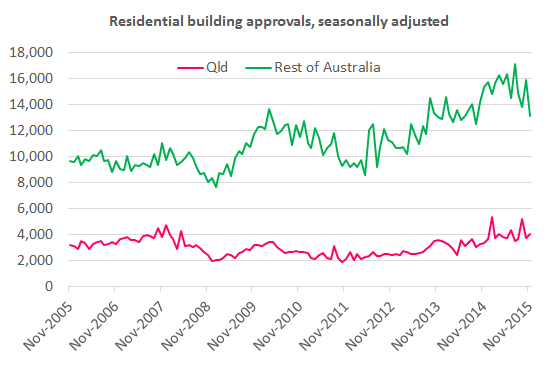
The Brisbane Times reported the other day that Brisbane renters were being offered inducements such as iPads, suggesting that supply growth has got ahead of demand growth in Brisbane recently. This should reduce the enthusiasm of investors for the Brisbane market, and we should expect a reduction in unit approvals in the year ahead, which will eventually have an impact on construction activity. The rest of Australia has already seen a major decline in unit approvals, driving total building approvals figures down (see chart based on latest ABS data below), and Queensland will very likely follow the rest of Australia in the coming months.

Building_approvals_Nov15

Posted in Housing, Uncategorized | Tagged , , , , , , , | 4 Comments