Qld returns to fourth place in population growth as WA falls back

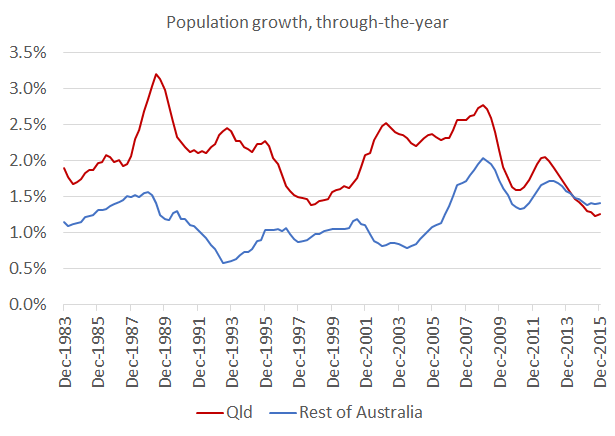
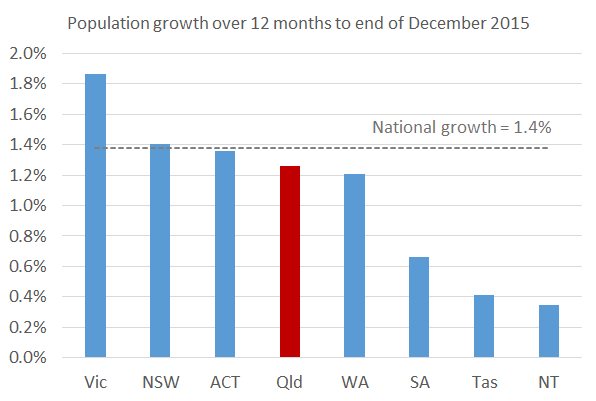
The new population data released by the ABS last week reveal Queensland is still growing slower than the national average, and much slower than Victoria (see first chart below), a State to which we are still losing interstate migrants in net terms (more on this point below).

Population_Dec15_Chart1

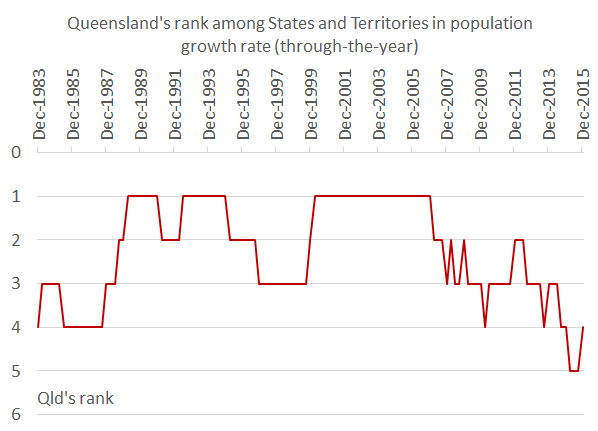
At least Queensland has regained fourth place among States and Territories in population growth rates, but that is due to WA slipping behind, and we have historically been ranked much higher (see chart below).

Population_Dec15_Chart2

Queensland has been growing at a slower rate than the national average since mid-2014 (see chart below).

Population_Dec15_Chart3

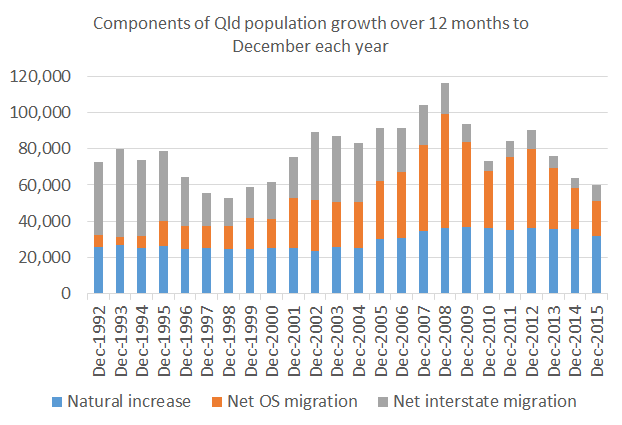
This reflects ongoing weakness in net interstate migration as well as a disproportionate drop in net overseas migration (see chart below).

Population_Dec15_Chart4

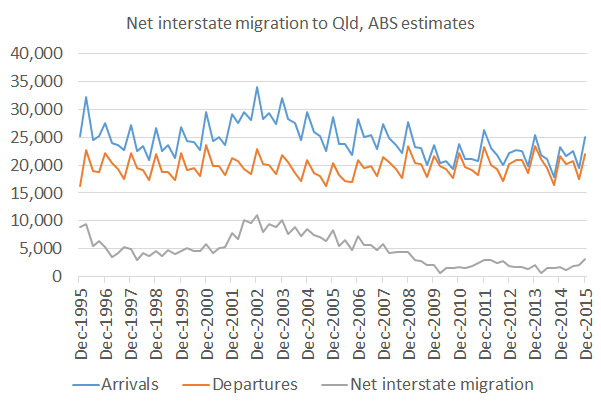
Luckily, there are some signs of a recovery beginning in net interstate migration, but it may be too soon to call it a recovery (see chart below).

Population_Dec15_Chart5

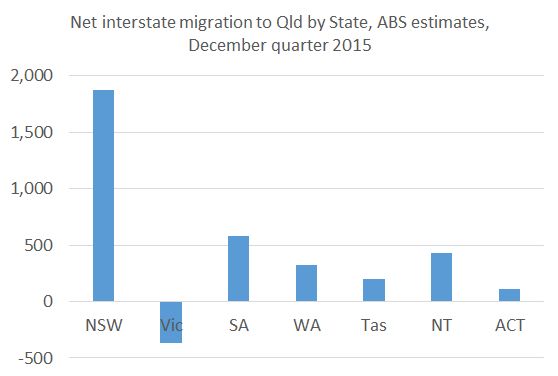
As noted above, Queensland is still losing interstate migrants to Victoria in net terms (see chart below).

Population_Dec15_Chart6

My previous comments on Queensland population issues include:

ABC radio interview on population growth & State income tax proposal

Queensland has fallen to 5th place in rates of population growth among States and Territories

Also see Queensland Treasury’s information brief.

Posted in Migration, Population, Uncategorized | Tagged , , , , , , | Leave a comment

Stark difference in unemployment rates between resources regions and rest of Qld

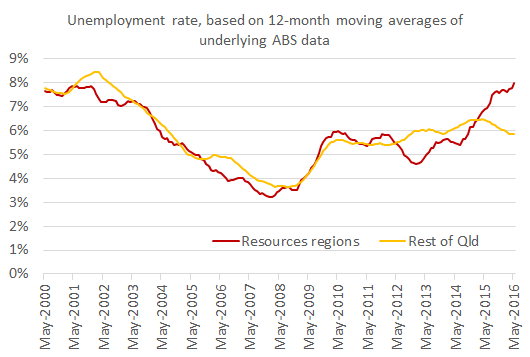
The Queensland branch of the Economic Society of Australia, of which I am the Secretary, was fortunate last Tuesday to host a presentation by Queensland Treasury official Greg Uptin on the economic forecasts underpinning the 2016-17 Queensland Budget. Greg gave a very interesting and highly informative presentation, full of terrific charts. One of my favourite charts compared the unemployment rate for the resources regions—Fitzroy, Mackay, Queensland outback and Townsville regions—with the unemployment rate for the rest of Queensland (see my reproduction of it below, based on the latest ABS regional labour force data released last Thursday). This clearly illustrates just how diverse economic conditions are across Queensland, and how much the regions have suffered from the mining downturn and drought.

Unemployment rates for resources regions and rest of Qld May 2016

Well done to Greg and his Queensland Treasury team for preparing such an excellent presentation.

On the latest ABS regional labour force data, also see Pete Faulkner’s post:

Both Cairns and Townsville see labour markets deteriorating in May

Posted in Labour market, Macroeconomy, Mining, Uncategorized | Tagged , , , , , , , , , | Leave a comment

Brexit impact depends on terms of divorce with EU

At the Tattersall’s race meeting at Eagle Farm today, I was fortunate to run into Morgans Chief Economist Michael Knox, and we had a good chat about, unsurprisingly, what everyone else is talking about, Brexit. Michael reminded me that he wrote a note on the topic back in April, which I read when I got home, and have posted a link to below, as I think it is one of the best pieces on Brexit I have read:

Michael Knox on Brexit

After the financial markets settle down over the next week or so, after there is a realisation about the extent of the over-reaction, attention will focus on exactly how Britain will extract itself from the EU, which is the crucial issue, as argued by Michael in his note. Michael wisely observed:

“The economic damage done by Brexit would be determined not by Brexit itself, but by the kind of deal that Britain does with the European Union after it leaves. Britain is the second largest economy in Europe. It is strong enough to get almost any kind of deal that it wants.

The more restrictive on trade and immigration the deal is, the greater the damage would be. The real problem is that the populists who might rule the British economy after it leaves the European Union might negotiate restrictive deals on both trade and immigration. They might manage to shoot themselves in both feet.”

This is certainly true, and there is the prospect of a reactionary clamp down on immigration, as it appears that one of the factors behind the successful leave campaign was dissatisfaction with high levels of immigration. This is regrettable because, at appropriate levels, immigration is good for the economy and society. That said, immigration does not necessarily benefit every member of the community in the short-term, and immigration can depress the wages of some domestic workers through increases in labour supply. Over the long-run, the beneficial impacts of immigration through expanding the economy should, hopefully, offset any short-term absorption problems. But, in the long-run, as Maynard Keynes said, we are all dead. Many British people are obviously unhappy with the present consequences of open borders in the EU and have consequently voted for Brexit. It is a most extraordinary result. The weeks and months ahead will give us a clearer idea of how greatly we should be concerned about its ultimate consequences.

Keep-calm-and-carry-on-scan

A very important message in these uncertain times

Posted in Macroeconomy, Uncategorized | Tagged , , , , , | 18 Comments

Upcoming Qld Treasury briefing on Budget economic forecasts to ESA Qld

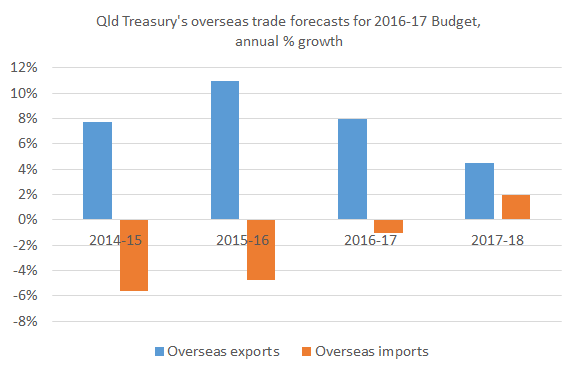
As the Secretary of the Queensland Branch of the Economic Society of Australia, I am very pleased that Greg Uptin, a senior Queensland Treasury official, will once again brief us on the Treasury’s economic forecasts underpinning the 2016-17 State Budget. The briefing will occur lunchtime this upcoming Tuesday (21 June) at Morgans, Level 29, Riverside Centre on Eagle St in Brisbane CBD. Greg is one of the most knowledgeable people on the Queensland economy around, and he always has very interesting charts to show. I am particularly interested in any insights Greg has into Queensland’s overseas trade numbers, which are being massively boosted by all the LNG we are increasingly shipping out of Curtis Island (see chart below). At the same, overseas imports are declining as we are obviously importing lower volumes of material inputs for construction and production processes in our previously booming resources sector.

Exports_imports

I am very much looking forward to Greg’s briefing and I hope you can come along, too. Note there is a small charge for attendance to allow us to recover costs. You can register via the ESA Qld website:

Post-Budget briefing on economic forecasts by Qld Treasury’s Greg Uptin

Posted in Budget, Macroeconomy, Uncategorized | Tagged , , , , , , , , , | Leave a comment

Workforce participation drops as Qld economy under-performs

Far North Queensland-based economist Pete Faulkner published a great analysis of the ABS labour force estimates for May on his blog yesterday (Jobs data in Qld is poor again):

Unfortunately the picture in Queensland continues to be a weaker one. Although the seasonally adjusted unemployment rate managed to fall slightly to 6.4% (from 6.5%) this is on the back of further job losses (down 1,700) with even more full-time jobs going (4,500). The only reason the unemployment rate has managed to drop is the decline in the Participation Rate to a level not seen since Sept 2004. Looking through the PR effect we see the Employment:Working Population measure down to 60.8 (it’s lowest since Nov 2014). The Trend data doesn’t provide any brighter notes with the Trend unemployment rate rising to 6.4% (from 6.3%…which was in turn revised up from 6.2%). Trend employment growth in the Sunshine State now stands at just 1% while the working population is increasing at 1.4%

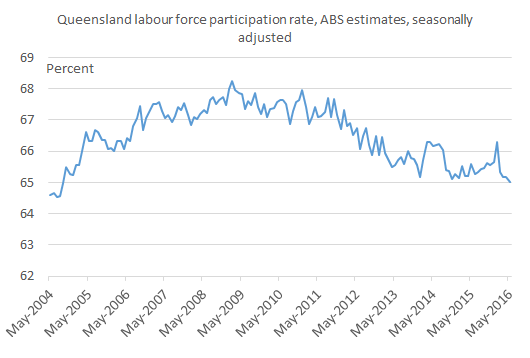
The point about the participation rate is an excellent one. It is likely that many Queenslanders who are marginally-attached to the labour force have temporarily given up looking for a job because of the under-performing economy (see figure below).

partrate_May16 Also see the latest labour force brief from Queensland Treasury which clearly shows the divergence occurring between Queensland and the rest of Australia as the local economy under-performs.

Posted in Labour market, Uncategorized | Tagged , , , , | Leave a comment

Qld Budget includes unbelievably low expenditure growth forecasts

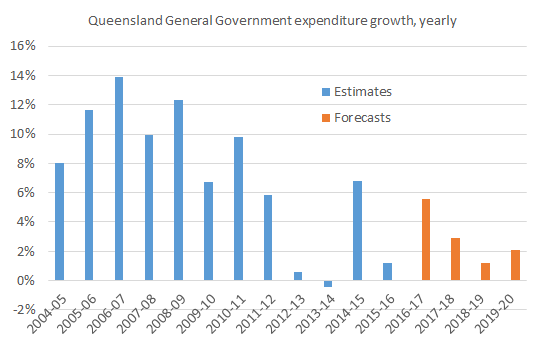
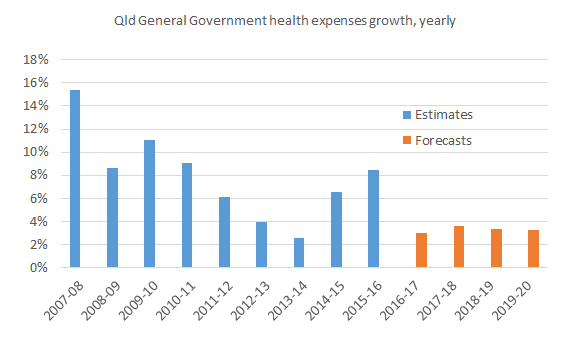
As the Queensland Budget bad news (revenue write-downs, super raids, etc) had already been released by the Government, there was not much to get excited about yesterday afternoon, or so I thought. Then I had a look at the Government’s fiscal forecasts and was very surprised that it is forecasting such unbelievably low growth in expenses, only 2.9% per annum over the four years to 2019-20, which would imply growth of no more than 1% per annum in real terms over the period. Compare the expenditure growth forecasts with the historical data and you will see how heroic they are (see the first chart below based on Budget data). And note the health expenditure forecasts seem particularly optimistic (see the second chart below based on data from the Budget and Queensland Government historical health expenditure data reported by the ABS).

QldGGexpenses

QldGGHealth

The low expenditure growth forecasts are necessary because the Government needs to claim it is maintaining an operating surplus over the forward estimates. The Government claims it can achieve the unbelievably low expenditure growth because:

“The Government continues its commitment to expenditure control, with new expense measures announced since the 2015–16 Budget being partly funded through expenditure reprioritisations. In addition, a new fiscal principle has been introduced to maintain a sustainable public service workforce. The overall growth in public service full–time equivalent employees, on average over the forward estimates, will be aligned with population growth.”

The Government still needs to demonstrate its commitment to expenditure control. With the recent blow out in public service numbers and employee expenses (over 7% growth in 2015-16), it is difficult to take such a commitment on faith. I suspect expenditure growth will be much higher than currently forecast over the forward estimates.

Posted in Budget, Health, Uncategorized | Tagged , , , | 6 Comments

Qld Government needs to avoid costly inter-state bidding wars

In the 2016-17 Queensland Budget being handed down today, among other measures, the State Government will allocate $40 million to “aggressively” attract businesses to the State, no doubt through a combination of payroll tax concessions, grants and similar financial incentives (see the Brisbane Times report). But offering financial incentives to encourage businesses such as Virgin or major events such as a Grand Prix to relocate can make us worse off, taking into account the actions of other States trying to do the same thing. We just end up continually poaching businesses and events from one another and competing to attract international businesses that would come to Australia anyway. The big winners are shareholders, not taxpayers. When we offer financial incentives to businesses, other States are likely to retaliate and do the same thing, so while we may gain some businesses and events, we may lose others. We would all be better off cooperating and agreeing not to offer selective financial incentives.

Former Productivity Commission Chairperson Gary Banks was highly critical of State Government selective industry assistance programs in an excellent speech to CEDA in Brisbane in 2002 (see Inter-state bidding wars: Calling a truce). In his speech, he observed:

“…the situation represents a classic prisoners’ dilemma, because while all States would be better off by cooperating, in some cases individual States will see benefits in defecting.

The need to avoid mutually impoverishing ‘beggar-thy-neighbour’ policies was an important reason for the formation of Australia’s Federation in the first place. Elimination of tariffs at State borders was critical in enabling a national economy to develop from early last century. Over time, regulatory and other impediments were also gradually removed or reduced, including through cooperative agreements on Mutual Recognition, National Competition Policy and Government procurement over the past decade or so. But selective assistance remains a growing threat to the realisation of this nationally beneficial goal…

…If governments can agree to a truce on inter-State bidding wars and other selective corporate support, they can then concentrate their forces on a much more worthy and productive battle: improving further their economic governance, tax regimes, infrastructure and other service delivery. These are the real mainstays of the contribution of State and Territory Governments to economic performance in the long term.

Very wise words. Instead of offering selective industry assistance and risking retaliation from other States, the Queensland Government should instead focus on improving the State’s economic fundamentals and providing tax relief to all businesses, not just the lucky few.

Posted in Industry policy, Uncategorized | Tagged , , , , , , , | 3 Comments

Cost of bad regulation increased by excessive enforcement against Uber drivers & riders

When the Queensland Government announced its personalised transport review, I hoped that Transport and Main Roads (TMR) would turn a blind eye to Uber. It seemed obvious the Government would eventually legalise Uber, so why continue to deny consumers and waste taxpayers’ money cracking down on Uber? Indeed, as I’ve noted on this blog many times, the current regulations are costly economically, and we would be better off if they were not enforced (see e.g. Cracking down on Uber would come at a high cost to the Qld community).

But, alas, TMR appears to have stepped up its enforcement effort, and a highly regarded, high achieving young university student I know claims he was harassed in the early hours of this morning by a public official. Here is an excerpt from an account of the incident he provided me:

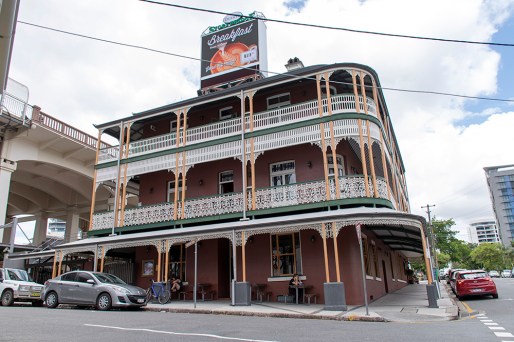
“I booked an Uber from Roma Street Train Station last night to take me home to Kangaroo Point. I was picked up by a really nice driver. I noticed a car that was nearby when I entered [the driver’s] vehicle that had ‘traffic management’ on the side, but thought it was merely a government roadworks vehicle. As we drove towards the Story Bridge the traffic management vehicle flashed its lights…We continued driving across the bridge, and I suggested to [the driver] that I didn’t want to cause him any problems and I was happy to do what he thought was best. He asked if I was happy for him to drop me outside the Story Bridge Hotel and I said that was fine.

It was around 1am at this point when I exited the car. As soon as I got out of the car, an officer exited the traffic management vehicle and physically intimidated me and prevented me from continuing on my walk home. He showed me an identification on his shirt but I did not read it. I can’t recall any clear uniform on the official; there may have been but it was not clear to me at the time. He asked me if I had just got out of an Uber. I asked what his authority was to ask me questions and he merely showed me his identification badge again, without explaining his powers or my rights in relation to answering his questions. He did not supply a reason for questioning me or state his suspicion of my involvement in an offence.”

Eventually, the young man complied with the official’s request to supply his ID. The young man also allowed the official to take photos of the receipt for the trip on his phone, after which the young man was allowed to go home. He is rightly concerned that the Queensland public has not been adequately informed about the powers of officials who are not police officers to compel them to provide information:

“The fact that anyone other than a police officer has the power to stop and harass a citizen as they get out of a car and walk along the footpath near their home is beyond me…There is a huge disconnect between what the law is in Queensland and what the public believe the law is, or believe the law ought to be. This is a huge problem in any situation, but even more of an issue when these ride-sharing laws provide outrageously broad enforcement powers to unrecognisable government officials that are not police officers.”

Jim Varghese cannot finalise his personalised transport review quickly enough. The current regulations and the aggressive enforcement of them are very costly to our community.

Story_Bridge_Hotel

A Qld university student claims he was harassed by a public official after hopping out of an Uber at the Story Bridge Hotel

Posted in Transport, Uncategorized | Tagged , , , , | 8 Comments

Guest post: Why are NSW mining regions enduring the mining downturn better than Qld regions?

Today I am delighted to publish a guest post from my NSW-based friend and fellow economist Alistair Robson. 

Why are NSW mining regions enduring the mining downturn better than Qld regions?

by Dr Alistair Robson

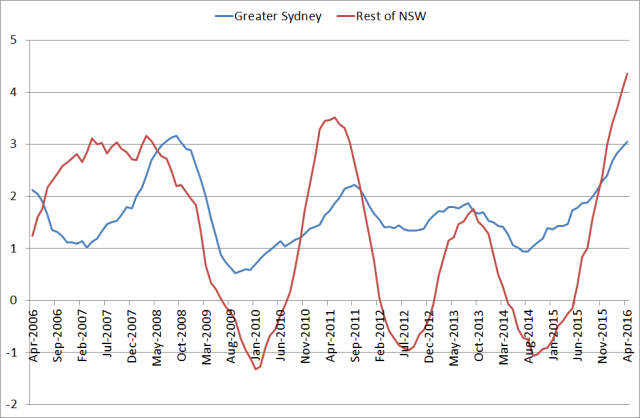
Despite the Sydney-centric focus on the New South Wales economy, a hidden gem has been the regional labour market. Employment grew by 4.4% over the year to April 2016 outside of Greater Sydney compared with 3.0% within the Greater Sydney area. This growth comes despite the housing construction boom underway in Greater Sydney and drought like conditions in some parts of regional NSW.

Employment growth – % over the year
Al_Chart_1

 Source: ABS, 6291.0.55.001 Labour Force, Australia, Detailed – Electronic Delivery, Table 16. Labour force status by Labour market region (ASGS) and Sex.  Original data have been adjusted to 12 month moving annual averages.

The last period employment in regional New South Wales significantly outperformed Greater Sydney was almost 5 years ago ending in November 2011.

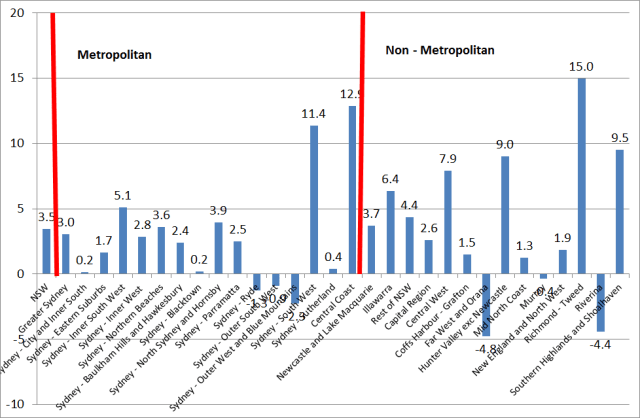
The Richmond-Tweed region bordering South East Queensland performed the best with a stellar 15.0% employment growth rate, followed by the Southern Highlands and Shoalhaven region at 9.5% and the Hunter Valley (excluding Newcastle) at 9.0%.

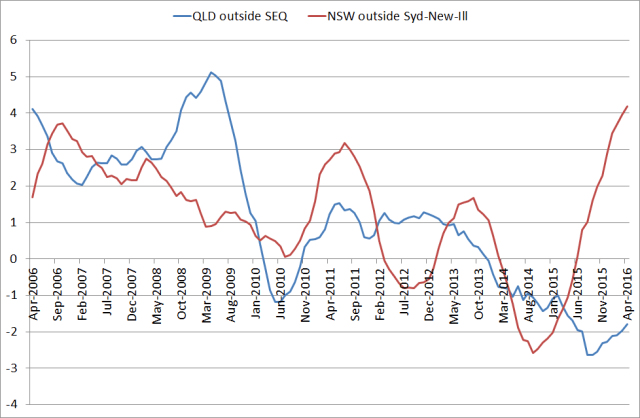
Comparatively, regional Queensland employment (ex. Brisbane-Gold Coast-Sunshine Coast) has been falling for over 2 years.  There is now a very large gap in regional employment growth between the two states.

Employment growth – Regional QLD (ex. Brisbane-Gold Coast-Sunshine Coast) and Regional NSW (ex. Sydney-Newcastle-Illawarra) — % over year
Al_Chart_2

Source: ABS, 6291.0.55.001 Labour Force, Australia, Detailed – Electronic Delivery, Table 16. Labour force status by Labour market region (ASGS) and Sex.  Original data have been adjusted to 12 month moving annual averages.

Considering the impact of lower coal prices on many Queensland regions it appears remarkable employment growth has been so high in the Hunter region. Proximity to Newcastle and Sydney may have helped the region’s labour market adjust, a benefit which Queensland regions such as Mackay do not have.

Despite strong regional employment growth some areas in NSW experienced falling employment, such as the Far West and Orana, the Murray and Riverina regions. The impact of the drought like conditions may have been detrimental to the labour market in those regions as they have in some regional Queensland regions.

Within the Greater Sydney area employment growth was greatest in the Central Coast region at 12.9% and the South West region of Sydney at 11.4%.

NSW Regional employment growth – % over year to April 2016
Al_Chart_3

 Source: ABS, 6291.0.55.001 Labour Force, Australia, Detailed – Electronic Delivery, Table 16. Labour force status by Labour market region (ASGS) and Sex.  Original data have been adjusted to 12 month moving annual averages.

It is difficult to ascertain why employment growth was higher in regional NSW compared with Greater Sydney and regional Queensland. Perhaps the relative wage and land price gap between Greater Sydney and regional NSW overcame remoteness costs for businesses operating in regional NSW. Regional areas that have recorded the highest employment growth were close to major urban agglomerations, such as the Hunter Valley region and the Southern Highlands and Shoalhaven region to the Sydney-Newcastle-Wollongong urban agglomeration and Richmond-Tweed region to the Brisbane- Gold Coast-Sunshine Coast urban agglomeration.

As Greater Sydney business occupancy and labour costs continue to grow, the competitiveness of regional New South Wales businesses should increase, particularly for urban periphery regions.

Dr Alistair Robson is an independent economist based on the Central Coast of New South Wales. He holds a PhD in economics from the University of Queensland.

Posted in Labour market, Macroeconomy, Uncategorized | Tagged , , , , , , , , , | 6 Comments

My comments in today’s Courier-Mail on $3bn Qld revenue write-down

Yesterday’s announcement that the Queensland Budget will suffer a further $3 billion in revenue write-downs confirmed what I have been saying for a while now about Queensland’s under-performing economy. I am quoted in today’s Courier-Mail (pay-walled, sorry) noting that the news reinforces the need to be prudent in spending and to consider privatisation of government-owned businesses. The ratings agencies (Moody’s, S&P, etc) will take a dim view of our fiscal performance if we cannot control spending and show a credible path to a fiscal surplus.  I am quoted this morning as follows:

Former Commonwealth Treasury official Gene Tunny said the revenue writedowns delay hopes of Queensland reclaiming a AAA credit rating and highlight the need to sell or lease state-owned assets.

“I think the rating agencies will take a very dim view of that,” he said.

“It just underlines the need for prudent spending and the consideration of asset sales.”

Posted in Budget, Uncategorized | Tagged , , , , , | 2 Comments