LSE’s Stephen Machin to deliver public policy evaluation Winter school at O’Reilly’s, Gold Coast

Economists will often caution that correlation does not necessarily imply causation, or that causation may not run the way you expect. So, for example, the negative correlation between educational attainment and crime, that more educated people are less likely to be criminals, might not have to do with the improving effects of education. It might be because an unobserved factor, e.g. a lack of conscientiousness, makes a person more likely to be a criminal and less likely to pursue education. Or that being a criminal denies you educational opportunities. Resolving the existence and direction of causality between education and crime can be important for public policy, because it could justify additional resources devoted to education, with a view to reducing crime.

Earlier this decade, LSE Professor Stephen Machin and his colleagues used innovative statistical techniques, based on the quasi-experiments generated by changes in the compulsory school leaving age in Britain, to prove that education does have a negative impact on crime (see this LSE working paper, later published in the prestigious Economic Journal).

LSE’s Professor Machin is one of the world’s leading experts in using innovative techniques to evaluate the impact of public policy measures. The Economic Society of Australia (Qld), of which I am the Secretary, is delighted to have arranged, in conjunction with Griffith University, QUT and UQ, a Winter School on public policy evaluation to be led by Professor Machin at O’Reilly’s Rainforest Retreat on the Gold Coast over 7-9 June:

2017 Winter School in Public Policy Evaluation

I would encourage you to book early to avoid disappointment, because this is an incredible opportunity to learn state-of-the-art public policy evaluation techniques from a world leader in the field.

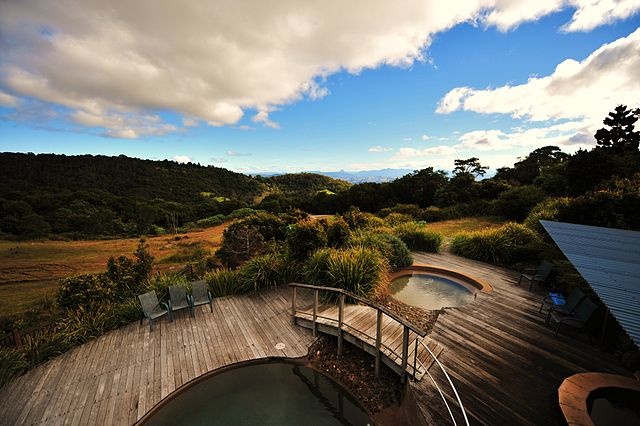
640px-OReillys_Rainforest_Retreat,_Queensland,_Australia_-view-16June2010

View from accommodation at O’Reilly’s Rainforest Retreat

By thinboyfatter [CC BY 2.0 (http://creativecommons.org/licenses/by/2.0)%5D, via Wikimedia Commons

Posted in Crime, Education, Labour market, Uncategorized | Tagged , , , , , , , , , , , | Leave a comment

Courier-Mail’s public service wages-budget threat story based on Joe Branigan’s QEW guest post

Well done to Joe Branigan on having his QEW guest post from last week, “Moody Blues”, quoted by the Courier-Mail’s Steven Wardill today (Qld Budget 2017: Public service wages threaten bottom line):

THE cash-strapped State Government will have to impose a public service hiring freeze for two years to avoid blowing its expense forecasts and risking a credit rating downgrade.

Analysis of Treasurer Curtis Pitt’s Budget projections has revealed the $1.2 billion extra forecast for employee expenses until 2018-19 would be soaked up by pay rises…

…Former federal treasury official Joe Branigan said the Government’s claim that it would keep overall expenses growth at 2.1 per cent on average for the rest of this decade was unfeasible.

“Remember that this 2.1 per cent needs to not only account for wages growth, but also the growth in the number of public servants,” he said.

“In my view, this is an impossible expenditure growth trajectory.”

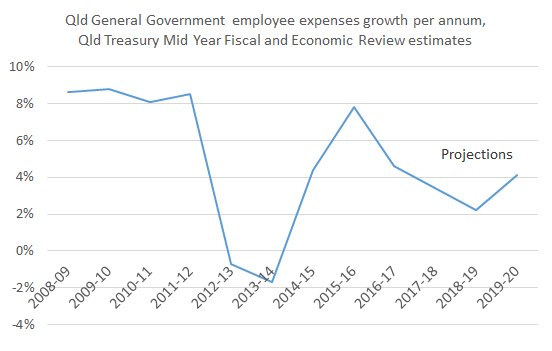
That quote from Joe is straight from his guest post on QEW. The current employee expenses growth projections certainly do look underdone compared with the post-Newman catch up growth in 2015-16 and with growth rates recorded during the Bligh Government (see chart below). I wouldn’t be surprised if these projections are revised upwards in the upcoming State Budget, however. Even though Cyclone Debbie will have an adverse impact on the Budget, higher coal prices will have helped the bottom line, and word on the street is that Queensland Treasury’s economic forecasts for the next few years are strong, providing the Government a much needed boost in revenue.

employee_expenses_growth_17

Of course, it’s all speculation at the moment, and we really need to wait for Treasurer Pitt to reveal the numbers on 13 June. But I would certainly expect a pre-election State Budget full of sweeteners, particularly for the regions. The Government needs to shore up its support in regional Queensland, where several seats might end up being won by Pauline Hanson’s One Nation. If that occurs, I expect we would see a change of government.

Posted in Queensland Government, Uncategorized | Tagged , , , , , , , | Leave a comment

Interview with ABC Radio’s Steve Austin on “The time Australia’s Treasury almost ran out of money”

I had a nice chat with 612 ABC Brisbane’s Steve Austin last Friday morning regarding my time in the Australian Treasury, particularly during the financial crisis in 2008-09, and focusing on what he described as:

The time Australia’s Treasury almost ran of money

The Australian Government didn’t run out of money, of course, because in late 2008 the Australian Office of Financial Management (AOFM), attached to the Treasury, projected the coming cash crunch, and the Government would announce an Updated Economic and Fiscal Outlook in February 2009. This update revealed the Australian Government would be going into deficit, and implied we would need to start selling a lot of bonds very quickly to fund those deficits. It also featured a massive $42 billion stimulus package, the Nation Building and Jobs Plan. I talked to Steve about my role during that period.

405px-Australian_Treasury

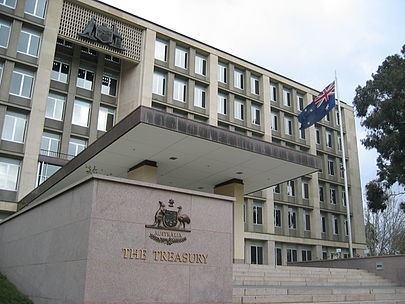
The Australian Treasury on Langton Crescent in Canberra’s Parliamentary Triangle

Note that, toward the end of the interview, I was confused by what was a very good question from one of Steve’s listeners. The listener asked whether the ATO fills out a Business Activity Statement (BAS). I’d now revise the answer I gave to this question, because the ATO would be paying GST when it purchases goods and services, and even though the GST paid would come back to it, it would need a way of accounting for it, so it may well lodge a BAS, or have an internal process that replicates it (hat tip to my colleague Zac for pointing this out). I will investigate further, as it really is an intriguing question.

Posted in Budget, Macroeconomy, Uncategorized | Tagged , , , , , , , , , | Leave a comment

Moody Blues – guest post by Joe Branigan

I am delighted to publish a guest post by my old friend and former Treasury colleague Joe Branigan on the recent upgrade to the outlook for Queensland’s credit rating from Moody’s. GT

Moody Blues

by Joe Branigan

Moody’s Investor Services has upgraded the outlook for Queensland’s public finances from negative to stable. This is undoubtedly welcome news for the Queensland Government and its liability manager the Queensland Treasury Corporation. And there’s nothing like a boost of confidence for Queensland in this somewhat miserable post mining boom decade.

However, in my view we need to keep the champagne chilled in the QTC boardroom fridge for a little while longer. The problem with Moody’s analysis is that it focuses too much on the short-term boost to revenue from the recent (and welcome) increase in coking coal prices as well as the initial boost to growth from LNG exports. Moody’s implicitly assumes that both of these factors will continue indefinitely. In fact, neither factor in isolation has much to do with Queensland’s long-term structural budget position, especially because of the way the Commonwealth Grants Commission discounts Queensland’s GST allocation every time the rivers of royalty revenue flow a little too fast for the CGC’s liking.

When you look through the fluctuating resource prices and one-off budget measures, such as the superannuation payment holiday and loading the Government Owned Corporations (GOCs) with debt, it is clear that Queensland has a structural budget problem that can only be addressed by consistently restraining spending growth in the general government sector to below long-run average revenue growth, not just next year but for the next generation.

The latest Queensland Treasury forecasts from the 2016-17 Mid Year Fiscal and Economic Review (released December 2016) show net debt in the General Government sector rising from $2 billion in 2016-17 to $9 billion in 2019-20. That is, the Government’s financial position continues to deteriorate. MYFER also assumes that the Queensland Government will manage to keep expenses growth to 2.1% per annum for the rest of this decade. Remember that this 2.1% needs to not only account for wages growth but also the growth in the number of public servants. In my view, this is an impossible expenditure growth trajectory.

And the fact that Queensland Treasury forecasts a fiscal deficit for the rest of this decade means that the government must continue to rely on ‘balance sheet management’ to reduce debt in the General Government sector. As I’ve said before the problem with these one-off accounting gymnastics is that they’re one-off. There’s only so much blood that can be drawn out of a GOC before its concrete and steel skeleton curls up and rusts away.

Moody’s also falls into the trap of comparing the current budget with the ‘worst of the worst’ years when Queensland lost its AAA rating in 2009 rather than evaluate Queensland’s public finances against best practice. It says:

“The affirmation of the Aa1 ratings reflects Queensland’s financial performance, which, although it is still registering deficits (on a net lending/borrowing basis), has shown improvements in recent years, following a period of large and consecutive budget gaps.”

Okay, we are doing much better than in the late 2000’s – good on us.

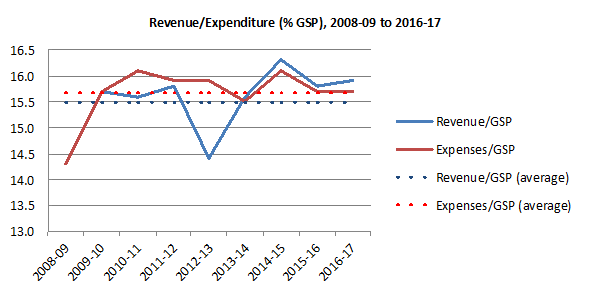
Moody’s analysts should focus on the capacity of the Queensland economy to reduce its public debt and deficit levels over time based on the long-run performance of the Queensland economy and long-run average growth in public expenditure and revenue. In other words, Moody’s should ask whether Queensland’s level of debt is sustainable at 3-3.5% economic growth, 3-4% expenditure growth, and wildly unpredictable revenue growth that has ranged between -8.8 per cent in 2012-13 and +18.0% in 2008-09?
JB_Moodyspost_chart1

This is not to say that Queensland is anywhere near risking default. Of course it isn’t because the state has a large pool of assets that it could tap into in an economic emergency. More generally, the Queensland Government always retains the coercive power of taxation over its law-abiding (and taxpaying) citizens, and (worst case) the Australian taxpayer will always stand behind the Queensland taxpayer.

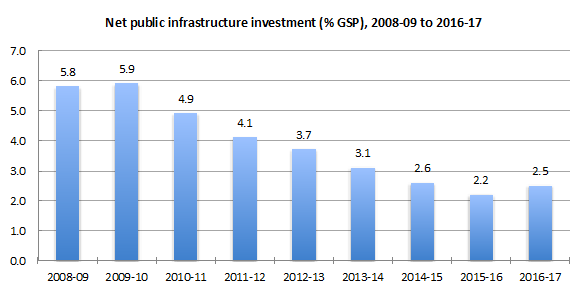
However, poor public financial management – letting our balance sheet slowly slip away – does affect long-run growth prospects. Higher debt and higher interest payments mean less money for future infrastructure investment, especially if the existing debt has proven unproductive (a point made in recent years by Professor Tony Makin and Professor Henry Ergas to name just two). And, to the extent that the debt is unproductive, an unfair burden is placed on the next generation.
JB_Moodyspost_chart2

In my view, the Queensland Government should focus on expanding the capacity of the Queensland economy. Invest in infrastructure that supports productivity and growth, and invest in people – especially the young and low skilled – to help them into a labour market hampered by the highest minimum wage in the OECD.

In other words, rather than trying to stimulate demand in particular industries that might be struggling, focus on stimulating the supply of productive infrastructure and productive workers.

Sounds easy, but it’s not. The challenge of course is knowing what infrastructure will be productive and which incentives will work to get the young and unskilled into work at the lowest cost to the taxpayer.

With public infrastructure, a rigorous and sober process of cost benefit appraisal helps to prioritise the best projects and make it that much harder for politicians to go with their pet projects if they don’t stack up. Transparency is also important – releasing full cost benefit appraisals and business cases is essential to good investment decisions, not just the summaries that are impossible to critique let alone replicate.

Unfortunately, the way our Federation works means that big bang mega-projects are often prioritised over smaller, more incremental, projects that may have better payoffs in terms of supporting productivity and growth – but that’s a post for another day.

Joe Branigan is a Brisbane-based Associate with Cadence Economics and a Senior Research Fellow at the SMART Infrastructure Facility UOW. His daughter Valentina recently started Day Care and, as a result, Joe is tentatively stepping back into the ‘blogging scene’.

Posted in Budget, Uncategorized | Tagged , , , , , , , , , , | 3 Comments

Qld full-time employment still below level of five years ago, but hopefully is on the upswing

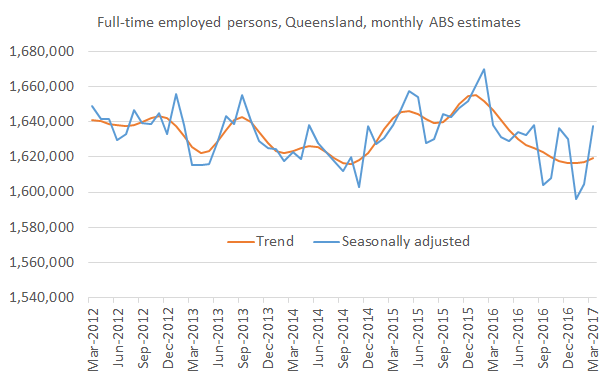
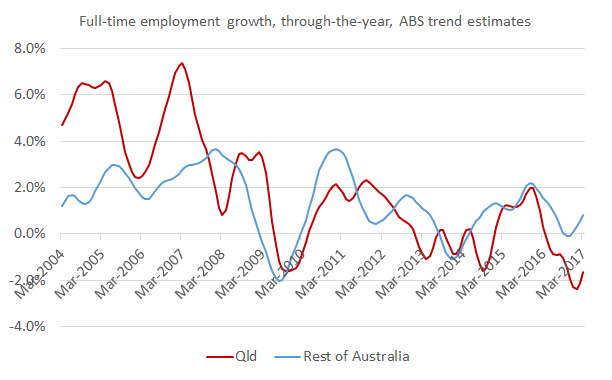
Queensland’s economic story over the last few years has been dominated by the end of the mining boom, which has had particularly adverse impacts in some Queensland regions, such as in the Fitzroy, Mackay and Townsville regions. The end of the mining boom is no doubt largely responsible for Queensland’s level of full-time employment still being lower than it was five years ago, as shown in the chart below.

FT_jobs

The new labour force data reported by the ABS last Thursday showed a rebound in full-time employed persons of 33,100 in seasonally-adjusted terms in March for Queensland, which hopefully is the start of a sustained upswing (see Queensland Treasury’s latest labour force briefing note for more figures).

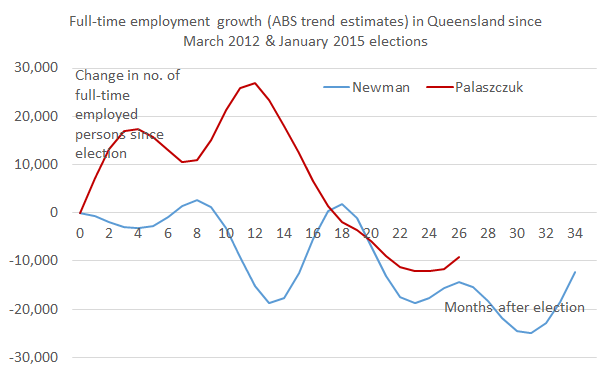
The Palaszczuk Government will definitely be hoping for a sustained upswing in full-time employment. Although the Government looks likely to be able to claim a greater increase in employment on its watch that the previous LNP Government could (see my post from yesterday), currently it is only part-time jobs (using the ABS trend data) that have increased over its term, while full-time employment has fallen (see charts below). The Newman Government also saw a decline in full-time employment over its term, but the Palaszczuk Government still has enough time to see positive full-time employment growth recorded. Indeed, using the more volatile seasonally-adjusted numbers, the Palaszczuk Government has recorded an additional 10,400 full-time jobs.

FT_jobs_since_electionPT_jobs_since_election

A decline in full-time employment in recent years has occurred in Western Australia as well (see chart below), supporting the notion that it is a phenomenon associated with the re-balancing of the economy at the end of the mining boom. Indeed, many of the full-time jobs in the mining sector may have been held by people who migrated from other States and Territories, and have subsequently returned to their original State or Territory.

Index_FTEs

Certainly Queensland experienced very high rates of full-time employment growth in the first phase of the mining boom in the 2000s, and what we have seen in the last few years may be considered the inevitable re-balancing (see chart below).

FT_empl_growth_tty

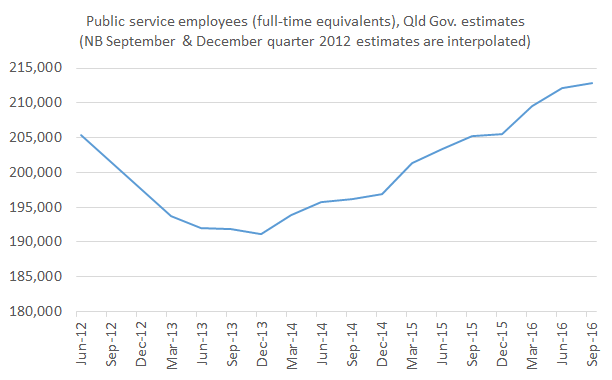
Another important qualification to my post yesterday is that, were it not for the strong growth in Queensland public service employment (see chart below), full-time employment would have declined much further since January 2015 (Hat tip to regular reader Russell Rogers for reminding me of the big increase in public sector jobs). The Palaszczuk Government will be hoping for strong growth in private sector, full-time employment over the rest of 2017, so it isn’t vulnerable to the claim that all the new jobs in Queensland are either part-time or in the public sector.

Public_service_FTEs

Posted in Labour market, Macroeconomy, Uncategorized | Tagged , , , , , , , , , | 1 Comment

Palaszczuk will most likely beat Newman in jobs created over term of government

Jobs_since_election

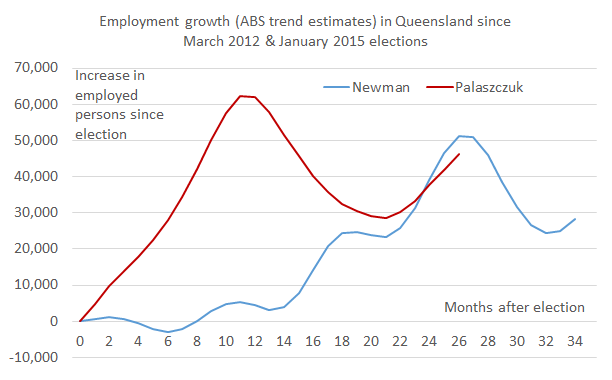
The Queensland Government looks likely to enter the next election campaign boasting a job creation record superior to the previous LNP Government’s. Let us put aside the debate over just how much credit governments deserve for job creation (but please take a look at Joe Branigan’s guest post from April 2016) and focus on the ABS employment estimates that will no doubt feature prominently in the State election campaign.

At 26 months since the election, jobs created on the Palaszczuk Government’s watch (around 46,300) are a bit below the level of jobs created at the same point on the Newman Government’s watch (around 51,300), but the Palaszczuk Government will most likely come out ahead at the end of its term (see chart above based on the latest ABS data released yesterday). The Newman Government was unlucky enough to experience an economic slowdown in the lead up to the January 2015 election, due in part to the end of the mining boom and its own large cuts to public service jobs and expenses, which, while in the long-term interests of the State, undoubtedly had a short-term contractionary impact on the economy.

So, even though jobs growth since the election has been below average, at an average annual growth rate of only 0.9 percent, the Palaszczuk Government will likely go into the election campaign being able to claim a better job creation record than the previous government. The Opposition will find itself on the back foot on the jobs issue and will be vulnerable to a scare campaign over public service job cuts. This will give the Government added confidence, but it needs to be kept in mind that the Government’s likelihood of re-election depends critically on One Nation imploding sometime over the course of this year. If One Nation gets even a handful of seats, Tim Nicholls will very likely be Premier, as Labor has ruled out any sort of deal with One Nation. Queensland politics over the remainder of 2017 is set to be very exciting!

Posted in Labour market, Macroeconomy, Uncategorized | Tagged , , , , , , | 2 Comments

NAIF $900M loan to Adani for mega-mine rail line is far from a first best solution, possibly second or third best

As a former Treasury official and long-time critic of industry assistance, I’m sympathetic to the Federal Opposition’s criticism of the expected $900 million soft loan from the Northern Australia Infrastructure Facility (NAIF) to Adani for the rail line to its Carmichael mine. Adani has not helped its case by admitting at one stage that it didn’t really need the loan (see this Brisbane Times report), undermining the rationale for the government providing the loan. I suspect the concessional loan would effectively provide Adani with a subsidy of at least $10 million per annum and possibly much more depending on the generosity of its terms.

If I were still in Treasury I would have argued against the Commonwealth setting up the NAIF in the first place, asking what is the market failure the facility is trying to address? Certainly the rationale for NAIF is not in sound economics, and former Treasurer Wayne Swan has raised important questions about its governance, as reported in the AFR.

That said, as a Queenslander and one hailing from Townsville, recognising our State and especially NQ will benefit in a major way from the mega mine (see my post from December last year), particularly through additional employment and the huge revenues from royalties, some hundreds of millions of dollars per annum, I can tolerate the loan, although I would prefer Adani found the money elsewhere.

With our inefficient environmental laws that have allowed protracted “law fare” by environmental groups against the mine, and the risk of policy changes in the future that would jeopardise the project’s viability, a loan from NAIF may be an important signal of commitment to the project from Australian governments, an excellent point made by John McCarthy in his Courier-Mail column this morning.

Posted in Infrastructure, Mining, Uncategorized | Tagged , , , , , | 5 Comments

Upcoming celebration of bicentenary of Ricardo’s Principles of Political Economy and Taxation on Wednesday 19 April

Wednesday next week, the 19th of April, will be the bicentenary of the publication of the hugely influential Principles of Political Economy and Taxation by the English classical economist and stockbroker David Ricardo (1772-1823). It was a book that revolutionised the world’s understanding of the benefits of trade. Since then, it has provided the intellectual support for the liberalisation of trade and reductions in tariffs worldwide. It is a book that is still relevant in a world that is debating once more the merits of free trade, as seen in the 2016 US election campaign, for example.

The Economic Society of Australia (Qld), of which I’m the Secretary, will be celebrating the bicentenary with a function in the Manhattan room at the GPO Hotel, Fortitude Valley from 6pm on Wednesday 19 April. From the ESA (Qld) website:

Published April 19th 1817, David Ricardo’s theory of comparative advantage underpins economic analysis of the merits of free trade, and has been influential in the push for free trade worldwide.

Ricardo’s work is a timely reminder of the power of economic thought for the betterment of humanity.

Professor Pascalis Raimondos, Head of Economic and Finance School at QUT, will share a presentation on the current state of Globalisation and the impact Ricardo’s work has had on the modern economic environment.

Further details are available on the ESA (Qld) website:

Bicentennial Celebration for Ricardo’s On the Principles of Political Economy and Taxation – Speaker: Pascalis Raimondos

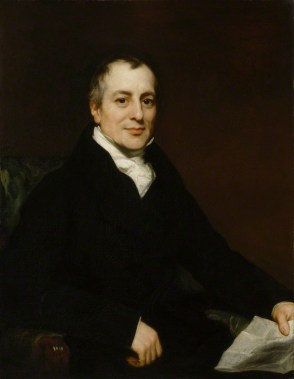
NPG L241; David Ricardo by Thomas Phillips

Portrait of David Ricardo by Thomas Phillips, National Portrait Gallery

Posted in Trade, Uncategorized | Tagged , , , , , , , , , | Leave a comment

Debbie hits Qld Budget, but QIC may help out Government by investing in Cross River Rail

Cyclone Debbie and the floods that followed have tragically resulted in the loss of at least five lives and have done billions of dollars’ worth of damage in Queensland and NSW. And through lower coal royalties (largely associated with an important rail line being out of action) and a hefty repair bill (a large part of which will be met by the Commonwealth, though), Cyclone Debbie will also adversely affect the Queensland State Budget, complicating the preparation of what will be the last State Budget before the next election. The magnitude of the impact on the Budget is difficult to gauge, given all the moving parts. One consideration, identified by Bill O’Chee yesterday, is the insurance the State Government has taken out on State assets since 2011, although at the time Premier Bligh suggested it would only cover a small part of the total cost of a natural disaster (see this ABC News report from 2011).  In the Courier-Mail yesterday, former CCIQ Director of Advocacy Nick Behrens was quoted on the possible Budget impact:

Economist Nick Behrens said the royalties income would still be “well ahead’’ of the original estimate last June, but the weather disaster would shave up to $200 million from the revised figure. “However the damages bill I suspect will be far higher than the $2.748b sugar hit from coal royalties and additional GST receipts (of $889m). “So the State Government may actually find themselves in net terms behind.”

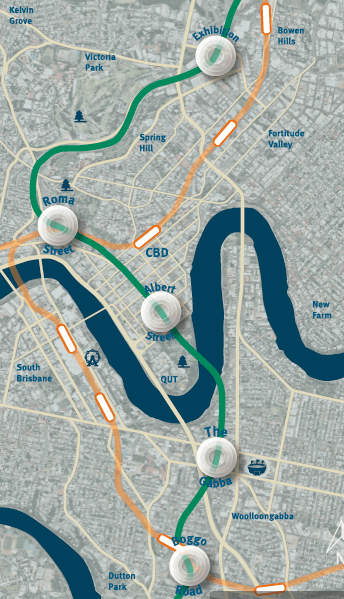
I agree Debbie will be a setback to the Budget. But nonetheless I expect the Government will pull a rabbit out of the hat sometime later this year, if not at Budget time, and set itself up for the election, with a major announcement on the $5-10 billion Cross River Rail (CRR) project. The Government needs to show real progress on CRR so it can defend itself against the Opposition’s criticism that it is a “do nothing government”. I expect the Queensland Investment Corporation (QIC), which looks after more than $20 billion set aside to meet the State Goverment’s superannuation liabilities, will commit to a major investment in CRR infrastructure, particularly the tunnels and subway stations, as its CEO suggested it may do last month (as reported in the Courier-Mail on 28 March).

We will need to look carefully at how the CRR project is structured to determine its impact on the Budget. We now have a CRR Delivery Authority that I expect will set up various companies to deliver different aspects of the project, and QIC will invest what may have to be billions into these companies. This should keep a lot of the expenditure for CRR off the State Budget, but the Government will no doubt have to commit to large ongoing subsidies, particularly of rail fares, to ensure the project’s commercial viability, given the project would not be commercially viable if it relied on fare revenue and other private income sources alone. The Government may be able to link some of this subsidy to value capture, but the project will undoubtedly be a net drain on the Government’s operating budget. CRR is not a commercially viable project on its own, and will require ongoing public subsidy of some kind.

This points to one of the major problems I see with QIC investing in CRR, in addition to risking the perception of QIC’s independence if it were to invest in one of the current Government’s priority projects. As noted above, the Government would need to subsidise CRR services so investors, including QIC, earn a return on the project. QIC would report a positive return on government funds invested in the project, because those returns are being guaranteed out of the current Budget. These returns would support the payment of the Government’s defined benefits superannuation payments. This would be a bit of smoke and mirrors, and would be rather fiendishly clever, but highly undesirable. My friend and former Treasury colleague, Joe Branigan, now an associate of Cadence Economics and Senior Research Fellow at the SMART Infrastructure Facility University of Wollongong, described it this way to me:

“When QIC invests in infrastructure that won’t by itself provide a commercial return, the lost earnings (from not investing in an alternative commercial asset) is not borne by Queensland’s defined benefit members (whose return is guaranteed) but, rather, by the Queensland taxpayer. In this sense, the returns paid to defined benefit members is a ‘fake return’, subsidised by the Queensland taxpayer.”

This is why it is very important that QIC ignores political considerations when it is making investment decisions. QIC should be investing the State’s superannuation money in commercial projects or investments outside of the State Government sector to avoid the risks I have described. While QIC proclaims it makes its decisions independently of the Queensland Government, it must be very challenging for the organisation when its owner, the Government, comes to it with an investment proposition.

Previously, in line with the recommendations of the 2013 and 1996 Commissions of Audit, I have recommended that QIC be privatised to avoid political interference and risks to the State’s balance sheet:

Selling QIC highly desirable and would avoid allegations of political interference regarding mega mine infrastructure

We will also need to look out for any borrowings associated with the project by Queensland Treasury Corporation that attach to entities classified as public non-financial corporations and which hence add to the State’s total debt reported in the Budget, currently projected to reach nearly $78 billion in 2019-20.

Let us hope the Government does not need to rely on QIC for CRR funding, due to the risks I have outlined above. I must say that I have been impressed with the Government’s response to the Cyclone and flooding to date, particular the focus on rapid economic recovery after the disasters.

CRR_map

CRR from Boggo Rd to RNA showgrounds

Posted in Budget, Cyclones, Transport, Uncategorized | Tagged , , , , , , , | 2 Comments

Still lots of room to boost population density in Brisbane

The vexed issue of heritage protection is in the news again, with controversy over the development of two apartment blocks behind the 1886 Clayfield heritage home Mundumburrah”, which will be raised and brought forward on its lot to accommodate the development, as reported in today’s Courier-Mail. I cannot see the problem with this, but it has upset local residents who are questioning whether the Council is committed to protecting Brisbane’s heritage.

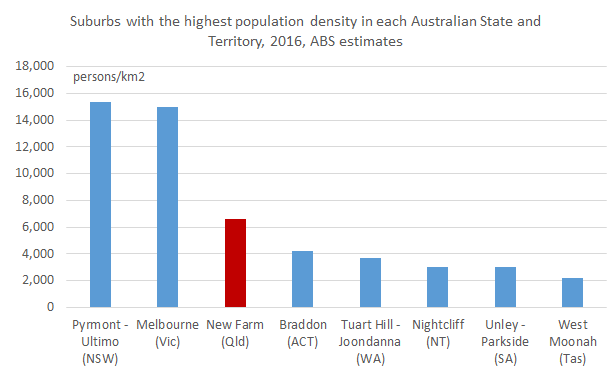
The Council’s decision regarding this particular property appears sensible within the current guidelines. Redeveloping those inner city suburbs with character housing, and increasing the population density of those suburbs, is a major way we can accommodate a growing population and house people closer to where they work and play. Consider that there is a lot of scope to boost population density in Brisbane, as ABS data reveal that the population densities of our inner city suburbs are well below those in Sydney and Melbourne (see the chart below).

population_density

As has been pointed out on this blog several times before, such as in Brad Rogers’s guest post Old Queenslanders in a New City, the protection of heritage can come at a high economic cost. We should respect our heritage, of course, but there are more sensible ways to do that than ruling out the re-development of every old house in Brisbane.

Posted in Housing, Uncategorized | Tagged , , , , , , , , | 5 Comments