Adani no go would be bitter blow to Townsville

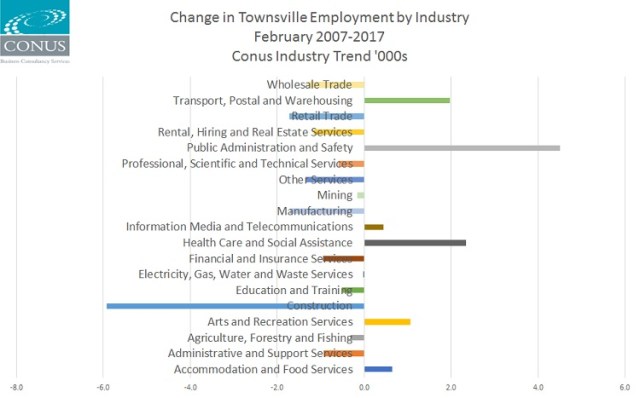
Townsville Mayor Jenny Hill is one of the strongest advocates for the Adani mega mine, and she must now be very worried that the mine will not proceed, and that Townsville will miss out on the mine HQ, FIFO jobs, and contracts for local businesses. Townsville has certainly been doing it tough economically in recent times, and it is desperate for the new jobs the mega mine would create, directly and indirectly (e.g. see my post Why the Adani mega mine is welcome news in Townsville). Over the last decade, the number of employed persons in the Townsville region fell by around 6,000, according to figures published by Pete Faulkner in an interesting recent post, in which he notes:

“The downturn in the Townsville economy has clearly been broad-based and impacted a large majority of industry sectors with a total loss of almost 6,000 jobs over the decade.”

If it were not for strong growth in public administration & safety and the health care & social assistance industries, i.e. in jobs largely funded by the public sector, Townsville’s economy would be in a far worse state (see Pete’s chart reproduced below).

Townsville_employment_PF

So it is no wonder that the Adani mega mine is seen as so critical, and why the news of recent days is so disappointing for so many in the region.

Further reading on the recent news regarding the Adani mega mine include thought-provoking posts by John Quiggin and Nick Behrens:

Adani outmanoeuvres Palaszczuk

Why Adani must not be given a $320 million ‘royalty holiday’

Posted in Mining, Townsville, Uncategorized | Tagged , , , , , , , , | 5 Comments

Pros and cons of a $300M royalties holiday for the Adani mega mine

The acrimonious political debate on the proposed Adani mega mine (see Brisbane Times coverage) would be well informed by a number of economic policy considerations that I discuss below. Some of these, but not all, would lend support to a royalties holiday. This is not a straightforward decision for the Queensland Government, so the reported split in Cabinet is understandable from that perspective.

Pros

Those considerations which would lend support to the royalties holiday include the following.

  1. Mining royalties are a bad way to raise revenue in the first place. You may recall Ken Henry’s tax review was scathing of them and recommended they be replaced by a resources rent tax. But the federal government of the day bungled its implementation, and we are no closer to efficient taxation of earnings from natural resources.
  2. There are quite a few credible predictions of rapid de-carbonisation of the world economy (e.g. see Dieter Helm’s Burn Out: The End Game for Fossil Fuels). So it may well be in Queensland’s economic interests to grant the royalties holiday, so the coal at the site can be extracted as soon as possible, and to get whatever royalties revenue we can, even if lower than previously expected.
  3. North Queensland economies with high rates of unemployment would benefit substantially from the mine, as I have noted previously (Why the Adani mega mine is welcome news in Townsville). This is relevant in a cost-benefit analysis to the extent that the mine employs people who would otherwise remain unemployed, and along with the royalties revenue is one of the major ways Queenslanders realise part of the net benefits of the mine.

Cons

Now for those considerations which would not support a royalties holiday.

  1. As noted above, royalties are one of the major ways Queenslanders benefit from the project, so any reduction in royalties consequently reduces the net benefits distributed to Queenslanders (and increases the net benefits to the foreign-owned Adani, if the project proceeds) and makes the project less attractive from the community’s point of view. The Government, which had previously decided the mine’s economic benefits outweigh its environmental risks, may well now take a different view.
  2. If the Government gives in to Adani on this, which mining company will it give in to next? The Treasury will be bombarded by approaches from mining companies pleading for royalties relief so they can maintain production or justify expansion. It may be desirable for the Government to maintain a hard line, to protect other royalties revenues from erosion. Royalties, after all, are worth $2-3 billion to Queensland’s Budget each year.

Conclusion

This is not a straightforward decision for the Queensland Government. I have previously supported the mega mine, but I would be willing to test just how much Adani needs the royalties holiday to make the mine viable. The Government should not meekly give in to Adani’s request for relief. A royalties holiday should only be considered as a last resort, in the case where, if it were not available, Queensland would forever lose any option of developing the resources at the site.

Disclosure: In 2015-16, I worked as a sub-contractor to an engineering company that was consulting to Adani.

Posted in Mining, Uncategorized | Tagged , , , , , , , , | 4 Comments

Qld full-time jobs growth since election back in positive territory

In April, full-time employment in Queensland continued to recover and is now back above the level that prevailed at the time of the last State election in January 2015, in terms of the trend data that Queensland Treasury prefers to report (see chart below).

election_chart_1_Apr17

As I commented in a post last month, it appears very likely the Palaszczuk Government will be able to campaign on the basis of employment growth being stronger during its term of government than it was during the previous government’s term (see chart below, which includes part-time as well as full-time jobs).

election_chart_2_Apr17

Of course, as other commentators have pointed out, a significant part of the employment growth has been due to the creation of new public sector jobs, some of which may be of dubious economic value.

For more on the latest ABS jobs figures released yesterday, which were generally good news for Queensland and are consistent with improving business confidence figures reported by CCIQ, see Pete Faulkner’s post:

QLD unemployment rate stays static, but this is a strong report for the State

Finally, I should note that a downswing in the residential construction sector will likely detract from growth somewhat over the remainder of 2017.

Posted in Labour market, Uncategorized | Tagged , , , , , , , , , , | 2 Comments

Trouble in Qld construction industry & worse may be to come

Referring to the recent failures of building companies such as CMF Projects, CKP, and Cullen, the Courier-Mail this morning observed:

…we hear that even the higher profile builders (household names actually) are getting nervous with soaring costs cutting into profits, despite a bulging work book.

With a Queensland election on the horizon the state of the construction industry will be a hot topic and the blame game has already kicked off in earnest.

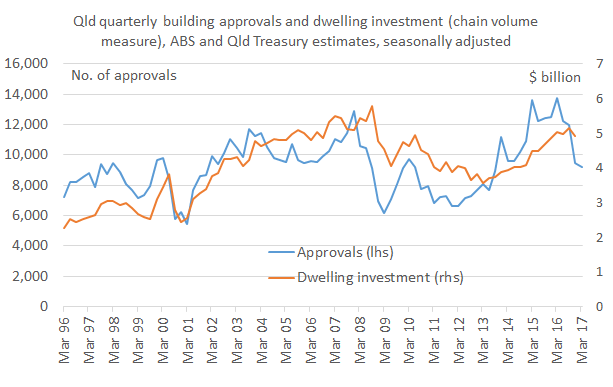
Unfortunately for the State Government, the construction industry appears to be on a downswing, with residential construction having peaked in the current cycle at the end of last year, and with non-residential construction yet to recover after plummeting at the end of the mining boom. Building approvals, which are a reasonable leading indicator of residential construction activity, have fallen substantially recently (see the chart below reporting ABS estimates of building approvals to March quarter 2017 and residential dwelling investment from the Queensland State Accounts to December 2016, the latest data available).

approvals_investment_Mar17

The AFR’s Matthew Cranston has recently provided a good summary of the troubles affecting construction companies (Apartment builder CMF Projects in administration), noting that, for CMF Projects, which had been focusing on apartment projects:

It is understood the builder had been under pressure with delays stemming from its unionised workforce, competition among builders and a sudden pull back in new apartment project plans in Brisbane…

…The number of apartment projects that have either started or been mooted for development has collapsed due to tighter financing from banks, stricter rules on both foreign and domestic investors, and rising construction and labour costs.

Construction is definitely a sector to watch closely in Queensland over the rest of 2017.

Posted in Housing, Uncategorized | Tagged , , , , , , , , , , | 2 Comments

Subsidised blockbusters like Aquaman crowding out local film productions

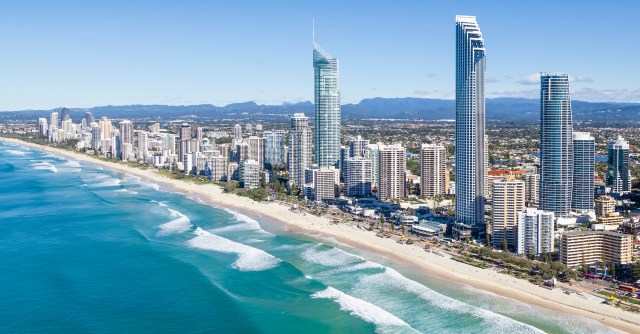
There is new anecdotal evidence from film industry insiders that subsidised blockbusters such as Aquaman, currently filming on the Gold Coast, are not delivering the economic benefits they allegedly deliver. International film productions on the GC have benefited from federal and state tax breaks and from a new $16 million sound stage at Village Roadshow Studios largely funded by the Queensland Government. But there is no sound public policy rationale for these subsidies. I have previously noted how the blockbusters attracted to the GC typically do not provide ongoing economic benefits and provide mostly temporary low-paid jobs for locals. Now some other facts which add to the con side of the pro-con analysis are emerging. As reported in Sunday’s Gold Coast Sun, regarding movies such as Aquaman and Ragnarok that benefited from federal and state government assistance, Gold Coast film insiders say Hollywood blockbusters may be doing more harm than good:

…according to several Gold Coast industry insiders the heavy focus on luring these movies to the area could be doing more harm than good.

They also said because these movies were so big they tended suck up all the available space at local studios, forcing smaller productions out.

They said while a lot of media focused on the job creating benefits of the movies, they failed to reveal that many of the films brought their talent with them from the US or imported it from Sydney…

…“When a show takes up an entire lot nothing else can be made there but they are paying a premium to occupy that space,” one insider said.

“It does bring focus to the area but in terms of local employment doesn’t offer much.”

I have previously been critical of government assistance to international film productions, so none of this comes as a surprise to me. For more on why governments should not subsidise Hollywood blockbusters, see:

Weekend reading: CIS Policy mag featuring my article on film industry subsidies, available at good newsagents

Should the Aquaman film production on the Gold Coast get a $22M tax break?

Gold Coast, Queensland, Australia

The GC has many natural advantages; we do not need to subsidise Hollywood on the GC

Posted in Gold Coast, Uncategorized | Tagged , , , , , , , | Leave a comment

Great work BDO, which had the best Budget summary (and a highly entertaining breakfast)

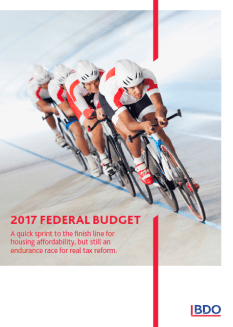
Leading accounting firm BDO consistently produces the best federal Budget summary, and this year’s did not let them down. The sub-title of the 2017 Federal Budget summary is:

A quick sprint to the finish line for housing affordability, but still an endurance race for real tax reform.

This nicely reflects the key theme of the budget, housing affordability, and that the prospects for major changes to the tax system in the interests of efficiency and simplicity have been deferred indefinitely.

Led by BDO tax partner Mark Molesworth, the BDO team have provided insightful analysis of the major Budget measures and have discovered some interesting implementation issues and have raised some doubts about the effectiveness of the government’s measures to promote affordable housing investments. One of BDO’s best insights relates to the removal of tax deductions for property investors regarding depreciation on already installed fixtures and for travel expenses:

“The Government has been true to its word and not removed negative gearing. However, it has curtailed some of the large discretionary expenditure deductions which can add to negative gearing losses.”

BDO followed up its Budget summary with its usual Thursday morning breakfast at the Brisbane Convention and Exhibition Centre, hosted by the ABC’s Chris O’Brien, who would no doubt find opportunities on the comedy circuit if he were ever a victim of budget cuts. Mark Molesworth gave an insightful and entertaining address, the highlights of which were:

  • pointing out that a young person could be disadvantaged if they make voluntary super contributions with a view to eventually purchasing a house, but then fall in love and live with a partner who already owns a house;
  • observing correctly that the Budget out-year projections are no more than “institutional guesswork”; and
  • my favourite observation of all, that the bank levy would effectively be the big banks’ “application fee for readmission to the human race”.

My own view is that the banks should consider themselves very lucky they have avoided a Royal Commission so far, as well as possibly harsher measures, and would be wise not to fight the Government on the levy.
BDO_budget_summary

Another excellent Budget summary from BDO

Also worth reading is Morgans’ Chief Economist Michael Knox’s take on the Budget:

A Thoughtful Budget

Michael’s view that it was a thoughtful budget is consistent with BDO’s view that it was a budget built around clear themes. Mark Molesworth noted this meant his team had a 2am finish this year, rather than a 5am finish.

Finally, readers in small business may be interested in the recording of Suncorp’s live stream of its Budget commentary:

Suncorp Small Business Connect Federal Budget Livestream

This was recorded at the Joinery on Montague Rd, West End, which is a terrific venue for live recordings and a wide range of functions. Small business expert Nick Behrens and I were there behind-the-scenes undertaking related work.

Suncorp_SB_Connect

The Suncorp Small Business Connect set at the Joinery, West End, Brisbane

Now, with the federal Budget delivered, we await the Queensland Budget on 13 June. Given the upcoming election, I expect a State Budget handing out lots of sweets to the voters!

Posted in Budget, Uncategorized | Tagged , , , , , , , , , , , | 1 Comment

Queensland Parliament Question Time featuring my Cross River Rail post

Thanks to local citizen journalist David Marler, @Qldaah, for his tweet yesterday afternoon which alerted me to the Question Time debate on Cross River Rail in the Queensland Parliament, in which my post from yesterday morning was quoted a few times, as you can see via YouTube:

Tim Nicholls quotes Gene Tunny to Annastacia Palaszczuk that CRR business case is ‘weak’

Deb Frecklington quotes Gene Tunny to Annastacia Palaszczuk on CRR business case release question

The Premier even quoted me when she referred to my comments at the time on the Newman Government’s Bus and Train (BaT) Tunnel, which also had surprisingly low estimated net benefits and would have been subject to the same mega-project risks as CRR:

Robert Dow & Gene Tunny quoted by Andrew Powell & Annastacia Palaszczuk over infrastructure

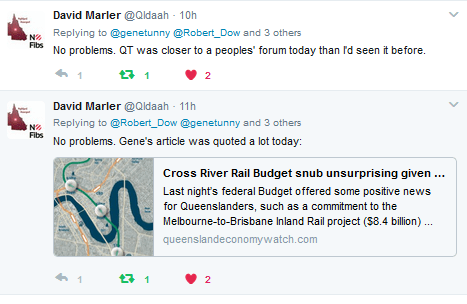
As public transport advocate Robert Dow was also quoted in the House yesterday, David Marler observed in the tweet reproduced below that Question Time “was closer to a peoples’ forum today than I’d seen it before.” That is very good news indeed.

marler_twitter

Posted in Transport, Uncategorized | Tagged , , , , , , , , , | 2 Comments

Cross River Rail Budget snub unsurprising given weak business case – will QIC now step in?

Last night’s federal Budget offered some positive news for Queenslanders, such as a commitment to the Melbourne-to-Brisbane Inland Rail project ($8.4 billion) and Bruce Highway upgrades ($844 million), but disappointed some by not providing funding for the State Government’s priority project, Cross River Rail (see Brisbane Times coverage). Instead, Queensland would have to compete with other States for a share of funds from a new $10 billion National Rail Program, on the strength of Cross River Rail’s business case.

Alas, as I have noted previously, the business case for Cross River Rail has never been compelling, and the reported estimated net benefits are surprisingly small for a project that allegedly is essential to avoid a looming capacity limit on Merivale Bridge and a public transport network that could not cope with passenger growth:

XRR business case should be released in full to give public comfort it is value for money

Either the business case failed to properly model the full range of benefits and avoided costs, or this rationale was incorrect. But it’s hard for independent observers to tell, because the Government has refused to release the full business case. This is actually against the best interests of the Government itself and the wider community. Public scrutiny of a draft business case would have helped strengthen the final business case. If a compelling business case was produced, it would have been difficult for the Federal Government to snub the project.

Other comments I have made on Cross River Rail include:

Cross River Rail equals mega-project equals mega-risk

On Cross River Rail, Government appears confused over meaning of “business case”

I doubt the State Government was surprised by the lack of funding for Cross River Rail in this Budget, and I expect it would have been planning for it. Indeed, the Government’s investment manager, the government-owned QIC, is very likely considering a major investment in Cross River Rail, as I have discussed previously:

Debbie hits Qld Budget, but QIC may help out Government by investing in Cross River Rail

This would be unfortunate, given Cross River Rail appears to be such a marginal project, and it would raise doubts about QIC’s independence in investment choices from its owner, the Queensland Government. But the Government needs Cross River Rail to prove it can get things done. So I expect it will do everything it can to get Cross River Rail moving.

CRR_map

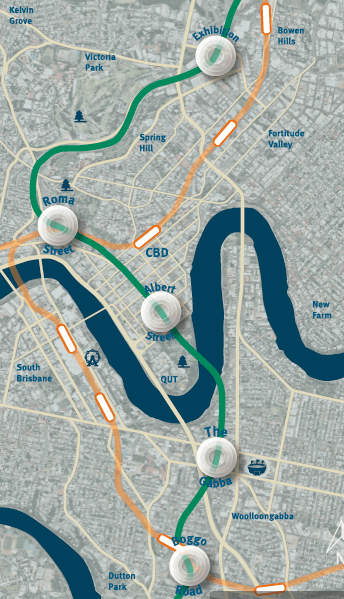
Cross River Rail: Great maps and brochures, but weak business case

Posted in Budget, Transport, Uncategorized | Tagged , , , , , , | 2 Comments

Surge in overseas exports has given Qld a rare trade surplus

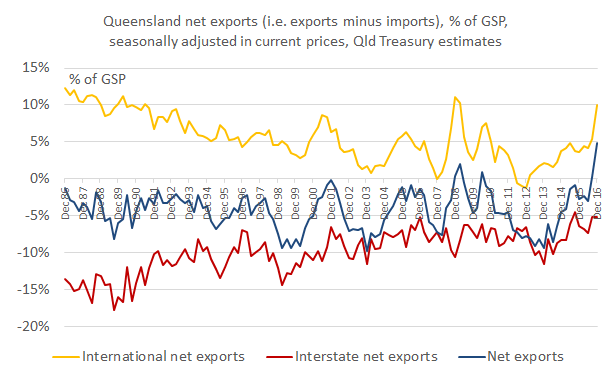
Queensland Treasury’s December quarter State Accounts estimates released earlier this week were encouraging, with gross state product (GSP) growth recorded at 0.9 percent for the quarter and 3.4 percent through-the-year, which are very respectable growth rates, particularly with population growth at only 1.4 percent per annum. A good part of the growth in GSP was due to a surge in overseas exports related largely to LNG being shipped in increasing volumes from Curtis Island off Gladstone. The surge in overseas exports is so significant that, over the last six months of 2016, Queensland ran a rare trade surplus, which is very likely to persist (see chart below). This is taking into account both overseas and interstate trade.

netexportschart

Traditionally, Queensland has had positive net exports (i.e. exports less imports) with respect to other countries, but has had negative net exports with respect to the rest of Australia. That is, Queensland has imported many more goods and services than we have exported to the rest of Australia. Until recently, this has meant that Queensland has had negative net exports overall.

The boost to Queensland’s overseas exports is great news for the Queensland economy. If we could improve our policy settings through reducing taxes and charges and making it much easier to do business in Queensland than in other States, we might be able to substantially boost our exports to the rest of Australia as well.

Posted in Trade, Uncategorized | Tagged , , , , , , , | Leave a comment

2017-18 Federal Budget Wish List – guest post from Nick Behrens

I am delighted to publish this guest post on the upcoming federal budget from Nick Behrens, Director at Queensland Economic Advocacy Solutions. GT

2017-18 Federal Budget Wish List

by Nick Behrens

According to business groups the 2017-18 Federal Budget should be one that stays the course on fiscal repair, builds on tax reform, doubles down on red tape reduction and invests in the next generation of infrastructure. I wholeheartedly agree with these but the political landscape and competing priorities of framing a Federal Budget makes it difficult to see one let alone all four being delivered.

Treasurer Scott Morrison’s second Federal Budget to be delivered next Tuesday is a crucial one for the Coalition despite it coming less than one year after the last Federal Election. It will possibly determine the success or otherwise of this Government at the next election. No doubt it has been an exceptionally difficult budget to frame for the Coalition as there are unprecedented tensions between seemingly mutually exclusive outcomes. In short, it is difficult for the Coalition to stay the course that the business community wants, when arguably that course and what it has been doing have been a large contributor to the Government’s lacklustre support in recent polls.

Furthermore it is difficult for the Government to maintain business community excitement when the Senate on 31 March 2017 has already passed elements of the Coalition’s 10 Year Enterprise Tax Plan delivering tax relief for 3.2 million businesses with a turnover up to $50 million. SMEs were the biggest winner from the last two budgets and it is difficult to keep doing new things to regenerate the positive vibe that SMEs felt. As of 1 July this year, small businesses with turnovers of less than $10 million will now have a company tax rate of 27.5 per cent. No doubt this initiative will be re-mentioned but in reality it has already been delivered.

In respect to businesses with a turnover greater than $50 million, which were jettisoned from the Enterprise Tax Plan Bill 2016 as a result of an impasse in the Senate, it will be difficult for the Coalition to prosecute the case for tax cuts to these companies as a result of a perception that it is pandering to Corporate Australia (a segment of the community that does not illicit much sympathy from the average voter at present). The net advantages of eroding the tax base in the short term to deliver an internationally competitive company tax rate of 25 per cent does not seem to fly with voters. This is a shame as modelling suggests a cut in the corporate tax rate to 25 per cent would generate a permanent increase in the level of GDP of just over 1 per cent and we are only part way to achieving this commendable outcome.

Frustratingly for the Coalition, despite the 10 Year Enterprise Tax Plan and spending cuts, last year’s Federal Budget was ultimately viewed by the business community as a missed opportunity for holistic reform to the way we tax and spend. At the same time, it upset many in the broader community. Fixing the embedded budget deficit should be the highest priority but the Coalition has been unable to bring the broader public on the journey of this important challenge.

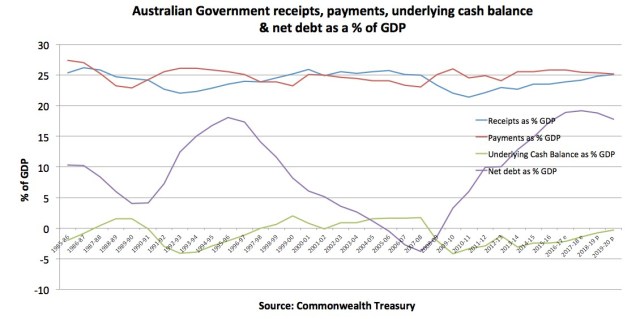
NB_post_chart

Support for budget repair needs to be bipartisan yet the ‘politics of populism’ appears to be trumping the need to live within our means. Whilst both sides agree something needs to be done, it is how we fix the problem that is proving elusive. Any fix is extremely difficult with over 50 per cent of the budget comprised of expenditure relating to social security, welfare and delivery of health services, no go areas for much of the community. In short, the 2017-18 Federal Budget needs to take action to reduce the deficit otherwise we burden future generations with either higher taxes or more severe austerity measures. Whether the Coalition puts this principle ahead of its own political fortunes will be fascinating to observe.

Finally it will be interesting to see whether the stoush between Queensland and the Coalition dissipates as a result of the Budget next week. In short, Queensland has arguably been short changed in infrastructure funding in recent years in comparison with other States. However, it is worth adding that this is largely as a result of our State’s steadfast refusal to recycle assets in order to access additional Commonwealth funding.  Recent comments particularly from the Prime Minister indicate that the Coalition’s hard line approach may be softening.

In closing I have provided below key recommendations that I believe should be included in the 2017-18 Federal Budget.

My Federal Budget Wish List

  1. Real spending growth should not exceed 2 per cent each year until a budget surplus is achieved and spending should be capped at less than 25 per cent of GDP. The Senate should as a matter of priority pass the Government’s omnibus bill.
  2. Extend the instant asset write-off scheme for small businesses with turnover up to $10 million for two years.
  3. Establish and prioritise a regulatory reform agenda, strengthen the Australian Government’s Regulator Performance Framework and implement the 2015 Competition Policy Review to streamline planning approval processes and increase mutual recognition of occupational licensing.
  4. Provide ‘asset recycling’ incentives to state and territory governments to privatise infrastructure assets and reinvest the proceeds into new infrastructure.
  5. Provide funding for several of the following projects listed in Infrastructure Australia’s February 2017 Priority List:
  • Cross River Rail – A rail solution to support an integrated passenger transport network in South-East Queensland (Brisbane CBD public transport capacity);
  • Ipswich Motorway Rocklea–Darra Stage 1c (Southern Brisbane–Ipswich road network capacity);
  • M1 Pacific Motorway – Gateway Motorway merge upgrade (Road network capacity Brisbane–Gold Coast);
  • Bruce Highway Upgrade – Cooroy to Curra Section C (Road network capacity Wide Bay–Burnett region);
  • Bruce Highway Upgrade – Mackay Ring Road Stage 1 (Road network capacity Mackay region);
  • M1 Pacific Motorway upgrade – Mudgeeraba to Varsity Lakes (M1 Pacific Motorway capacity);
  • Inland Rail (Melbourne to Brisbane via inland NSW) (Freight connectivity Melbourne-Brisbane);
  • Ipswich Motorway Rocklea–Darra (remaining sections) (Southern Brisbane–Ipswich road network capacity); and
  • Port of Brisbane dedicated freight rail connection (Freight rail access to Port of Brisbane).

Nick Behrens is Director at Queensland Economic Advocacy Solutions.

Posted in Budget, Uncategorized | Tagged , , , , , , , , , , , , , | 2 Comments