Qld Government gets lucky in election Budget, but debt to climb to $81 billion in 2020-21

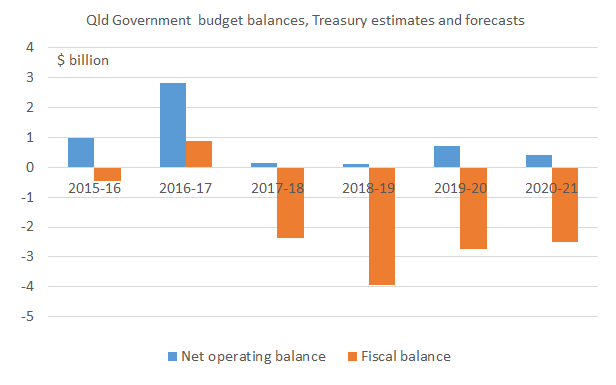
The 2017-18 State Budget reveals the Queensland Government got very lucky this year, benefiting from a surge in royalties that has allowed it to generate a positive fiscal balance (i.e. the budget balance that also accounts for infrastructure spending) in 2016-17, and to record a genuine fall in total debt next financial year. The extraordinary budget outcome in 2016-17 was associated with huge estimated growth in nominal Gross State Product (GSP) of 11.75%, driven by higher coal prices.

Budget_1718_Chart1

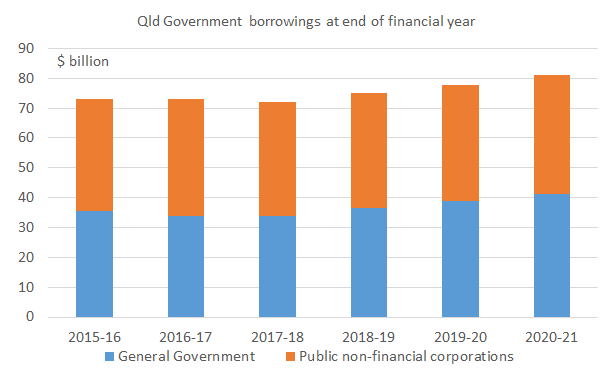
This extreme good luck is not expected to continue obviously, and the budget records fiscal deficits for the years after 2016-17. So Queensland Government debt will continue to increase, and by the end of 2020-21 debt will exceed $41 billion for the general government sector (i.e. the public service departments) and $81 billion in total, taking into account government-owned businesses such as Energy Queensland, Queensland Rail and Seqwater as well (see chart below). In the Budget, these are called public non-financial corporations.

Budget_1718_Chart2

The total debt-to-revenue ratio, which ratings agencies such as S&P and Moody’s are concerned about, will end up at 138 percent in 2020-21 compared with 143 percent in 2015-16. But this ratio needs to fall much further, to around say 110 percent, if Queensland is to regain a AAA credit rating. The Government has delivered a politically clever election budget, but is doing little to repair Queensland’s poor fiscal position.

Posted in Budget, Uncategorized | Tagged , , | 1 Comment

Qld economy needs pick up in private sector investment

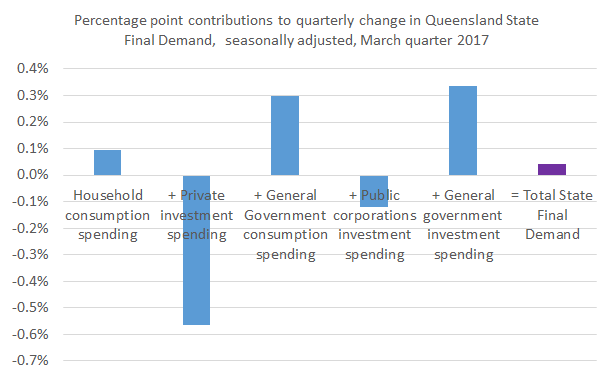
According to the latest National Accounts released by the ABS last week, private sector investment spending fell in Queensland over the March quarter (in seasonally adjusted terms) and State Final Demand would have fallen as well, if it were not for growth in public sector expenditure (see chart below).

Decomposition_Mar17

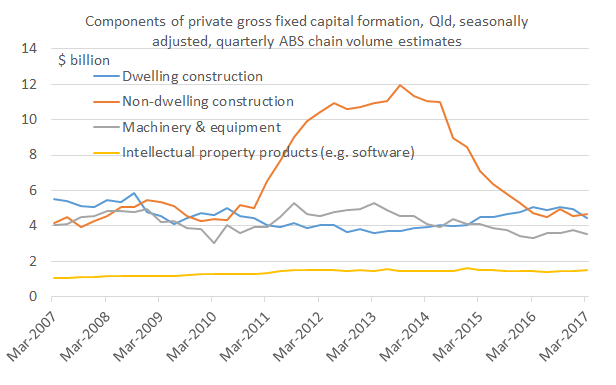
Traditionally, economic growth is associated with growing private sector investment, and the absence of a pick up in private sector investment, after it plummeted at the end of the mining investment boom, has meant Queensland’s economy has been performing below-average (see previous post). While non-dwelling construction increased in March quarter by 2.1 percent, this was more than offset by a large fall in dwelling construction of 9.4 percent. Also, business investment on machinery and equipment was 6.1 percent lower than in the previous quarter (see chart below).

Investment_Mar17

As I have noted before (see Nervous times for construction industry as downswing underway), dwelling construction is in a downswing at the moment, but the large fall in March quarter would partly be attributable to the wet weather and Cyclone Debbie at the end of March quarter.

Regarding non-dwelling construction, further growth should occur as the Queen’s Wharf project ramps up and as other projects including possibly the Adani Carmichael mine and rail line commence. But more broadly-based private sector investment is required to really push the Queensland economy along.

For Queensland Treasury’s view on the outlook for the Queensland economy, please consider attending an upcoming Economic Society of Australia (Qld) seminar:

Upcoming Qld Treasury post-Budget briefing on outlook for Qld economy

Posted in Macroeconomy, Mining, Uncategorized | Tagged , , , , , , , , | Leave a comment

Qld economy surviving, but not thriving

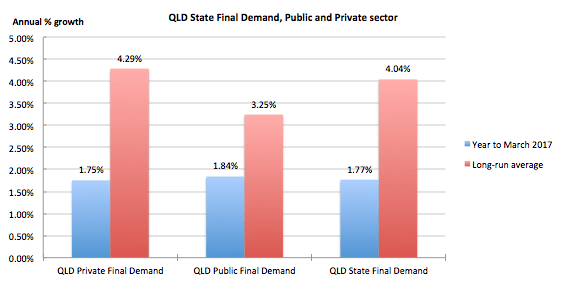
In his latest column, Stormy times for an economy in the doldrums, Ross Gittins refers to Queensland’s “below-par” growth in State Final Demand, one of the statistics released by the ABS last Wednesday as part of the March quarter National Accounts. Certainly, the domestic drivers of growth in Queensland, such as consumption and investment expenditures, which are measured in State Final Demand, are growing well below average. My old friend and former Treasury colleague Joe Branigan, now Senior Associate at Cadence Economics, alerted me to this the other day, and provided the handy chart below, which shows just how below-par State Final Demand growth has been in Queensland.

SFD_chart_Mar17_JB

Joe observed:

  • State Final Demand growth is well below the long-run average (1.77% v 4.04%)
  • The only sectors that are materially beating the long-run average are:
    • Electricity, gas and other fuel; i.e. power bills (Year to March 2017 growth = 6.5%, long-run average = 3.2%)
    • Commonwealth public corporations; presumably the NBN (Year to March 2017 growth = 28.5%, long-run average = 1.0%)

I should note State Final Demand is the sum of the domestic sources of demand in a State economy. It does not include exports or subtract imports, and is hence not a true measure of State economic performance. The Queensland economy has been performing better than State Final Demand data have suggested recently, due to growing exports, particularly of LNG. But, even so, it is clear from the chart in my last post that GSP growth has been running at below its long-run average, too:

Upcoming Qld Treasury post-Budget briefing on Qld’s economic outlook

Queensland’s stellar export performance has helped our economy immensely, but given weaknesses in domestic drivers, arguably the economy has merely survived, rather than thrived.

Also see Pete Faulkner’s commentary on the latest National Accounts:

GDP slows (as expected) while QLD grinds to a halt

Posted in Macroeconomy, Uncategorized | Tagged , , , , , , , , | Leave a comment

Upcoming Qld Treasury post-Budget briefing on Qld’s economic outlook

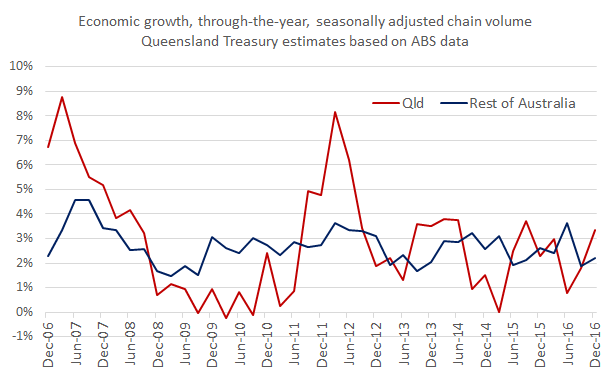
Today is National Accounts day, one of those four glorious days each year on which we receive the latest quarterly GDP figures for the national economy, this time for the March quarter. Alas, based on the partial indicators such as construction activity and net exports, economists are expecting a pretty discouraging result today (e.g. see ABC News coverage). This will add to growing concerns about the outlook for the Australian economy over the next twelve months. Given our booming tourism sector and strong resources sector exports, Queensland’s economic outlook is much better than the rest of Australia’s at the moment, in my view. Certainly the last set of Queensland State Accounts data for December quarter 2016 had the Queensland economy overall now growing at a healthy rate and faster than the rest of Australia’s (see chart below).

Qld_v_ROA_Dec16

But will the Queensland economy continue to grow at a healthy rate over 2017-18? Someone well placed to offer a view is Greg Uptin, who is in charge of forecasting the State economy at Queensland Treasury, and who will be presenting to the Economic Society of Australia (Qld), of which I am the Secretary, on Wednesday 21 June:

2017 Post-Budget Briefing on the Economic Forecasts by Queensland Treasury

If you’re interested in the outlook for the Queensland economy, then I highly recommend you attend this lunchtime event, which is being held at ShineWing Australia at their Riparian Plaza offices on Eagle St, Brisbane.

Posted in Macroeconomy, Uncategorized | Tagged , , , , , | 2 Comments

Qld Solar Bonus Scheme shows how bad government policy can cost taxpayers for a long time

The Queensland Government yesterday directed its electricity network business Energy Queensland to remove the cost of the Solar Bonus Scheme from its charges until 2020, which will reduce Energy Queensland’s earnings and hence adversely impact the State Budget (see the media release). So, for the next three years, the huge cost of the Solar Bonus Scheme, introduced in 2008, will now be paid for by taxpayers, rather than being cross-subsidised by other electricity consumers without solar. Average electricity bills will be lower than otherwise, but, of course, there is a large overlap between taxpayers and electricity consumers, so there is a large degree of smoke and mirrors here.

The Government’s decision is expected to adversely affect the State Budget and hence taxpayers by $770 million over three years, as reported in the Brisbane Times:

Government steps in to reverse decision on power price hike

While electricity bills will be lower than otherwise, the adverse budgetary impact means Queenslanders will need to endure higher taxes and charges, either now or in the future, than otherwise.

The Solar Bonus Scheme’s overly generous 44 cent/kWh feed-in tariff, available to households which installed solar PV cells before July 2012, will last until 2028. This is much longer than households will have needed to recoup their investment in solar PV cells, delivering a “financial windfall” to many households, as the Queensland Productivity Commission found last year (as reported by Mark Ludlow in the AFR in February 2016).

Unfortunately, the Queensland Government rejected the QPC’s recommendation to abolish the Solar Bonus Scheme. This was disappointing. It is a highly inequitable policy adversely affecting lower-income households. Even though its impact has now been removed from electricity bills, meaning average annual regional electricity bills will go up only by $50 rather than $100, households without solar will still end up paying somehow, through higher taxes and charges, now or in the future, than otherwise, as noted earlier. The Bligh Government’s Solar Bonus Scheme, introduced nine years ago in 2008, is just another example of how poor policy decisions can have long-lasting adverse impacts.

Hat tip to Joe Branigan who alerted me to this announcement and prodded me to comment.

Posted in Energy, Uncategorized | Tagged , , , , , , , | 11 Comments

Better policies would help Qld win the Economic State of Origin

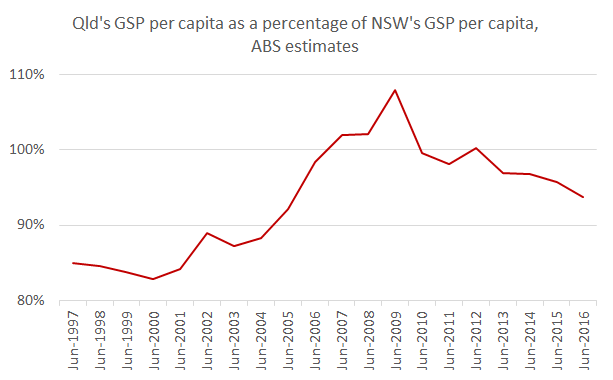
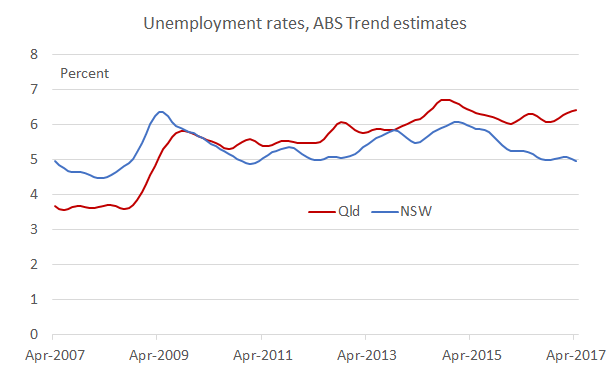
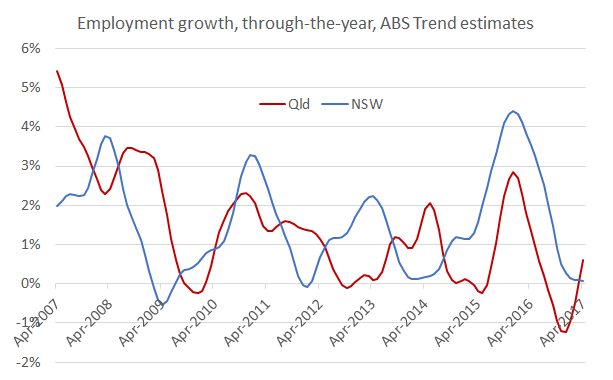
At times during the last mining boom, Queensland was winning the economic State of Origin against NSW, with higher employment growth, a lower unemployment rate and a higher gross state product (GSP) per capita. But those glorious days are behind us, and we have started to fall behind NSW again in recent years (see charts below). While Queensland’s recent pick up in employment growth is encouraging, there are concerns regarding how sustainable it is, particularly given the large contribution of public service jobs to the recorded increase. To win the Economic State of Origin, I would recommend policies designed to reduce costs to business and to reduce constraints on their operations, e.g. by cutting payroll tax or deregulating retail trading hours. I would also consider, as NSW has done, privatisation of state assets, and using part of the proceeds to fund new infrastructure—so-called “asset recycling.”

ESOG_chart1ESOG_chart2ESOG_chart3

Posted in Labour market, Macroeconomy, Uncategorized | Tagged , , , , , , | Leave a comment

Impressive list of speakers at IAQ Qld Infrastructure Summit on 29 August

I am honoured to be a presenter at IAQ’s upcoming Queensland Infrastructure Summit on 29 August in Brisbane, alongside our Deputy Premier Jackie Trad, Treasurer Curtis Pitt, Deputy Opposition Leader Deb Frecklington, and other luminaries including my old UQ economics classmate Damian Gould, CEO of Building Queensland (see speaker list snipped from website below). This is a must attend event for anyone involved in the planning, design or construction of infrastructure in Queensland. My presentation will explore the pros and cons of state development or infrastructure banks.

IAQ_Summit_speakers

The summit is well timed in the lead up to the next State election, and I expect the Deputy Premier and Treasurer will be promoting their plan for Cross River Rail, which I expect a major announcement on soon, either at Budget time (13 June) or not long after. Cross River Rail is a must-deliver project for the Government, so it can rebut the Opposition’s claim it is a do-nothing government, so expect the Government to do whatever it can to make it happen. If there is no action on Cross River Rail, the Deputy Opposition Leader Deb Frecklington will get a free kick at the Government at the Summit. I have previously posted on the Government’s options regarding Cross River Rail:

Cross River Rail Budget snub unsurprising given weak business case – will QIC now step in?

Posted in Infrastructure, Uncategorized | Tagged , , , , , , , , | Leave a comment

More details needed, but royalties deal better than the one before Trad’s intervention

We still have scant details on the new Adani mega mine royalties deal, particularly the exact royalty rates and the deferral terms (interest rate and collateral/financial security required), but at least it appears the Government has pulled back from its original overly-generous royalty holiday. The Courier-Mail reports:

It is understood the deal involves a royalty escalation – paying smaller amounts at the start and the full rate and interest as production increases. The deal is expected to include a substantial reduction to the royalty rate in the first five years, but payments would then revert to the full rate from the sixth year.

Interest on any deferred royalties would also be paid from the sixth year onwards.

Adani will be required to provide a financial security to the State Government to ensure the company can get the reduced rate in the first five years of production.

Over the last week, Deputy Premier Jackie Trad has received a lot of criticism for kyboshing the original royalties deal proposed by the Treasury to Adani, but I think she deserves credit for taking what should have been the standard Treasury line against tax concessions (most eloquently put by Nick Behrens in his post earlier this week), even if her motivation was primarily political. Her intervention has likely resulted in a better outcome for Queenslanders, and for that we should be thankful.

I hope the project now proceeds, so that Queenslanders can benefit from the royalties income and from the jobs and economic opportunities provided by the mine. I should note, however, that many observers are skeptical about whether the mine will proceed or ever pay the State Government a reasonable amount of royalties. UQ Professor John Quiggin thinks Adani has been going through the motions, doing the minimum to keep the project going, so it can delay a huge write off and to strengthen its case for compensation, and it has not intended to proceed with the mine for a while now:

My guess is that, before anything of substance happens in the Galilee Basin, Adani will be back with more demands (maybe a Danzig corridor). Sooner or later, they’ll make an offer that can be refused, at which point they’ll pull up stumps and send in the lawyers asking for compensation. (from John’s post More Adani Asterisks)

And, at MacroBusiness (QLD fights a losing battle with Adani), Houses and Holes is skeptical about whether the Queensland Government will receive any significant royalties if they are deferred:

Given thermal coal remains in a huge global gut that will get worse not better, if it were to go ahead Adani won’t be paying anything back. It’ll get another holiday later.

It has been an extraordinary week in Queensland politics and business, and any rational observer would significantly write down their estimates of the probability the mega mine will actually proceed and the net benefits to Queensland it would provide. I await further details of the new royalties plan.

Finally, I should note there are a lot of different figures being quoted regarding the jobs impact of the mega mine. Apparently the project will result in up to 5,000 jobs while under construction and over 4,500 jobs when operating at peak capacity. However, regarding the ultimate impact on the economy, we need to take into account crowding out effects, given much of the labour would be sourced from alternative employment. Only a fraction of the jobs (directly and indirectly created) would go to otherwise unemployed people. ACIL Allen’s Carmichael Coal and Rail Project Economic Assessment, prepared for McCullough Robertson acting on behalf of Adani, found that the project would result in around 1,500 additional jobs relative to the baseline (see pp. 15-16 of the report). This is not insignificant, but not as substantial as some figures (e.g. 10,000 jobs) I have heard quoted recently.

Posted in Uncategorized | Leave a comment

Nervous times for construction industry with downswing underway

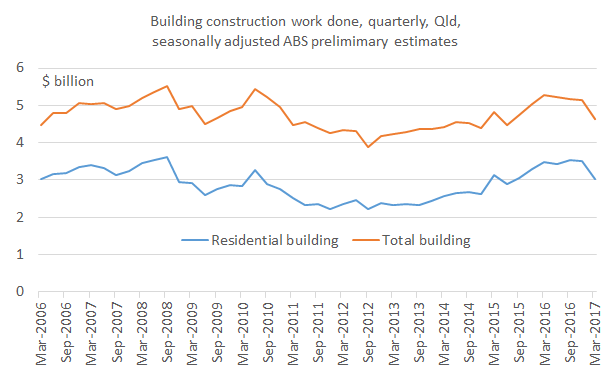
Last week I forecast a continuing downswing in construction activity (Trouble in Qld construction industry & worse may be to come) and the March quarter construction data released by the ABS on Wednesday have confirmed this (see chart below), as well as a national downswing, as reported by ABC News:

Construction data hints at GDP slowdown: ABS

Building_Mar17_Chart1

So expectations of national economic growth in the March quarter have been cut significantly, and the downswing in Queensland should prompt Queensland Treasury to consider its own economic forecasts leading into the Budget. While I still expect the Queensland economy to grow over the rest of 2017, due to strong tourism, international education and export sectors, the construction downswing will certainly lower the growth rate.

On the same day the new construction data were released, we learned that another Brisbane builder has failed in tough market conditions:

Brisbane builder AKS Homes calls in administrators

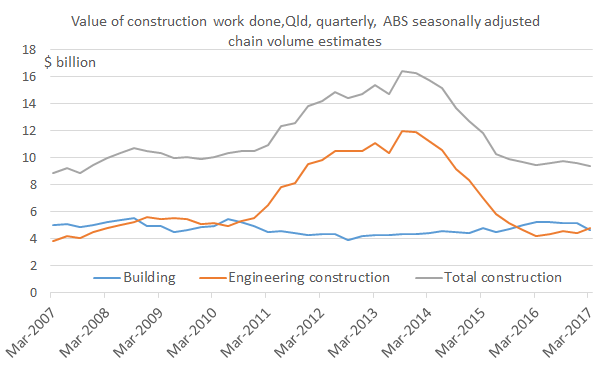
In Queensland, the downswing in the building construction sector was offset partially by what may be the start of a recovery in engineering construction (see chart below).

Building_Mar17_Chart2

As one of my regular readers Glen noted in a comment last week, this suggests it may not be a good time to introduce the new Project Bank Accounts (see this media release) which are of great concern to industry peak bodies. Glen commented:

…what is of most concern is the proposed sub-contractor legislation. Whilst the legislation is required its timing couldn’t be worse, the industry just isn’t prepared. Many currently don’t have the cash flow to be able to comply with the new laws and rely on revolving credit to contractors and suppliers to survive. Many suppliers to the industry that I talk to have already acknowledged they will be last on the list now as sub-contractors will be paid before suppliers. Accordingly many suppliers have begun to enforce their credit conditions more rigorously. It is all starting to point to a nasty conclusion.

An ominous forecast from an informed source. I will continue to keep a close watch on the industry.

Posted in Housing, Uncategorized | Tagged , , , | Leave a comment

On mega mine, Qld Government should avoid taking equity risk for just a return on debt

Financial journalist Trevor Sykes would frequently point out that the problem with lending to highly-leveraged companies is that you can effectively take on equity risk while only receiving a return on debt. The Queensland Government needs to avoid this risk when establishing a new royalties regime for first movers such as Adani in new mining regions. The Australian reports:

A compromise was struck ­between Queensland Premier Annastacia Palaszczuk and her deputy, Jackie Trad, on the deal that will be used as a template to lure other resources companies into the state’s burgeoning ­Galilee and Surat basins and the northwest minerals province.

The Australian understands Adani will be given the cut-price flat rate for up to six years — understood to be several million dollars a year — but it will be eventually required to pay the ­entire amount of deferred royalties owed to taxpayers for coal ­extracted at its proposed Galilee Basin mine.

Adani will have to pay interest on the delayed amount.

The State Government should push for more than a standard interest rate on debt and for as rapid repayment as possible. It should arguably receive an equity-like return in the range of 10 percent or more given the level of risk, including the not insignificant risk of the project eventually falling over and the Government receiving hardly any royalties income at all. Indeed, the head of the QRC Ian Macfarlane notes in the Courier-Mail today that he wants the government to have “some skin in the game.” In which case, I would suggest, the Government should earn an equity return, not just a return on debt.

Posted in Mining, Uncategorized | Tagged , , , , , , , | 6 Comments