Park Rd CityCat stop and pedestrian subways are best ideas for River’s Edge Strategy

Although living by the Brisbane River has its downsides (e.g. a major flood once every generation or so), it is largely a positive experience, and I feel incredibly lucky to be able to catch the CityCat into work everyday. When I received the River’s Edge Strategy survey on the CityCat on Friday morning I was happy to learn the City Council is seeking views on how to improve public access to the river. If you’re interested, you can complete the survey on-line by following the link from the River’s Edge Strategy site.

I think the most cost-effective options for improving access to and use of the river would be a Park Rd CityCat stop and more pedestrian/cyclist subways under Coronation Drive. Any pedestrians who have had to cross Coronation Drive at Sylvan Rd or near Park Rd would attest to the long waits (over two-and-a-half minutes in peak hour) for the lights to change. Ultimately, as I’ve previously posted on, I’d like to see a Toowong-West End Bridge, but I doubt that would be within the scope or intended budget of the River’s Edge Strategy.
Posted in Brisbane | Tagged , , , , , , | Leave a comment

Direction for directors

University of Queensland Emeritus Professor Geoff Kiel gave a great speech at the Australian Institute of Management at Spring Hill, Brisbane on Thursday night, launching the new book Directors at Work, which he co-authored with three of his colleagues (one of whom is my mother).  In a wide-ranging speech, Geoff made it clear why board directors need a practical guide to doing their job, noting that even directors’ jottings on board papers can cause trouble for them, as Lachlan Murdoch might attest after his experience with the OneTel inquiry.

One of the novel features of the book is it emphasis on board behavioural dynamics (i.e. how the board members interact with each other), and it contains a useful overview of the different personality types of directors (e.g. dominant versus subservient directors) and discusses how boards can attempt to limit dysfunctional behaviours.

Good governance of corporations is very important for company performance, as a 2009 Treasury working paper cited in Directors at Work makes clear:

Corporate Governance and Financial Performance in an Australian Context

Hence Directors at Work, as a practical guide to how boards can govern their companies better, can hopefully make an important contribution to improving the performance of companies worldwide.

Posted in Uncategorized | Tagged , , , , , | Leave a comment

Temporary surge in unemployment due to public service cuts and spending restraint

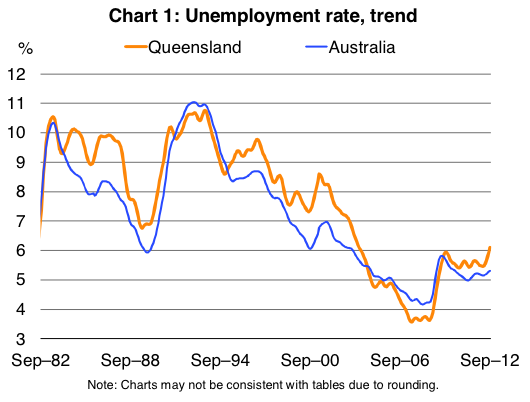
KS at Loose Change nicely summarises today’s new ABS labour force data with the title of his post: Qld employment shocker! I suspect today’s bad numbers are largely due to the fiscal restraint from the Queensland Government we’ve seen over the last six months and the recent shedding of public service jobs. Hence I expect it will be temporary in nature, as many redundant public servants will eventually find other jobs, and I don’t expect the unemployment rate to remain above 6% for long. While the fiscal austerity is likely to bring some long-term benefits, there is no doubt it will have short-term macroeconomic consequences.

Here’s OESR’s nice chart from its briefing note showing today’s bad news:

Posted in Labour market | 1 Comment

New taxi industry review urgently needed

Reading Matthew Yglesias’s recent piece in Slate on ride sharing made me think of Queensland’s own highly regulated transport system and the issues we have with poor service from taxis despite large amounts of regulation (see Taxi refusals just not fare). While the previous Government held a review of the taxi industry (as discussed in this previous post of mine), it obviously didn’t amount to much.

Hence there is a need for the Government’s new Office of Best Practice Regulation (the Queensland Government’s mini-Productivity Commission) to review regulations affecting the industry, particularly those that might inhibit the adoption of new approaches that use the web to connect passengers with regular drivers. What we really need in Queensland is something like the muscular Fels review that was held in Victoria (discussed in this AFR editorial), even though it probably didn’t go far enough in my opinion.

Posted in Transport | Tagged , , , , , | Leave a comment

Positive outlook for Far North tourism with direct flights from China about to commence

Pete Faulkner at Conus Economics Blog has a nice summary of today’s new ABS overseas arrivals and departures data and their implications for Far North Queensland (FNQ), noting:

…Importantly for the FNQ tourism industry, the influx of Chinese visitors showed some very healthy growth. Arrivals from China grew 15.7% from a year ago (to 56,600) and for the first time now make up fully 11% of all visitors. With direct Shanghai-Cairns flights just a few weeks away this sector of the market looks set to become ever more important for the FNQ industry.

KS at Loose Change also recently posted on this issue:

Chinese Big Spenders!?

Posted in Cairns, Tourism | Tagged , , , , , | 1 Comment

Latest Brisbane Economic Series issue – Energy and Resources

The October 2012 issue of Brisbane Marketing’s Brisbane Economic Series covers energy and resources and is worth a read. I agree with the positive outlook for the Queensland economy expressed by Deloitte Access Economics:

…despite a slowing of Queensland’s recent record breaking project investment, there will be continuing investment in the state. Queensland has a proud history of its economic growth outpacing that of Australia as a whole, and Deloitte projects that broad trend to continue over time. Or, as we often put it, Queensland is on the right side of history, perfectly positioned to sell its resources, tourism, agribusiness and other products into the growth of emerging Asia, which is the dominant driver of today’s business landscape.

I was also impressed by the following statement from the Chairman of the Queensland Exploration Council, Dr Geoff Dickie:

…Queensland is more than 1.7 million sq km, and only a fraction of that has been explored to any meaningful extent.

And by ‘meaningful’, I mean that all its possibilities are known in the context of the era when exploration occurs.

For example, a mineral of marginal or non-economic value 100, 50 or even five years ago could become the most sought-after component in the world for the next wave of technology.

Posted in Macroeconomy, Mining, Uncategorized | Leave a comment

Whole world struggling to manage disaster risk

I was pleased to learn that the World Bank and Government of Japan are hosting the Sendai Dialogue tomorrow and Wednesday this week to discuss how the world better manages disaster risk. This is a critical issue because, assuming no action, we can expect greater loss of life and economic damage than we have seen previously. As the World Bank observes:

…unplanned growth of cities puts more people at risk. By 2050, the urban population exposed to storms and earthquakes alone could double to 1.5 billion.

All economies, developing and developed, are subject to disaster risk, and indeed recent floods and cyclones in Australia have revealed issues in our policy settings, and we have had action on improving flood insurance at least. Unfortunately the Federal Government has been slower to respond on strata insurance and, as noted by KS at Loose Change, the due date for a report from the Australian Government Actuary on this issue has passed (Silence on Strata).

I’m not necessarily convinced the Government needs to intervene in strata insurance, as recent premium increases might reflect insurance companies finally realising how risky it is insuring multiple units in the same building subject to the same risks. But we at least need to see the Actuary’s advice on the source of recent steep premium increases to reach a conclusion.

This is an issue that is causing a lot of angst in the North and Far North. As reported in the Townsville Bulletin today (Insurance price hike rallies homeowners):

NORTH Queenslanders have come out in force and backed plans to lobby insurance companies and all levels of government to keep skyrocketing property insurance charges in check.

A lobby group set up by unit owners from Airlie Beach, Townsville and Cairns is hoping to use people power to force insurance companies, state and federal governments and body corporate managers to reduce the cost of insurance for unit blocks in the region.

Posted in Cairns, Cyclones, Floods, Housing, North Queensland | Tagged , , , , , , | 2 Comments

Treasury forecasts agricultural boom

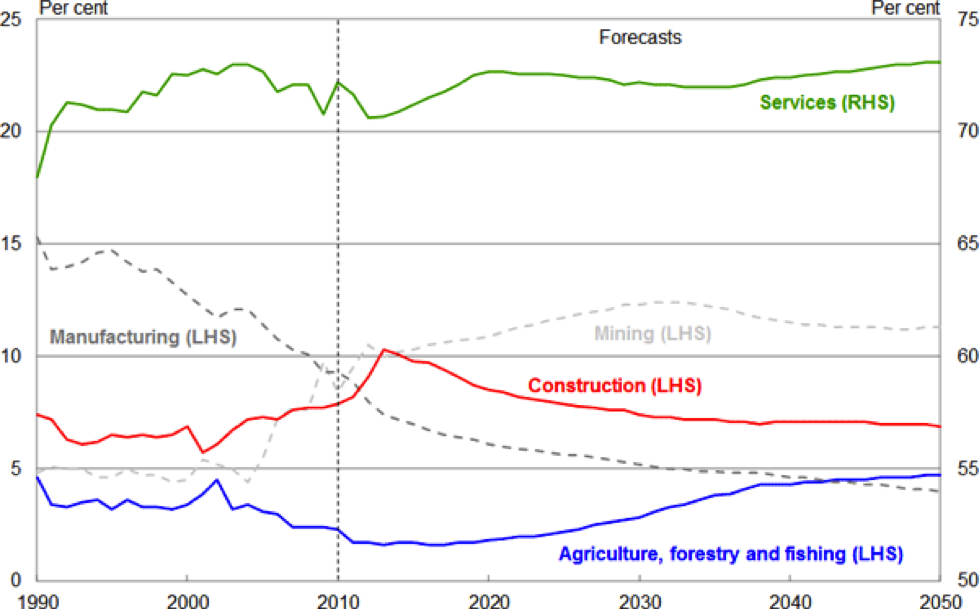
While Dr Parkinson’s speech on Friday attracted attention for his controversial comments on payroll tax, I found the boom in the agricultural sector forecast by Treasury the most interesting thing in the speech. This is a chart of industry shares of total gross value added:

Dr Parkinson notes:

The second wave flowing across our economy from the tidal economic shifts in Asia is in agriculture, as global demand for agricultural produce increases. We’re likely to see a significant increase in demand, particularly from China, for high-end agricultural products like fruit, dairy, high-grade meat and seafood.

I posted on a similar prediction from an agribusiness expert a couple of weeks ago (see Asian growth boosts our agricultural sector).

On Dr Parkinson’s payroll tax comments, I agree with him that the incidence of payroll tax largely falls on workers through lower wages. But even though it may not be the job destroyer some claim, it is still an inefficient tax (e.g. through discouraging labour supply), as made clear by analysis KPMG-Econtech undertook for the Henry Tax Review, which I posted on last year:

Inefficient State Taxes

At least Dr Parkinson mentioned land tax as another possible area for reform. Land taxes are generally very efficient, because land can’t move to escape the tax.

Posted in Agriculture, Tax | 1 Comment

Clive Palmer right on future of mining industry

I agree with Clive Palmer’s comments today that the mining boom isn’t over. While Mr Palmer obviously isn’t a disinterested observer of the mining sector, he nonetheless has compelling logic backing up his case, as reported in regional papers earlier today (Palmer optimistic about mining boom):

…Mr Palmer remains optimistic and spoke confidently to reporters in Brisbane about the future of Australia’s resources industry.

He said migration plans in China, which would see 50 million residents move from the country to the city, would result in steady demand for minerals.

“There are no questions if those plans will be implemented. China has the money to do that,” he said. “There needs to be homes with new facilities and that requires resources. So the underlying demand is there for our resources, there is no doubt about it…

…”It is not a matter of whether the mining boom is up one year and down the next. You need to look at large projects like our iron ore in Western Australia – it’s a $6-7 billion project and you don’t make that sort of investment because it’s a high or low market this year.”

I’ve made similar points in previous posts:

There will still be plenty of mining jobs in Queensland

Treasury sees China-driven resources boom continuing for decades

Posted in Mining | Leave a comment

Tea Party debate in Brisbane Thursday night

The Young Economists debate tomorrow night in Brisbane on whether Queensland needs a Tea Party looks fascinating:

Queensland Competition Authority is proudly supporting the 2012 Young Economists Debate Night.

The rather timely topic is

Queensland needs a ‘Tea Party’ – the future is small government

Our guest debaters for the evening are Euan Morton, Principal of Synergies Economic Consulting, and Cameron Murray, regular contributor to MacroBusiness, and current PhD candidate at the University of Queensland.

DATE Thursday, 4th October 2012
TIME Arrive 5.30pm for 6pm start
VENUE Bleeding Heart Gallery, 166 Ann St, Brisbane
ENTRY Free (some free drinks for members)
RSVP to youngeconomistsESA@gmail.com

Posted in Uncategorized | Leave a comment