Qld Govt follows through on open data policy – now I know where all the E-Type Jaguars prowl

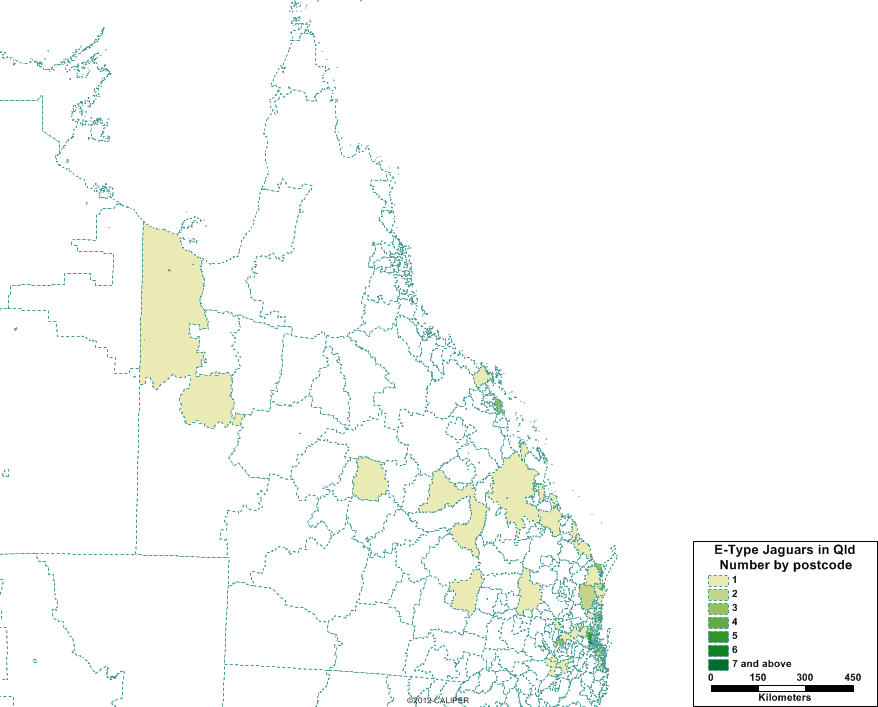
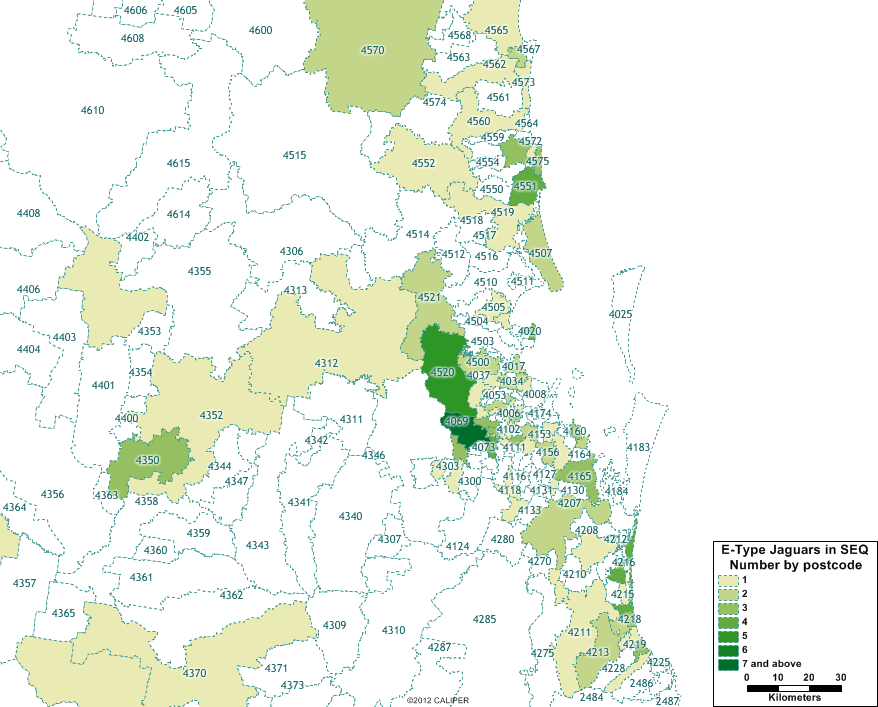
A tweet by Possum Comitatus yesterday alerted me to the newly released data on car registrations in Queensland released under the Queensland Government’s new open data policy. This is an extensive database, including nearly every bit of relevant registration data short of names and addresses. I’ve used the postcode data field to track the locations of the most beautiful car ever made, the E-Type Jaguar. The bulk of these exquisite creatures are registered in South-East Queensland, with the Kenmore-Brookfield, Samford, Caloundra and Gold Coast areas home to significant numbers (see the map below). Many unfortunate postcodes (those uncoloured) have no E-Types registered at all.

SEQ map

The rest of Queensland fares rather poorly in E-Type numbers:

Qld map

Posted in Queensland Government | Tagged , , , , , | 2 Comments

Sunnybank a major centre for diversity in Brisbane

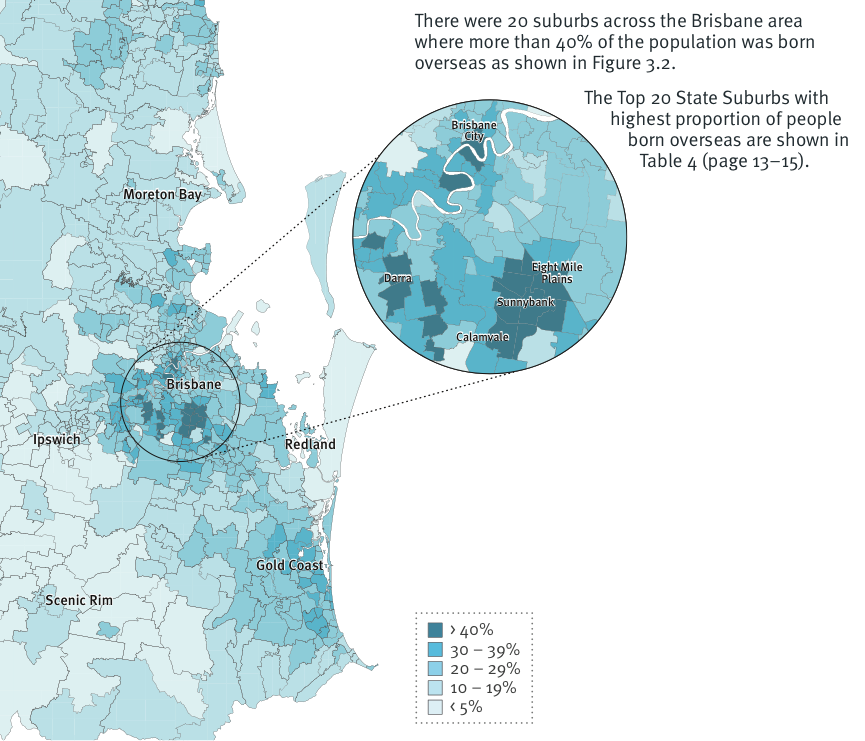
The Government Statistician and the Queensland Department of Aboriginal and Torres Strait Islander and Multicultural Affairs (DATSIMA) have released a great new publication Diversity Figures based on 2011 Census data. Check out this excellent map in the publication showing the proportion of people born overseas by suburb:

brisbanemap

Posted in Migration, Population | Tagged , , , , | Leave a comment

Very surprising employment numbers for Qld – ABS needs to investigate volatility

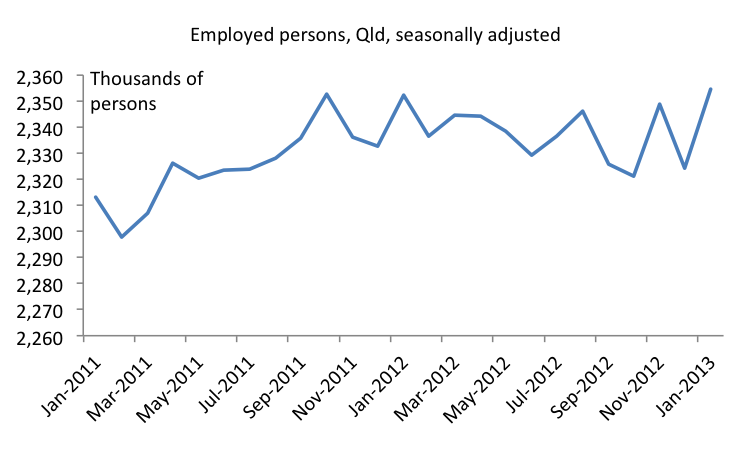
Given the low levels of job vacancies toward the end of 2012 (see this previous post), I’m very surprised to see the strong rebound in employment in January (30,200 new jobs) and the unemployment rate dropping to 5.5% from 6.1% the previous month (from the new ABS Labour Force data). While I always expected the impact of Queensland Government job losses would be temporary (see my post on the temporary surge in unemployment), this appears to be a very sudden turnaround. I’m hoping it’s true, but I know there are reasons for interpreting today’s data cautiously.

In its labour force briefing, Queensland Treasury’s Macroeconomics team notes “the sa data has been even more volatile than usual recently.” They certainly have, with the estimate of employed persons bouncing up and down over the last six months, as shown in the chart of employed persons below:

employment Further, Pete Faulkner at the Conus economics blog observes:

…as the ABS points out in their release, the data for QLD may well be compromised in Jan by the floods in the south east of the state. So, although this appears to be good news for QLD, we need to be cautious.

Oddly, while it identifies the possible impact of the floods and bushfires in other States on the January data, the ABS notes “…there were no observable impacts on the data.” Frankly, I don’t think the ABS was looking hard enough.

I’m increasingly disappointed by the quality of Queensland data produced by the ABS. I’d suggest the ABS review its sampling techniques and sample sizes to see if there are improvements that can be made to increase the reliability of Queensland data.

Posted in Labour market | Tagged , , , , , , | Leave a comment

Queensland’s inactive children will cost health system in the future

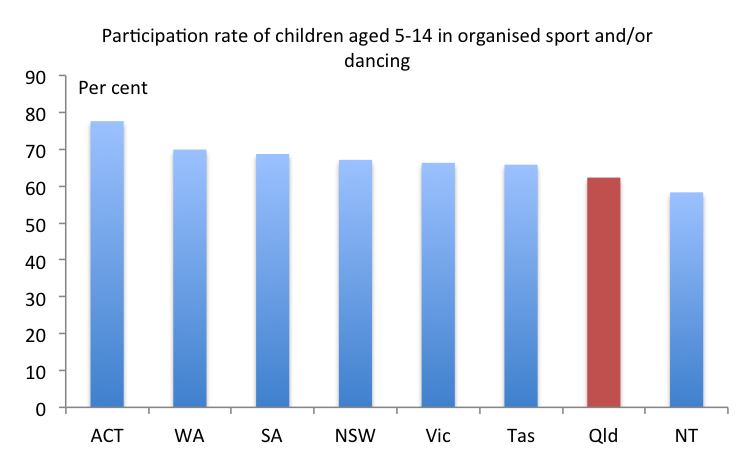
Queensland ranks second lowest among States and Territories for the participation of children in organised physical activity (sport or dancing), according to new ABS data released today (see chart below). I am concerned about what this means for our future rate of obesity, which is already relatively high  (see Queensland leads Australia on obesity), and the ultimate cost to our health system.

sport

Posted in Health | Tagged , , , , , , | Leave a comment

Still waiting for building industry recovery

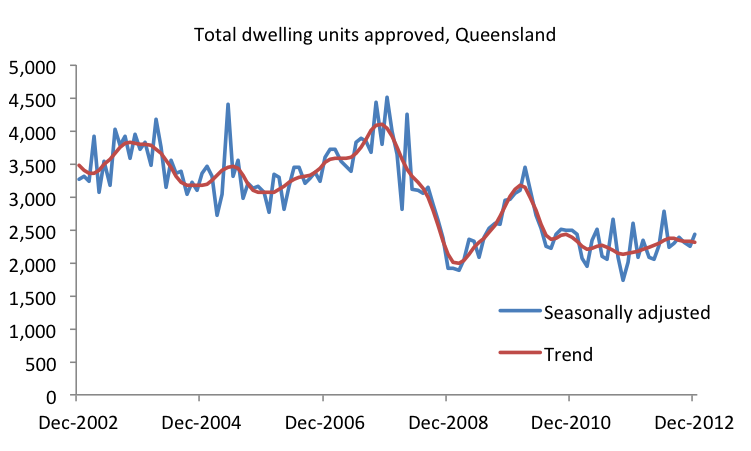
New ABS building approvals data show building approvals (seasonally adjusted) in Queensland increased by nearly 8% in December 2012, but they remain at a low level:

approvals

The national data aren’t encouraging. See, for example, coverage at MacroBusiness (Building approvals fall sharply in December) and the Conus economics blog (Building Approvals decline; but the trend data is up…just).

Posted in Housing | Tagged , , , , | 1 Comment

Gold Coast shouldn’t expect too much of an impact from big events

After several years of poor economic conditions which are only now improving, it’s understandable the Gold Coast is excited about the economic potential of some upcoming big events, such as the 2013 Australian Surf Life Saving Championships. The Gold Coast Bulletin reports Upcoming events set to bring in cash:

THE southern Gold Coast is bracing for an economic wave of prosperity as it prepares to host some of the city’s largest events.

The Australian Surf Life Saving Championships, Bleach Festival and Cooly Rocks On are just some of the major events which will be held from this month to June.

The string of events is expected to bring more than $30 million into the economy. Southern Gold Coast Chamber of Commerce president Gail O’Neill said she expected the events season would have a “huge” impact on businesses.

The big events in the first half of 2013 are certainly welcome, but I expect they won’t have a huge economic impact. The Gold Coast is at least a $25 billion economy. New spending of $30 million over the first half of 2013 is equivalent to around 1/4 of one per cent of gross regional product (GRP) for the period. This is respectable, but is probably much less than local businesses may expect. Of course, businesses and hotels located close to the events are likely to benefit much more than other Gold Coast businesses.

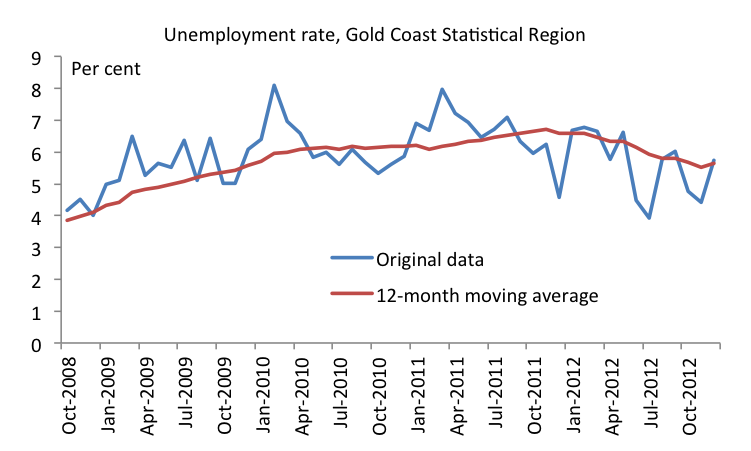
Luckily there are positive signs that the Gold Coast economy is recovering, with the unemployment rate dropping over 2012 (see chart below) and a better outlook for tourism (see my post Gold Coast holiday bookings confirm domestic tourism recovery). There is also the possibility of a recovery in the building industry, a major driver of activity across the economy, with the December quarter 2012 Survey of Industry Conditions from Master Builders Queensland recording a satisfactory building industry outlook for the Gold Coast.

GCunempl

Posted in Gold Coast | Tagged , , , , , | Leave a comment

Compelling evidence of robust recovery in Far North Qld

Cairns and the broader Far North Queensland (FNQ) economy appeared to be in a lot of trouble in the immediate post-financial crisis period, as a result of a large decline in tourism and an over-supply of housing and commercial property which suppressed construction activity. But there is compelling evidence of a solid recovery in FNQ, as discussed in the latest Cairns Watch publication from Rick Carr at Herron Todd White (HTW), Cairns (Hat tip to KS at Loose Change for alerting me to this in his post Cairns Watch Optimistic).

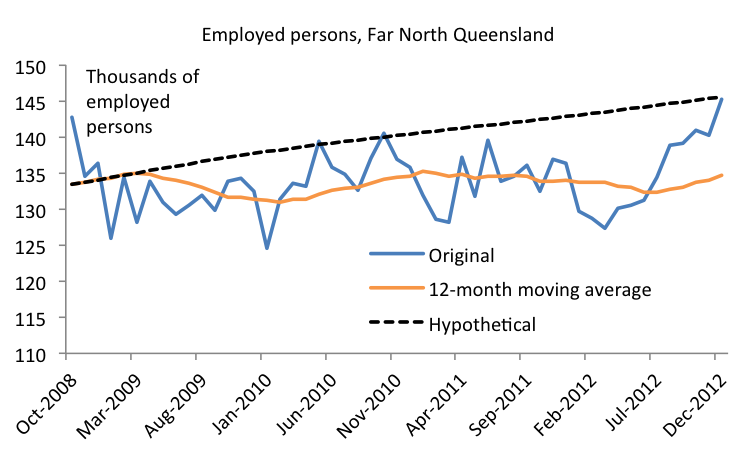
I found the Cairns Watch chart of the ABS estimates of people employed in FNQ very interesting, although I think the trend time series estimated by HTW looks a bit odd. It appears too responsive to the most recent observations. Given regional employment data are highly volatile, I’d prefer a more conservative trend estimate such as a 12-month moving average (see chart below). Regardless of the trend estimate chosen, it appears clear there is a recovery in the FNQ labour market. If the most recent original data are close to the true employment level (i.e. FNQ employment is around 145,000) then employment in FNQ has recovered to at least what you’d expect it to be based on population growth (the hypothetical line below). New ABS data over the next few months will hopefully confirm this employment rebound.

FNQPrevious posts of mine on the FNQ economy can be found at this link.


Posted in Cairns, Labour market | Tagged , , , , , , | Leave a comment

Why is Qld’s participation rate higher than the rest of Australia’s?

Queensland’s labour force participation rate is slightly higher than the national average (see chart below), and historically this has been cited as a reason for a higher unemployment rate than the national average, as I discussed in a post last week. (The participation rate is the ratio of the labour force, i.e. the sum of employed and unemployed persons, to the civilian population aged 15 and over.)

partrate

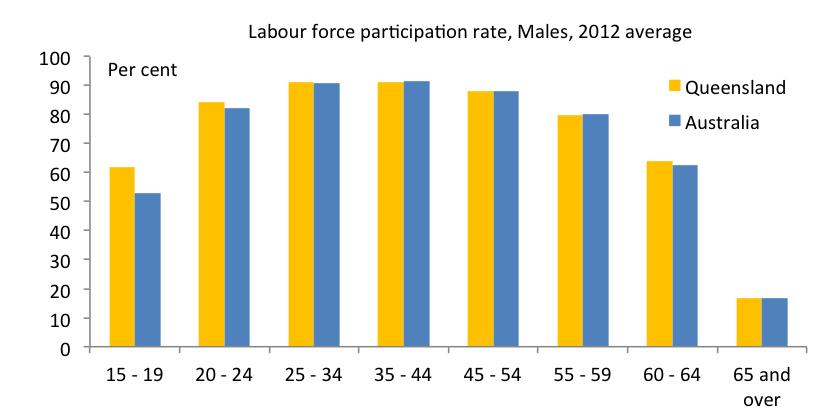
Queensland’s participation rate is higher than the national average primarily due to much higher labour force participation by young people in Queensland than young people in the rest of Australia (see charts below).

males

females

In large part, this is likely due to Queensland’s lower average school finishing age, which means in Queensland a higher proportion of the 15-19 year old cohort has finished high school compared with 15-19 year old cohorts in other States. I expect Queensland’s participation rate will gradually come closer to the national average as Queensland’s average school finishing age rises as a result of the introduction of a prep year.

Posted in Labour market | Tagged , , , | Leave a comment

Growing list of impacts and costs of big wet

One economic impact I failed to explicitly mention in my post yesterday on the economic impact of the big wet is the impact on the sugarcane crop, which may be very signficant, as reported in the Courier-Mail this morning:

Yesterday, Canegrowers chief executive Steve Greenwood said that it would take a week or more to fully assess the damage across 18 sugarcane growing regions.

“Early reports are that broadscale flooding in the Bundaberg, Maryborough and Childers areas will cause major damage to sections of this year’s cane crop,” Mr Greenwood said.

“While in other areas, reports are coming in that the crop is looking good under the circumstances – some even reporting that rains in their area have broken a prolonged dry spell and provided the much-needed moisture this year’s crop needed.”

As with the cotton and beef industries, it appears that, to some extent, there will be an offsetting benefit from the rainfall on the cane crop in some regions.

In other news, early indications are that the costs of the big wet in terms of damaged buildings and infrastructure will be large, albeit lower than the costs of the 2010-11 disasters, as reported by the Brisbane Times this morning:

Already, 9800 insurance claims have been lodged in Queensland worth a combined $116 million, according to the Insurance Council of Australia.

The damage to infrastructure is still being assessed, but it has been estimated the bill will run into the hundreds of millions, without counting crop and livestock losses.

That sounds like a plausible estimate to me.

In analysing the economic effects of the big wet, it needs to be remembered that costs reported in terms of damage to buildings and infrastructure won’t be exactly reflected in Gross State Product (GSP). Damage to houses, buildings and infrastructure will affect GSP in two major ways:

  • impacts on ongoing business (e.g. losses of wages and profits in affected businesses and rents in damaged houses) will subtract from GSP; and
  • during the reconstruction period, spending associated with rebuilding damaged houses, businesses and infrastructure will add to GSP.

It is too early to estimate the relative magnitude of these different impacts.

Posted in Cyclones, Floods, Macroeconomy | Tagged , , | Leave a comment

Economic impact of the Big Wet in Queensland

The heavy rain, winds and floods that have resulted from ex-tropical cyclone Oswald have caused a large amount of human suffering and will have an adverse short-term impact on Queensland’s economy. I expect the adverse short-term impacts will arise mainly as a result of:

  • disruptions to coal production in Central Queensland,
  • loss of agricultural output in the Lockyer Valley and other regions, and
  • temporary suspension/reduction in normal economic activity in Bundaberg, Gympie, Laidley and other affected cities and towns from the Far North to the Gold Coast.

It’s still too early to come up with accurate estimates of these impacts, but some back-of-the-envelope estimates are possible. These estimates rely heavily on assumptions and guesses around possible impacts, but I think they might provide a sense of the order of magnitude of the likely impacts. (Of course, I would welcome any comments and suggestions.)

Regarding the disruption to coal production, the Queensland Resources Council (QRC) noted today that (Qld resources flood update):

Queensland’s export coal industry could take several weeks to resume full production in the wake of ex-tropical cyclone Oswald, Queensland Resources Council Chief Executive Michael Roche said today.

‘We are receiving reports of significant damage to the Blackwater and Moura rail systems that carry coal from the southern and central Bowen Basin to the Port of Gladstone, where operations have also been hampered by around 800mm of rain,’ Mr Roche said.

‘While the situation is still being assessed by network operator Aurizon, these rail lines to Gladstone could be out of action for up to seven to 10 days.

This is potentially a significant impact on Queensland’s Gross State Product (GSP), if it can be assumed that we lose, say, 10 days worth of coal exports out of Gladstone. Based on a range of assumptions taken from different sources, this could result in a loss of up to $200 million of GSP in the March quarter, or up to 0.3% of March quarter GSP.

There are no data at this stage by which to estimate the possible loss of agricultural output. The Lockyer Valley appears to be hardest hit, and while the loss of crops will have a very significant regional impact, at the State level it may only have a small impact on GSP, given that the Lockyer Valley produces only a few per cent of Queensland’s total agricultural output. While there will also be some crop losses in other regions such as the Darling Downs, there appears to be less concern about possible crop losses in these regions, and indeed there is an expectation there could be offsetting longer-term benefits through the impacts of much needed rain on the cotton and beef industries (see Big wet’s winners).

The impacts on GSP from the reduction in economic activity in affected centres are hard to estimate and depend on how long it takes for economic activity in these centres to return to normal. The most severely impacted centres of Bundaberg, Gympie and Laidley account for around 2% of Queensland’s GSP. If, say, in an extreme scenario, half a month’s output is lost from these centres, there could be a -0.3% impact on March quarter GSP. This loss of activity would be offset to an extent by the massive clean up and reconstruction effort that will need to occur in these centres, although this effort will be spread across several quarters and may not offset the adverse shock in the March quarter.

Based on these back-of-the-envelope calculations, at this stage I expect the big wet will result in a negative shock of around -0.6% of March quarter GSP, taking 0.15% off 2012-13 GSP growth which was forecast by Queensland Treasury at 3.75% (see the Mid Year Fiscal and Economic Review). The negative shock may be slightly larger than this if the disruption to economic activity elsewhere in Queensland (e.g. Cairns, Gold Coast) and possible impacts on Rockhampton (see Fitzroy River set to peak at 8.5 metres this Saturday night) are taken into account. As such, it may be that the negative shock in the March quarter could equal up to 1% of GSP, which would bring 2012-13 GSP growth down to 3.5%. Even if this is the case, the State economy should readily be able to endure the adverse economic impact of the big wet, although the impacts on particular regional communities will be severe.

The longer-term impacts of the big wet are much harder to judge. Obviously, it may have a negative impact on tourism, and it also might adversely impact interstate migration. Queensland must look a much less hospitable place to people living in NSW and Victoria, our major sources of interstate migrants. Queensland Treasury may need to reconsider its population growth projections.

Posted in Cyclones, Floods, Macroeconomy | Tagged , , , , , , , , , , | 3 Comments