Economics: Keeping the World in Business – speech to high school students at UQ

Below is the prepared text of a talk I gave to high school students attending the Careers that Shape the World day at the University of Queensland, St Lucia Campus, on Wednesday, 23 April 2014. I varied the talk significantly in its delivery, but the points I made were basically the same as the ones I make below. 

Economics: Keeping the World in Business

Good morning and thank you for coming along. Today my topic is how economics keeps the world in business. This is a pretty easy topic in one sense. Economics is what economists do, and economists have been very important in the world economy over the last few decades. Many of you would have heard of Alan Greenspan who was Chairman of the US Federal Reserve, and probably the most influential person for business on the planet for a decade or two. And if you look closely at people’s CVs, you’ll find many important people who were economists or studied economics at one time. For example, Sheryl Sandberg, Chief Operating Officer of Facebook, is an economist by training and worked for former US Treasury Secretary Larry Summers.

In my own experience as an economist, I’ve done what I consider to have been some pretty important things. For example, while at the Commonwealth Treasury, in the aftermath of the 2008 financial crisis, my team more-or-less prevented the Commonwealth Government from running out of money. And we did the policy work to get the cash to fund the massive February 2009 stimulus package that, arguably, averted a recession. (The AOFM actually raised the funds, so much credit goes to them, of course.)

More recently, as a consulting economist, I led a feasibility study looking at the costs and benefits of a new high school co-located with James Cook University in Townsville, which was an election commitment of the Newman Government’s. I’ve also investigated the economic costs and benefits of building a long-distance walking track – the dreaming track – from Cape Tribulation in Far North Queensland to the tip of Cape York.

So economists work across a huge range of issues. These issues range from the big picture of the macro-economy to the smaller picture of individual construction projects, businesses or government programs.

This morning, while explaining how economics keeps the world in business, I also hope to convince you that studying Economics at UQ is worthwhile. I will first explain why economics is important – that is, how it keeps the world in business. Second, I will discuss the important careers and opportunities that economics can lead you into. Third, I will discuss what distinguishes UQ Economics.
Continue reading

Posted in Brisbane, Labour market, Macroeconomy | Tagged , , , , , | Leave a comment

How important is tourism to the Queensland economy?

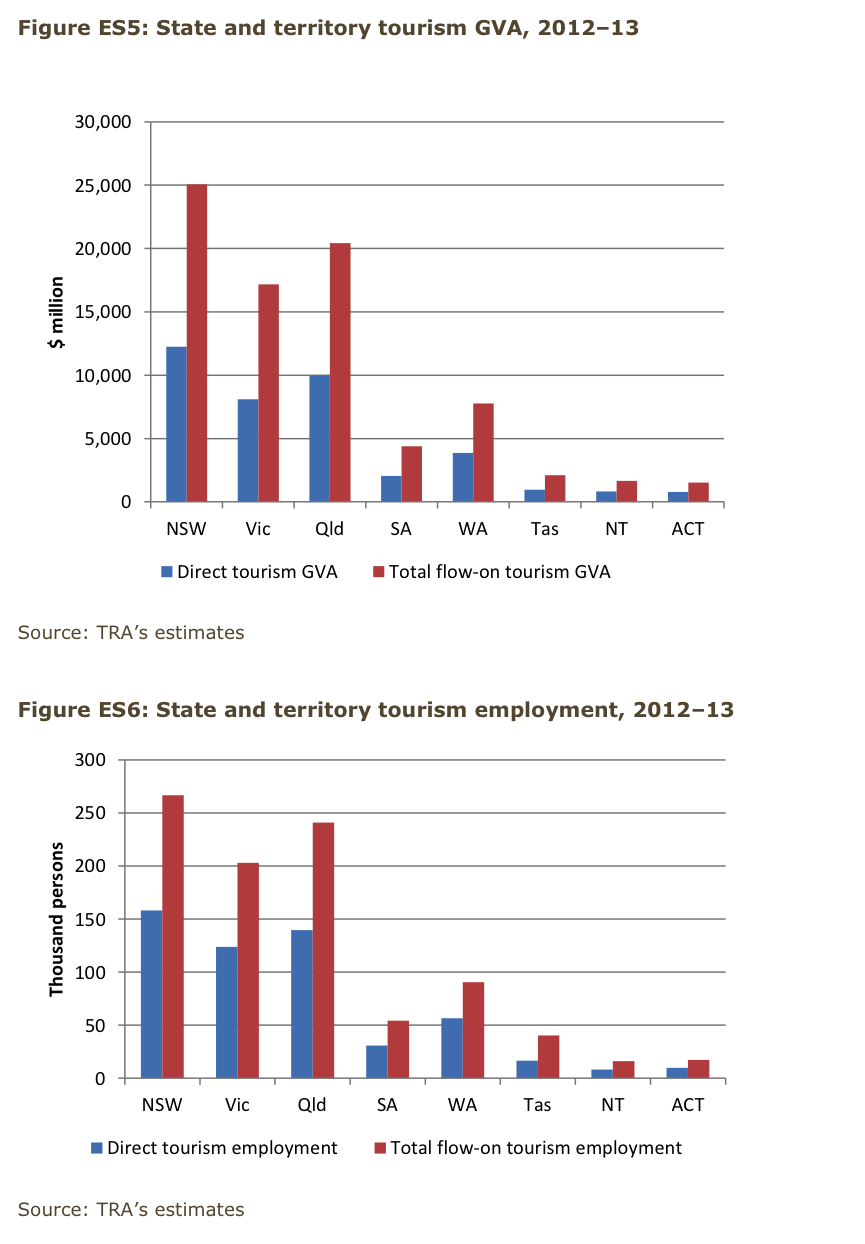
It is being reported that visitor numbers over Easter at Queensland tourism centres such as the Gold and Sunshine Coasts were at levels not seen since before the financial crisis. This is great news given the importance of tourism to the Queensland economy. Recall that tourism is one of the so-called four pillars of the Queensland economy. According to the State Tourism Satellite Accounts 2012-13 prepared by Tourism Research Australia, tourism directly contributed $10 billion to the Queensland economy in 2012-13, supporting 140,000 jobs (see charts I’ve copied and pasted below; N.B. GVA stands for gross value added, which measures the industry’s economic contribution). This was equivalent to 3.8% of the State economy and 5.9% of total employment. This puts tourism in third place among the four pillars, with mining contributing $30 billion, construction $26 billion and agriculture $8 billion.

Tourism

Incidentally, tourism appears less important than some other industries, such as manufacturing ($20 billion). (Note that I’ve taken some liberties with these industry comparisons since tourism strictly isn’t an industry, but a category of expenditure, and the tourism sector estimates are constructed by extracting tourism activity from other industries, particularly accommodation and food services, transport and retail trade.)

I haven’t mentioned the estimates of flow-on activity and employment, because the calculation of flow-on impacts is imprecise and controversial. I’ll try to elaborate on this point in a future post.

Posted in Tourism | Tagged , , , | 2 Comments

Entrepreneurs seeking venture capital better off going to US

Australia’s low level of venture capital investment is often raised as a cause for concern, as in today’s article from Elizabeth Knight in the Age, Start ups starved of venture capital:

In Australia the venture capital sector is not starved but neither is it properly supported.

The two people operating out of their garage that need a couple of hundred thousand dollars to develop an app can find the money. However, getting another couple of million to commercialise it is tricky here.

This is absolutely true. I recall my former Treasury colleague Anthony Goldbloom struggled to find funding in Australia for his Kaggle website, which runs data mining competitions, including for major companies such as GE and Facebook. But he was much more successful when he went to the US, where he was able to raise $10 million.

In my view, it makes sense for talented entrepreneurs to go to the US, because that is where they’ll receive the most support – it’s where the existing venture capitalists who are highly experienced in nurturing start-ups are, and it is where there already exists an entire community of people with the ideas and skills to contribute to innovative start-ups. This is the point Dominic Regan and I made in our 2008 Treasury Economic Roundup paper, Venture Capital in Australia. We noted:

High-technology industries tend to be heavily concentrated in regional ‘clusters’. For example, there are highly successful ICT clusters in Silicon Valley and Boston and there is an aerospace cluster in Seattle. It is a firm’s nearness, both in terms of location and relationships, to entrepreneurs, industry experts, financial and accounting specialists, marketers, and related businesses that determine the success of the firm and the intensity of a high-technology cluster (O’Mara 2005). Clusters such as Silicon Valley constitute a complex economic ‘ecosystem’, with a vast array of specialised businesses in related industries.

Regions that already have high-technology clusters tend to be more productive and attract a highly skilled workforce. They are also more likely to attract and sustain a large venture capital sector because the factors that result in clustering also are likely to reduce the risk to investors and increase potential profits. In this way they maintain their competitive advantage while driving the technological frontier forward.

Combined with competitive pressures, the confluence of the innovator’s knowledge and the venture capitalist’s industry experience creates a ‘hothouse’ environment that drives rapid growth of start-up firms. While venture capital is seen as a risky business, it is the considerable expertise of the venture capitalists that reduces risks and creates successful firms with self supporting clusters.

High-technology industries tend to be global in outlook. It follows that high-technology clusters will attract ideas that originate in other regions or countries. Ideas generated by Australian entrepreneurs may be easier to fund and generate higher returns in the US, for example, because they can take advantage of the unique opportunities within clusters. However, Australian firms and consumers will ultimately benefit from the commercialisation of the ideas, irrespective of where they are developed, as Australians are typically early adopters of new technologies.

In undertaking its current review of industry assistance, the Queensland Competition Authority should be vigilant against arguments that the Government should promote high-tech clusters, which appear very difficult for governments to artificially create.

Posted in Industry policy | Tagged , , , , , | Leave a comment

Penalty rates reform a priority given youth unemployment rate

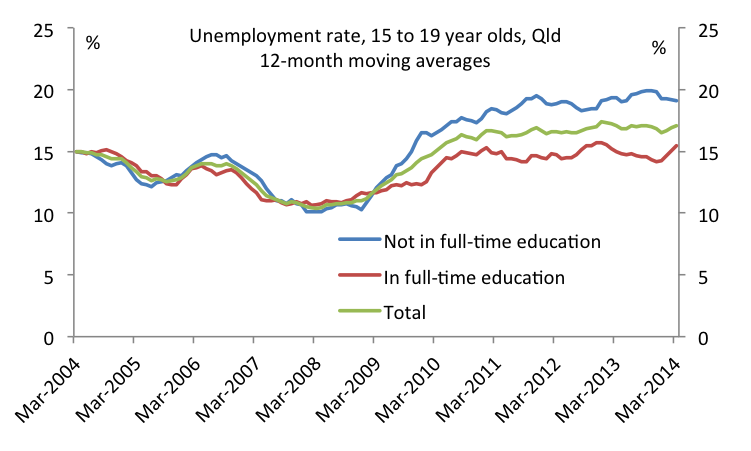
The Easter long weekend has once again highlighted the adverse impact penalty rates are having on the hospitality sector, with the Courier-Mail reporting restaurants close over Easter as penalty rates see wages skyrocket. I’ve commented before on how penalty rates make it much more difficult for young people to get work and, given youth unemployment is re-emerging as an issue, particularly among those young people not studying (see chart below based on ABS data), it really is time to fix the problem.

youthunemployment

My previous posts on penalty rates and youth unemployment include:

Reduce youth unemployment through improved regulation – e.g. of penalty rates, taxis

Challenging labour market conditions for young Australians

Hospitality suffering under IR regime

(Hat tip to one of my readers who goes by the nickname “Toad” for pointing out the data I’ve used in the chart to me.)

Posted in Labour market, Tourism | Tagged , , , , , , , , | Leave a comment

Strong Choices poorly received by public – Treasury needs to do a lot more work

The Queensland Government needs some new advisers who can prepare logical, coherent arguments as to why particular assets such as ports and electricity businesses should be privatised, because the current Strong Choices campaign has flopped (see the Brisbane Times article Strong choices on budget spark debate). The campaign appears to have been developed by PR consultants, but it doesn’t present any facts or logic that would convince the public on the need to sell assets. It doesn’t address the primary concern people have over asset sales – that the community will get ripped off and private operators will make monopoly profits. The Government needs to explain how the proposed sale process and post-sale regulation will protect the public from getting ripped off. Given I support the Government’s position on asset sales, I’m disappointed that it is being let down by poor PR advice.

Steve Austin and I had a good chat about the problems with the Strong Choices campaign and the People’s Budget website application on 612 ABC Brisbane radio yesterday morning:

Economist labels “Strong Choices” a joke

Steve got in touch with me early yesterday morning after he read my Monday night post:

Qld Treasury needs to explain logic of asset sales much more clearly

Also, I’d recommend Mark Beath’s post from yesterday:

Clean for Gene: Strong Choices or Weak Leadership?

Mark makes a great point about the failure of the website application to offer genuine choices around changing the tax mix:

Sadly, there was no interactive option which allowed me to play with abolishing stamp duties on insurance and property transactions in return for a broad based land tax. More sadly the responses they are likely to receive on the info provided could well lock out any such reform. The explanatory information provided on land taxes will inevitably skew a more negative response.

The Queensland Treasury needs to pay less attention to its PR consultants and instead focus on producing solid economic analysis of the pros and cons of asset sales, which can then inform a serious public debate.

Update: I was interviewed by Brisbane Ten News regarding Strong Choices:

Hard Sell

Posted in Budget, Queensland Government | Tagged , , , , | 7 Comments

Qld Treasury needs to explain logic of asset sales much more clearly

In her terrific book On Speaking Well, former Presidential Speech Writer Peggy Noonan argues convincingly that people ultimately are moved by logic, and you shouldn’t underestimate the intelligence of your audience. She writes:

A good case well argued and well said is inherently moving. It shows respect for the brains of the listeners. There is an implicit compliment in it. It shows that you’re a serious person and understand that you are talking to other serious persons.

Peggy Noonan’s words came to mind when I learned about the Queensland Government’s Strong Choices campaign, which unfortunately doesn’t present the strongest case it could for privatisation. The campaign seems vulnerable to the standard attack that privatisation doesn’t really improve the budget balance because of the forgone earnings (e.g. see John Quiggin’s post The “People’s Budget” that doesn’t add up), and, alas, it seems a bit of a gimmick.

A problem with the campaign is that it appears to assume it is absolutely necessary to cut the State debt by $25-30 billion. Well, in my view, it’s highly desirable to do so, but it isn’t absolutely necessary. The Government faces higher borrowing costs because of its large debt, but the Government is not at risk of defaulting on its debt. The Queensland Government can borrow at a rate of 4.44% p.a. for a ten-year term, which doesn’t suggest the bond market is too panicked about our capacity to repay. (We are, of course, penalised by the bond market for our level of debt and lack of a AAA rating though. Compare Queensland’s borrowing rate of 4.44% p.a. with the Commonwealth’s borrowing rate of 4.02% p.a. for a ten-year term).

The Government needs to explain more clearly why it needs to sell assets. In my view, the two strongest arguments are:

  • the assets will be better managed by the private sector, boosting efficiency and productivity across the economy and improving the State Budget (see Brad Rogers’s great post Queensland ports for sale), and
  • the Government will save hundreds of millions in borrowing costs every year (through a lower interest rate) if we can regain our AAA credit rating by using the proceeds of asset sales to pay down debt.

I’ve made these points in several posts, including:

Govt should embrace Costello Commission of Audit privatisation recommendations

Qld budget surplus delay not a big deal, but reinforces need to consider Energex & Ergon sell off

It’s not too late for the Government to win the debate on asset sales, but it needs to present more compelling logic. The Government’s current arguments for asset sales are too simplistic and probably won’t persuade the public. The Government should ask the Treasury to produce a solid report presenting the pros and cons of privatisation – analysing in detail the merits of selling particular assets such as energy businesses and ports, directly addressing the question of whether they would be better run by the private sector. The Government should then present this analysis to the public in speeches and informative publications and websites.

Posted in Infrastructure, Macroeconomy, Queensland Government, Transport | Tagged , , , , , | 4 Comments

Economic impact of natural disasters

Having grown up in Townsville, I know very well that North Queenslanders are a resilient bunch and will recover quickly from the impacts of Cyclone Ita, although, as we’ve seen, the immediate impacts on some families and communities have been severe (see Ita’s clean up to be lengthy and costly and Cyclone Ita smashes Ingham’s four-million-tonne sugar cane crop). I’ve posted before on how communities and economies bounce back quickly from natural disasters and how the macroeconomic impacts of disasters tend to be small:

Recovery from natural disasters

Northern and Far North Queensland account for around 9% of the Queensland economy (see Queensland Treasury’s Experimental Estimates of Gross Regional Product). Even if the cyclone affected regional gross regional product (GRP) by 1% over the year, the impact on gross state product (GSP) would be less than 0.1%.

Posted in Cyclones, North Queensland | Tagged , , , , , , | 2 Comments

QCA issues paper shows large potential savings in industry assistance

The Queensland Competition Authority yesterday released its issues paper for its inquiry into Queensland Government industry assistance. The paper provides an excellent framework for evaluating industry assistance measures. It also highlights a number of costly assistance measures provided by Queensland Government, including:

  • $13 million p.a. for Screen Queensland,
  • $46 million p.a. for the First Start Loan Program (concessional loans to new farmers),
  •  $75 million p.a. for Tourism and Events Queensland,
  • $120 million p.a. in tax concessions for owners of gaming machines and casinos (which seems very peculiar), and, among many more,
  • $110 million p.a. in subsidised electricity prices to regional businesses, mainly farmers and irrigators.

This is a great start for the QCA. What I’d really like to see in the final report is a hit list of programs with strong logical arguments for why they should be cut. I look forward to the interim report at the end of August.

I’ve previously posted on the industry assistance review:

QCA review of Qld Govt industry assistance is great news

Posted in Industry policy | Tagged , , , , , | Leave a comment

Qld unemployment rate falls slightly to 6.1% – rising participation a good sign

The March labour force data released today by the ABS, showing the unemployment rate falling to 5.8% from 6.1% in February, were good news for the Australian economy, as reflected in the dollar surging and one prominent commentator forecasting an increase in interest rates later this year (see MacroBusiness’s post Bloxo: Rate hikes this year!). While falling slightly (by 0.1 percentage points) in March, the Queensland unemployment rate stills remains above 6% at 6.1% in seasonally adjusted terms (see chart below).

urate

I agree with Pete Faulkner’s assessment that Queensland’s rising participation rate is a good sign of a recovering labour market (see Strong jobs sees UR fall; QLD also looks better and the chart below). The participation rate is the fraction of the civilian population aged 15 or over that is in the labour force – i.e. either already in work or actively looking for work and hence counted as unemployed. It typically rises when an economy is recovering because a number of people – particularly the so-called marginally attached to the labour force – decide it might be time to begin actively looking for work now that conditions are better (see my post People marginally attached to the labour force behind participation rate movements).

prate

Posted in Labour market | Tagged , , , , , , , , , , , | 5 Comments

New Treasury modelling supports change in tax mix towards GST

In the latest Commonwealth Treasury Economic Roundup, there is an excellent paper on the economic impacts of company tax. The paper could be viewed as supporting a cut in company tax and replacing the lost revenue with greater GST revenue, either from broadening the base or increasing the rate of the GST (The incidence of company tax in Australia). As the paper shows, company tax is an inefficient tax because it reduces the level of investment in the economy, and this cost is borne by both shareholders and workers. The authors of the Treasury paper note (p. 43):

The welfare effects of a 1 percentage point cut in the company tax rate are shared between company owners and workers. Estimates from the main scenario, which includes economic rents, suggest that in the long run only around one-third of these benefits accrue to the owners of capital, with the remaining two-thirds flowing to households primarily through higher wages.

I’ve previously posted on taxation issues and I’ve noted that it would be desirable to cut a range of inefficient taxes, particularly stamp duty, and to replace forgone revenue with a broader-based GST. Relevant posts include:

Dr Parkinson right that the GST should be broadened

GST changes should be considered as part of wide-ranging tax and expenditure review

 Inefficient State taxes

Posted in Tax, Uncategorized | Tagged , , , , , , | 2 Comments