Senate inquiry should consider impact of heritage protection on housing affordability

I was pleased to see the Queensland Government note, in its submission (available on the submissions page) to the Federal Senate Inquiry into Affordable Housing in Australia, that “local government must be more responsive and flexible if improved housing affordability is to be achieved.” However, I would have really liked it to have specifically identified heritage protection as a major constraint on housing supply in Brisbane. As discussed in a post by Brad Rogers (Old Queenslanders in a New City), protection of old Queenslanders in Brisbane’s older suburbs limits the population density of these suburbs, which could house a lot more people – and provide more affordable housing options – if lots containing old Queenslanders were re-developed to contain townhouses or apartment blocks.

That said, at least the Government’s submission has started a new discussion about housing supply issues in Queensland. Figures on Queensland’s low rate of home ownership contained in the Government’s submission prompted a Brisbane Times article this morning (Queensland home ownership falling) and Steve Austin’s interview of Urban Development Institute of Australia (UDIA) President Brett Gillan this morning on 612 ABC Brisbane (Queenslanders balk at buying first home). The reported figures relate to outright home ownership, but total home ownership rates in Queensland are also relatively low – i.e. if one counts houses owned with a mortgage as well, as in the chart below from the ABS (copied from Home ownership in Local Government Areas).

Home ownership rates
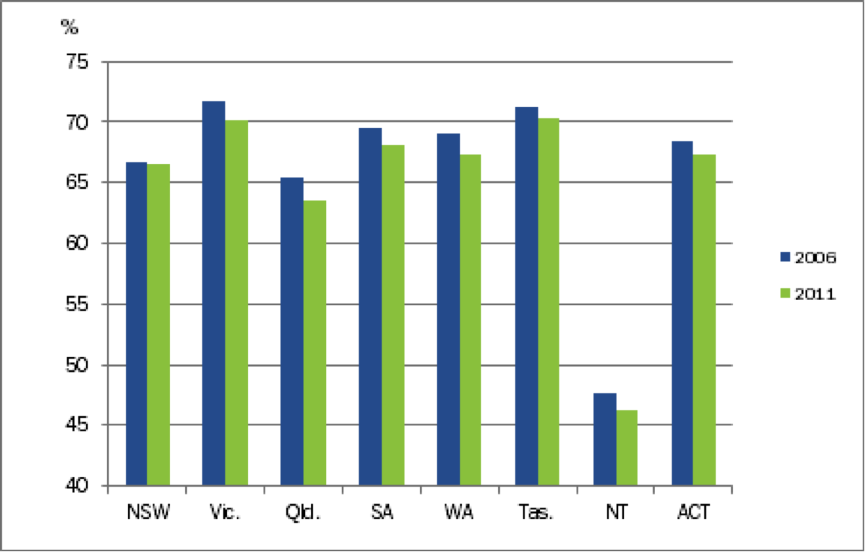
homeownership

Let’s hope the discussion continues and will take on the issues of heritage protection as well as the conservative attitude some Councils have towards the development of new land, whether that be due to concerns over the impacts on the environment or property prices of existing residents.
Posted in Housing | Tagged , , , , , , , , | 10 Comments

Should Townsville port long-term lease earnings be earmarked for NQ?

It would be poor public policy to earmark the earnings from the long-term leasing out of the Port of Townsville for investment in North Queensland, as desired by Townsville community leaders. The Townsville Bulletin reports today:

A LONG-TERM lease on the Port of Townsville is estimated to be worth more than $405 million and the region’s leaders have been warned they must push the Government to reinvest a fair amount back into the city.

Regional economist Colin Dwyer said last week’s sale of the Port of Newcastle for $1.75 billion on a 98-year lease gave an indication of the price tag on Townsville’s port.

The sale price for the Port of Newcastle was 27 times its annual dividend and, using the same formula, Mr Dwyer said the Port of Townsville would be worth at least $405 million…

…Townsville City Mayor Jenny Hill agreed it was vital a fair share was reinvested into the area that built the port.

“The wealth of that port has been generated through Townsville and the region, so it shouldn’t just all be about paying down the state’s debt,” she said.

“It should be about investing as much as you can into developing the region.”

It appears that lessons in public finance are desperately needed in Queensland. Investments should be made if it’s determined (hopefully by a rigorous cost-benefit analysis) that they would yield a net community benefit. Just because money becomes available from an asset sale/lease doesn’t mean it should automatically be re-invested in a project and certainly it shouldn’t automatically be re-invested in the same region, because better opportunities may be elsewhere. The Government needs to consider whether there are worthwhile projects around the State – all the State, not just NQ – to invest in. Otherwise it should use the money to pay down the debt, because restoring our AAA credit rating should be a priority, given the hundreds of millions of dollars we could save in interest payments each year if we regain it.

As a former North Queenslander I understand people in NQ feel frustrated by how they are treated by George St, but I’ve never been convinced NQ has got a raw deal from George St. For previous related comments of mine, see:

Northern economic cooperation appears sensible, but may not last

Townsville Super Stadium-land sales link would only be indirect

On the merits of selling/leasing out the Port of Townsville, see Brad Rogers’s post Queensland ports for sale.

Posted in Townsville, Transport | Tagged , , , , , , | 2 Comments

Grattan report shows need for permanent budget measures, not temporary debt levy

The highly regarded think tank the Grattan Institute yesterday released the 2014 update of its excellent Budget pressures on Australian Governments report. The report makes it clear that Governments need to take permanent measures to repair budgets, not short-term fixes such as the proposed debt levy. The report highlights the huge cost pressures from health and the aged pension and identifies some useful sources of possible savings (p. 1):

…the most promising reforms include lifting the age of access to Age Pension and superannuation, tightening the Age Pension assets test, paying less for pharmaceuticals with expired patents and asking students to pay a greater share of their tertiary education.

However, given the size of the problem, budgets can only be balanced by looking at both expenditure and revenue. The highest priority tax increases should be the withdrawal of poorly targeted tax concessions, particularly superannuation for the wealthy, capital gains discounts, and negative gearing.

I’d be reluctant to move on negative gearing because of possible adverse impacts on the rental market, although I’d note many economists would disagree with me (see MacroBusiness on the The negative gearing myth that just won’t die). But the other measures listed should certainly be considered. (And the Government, of course, has recently announced an increase in the age of access to the pension to 70 for people born after 1965.)

The Grattan report is consistent with the points I made in my discussion on the debt levy with Steve Austin last week on 612 ABC Brisbane:

ABC radio interview on the debt tax and paid parental leave


Posted in Budget | Tagged , , , , | 3 Comments

Weekend reading and listening – 3-4 May 2014

Recording of my interview by Pat Hession on Townsville radio on the National Commission of Audit report: Reworking the Budget

Excellent article on how to save money on pharmaceutical benefits spending: PBS savings: two sides of the coin

Great paper from the CIS’s Jennifer Buckingham on school funding: School Funding on a Budget

The Economist provides an informative, though somewhat predictable review of Piketty’s Capital in the Twenty-First Century: A modern Marx

Pete Faulkner analyses the potential fiscal impact of a proposal relating to natural disaster relief and recovery arrangements contained in the Commission of Audit report: Proposed changes to NDRRA would hit QLD hard

Mark Beath has had some interesting posts recently on tourism, including Tourism and the exchange rate and Milk powder trumps Tim Tams

Posted in Uncategorized | Tagged , , , , , , , , , | Leave a comment

Commission of Audit report brings back memories of Fightback!

The Federal Treasury and Finance Departments have been very influential in shaping the National Commission of Audit report released yesterday. It targets a lot of expenditure items and Government bodies that Treasury in particular doesn’t like, such as industry assistance programs and bodies such as Austrade, EFIC and Tourism Australia. Like the Commission of Audit report produced in Queensland last year, the report is an impressive guide to economic reform, but many of its policy proposals are so radical, they will never be implemented. In this way, it reminds me a lot of Fightback! from the early nineties.

The policy proposals in the report are generally soundly based and deserve thorough consideration. Equity considerations are obviously relevant and detailed modelling should be done of the impacts of proposals relating to Family Tax Benefits and childcare on household budgets. I made this and a number of other points in an interview with Pat Hession of Townsville ABC radio yesterday afternoon. Other points I made included:

  • the Commission has done a good job of identifying permanent budget savings that are necessary if the Federal Government is going to correct its structural budget deficit (the fact it is spending too much relative to its revenue sources over the entire economic cycle);
  • it is prudent to delay the rollout of the National Disability Insurance Scheme to ensure it’s done right and that cost blowouts are avoided;
  • the Commission rightly recommended tightening the Paid Parental Leave policy so that the maximum payment is equivalent to average weekly earnings (just under $60,000 p.a.), rather than equivalent to $150,000 p.a. as originally intended or $100,000 p.a. as announced the other day; and
  • there is definitely scope for large reductions in the federal public service, as the Government can, in my view, make greater use of information technology and out-sourcing to deliver essential services (and under the Commission’s recommendations, the Federal Government would have significantly fewer policy responsibilities).

Regarding the Commission’s idea of transferring some income tax power back to the States, I can’t say I’m too excited by it. Rather I’d prefer to see a much more radical overhaul of our system of Government (see Great new ANZSOG paper recommends two tiers of Government), removing one layer entirely – a policy proposal even less likely to get up than much of what is contained in the Commission of Audit report.

Posted in Uncategorized | Leave a comment

Will laneway cafes revive Townsville CBD?

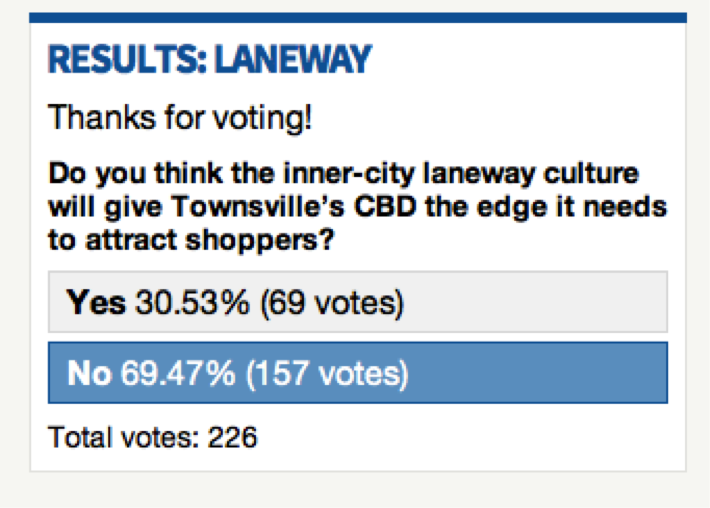
Some Townsville business people appear excited by the prospect of laneway developments in Townsville CBD, which has struggled for years to compete as a retail centre against the big suburban shopping centres at Aitkenvale and Willows (see CBD set to move into the espresso lane and Flinders St Traders welcome laneway precinct). Many Townsville residents are obviously skeptical, however, based on a poll on the Townsville Bulletin website:

lanewayI voted no in the poll, because, as I’ve posted on before (see Townsville’s Flinders St to re-open for traffic by June), I think it’s unrealistic to expect much of a revival in the CBD for a couple of reasons:

  • the Townsville CBD is no longer the geographic centre of Townsville due to strong population growth out past Aitkenvale, and
  • the big suburban air-conditioned shopping centres are very popular given Townsville’s tropical heat and humidity.


Posted in Retail trade, Townsville | Tagged , , , , | 6 Comments

ABC radio interview on the debt tax and paid parental leave

Company Director and advisor Monica Bradley and I joined Steve Austin on 612 ABC Brisbane radio this morning to talk about paid parental leave, the debt tax and the upcoming Federal Budget more broadly.

Is a paid parental leave scheme what women want?

I’m introduced into the conversation at around 14 minutes, 50 seconds. As I’ve commented before, I believe the Federal Government’s proposed paid parental leave scheme is inequitable and should be re-considered (see Multiple exemptions to evidence-based policy). The other main point I make in the interview is that the debt tax is undesirable. It doesn’t do anything to correct the structural deficit that has occurred at the Federal level because the Federal Government hasn’t cut spending to match the lower tax-to-GDP ratio we now have as a result of tax cuts in the 2000s. A temporary debt tax is a way of avoiding the tough decisions on spending cuts that need to be made to fix the Federal Budget. 

Posted in Budget | Tagged , , , , , | Leave a comment

Brisbane Times article on asset sales

I’m quoted in a Brisbane Times article today regarding asset sales:

Asset sales divide economists – but they are united in saying ‘Strong Choices’ is flawed

I re-iterated the same points I’ve made over the last couple of weeks: that asset sales are probably desirable, but Strong Choices is unconvincing and the Government urgently needs better advisers to help it make the case for asset sales (see Strong Choices poorly received by public). Here are the relevant quotes from the article:

“They could have used the $6 million much more wisely and spent it on decent research, decent studies, what these privatisation proposals could mean, thinking about how do we communicate this to the public,” Mr Tunny said.

“And that is not through PR and it is not through a flashy website, it is through well crafted speeches delivered to the public, well written opinion pieces, a genuine information campaign rather than a PR campaign.”

….“People are worried about the assets being sold too cheaply, the community being ripped off, some people are worried about foreign ownership, there are a whole lot of reasons people in the community are worried about asset sales,” he said.

“Strong Choices is very simplistic and doesn’t go anywhere near addressing what people’s concerns are.”

Posted in Budget, Queensland Government | Tagged , , , | 2 Comments

CommSec State of States report misleading on population growth

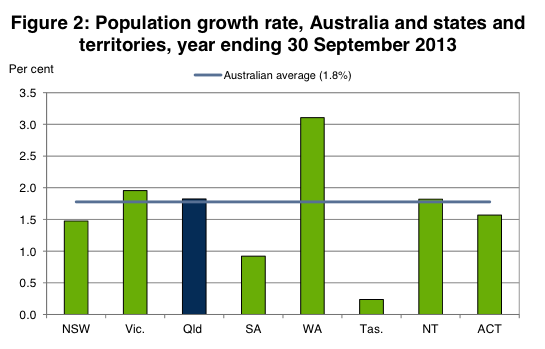
CommSec’s State of the States report is a PR exercise for the Commonwealth Bank rather than a serious piece of economic analysis. As I’ve posted on before, its methodology is daft and gives weird results (Ask a silly question, get a silly answer). As the Brisbane Times reports (Queensland slips down population growth table), the latest State of States report finds “Queensland’s population growth rate ranks it just above Tasmania and behind every other Australian state.” But check out the latest ABS population data, which are nicely analysed in Queensland Treasury’s population growth information brief. Here’s the relevant chart:

popgrowth

That doesn’t look like we’re second last in Australia, does it? CommSec’s methodology penalises Queensland because we had strong population growth ten years ago, but I fail to see how that’s relevant in an assessment of the relative economic performance of the States in 2014.

Posted in Population | Tagged , , , , , , | Leave a comment

Higher incidence of long-term unemployment in outer metro areas, Qld outback and Wide Bay

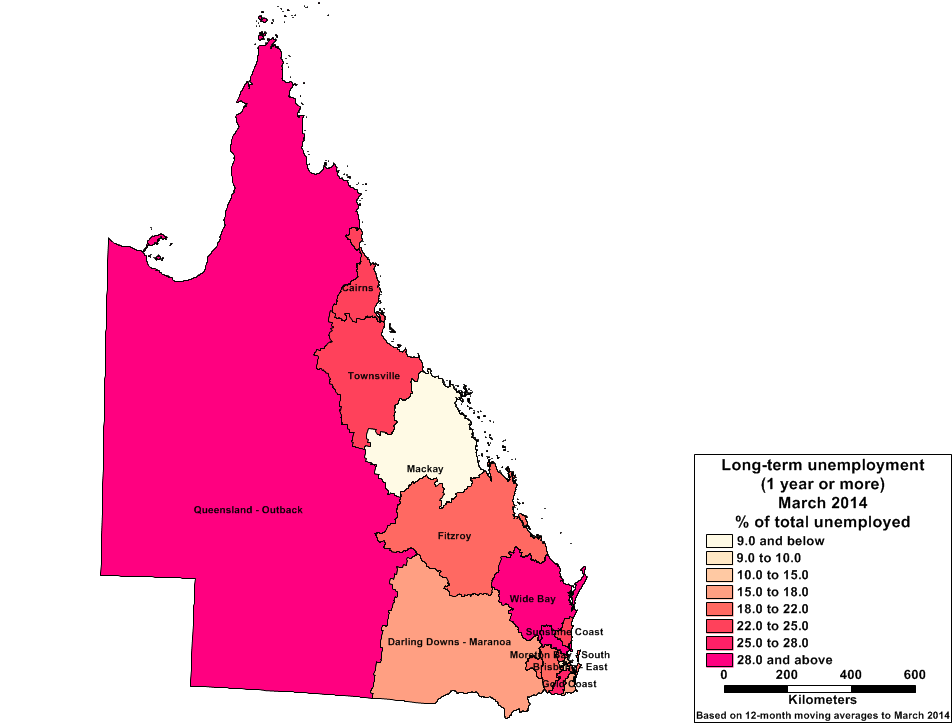
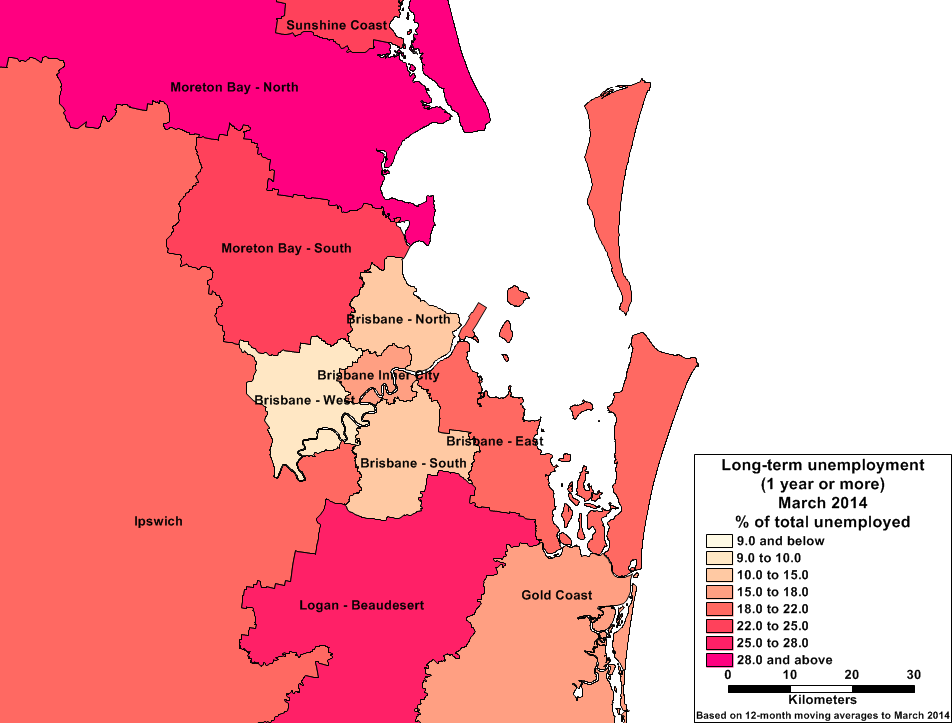
Around one-in-five of the 150,000 or so unemployed people in Queensland have been out of work for one year or more, corresponding to around 30,000 people, according to ABS labour force data. There is considerable variation in the incidence of long-term unemployment across Queensland regions, with long-term unemployment particularly high in outer areas of the Brisbane metro region and in the Queensland outback and Wide Bay regions (see maps below), where the incidence of long-term unemployment (% of unemployed out of work for one year or more) is approaching 30%. Here’s the Queensland map:

Qld map of LTUAnd here’s the close up for South-East Queensland:

LTU_SEQ

Higher long-term unemployment in outer areas of the Brisbane metro region will partly reflect difficulties people in these areas face in accessing employment opportunities that might exist elsewhere in the metro region, whether due to transportation issues or not being part of the right networks that would allow these opportunities to be seized. The geographical separation of highly advantaged and disadvantaged areas in the metro region, with significant disadvantage existing in outer areas, is one reason we should consider policies to promote higher-density living. My friend and colleague Brad Rogers has previously posted on how greater urban density and less urban sprawl would deliver substantial economic and social benefits:

Old Queenslanders in a New City

Posted in Brisbane, Labour market | Tagged , , , , , , , , | Leave a comment