Gold Coast light rail debacle should serve as a warning to other cities

The Gold Coast light rail project has had a number of significant failures, including major cost blowouts, major disruptions to local businesses during construction, and poor signage that will infuriate tourists who hop off at the Surfers Paradise station when actually another station, Cavill Avenue, is in the heart of Surfers. Now it’s being reported that screeching noises from the trams are upsetting local residents (Tram noise infuriates residents). So the benefit-cost ratio of the light rail system would be even lower than the low value previously expected, taking into account this disruption to the amenity of local residents.

Sure, light rail may encourage some tourism to the Gold Coast – e.g. some day-trippers from Brisbane wanting to take one ride on the tram – but I doubt the long-term tourism boost will be of the magnitude expected, as once people have ridden the tram once for novelty value they probably won’t come back. The major users of the tram service will probably be Griffith Gold Coast students catching the tram from the campus to the beach. I expect most tourists would be staying near the beach anyway or have their own car or a hire car with them. So I doubt the trams will yield significant tourism benefits and a significant injection of cash into the region. The major beneficiaries are likely to be students already in the region, and who could be more cost-effectively transported by buses (see my post Trams unlikely to be cost-effective – buses much cheaper).

So other cities would be wise to be wary of light rail given the experience on the Gold Coast, and trams certainly should not be returned to Brisbane streets, an idea which was floated a few weeks ago by Tourism chief Daniel Gschwind. It appears the ACT Opposition has figured out light rail is a waste of money based on the Gold Coast experience, with the Opposition Transport spokesman noting “What we have seen on the Gold Coast is the cost [of a light rail network] blow out to $100 million per kilometre.” (see ACT Liberals would stop light rail project if elected) Unfortunately, given the Gold Coast system has already been built, it will operate. Hence it will continue to cost Queensland taxpayers and Gold Coast ratepayers, who will subsidise the operating costs of a transport system that is unlikely to achieve sufficient passenger numbers to justify its huge cost.
Posted in Gold Coast, Transport | Tagged , , , , | Leave a comment

North Qld struggling to recover – Cairns looking slightly better, but not Townsville yet

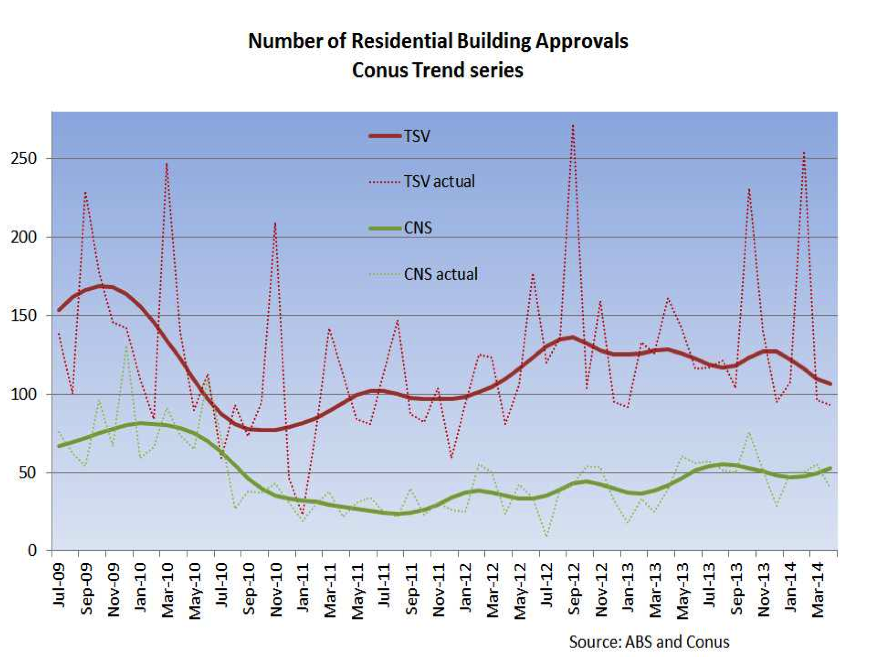
North and Far North Queensland have had lacklustre economies in the years since the financial crisis, with Cairns especially having suffered from the combined impact of the tourism downturn and an over-supply of properties due to a pre-financial crisis construction boom. Both Cairns and Townsville have unemployment rates higher than the State average, at 8.1% and 6.6% respectively compared with a State average of 6% (see Qld Treasury regional labour force information brief). Recent data unfortunately don’t give cause for great optimism that a strong recovery in the North is imminent. Last week, in his latest Conus Quarterly, Pete Faulkner presented a useful piece of analysis on trends in residential building approvals in Cairns and Townsville (see chart below). Pete notes: “We see trend approvals in Cairns on a slow upwardly trajectory (from very low levels); Townsville is drifting lower”.

conusThe prospects for Cairns appear much better than for Townsville over the longer-term, given Cairns’s superiority as a tourism destination. Local confidence in Cairns should be boosted significantly by the proposed $8 billion Aquis casino resort, which appears likely to proceed now a casino licence has been promised (see Cairns post report). Meanwhile, prospects for private sector investment don’t appear as bright in Townsville, and local MPs are banding together to lobby for Government funding for projects such as a Super Stadium for Townsville (see Townsville Bulletin report). Regrettably, but as is usually the case, the economic development of Townsville is seen as depending crucially on State and Federal Government investment.


Posted in Cairns, Townsville | Tagged , , , , , | 2 Comments

Tourism & Events Qld deserved funding cut – no turnaround in share of international visitors

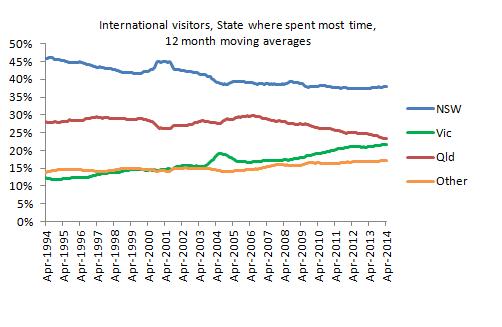
I was pleased to see the Government cut funding to Tourism and Events Queensland (TEQ) in the State Budget earlier this week (Tourism and Events Queensland budget slashed by $4.9m), because I’ve always doubted the value of its promotion activities, which have clearly failed in recent years. As I’ve posted on before (Qld’s falling share of international tourism in Australia), Queensland has lost a significant share of short-term visitors from overseas, many of whom would be tourists, to Victoria. And the most recent data from the ABS, released earlier this week, show no sign of a turnaround (see chart below).

International_visitorsHopefully the funding cut to TEQ forces it to think of smarter and more innovative promotion campaigns, along the lines of what Victoria has been doing (see Qld should look to Victoria for tips on tourism promotion). More broadly, we should consider whether the $100 million spent on TEQ could be better spent on projects designed to improve the attractiveness of Queensland as a destination. There is no shortage of eyesores in Brisbane – for example, Roma St near the Transit Centre – which could do with some sprucing up. Let’s hope the QCA gives tourism and events funding a rigorous going over in its current review of industry assistance.

Hat tip to Mark Beath from Loose Change for alerting me to the latest overseas arrivals and departures data in his post: Overseas arrivals and departures.

Posted in Tourism | Tagged , , , , , , | Leave a comment

Mabo’s legacy of lasting importance to Torres Strait

The Tuesday that has just passed, the 3rd of June, was Mabo day. To commemorate Mabo day, the Torres Strait Regional Authority has held its monthly Board meeting this week on Murray Island (known to traditional inhabitants as Mer Island), which was the birthplace of Eddie Mabo. I’ve been working on a project for the TSRA and felt privileged to present the report, co-authored with my colleagues Craig, Amanda and Jeremy, to the TSRA Board today on Murray Island.

Mabo’s legacy is ongoing. Last year, the Torres Strait people won a claim for native title over the sea (see Native title rights, regulations and licences: the Torres Strait Sea Claim). This will likely have wider ramifications than a strict reading of the judgment would suggest. It has encouraged the people of Torres Strait in their push for greater control of the fisheries in their region. This has the potential to provide a significant and sustainable income stream to Torres Strait communities, and may promote further economic development.

I’ve posted some photos from my visit to Murray Island below.

photo_Murray_2Memorial to Eddie Mabo outside the Torres Strait Regional Council Office on Murray Island.

photo_murray_4Tagai State College campus on Murray Island.palmtreeBeach at Murray Island. Be careful of sharks!Gene_Horn_IslandMe, back on Horn Island, after returning from Murray Island.

Posted in North Queensland, Uncategorized | Tagged , , , , , | Leave a comment

The economics of cheating – Australia’s new leisure class can afford time and resources for affairs

In an interesting Brisbane Times article last week (Mistresses, married women and early morning workouts), Katherine Feeney quoted her hairdresser on how common affairs are nowadays:

“So many married men – so many wealthy, married men – have mistresses these days. I know this for a fact. I know, because I do their wives’ hair, I do their hair – I probably even do the mistresses’ hair. In any case, I know these affairs are happening – Brisbane, Sydney, Melbourne – it’s always been the way.”

Apparently affairs between personal trainers and wealthy clients with time on their hands are very popular now. The opportunities to cheat are probably greater nowadays, with dating websites – including the Ashley Madison site which is dedicated to people seeking affairs – and social media making it much easier to connect with new potential partners than ever before. No doubt greater opportunities lead to greater instances of cheating, as many find temptation hard to resist.

It’s also possible that there are economic factors at play. While reading the Brisbane Times article, I was reminded of Ray Fair’s brilliant 1978 article in the Journal of Political Economy, A theory of extramarital affairs. To summarise, the theory is that a person’s hourly wage/salary doesn’t have a clear effect on the likelihood of having an affair, but an increase in non-wage income (e.g. earnings from dividends, interest or rent) makes it more likely someone will have an affair.

The impact of wages on cheating is ambiguous, because although higher wages might give someone the resources to pursue an affair, this is offset by the attractiveness of working the same or more hours at a higher wage rate, rather than wasting time on an affair. Economists will recognise this as the conflict between the income and substitution effects, which work in different directions.

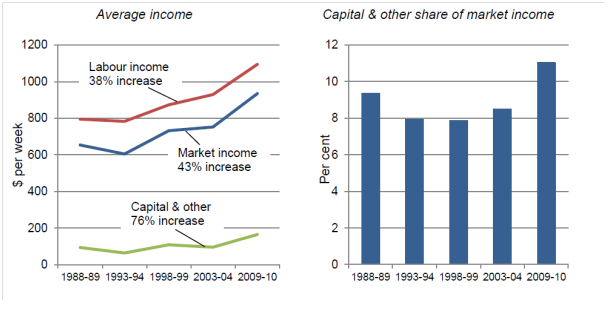
While wages have an ambiguous impact on the likelihood of affairs, non-labour income has a clear positive impact. With greater non-labour income, people can cut back on their working hours and devote more time to affairs. One of the noticeable trends in Australia’s income distribution in recent years has been the strong growth in non-labour income and the growing inequality in this income (i.e. the rich are getting richer), as described in a 2013 Productivity Commission report, Trends in the Distribution of Income in Australia (see the charts I’ve copied and pasted from the report below; N.B. non-labour income is labelled “Capital & other” in the charts).

incomeThis growing non-labour income allows more time and resources to be devoted to affairs by the wealthy. So, in addition to seeing an increase in the incidence of affairs across the whole population because of the greater opportunities provided by the internet, I’d expect to see a disproportionate increase among the wealthiest Australians. With their increasing non-labour income, the wealthy can buy time and other resources for affairs. This is why it appears a disproportionate number of wealthy people are having affairs – they can afford to.

Posted in Uncategorized | Tagged , , , , | 6 Comments

Government should just sell Energex, Ergon & Powerlink

The Government’s interesting proposition for private sector participation in Energex, Ergon and Powerlink, which raises the bulk of the $30-35 billion under the Strong Choices plan, should be attractive to investors because the businesses have reasonably reliable revenue streams they can use to pay back investors. But, as John Quiggin has noted (If it looks like a debt, walks like a debt and quacks like a debt …), the private sector is essentially just loaning money to these companies, rather than genuinely investing in them. It is debt, dressed up as equity, so the Government has money to get other debt off its balance sheet. It’s a clever arrangement and will certainly give private investors an interest in the performance and profitability of the businesses, but it doesn’t give them any real influence over how the businesses are run, because the Government retains 100% ownership. The Strong Choices plan notes (p. 31):

Private sector management discipline resulting from the participation may result in operational efficiencies and more competitive electricity pricing

Given they’ve used the word “may” the Government doesn’t appear too confident private sector discipline will be instilled in the companies as a result of the private sector participation. As I’ve noted before, the Government should simply sell these businesses, because they’d be better run by private operators, and there is no rationale for Government ownership (Productivity Commission says no rationale for State ownership of Energex and Ergon).

Posted in Budget, Energy, Queensland Government | Tagged , , , , , , , , | Leave a comment

Overall a good Budget, but earmarking sales proceeds for infrastructure funds undesirable

The Queensland Budget released yesterday is a sound plan to reduce Queensland’s large State debt and to set us on a path to eventually reclaiming our AAA credit rating. My old friend and former Treasury colleague Joe Branigan has a great piece in today’s Australian noting that, if the Budget plans are realised, Queensland’s fiscal turnaround would be impressive (Newman’s cuts will pay off). Joe also makes a very good point about the problem with the Government not dedicating all of the $33 billion in proceeds from asset sales to debt reduction:

The asset sales proposal in the budget should reap $30bn-$35bn, but Nicholls will allocate only $25bn to reduce debt and the rest to recycle assets. This is risky because the Newman government does not yet have in place a proven best-practice method for identifying, prioritising and evaluating infrastructure projects, or a successful strategy to ensure that the projects that are built are able to be funded.

This is particularly true in the transport sector, which is funded by taxes, tolls and fees, with no direct price signal on demand.

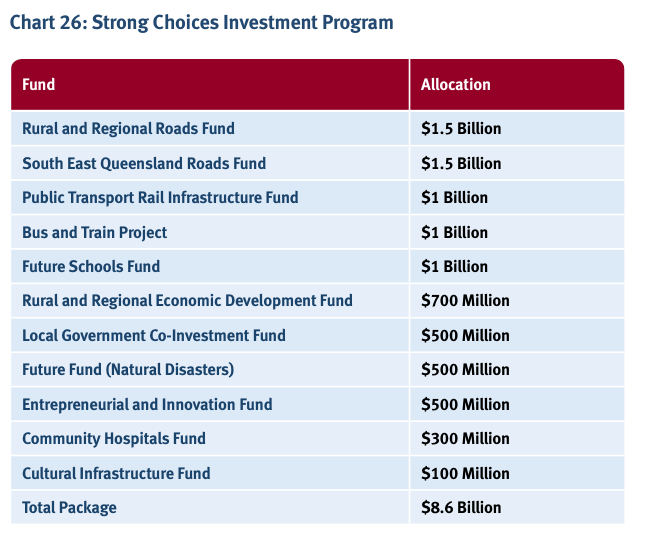
Unfortunately, the Government’s proposed Strong Choices Investment Program (see table I’ve copied and pasted below) allocates sales proceeds to particular infrastructure funds (Regional and Rural Roads, Future Schools, etc) without any comprehensive analysis, as far as I can tell, of what the most beneficial infrastructure projects are. I expect many officers in Queensland Treasury would hate this idea. Treasury officers typically hate earmarking funds because it reduces budgetary flexibility. It’s annoying for Treasury officers to see funds locked away for specific purposes that could be better spent on something more urgent and unavoidable. The Government may well need $8-9 billion to invest in new assets over the next six years, but it shouldn’t tie its hands by pre-committing the funds to particular purposes.

SCIP


Posted in Budget, Queensland Government | Tagged , , , , | 5 Comments

Queensland Treasurer will deliver necessary though unpopular Budget

Today the Queensland Treasurer will deliver a State Budget that is necessary, but which is likely to be unpopular. It is necessary because getting State debt under control and restoring our AAA credit rating needs to be done now, to reduce our borrowing costs and to provide a buffer if we face a severe downturn in the future. But it will be unpopular, because the public remains largely unconvinced by the need to sell assets – the Strong Choices campaign has failed – and because it may include some reductions in pensioner discounts (Newman Government’s 2014 State Budget to cut pensioner concessions).

Pensioner discounts for rates, water and electricity bills and public transport aren’t ideal policy, because, broadly speaking, Governments shouldn’t interfere with prices, and basic economics tells us pensioners would be better off with an equivalent cash transfer (and probably a smaller than equivalent cash transfer) that they could spend as they choose. But there’s no doubt cutting concessions would hurt pensioners, and I expect the Government will be mindful of the impacts. Slight cuts to the rates and public transport concessions would likely be better from an equity perspective than cuts to the electricity and water rebates.

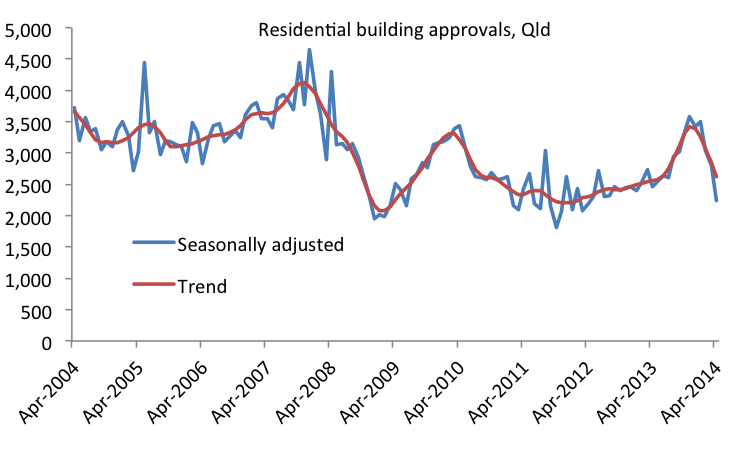
Finally, I look forward to seeing what economic forecasts underpin the Budget handed down this afternoon. I expect Queensland Treasury will have made some conservative economic growth forecasts consistent with those at the Federal level. This would make sense given the relatively low levels of business and consumer confidence in Queensland at the moment. Also, a big correction in the number of monthly residential building approvals, reported yesterday by the ABS, is a little concerning (see chart below).

buildingapprovals_Apr14

Posted in Budget, Housing | Tagged , , , , , , , , , , | Leave a comment

Comment on Nine News about desirability of asset sales in Qld Budget

I was pleased to run into Katherine Feeney from Nine News on Boundary St, West End this afternoon. She was gauging community views on the upcoming Queensland Budget and I made a comment to her on the desirability of asset sales:

Newman gives no clues about third budget

As I’ve commented before, asset sales are a quick, no regrets way to pay down a large amount of debt so Queensland can get its AAA credit rating back. Otherwise we’d need to restrain spending growth even more or raise taxes – both measures that are possibly undesirable given the current risks to the economy, as I posted on last week:

Qld Budget needs to reflect challenging conditions – asset sales good option to cut debt

Posted in Budget | Tagged , , , , | 7 Comments

7.30 Qld interview on asset sales

Last week, Maria Hatzakis interviewed me for the Queensland edition of the 7.30 Report, which aired on Friday night:

Privatisation push as power prices surge again

In understanding why the sale of electricity assets is desirable, the Productivity Commission’s Electricity Network Regulation Inquiry Report from last year is instructive:

While governments have a legitimate role in owning and operating many services in Australia, the rationale for state-ownership of electricity network businesses no longer holds. This reflects the development of sophisticated incentive regulations that function best when the regulated businesses have strong cost-minimising and profit motives… (from page 24)

…There are strong arguments for privatisation of these businesses. There is no evidence that the productivity, reliability, quality or cost performance of private sector electricity network businesses is worse than their public sector equivalents. To the contrary, the evidence in Australia and internationally suggests that such private sector enterprises are more efficient. (from page 25)

Hence, privatisation would most likely result in lower costs and prices for consumers (relative to what they would otherwise be). In my view, there is a strong case for selling Energex and Ergon as well as the generators and Powerlink.

Posted in Budget, Energy, Queensland Government, Uncategorized | Tagged , , , , , , , , , | 2 Comments