Don’t panic about unemployment just yet – still below long-run average

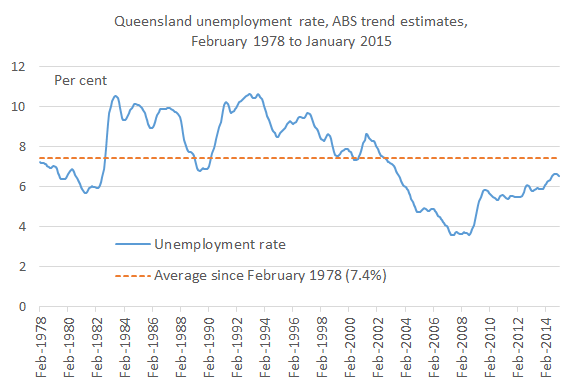
I’ve noticed the Courier-Mail is reporting the incoming Government has “been handed a massive headache with new figures showing unemployment rising and Queenslanders dropping out of the job market.” However, yesterday’s figures simply confirmed the labour market has been lacklustre for some time. There is no reason yet to suspect it will get much worse. As I’ve commented frequently, it is important not to over-react to month-to-month changes in employment and unemployment data, given the sampling errors involved. Finally, from a historical perspective, unemployment really doesn’t look too awful (see chart below). Hence the Government should proceed cautiously in developing new measures to tackle unemployment as they may not be cost-effective, particularly given the RBA’s monetary policy is imparting a significant stimulus to the national economy.

Unemployment_since_78_latest

Posted in Labour market | Tagged , , , , , , | 11 Comments

Low employment growth over the term of the outgoing Qld Government

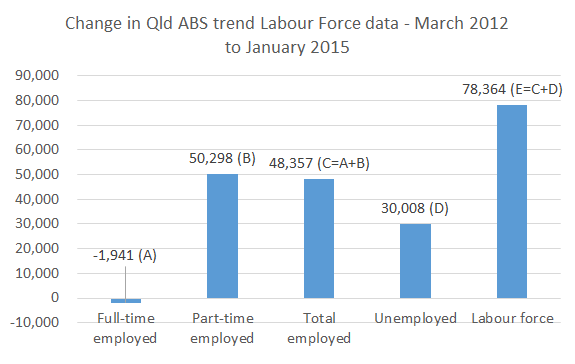
As an economist, I’m naturally a big believer in the importance of economic factors in society. And I thought one (though not the only) reason for the big swing against the Newman Government was Queensland’s lacklustre economy, which was largely outside the control of the Government, of course. The ABS labour force data released today confirm Queensland’s labour market remains sluggish and also provides a full set of data with which to assess jobs growth over the term of the (likely) outgoing Queensland Government (shown in the chart below).

Employment_growth_Newman_Govt

As I’ve noted before, employment growth was unimpressive and only in part-time jobs (see my post Qld Govt benefits from volatile jobs data – still vulnerable over bulk of jobs growth being part-time over first term). Job creation was only running at around 1,400 per month, which was nowhere near enough to keep up with labour force growth (see How many new jobs needed to be created over the Qld Government’s first term?). As a result, the unemployment rate increased from 5.5% in March 2012 to 6.5% in January 2015.

The Newman Government found it difficult to sell its economic message because the economy was so unimpressive to many Queenslanders. This fact, along with misplaced fears about leasing out assets, contributed to the incredible swing at the 2015 election.

For more on today’s labour force figures, see Pete Faulkner’s excellent post Jobs data headlines look poor, but the true story is rather different, in which Pete attempts to look through the noise in the seasonally adjusted data to figure out what is really going on.

Posted in Labour market | Tagged , , , , , , | 6 Comments

No tears for BaT tunnel – it most likely didn’t stack up

BaT

Whichever party forms government in Queensland, the Bus and Train (BaT) tunnel project is no more, as reported by the Brisbane Times (BaT tunnel plans scrapped). I was always skeptical about the economic case for the project, and was very concerned about its unimpressive benefit-cost ratio. For example, see:

$5 billion Bus and Train Tunnel has unimpressive benefit-cost ratio

Time for Qld Govt to reconsider $5bn BaT Tunnel – my submission to the EIS process

If Labor forms government, it may consider reviving the Cross River Rail proposal which the BaT tunnel was a cheaper substitute for, but it’s hard to see how it could afford to pay for Cross River Rail given its proposed fiscal strategy. As I’ve commented before, Labor’s fiscal strategy implies relatively low levels of capital expenditure over the rest of the decade:

New Queensland Government faces big fiscal challenges

Posted in Budget, Transport | Tagged , , , , , | Leave a comment

Has Queensland kicked the can down the road? – guest post from Keiran Travers

The still undecided Queensland election has given many of us reason to think about the future of our State, and I’m delighted to publish a guest post from Keiran Travers, a Brisbane-based infrastructure expert, who wonders whether Queensland has kicked the can down the road? 

On January 31 Queenslanders made a choice that Asset Leases (or sales) weren’t for them. Anna Bligh and now Campbell Newman have experienced the wrath of an angry electorate. Both results were devastating for the respective premiers and their parties. Where to from here?

In 2012 I felt for Anna Bligh. With economic conditions turning, she led a tired government and went into a campaign with several key ministers announcing that they were not seeking re-election. She was fighting an election alone facing a LNP with momentum.

Three years down the road and the LNP has expensed its valuable political capital on what seemed needless fights and the massive majority was eroded. A stunning turnaround no doubt.

Ross Gittins, the left leaning Fairfax columnist, has written a great article over the weekend about privatisation and more importantly competition (Searching for our salvation in privatisation). He correctly states that the general public doesn’t like or want “their” assets in private hands. I agree with him. He also makes a point about what happens afterwards: “though many people disapprove of selling off government businesses, once it has happened we get used to it pretty quickly.”

I say that the sale of the Port of Brisbane and what is now called Aurizon by Queensland, the Port of Newcastle by the NSW Government and the many airports by successive (including Labor Governments) and Telstra and Qantas really has not affected the daily lives of the average punter. Nearly all of the businesses have improved and are supplying good service. They are competing in a very competitive market.

More importantly these business operate free of government budget issues and restrictions. Since the previous Qld Labor Government (led by Bligh) sold what was then called QR National (now Aurizon), the new company has invested in new infrastructure and widened its asset base. Could this have occurred under government ownership? I think not. Can you imagine the public outcry if a government entity invested in a private port when hospital waiting lists are still long?

A hidden saving of an asset sale is that it relieves the government of excessive capital expenditure on future improvements. For example, the now sold Port of Newcastle can expand using private sector money rather than government money.

However, assets sales, or more importantly losing government ownership and control, is what the public voted against.  Another option that now needs to be considered is the New Zealand option of a partial sale. This allows the government to sell say 49% and retain control (and most Board positions), but allows the new company to attract private capital (debt and equity). In effect the government is the key shareholder only, but still an owner and controller, and the business can get on delivering products and services. Are the Kiwis showing us the way (again)? Telstra, which followed a similar but slower path than what was done in New Zealand, is a much better business than 15 years ago.

I have heard that there should be no asset sales anytime. A fair point but where is the capital coming from? Most Government Owned Corporations operate with a ROI of less than 5% so they don’t provide the profit to reinvest in infrastructure. Meanwhile our competitors (other states) are moving ahead, as evidenced by the latest net migration results.

The recent LNP Government ran a poorly advertised but technically sound exercise in 2014 when they asked the public what to do with the $80 billion debt. The choices were sell / lease assets, increase taxes or cut services. Well now we have to cut services or increase taxes. I don’t hear anyone saying they want that. A colleague of mine said to me in 2014 ‘the public want another choice – kick the can down the road and let someone else worry about it”.  Sadly this attitude seems to be right.

When a family is under financial stress they can either sell their house or car, get a new job or cut back on spending. The government needs to do the same.

But are we kicking the can down the road? 2015 will be an interesting year.

Keiran Travers,
Harbak Holdings

Posted in Budget | Tagged , , , , | 5 Comments

What are investors to make of depression economics?

krugman

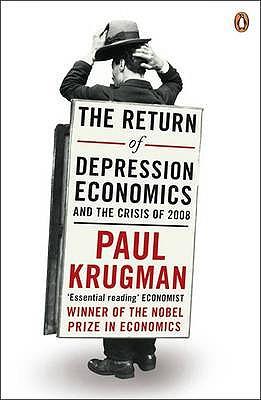
After the RBA Board cut the cash rate target to 2.25% last Tuesday I mentioned to a friend that the best guide to the world economy since 2008 has been Paul Krugman’s brilliant little book The Return of Depression Economics. Krugman explains how the economy can get stuck when everyone is fearful and wants to hold on to safe assets (e.g. bonds), and no one is willing to invest in anything risky. It is fear that has driven interest rates to such low levels worldwide, as investors have been willing to massively bid up the price of bonds to park their money somewhere safe and to receive the guaranteed regular coupon payments.

Much of the fear appears irrational because financial markets are effectively demanding very low compensation for inflation over the long-term. The historical experience and the dependable phenomenon of regression to the mean suggest current interest rates are abnormally low and won’t persist. Indeed, judging by the comments in its box on “The Decline in bond yields and inflation expectations” in its latest Statement on Monetary Policy, the RBA can’t find any rational reason yields are so low.

I don’t expect the fear driving abnormally low interest rates will last forever, and no doubt, before the end of the decade if not earlier, enough positive economic developments will occur for investors to realise their fears are irrational, at which time the bond market will experience a large correction, with bond prices falling and yields increasing sharply. There will be a flood of money into equities, and the sharemarket will experience large gains. Many investors have already realised this, and there is now much talk of the search for yield.

Even considering recent sharemarket gains, there appears much scope for further gains in equities. I agree with the comment by Credit Suisse analyst Hasan Tevfik reported in the Sydney Morning Herald last week (Shares in longest ever winning streak), that “If there is a bubble anywhere in the world, it’s in the bond market, it’s not in the equity market.” When the bulk of investors realise there is an unsustainable bond market bubble, money will flood out of it into the sharemarket. It’s all just a matter of time.

This isn’t investment advice, but it appears to me that the sharemarket remains an excellent investment opportunity over the medium to long-term, probably even better than the property market, but I’ll need to elaborate on that in a future post.

Posted in Macroeconomy | Tagged , , , , , | 3 Comments

December sales provided some relief, but Qld retailers saw very low growth in sales over 2014

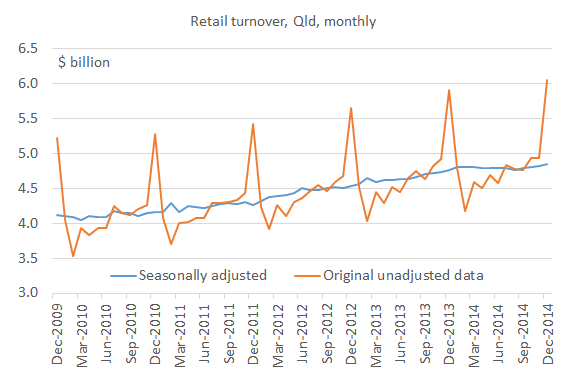
Retail_trade_Dec14

In seeking re-election, the Queensland Government was disadvantaged by the lacklustre economy, which was evident in many sectors, including retail. Estimates of retail turnover published yesterday by the ABS confirm that, while there was a December boost to sales (see chart above), it wasn’t enough to massively improve the annual result. The ABS figures confirmed the relatively weak conditions that existed over 2014 in the retail sector, which experienced very low growth of turnover (0.5% in Qld compared with 3.3% nationally, in trend terms). As Queensland Treasury reports in its latest retail trade briefing note:

Queensland recorded the lowest annual growth in retail turnover of all states and territories (0.5%). New South Wales recorded the highest increase (6.1%).

Also see Pete Faulkner’s commentary on yesterday’s retail turnover figures:

Volume of retail sales in QLD actually up (just) over the year

Posted in Retail trade | Tagged , , , | 2 Comments

Fiscal reality will drive the next reform agenda – guest post from Joe Branigan

I’m delighted to present a guest post from my old friend and former Treasury colleague Joe Branigan. It goes without saying that the views presented below are Joe’s and not necessarily mine. That said, I agree broadly with Joe regarding the fiscal reality that will face the new Government. 

Fiscal reality will drive the next reform agenda

What a week in Australian politics! And the upheaval is still not over.

It would seem that the most likely election outcome in Queensland is a minority Labor Government of 44+2+1=47, with perhaps Peter Wellington elected Speaker and the two KAPs agreeing to vote on the floor with Labor to guarantee its government.

The price of that guarantee will be billions in new capital expenditure in the regions, primarily on roads. Without asset leasing, this money will need to be borrowed. KAPs proposal to defer or cancel the BaT tunnel in Brisbane and the Townsville Stadium won’t help because no money has been allocated to these projects in the current budget’s forward estimates.

And maintaining KAPs new inland highway will cost an additional tens of millions annually, which must be factored into the forward estimates. Without additional borrowing, we are about to see the deferral of infrastructure projects in SEQ that benefit millions of people to fund projects that benefit thousands of people – just imagine how that affects overall state productivity.

Queensland’s fiscal realities will hit the new Palaszczuk minority government like a hammer to the back of the head in a matter of weeks as the Expenditure Review Committee wrestles with Labor’s campaign promises, union demands for more public servants and higher pay rises, and the fact that our royalty revenues and other state taxes are at an ebb through the bottom of the resources cycle. And don’t expect LNG to save us as global supply rapidly expands.

If Labor chooses to put its collective head in the sand, by the 2018 election, state gross debt could again be approaching $80 billion and with the demands of KAP, the public service unions and the Greens (that remember lifted Labor’s primary vote above the LNP’s), it will prove impossible for Palaszczuk to maintain a firm grip on the state’s finances. Remember that the LNP actually cut spending in real terms in its first two budgets and limited the spending increase to just 1.5% in real terms in its third budget, and yet it still did not achieve a surplus in its first term. How Labor could possibly achieve a surplus is a question for greater minds than me.

There will, therefore, be an enormous temptation for Labor to increase taxes, fees, levies and charges, and permanently defer the stepped increases in the payroll tax threshold – anything that can close the gap between spending and revenue. I expect environmental levies to make a comeback (remember the Kate Jones $373 million Waste Levy?) and a new round of climate-change and animal-protection red and green tape to strangle the private sector economy but grow the public service.

But by 2018 the need for reform will be more urgent and more obvious than in 2012-2015. Labor will not deliver a budget surplus in its first term because it will not address the structural deficit that is causing the difference between spending and revenue, and as a result our net and gross debt will rise. Asset sales will again be back on the agenda and central to fiscal and economic reform. The election of a Labor minority government has simply delayed the inevitable by 3 years.

Will the LNP be ready to fight for good policy in 2018? Of course not! The LNP will draw the wrong lessons from its defeat and looks set to throw not only good policies overboard but its chief remaining advocate, former Treasurer Tim Nicholls. While Nicholls will be looked on favourably by history, having achieved the greatest fiscal consolidation since Keating in 1987-88, the next lot of LNP leaders will not.

Under new leadership, the LNP will almost certainly abandon its commitment to fiscal and economic reform and return to the old Nationals/Labor style of big government, industry assistance and barrels of pork. Yet, their quickest way back to government would be to stand their ground on economic and fiscal reform, elect Tim Nicholls as leader who will sell the message clearly and without aggro, and sit back and watch Labor’s magic pudding melt in the harsh Queensland sun.

Joe Branigan is Senior Research Fellow at the SMART Infrastructure Facility and a former Regulator at the Queensland Competition Authority. In an earlier incarnation, he was one of Brisbane’s greatest pizza delivery drivers in the 1990s, and perhaps of all time.

Posted in Budget, Uncategorized | Tagged , , , , , , , | 7 Comments

Is any Opposition truly ready to govern?

I’m surprised by former Treasurer Keith De Lacy’s comments on the Opposition’s readiness to govern reported by the Brisbane Times this morning (Labor had ‘secret’ plan to govern).  It seems a little unfair given I doubt any Opposition in Australian political history was fully prepared for the challenges of Government. Luckily, however, there is a huge bureaucracy, generally with very good people at the top, who will have an incoming Government brief ready for their first meeting with the leadership team. This will set out the economic and budgetary state of play, any important urgent business, and an assessment of how the new Government’s policy agenda can be implemented. It will, of course, note the policy measures that cannot be implemented or are truly silly.

I have no doubt that the new Government will need to change some of the policies it put forward before the election – e.g. its plan to prop up TAFE seems overdone and “back to the future.” But all new Governments change their plans. I remember once asking a (very) senior Treasury official in Canberra whether we should have been worried about some of the plans that were being presented by the Opposition led by Kevin Rudd prior to the 2007 election – e.g. Grocerywatch, Fuelwatch. The official replied that you need to be forgiving of Oppositions because they don’t have the resources that Governments do, and all Oppositions end up putting forward a few silly policies. That was the voice of experience. No Opposition is truly ready for Government, in a sense, which is why I find Mr De Lacy’s criticism a little unfair.

Posted in Queensland Government | Tagged , , | 7 Comments

Big year for Econ Society in Qld – the Governor returns & national conference in July

Governor

The Reserve Bank of Australia is making a return to the spotlight with the RBA expected by many market players to cut the cash rate today or at its March meeting, to stimulate an economy needing a boost in investment and to prevent a currency appreciation due to our interest rates being higher than those in other parts of the world (see Vesna Poljak’s nice analysis Roubini Global urges RBA to hold interest rates). Contrary voices include Nouriel Roubini, as noted in the article just linked to, and Far North econ blogger Pete Faulkner (see Will rates be cut on Tuesday?).

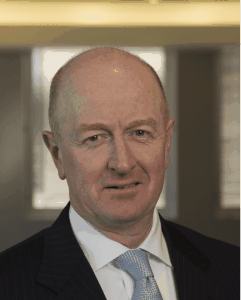
So 2015 will be a big year for the RBA. The Economic Society of Australia (Qld), of which I’m Deputy Secretary, is very pleased to have RBA Governor Glenn Stevens back for a business lunch on Wednesday 10 June. Details are yet to be fully worked out, but we’ve issued a date claimer for it:

2015 Business Lunch – Glenn Stevens

ESA (Qld) will also be busy organising the 2015 Australian Conference of Economists, which is being held from 7 to 11 July at QUT, Gardens Point, Brisbane:

2015 Australian Conference of Economists (ACE 2015)

I know that the timing of this conference will make it very attractive to many of my former Treasury colleagues who might like an escape from the Canberra Winter. We’re currently putting together some exciting events aimed at policy and business economists, which I’ll update you on soon.

Posted in Macroeconomy | Tagged , , , , , , | 1 Comment

New Qld Government faces big fiscal challenges

Many Queenslanders in the construction and engineering sectors will be disappointed by the capital spending plans of the likely new Queensland Government. Previously, there was some excitement at the prospect of a large boost to capital spending across Queensland, with $8.6 billion from asset leases to be allocated to infrastructure. But, with the likely demise of the current Government, that is no more.

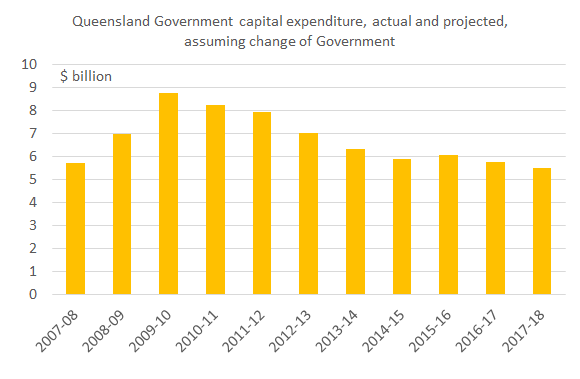
To its credit, the Opposition committed to only relatively modest new capital spending in its election costings, but it may have simply deferred a problem. Currently there is declining funding allocated to capital spending over the Budget forward estimates (for 2014-15 to 2017-18), which I’ve adjusted (very slightly) to account for the Opposition’s election commitments.  I suspect that it will not be feasible or desirable for actual Queensland Government capital spending to decline over this period – even more so if our population growth recovers. That is, it is very likely the new Government will have to spend more on infrastructure than is currently provided for in the forward estimates.

Qld Govt capex

Other fiscal challenges for the Government include:

  • finding actual savings in advertising, consultancies and public service inefficiencies without compromising the quality of government administration and policy development; and
  • maintaining the tight control on expenditure growth that will be necessary to have large enough surpluses to start paying back $1.7 billion in debt each year from 2018-19.

The new Government may get some benefit over the forward estimates from the “hollow logs” the current Government had stashed money in for its election commitments, but this money won’t solve the long-term fiscal challenge of paying down Queensland’s debt.

I commented on Labor’s fiscal strategy and election costings on several occasions last week:

Black hole election – speech notes and slides

4BC Drive interview on election costings

Posted in Budget | Tagged , , , , | 2 Comments