Strong Choices was never persuasive – similarities with Fightback

After yesterday’s extraordinary swing against the Queensland Government, which will likely deliver the Opposition to power, it’s now clear that the Government’s privatisation plan was too ambitious and, as Sir Humphrey would have said, courageous. Strong Choices will join John Hewson’s Fightback as an example of why you shouldn’t take a comprehensive economic reform package to an election. The Queensland public were obviously concerned about the proposed privatisations and were worried about what would happen to electricity prices, jobs, and the State Budget, among other things.

As I’ve commented previously, the Government failed to present a convincing case for its privatisation plan. I think there was one to be made, but the Government went wrong from the outset when it didn’t engage seriously with the public on the pros and cons of privatisation. And, by failing to produce a comprehensive economic and fiscal analysis of its plan, it couldn’t effectively respond to obvious questions about economic and fiscal impacts.

Relevant previous posts of mine include:

Failure of Strong Choices now obvious – missed chance to persuade on asset sales

Strong Choices poorly received by public – Treasury needs to do a lot more work

Brisbane Times article on asset sales

4BC Drive interview on election costings – problems with economic plans from both major parties
Posted in Budget | Tagged , , , , , | 9 Comments

Black hole election – speech notes and slides

For the record, I’m posting the speech notes I prepared for the presentation I gave Wednesday night at the Ship Inn Function Centre in South Brisbane on economic policy issues in the 2015 Queensland election. My slides are available via slideshare. Many thanks to Dr Alex Robson from Griffith University for having organised the event, which was a lot of fun.  Note that, while I prepared these speech notes prior to the releases of the costings documents from the Government and Opposition, the substantive points in my speech notes are unaffected by these documents.

The black hole election

There has been much talk of black holes this election campaign, thanks in part to the efforts of the Courier-Mail [SLIDE 2]. The Government has accused the Opposition of creating a $1.3 billion black hole, but the Government has been criticised by Professor John Quiggin for creating its own budget black hole.

Tonight I will consider these so-called black holes, and attempt to come to a balanced assessment of where the truth lies. This means I’ll consider the fiscal strategies of both major parties. Unfortunately, in their proposed fiscal strategies, neither the Government nor the Opposition gets a high distinction, as I’ll explain below.

In examining the fiscal strategies, I’ll particularly focus on the merits of the Government’s privatisation proposal—to lease out (rather than sell) State assets, including electricity businesses, ports and dams. The main point I’ll make is that, while the proposal is generally a good one, a full assessment of its merits requires consideration of how the proceeds will be spent. Alas, according to the Government’s plans, there is a risk the money won’t be spent well.

Continue reading

Posted in Budget | Tagged , , , , , , , , | 4 Comments

4BC Drive interview on election costings – problems with economic plans from both major parties
I had a nice chat with Ben Davis from 4BC’s Drive program yesterday afternoon on the economic plans the major parties are taking to today’s Queensland election. You can find the audio for the interview if you scroll down on this page:

Queensland election: Day 5, Week 4, January 30

Consistent with my previous comments, I was critical of both the Government’s and Opposition’s plans.

As I discussed with Steve Austin on 612 ABC Brisbane on Wednesday (see Media commentary on Qld Government election costings), the Government’s election costings have not addressed the Quiggin critique. That is, largely because it is proposing to spend one-third of lease proceeds on infrastructure and subsidising electricity prices, the Government will not get sufficient savings on its interest bill to fully offset the loss of income from the government-owned enterprises (e.g. Energex, Ergon) whose assets are leased out. Based on John Quiggin’s estimates, this could make the State Budget worse off by around $1 billion per annum.

Regarding the Opposition’s plan, which I posted on yesterday morning (Consultancies are an easy target, but more cost-effective than maintaining bloated public service), I told Ben that the Opposition is asking us to take a lot on faith:

  • first, that they will find sufficient savings in consultancies, advertising and public sector inefficiencies to pay for their election commitments; and
  • second, that they will manage the Budget well enough that, eventually, they will start paying down the debt.

Regrettably, the Opposition doesn’t appear to offer any real plan to pay down Queensland’s debt to the level necessary to regain our AAA rating.

Posted in Budget | Tagged , , , , , , , , | 2 Comments

Consultancies are an easy target, but more cost-effective than maintaining bloated public service

In its election costings, the Opposition has identified that it would cut expenditure on consultancies as part of a cost-cutting drive to pay for its election commitments (see Qld Labor reveals election costings). As a consultant I’m obviously biased, but I’ve always seen consultancies as a cost-effective way for a government to bring in the skills it needs when it needs them, rather than maintaining a large, under-utilised public service which is not making the best use of its professional staff.

If the Opposition gets into power, instead of focussing on consultancies, which typically respond to urgent, well-identified needs set out in clear terms of reference, it should forensically review the still over-sized public service, particularly “policy officer” jobs. I suspect that the efficiency targets that would be set by the Opposition if it wins government wouldn’t be strong enough, and hence a forensic review is needed.

Finally, as Professor Tony Makin and I pointed out at a Griffith University-Economic Society of Australia (Qld) event on Wednesday night, there is considerable scope for budget cuts in industry assistance, a frequent call I make on this blog:

 QCA issues paper shows large potential savings in industry assistance

Posted in Budget, Queensland Government | Tagged , , , , , , , | 6 Comments

Media commentary on Qld Government election costings

I spoke with Steve Austin on 612 ABC Brisbane yesterday morning regarding the Queensland Government’s election costings, after Steve first spoke with Treasurer Tim Nicholls (3 days until the election – Treasurer Tim Nicholls). The main point I made was that, while it appears the Government will be able to meet its election commitments from the asset lease proceeds (plus the 1 billion dollars or so it had stashed away in departmental budgets), the costings document didn’t respond to the Quiggin critique – that is, that the State Budget will be worse off because forgone income from government-owned businesses will exceed interest savings from debt reduction paid for by lease proceeds.

The Government still has not released any modelling of the impact of the proposed asset leases on the Budget bottom line. As I’ve noted previously, because the Government is not allocating all of the $37 billion in lease proceeds to debt reduction, but is instead spending $8.6 billion on infrastructure (including poor investments such as the Townsville Super Stadium) and $3.4 billion on cost-of-living measures, it won’t get the maximum reduction in interest payments it could. As such, it’s very likely the interest savings from the $25 billion of debt reduction won’t fully offset lost income from the leased-out assets.

My comments were later reported in an ABC news article:

Questions still to be answered on LNP costings, economist says

Posted in Budget | Tagged , , , , | 2 Comments

QR-Aurizon experience shows benefits of privatisation – Steel on Steel is recommended reading

Steel_on_SteelIf you’re interested in the issue of privatisation, I recommend you read a new book, Steel on Steel, published by UQ Press, on the QR float from Aurizon insider Stephen Baines. The book contains an excellent description of the political and economic considerations involved in the float, particularly the important issue of whether QR’s freight business should remain vertically integrated (i.e. keeping the rail lines and the trains together in the one business) or broken up.  There is a solid defence of the decision to maintain vertical integration, which it is argued is the best way to provide incentives for the rail company to invest in capacity augmentations, as may be needed during a resources boom.

I’m also a big fan of the book because of its accurate description of the constraints and inefficiencies that affect government-owned corporations. For example, the 2008 Riverfire party controversy was indicative of the overlay of political consideration that constrained the best management of the railway. As Mr Baines notes in Steel on Steel:

There was significant day-to-day interference by government, and every aspect of the organisation was restricted to some degree by government ownership. The dead hand of government was palpable, and was felt all the way from the operating sites across Australia to the CEO’s office in Brisbane. (from p. 29)

Also instructive is the brilliant description of the perverse workforce culture that can afflict a government-owned corporation:

The old QR could boast many highly skilled people who wanted to do a worthwhile job. It was also home to many who had a strong sense of entitlement and believed the company owed them a living, and indeed a ‘job for life’. Inefficiencies were tolerated or ignored. Materials would mysteriously disappear regularly from storerooms. (from p. 153)

Mr Baines’s book makes it very clear that privatisation has done a lot of good for QR’s privatised freight business, and I expect similar stories of efficiency improvements in years to come as a result of the currently proposed privatisations.

Posted in Transport | Tagged , , , , , | 4 Comments

Discouraged workers have moderated rise in unemployment rate since March 2012

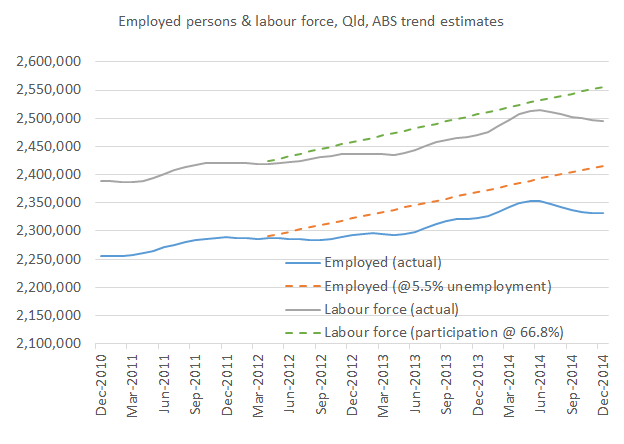
In my post last week How many jobs needed to be created over the Qld Government’s first term?, I compared the actual job creation rate of 1,400 per month with the rate of 2,200 per month that would have been required to maintain the unemployment rate at 5.5% (instead of seeing it increase to 6.6%). A comment from Pete Faulkner made me realise that the required job creation rate would have been much higher if the labour force participation rate (i.e. employed + unemployed as a percentage of 15+ population) hadn’t fallen from 66.8% to 65.2%.

The fall in the participation rate has reduced labour force growth and thus the required number of jobs. If the participation rate hadn’t fallen, around 3,900 jobs would need to have been created each month since March 2012, nearly three times as many as were actually created (see chart below). To some extent, the fall in the participation rate since March 2012 will have reflected the ageing of the population, but a large part of it would have been due to many people being discouraged by the weak labour market and giving up on looking for a job.

LF_constantPR_Dec14

Pete Faulkner and his fellow Far North economics blogger Mark Beath have had some good posts lately on employment issues:

Regional jobs data is poor for Cairns

Regional employment a drag on Queensland

Posted in Labour market | Tagged , , , , | Leave a comment

Qld Treasurer rightly avoids committing to a fall in power prices

Queensland Treasurer Tim Nicholls performed well in his interview on 612 ABC Brisbane radio yesterday morning, rightly avoiding a commitment that power prices would fall as a result of privatisation, which he certainly couldn’t guarantee. In a question to the Treasurer, at 5 minutes 15 seconds into the interview, host Steve Austin quoted from my post from yesterday morning Power prices would be lower than otherwise, but may not fall, under privatisation:

Steve: Economist Gene Tunny has written this morning that, contrary to way the [Courier-Mail] story has been written, he says, and I quote, “I don’t think it [the EY report] can be read as saying prices will fall under privatisation, only that the growth rate of prices under privatisation would be lower.” So, either way, prices are going up.

Treasurer: Steve, When I read to you from the report on page 10 I said that prices have increased in the States – network charges being the main driver of those increases only in Qld and NSW, and just a moment ago I said the rate of increase has been much lower in Victoria and SA than in Qld and NSW.

Steve: So you agree that prices are still going up.

Treasurer: I understand that exactly and prices have gone up here…why have they gone up here in Qld? We had the solar feed in tariff scheme…

That was a pretty good answer from the Treasurer, particularly because he avoided a commitment to lower power prices that could come back to haunt him in future years.

Posted in Energy | Tagged , , , | Leave a comment

Power prices would be lower than otherwise, but may not fall, under privatisation

I’m pleased to see some analysis finally published on the potential benefits of the privatisation of electricity businesses from a Queensland perspective: Network Pricing Trends in Queensland prepared by EY. The Courier-Mail has covered this report with the headline, on its website at least, Electricity prices to fall under privatisation, says audit. While the report is certainly supportive of privatisation, I don’t think it can be read as saying prices will fall under privatisation, only that the growth rate of prices under privatisation would be lower than the growth rate of prices if the businesses weren’t privatised – that is, prices would be lower under privatisation than they otherwise would be.

The reported estimated electricity bill saving of $570 p.a. is from an historical simulation of power prices, covering 1997 to 2013, assuming Queensland experienced Victorian growth rates in network costs (see p.13 of the EY report). Unfortunately, consumers won’t get this $570 p.a. back if the businesses are privatised (technically, if their assets are leased out). The inefficiency is already largely baked in, due to network investments that have already occurred (i.e. gold plating). That said, under privatisation, I expect bills will be lower than they otherwise would be, as private operators would more ruthlessly control costs, running “lean and mean”, as I noted in my 7.30 Report Queensland interview last year:

7.30 Queensland interview on asset leases and power prices

I’ll talk more about the potential benefits of privatisation at the upcoming EPAP-ESA Qld panel discussion on economic policy issues in the 2015 election.

Posted in Energy, Queensland Government | Tagged , , , , | 6 Comments

How many new jobs needed to be created over the Qld Government’s first term?

I was surprised earlier this month when I first saw the Queensland Government’s election campaign ad on TV noting the Government was creating over 1,100 new jobs per month. As I’ve noted previously, while the Government has had a number of economic policy successes (e.g. impressive budget management), employment has not been one of them. Jobs growth has fallen below labour force growth, pushing up the unemployment rate.

Based on the December ABS labour force estimates released last week, the Government can claim around 45,000 new jobs since it was elected in March 2012, or about 1,400 new jobs per month. But unemployment has risen from 5.5% to 6.6%. Unemployment in Queensland would need to be around 137,000 rather than 164,000 people for the unemployment rate to currently be 5.5% (as opposed to the actual rate of 6.6%). That implies the economy needed to have created 27,000 jobs on top of the 45,000 created since March 2012. That is, to have kept the unemployment rate at 5.5%, the Queensland economy needed to have created an additional 72,000 jobs since March 2012, or around 2,200 jobs per month, compared with the actual 1,400 new jobs per month (see chart below, in which I’ve plotted what employment would have to be to keep the unemployment rate at 5.5%).

Employed_hypothetical

Posted in Labour market | Tagged , , , , , , , , , | 2 Comments